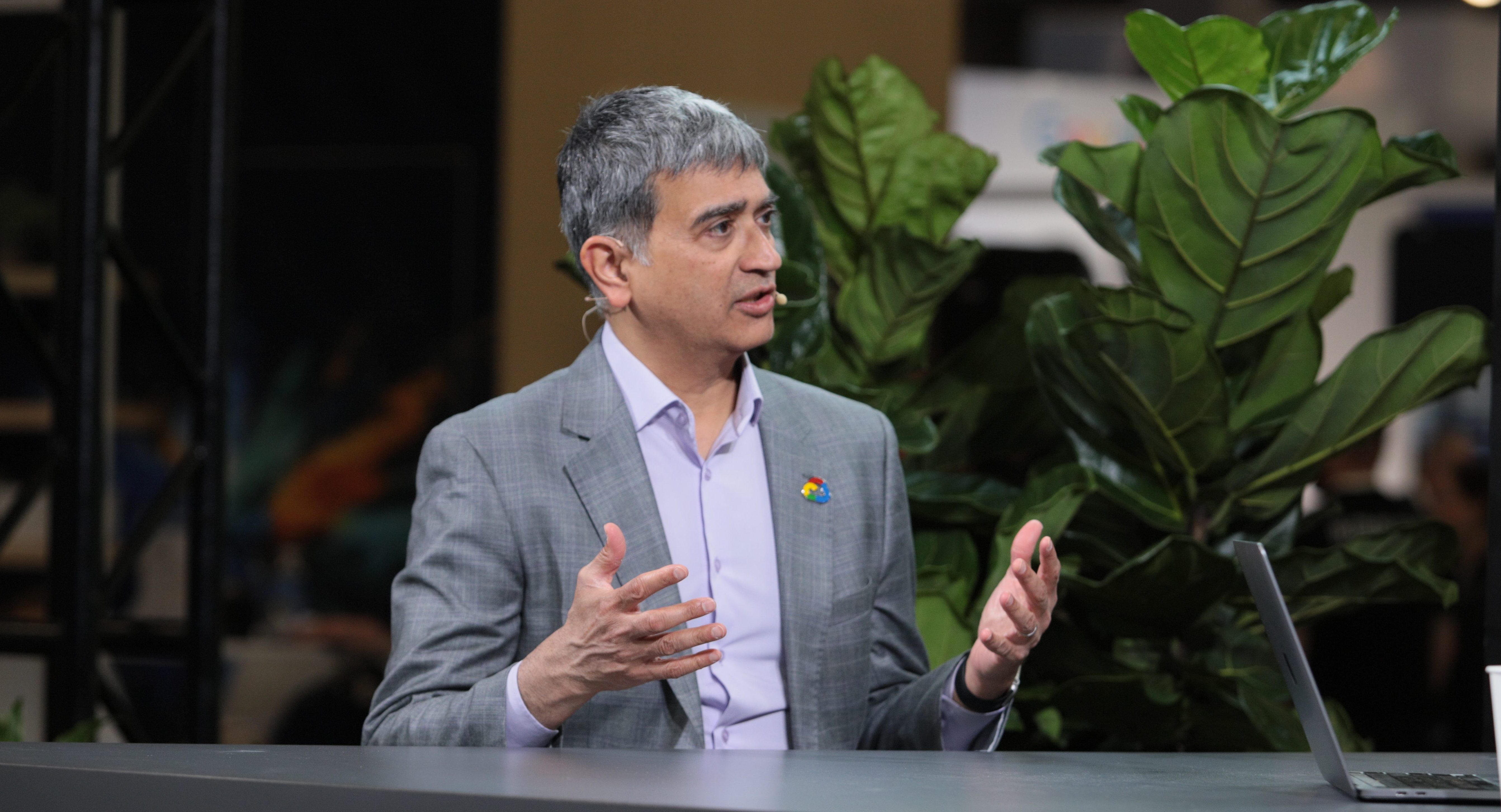
In this interview from Google Cloud Next 2026, Sailesh Krishnamurthy, vice president of engineering for databases at Google Cloud, joins theCUBE's John Furrier to discuss the transformation of enterprise databases from passive record-keepers into intelligent, AI-native infrastructure. Krishnamurthy makes the case that data has emerged as a fourth pillar of cloud computing alongside compute, storage and networking — and that AI is only as powerful as the context it can access. He details how Google's knowledge catalog captures the metadata and semantics across the enterprise data estate, enabling AI agents to generate accurate data pipelines and deliver high-quality results without unnecessary data movement.
The conversation also explores how Google Cloud is fundamentally rethinking what a database must do. Krishnamurthy explains that for decades databases had one job — preserve the data and return exact results — but modern systems now combine vector indexing, graph traversal and direct LLM calls within SQL queries. He highlights Spanner Graph as a standout solution for AI context retrieval and introduces the data agent platform, anchored by a new tool called query data that delivers secure, high-quality access to operational data for conversational AI applications. The interview also covers the launch of Spanner Omni, which extends Google's globally consistent, infinitely scalable database to on-premises environments and competing clouds. From agentic migration tools that dramatically accelerate full application stack transitions to the convergence of transactional and analytical systems through open formats like Iceberg and GQL, Krishnamurthy outlines how enterprises can move beyond legacy database architectures and into a fully AI-native data future.
Forgot Password
Almost there!
We just sent you a verification email. Please verify your account to gain access to
Google Cloud Next 2026. If you don’t think you received an email check your
spam folder.
In order to sign in, enter the email address you used to registered for the event. Once completed, you will receive an email with a verification link. Open the link to automatically sign into the site.
Register for Google Cloud Next 2026
Please fill out the information below. You will receive an email with a verification link confirming your registration. Click the link to automatically sign into the site.
You’re almost there!
We just sent you a verification email. Please click the verification button in the email. Once your email address is verified, you will have full access to all event content for Google Cloud Next 2026.
I want my badge and interests to be visible to all attendees.
Checking this box will display your presense on the attendees list, view your profile and allow other attendees to contact you via 1-1 chat. Read the Privacy Policy. At any time, you can choose to disable this preference.
Select your Interests!
add
Upload your photo
Uploading..
OR
Connect via Twitter
Connect via Linkedin
EDIT PASSWORD
Share
Forgot Password
Almost there!
We just sent you a verification email. Please verify your account to gain access to
Google Cloud Next 2026. If you don’t think you received an email check your
spam folder.
In order to sign in, enter the email address you used to registered for the event. Once completed, you will receive an email with a verification link. Open the link to automatically sign into the site.
Sign in to gain access to Google Cloud Next 2026
Please sign in with LinkedIn to continue to Google Cloud Next 2026. Signing in with LinkedIn ensures a professional environment.
Are you sure you want to remove access rights for this user?
Details
Manage Access
email address
Community Invitation
Sailesh Krishnamurthy, Google
Sailesh Krishnamurthy of Google Cloud, vice president of engineering for databases, joins theCUBE Research conversation on data architecture, agentic platforms and Spanner updates during Google Cloud Next 2026. Krishnamurthy outlines how databases evolve to support native vector, graph and full-text search. They describe how Gemini and agentic tools integrate with knowledge catalogs to generate pipelines and secure queries while enabling low-latency access.
The discussion emphasizes the centrality of data to artificial intelligence. Krishnamurthy highlights that models require enterprise context from operational and analytical systems and knowledge catalogs. They emphasize native database capabilities such as integrated vector and graph processing, the Query Data tool and the data agent framework. Analysts underscore Spanner Omni and migration agents as enablers for cross-cloud and large-scale migrations, and they discuss migration strategies, data modernization and cloud migration best practices.
Hosts John Furrier and Alison Kosik moderate the session during live Google Cloud Next 2026 coverage.
In this interview from Google Cloud Next 2026, Sailesh Krishnamurthy, vice president of engineering for databases at Google Cloud, joins theCUBE's John Furrier to discuss the transformation of enterprise databases from passive record-keepers into intelligent, AI-native infrastructure. Krishnamurthy makes the case that data has emerged as a fourth pillar of cloud computing alongside compute, storage and networking — and that AI is only as powerful as the context it can access. He details how Google's knowledge catalog captures the metadata and semantics across...Read more
exploreKeep Exploring
What role does data — especially the data cloud and enterprise databases — play in AI, and how does it provide the context needed by models like Gemini?add
How should organizations move and transform data from operational systems into analytic systems—can generative/agentic approaches automate pipeline creation, what role does a knowledge catalog play, and is it necessary to copy data into specialized stores (vector DBs, search indexes, graph engines)?add
Do applications still need to copy operational data into separate systems (vector stores, full‑text search engines, or graph databases) to support semantic search, graph queries, and similar modern workloads?add
Is SQL obsolete, and what impact will AI (and tools like knowledge catalogs) have on its continued relevance in data systems?add
>> Welcome back everyone to theCube live stream coverage here at Google Cloud Next 2026 here in Las Vegas. I'm John Furrier, host of theCube here with Alison Kosik and our full team coverage. Dave Alonte and our analysts are out there getting all the stories. Of course, we're getting all the action here on theCube as Google released their full stack. A lot of Gemini, a lot of data cloud, agentic layers and agents are coming, but a lot of great GenAI results. Of course, demand is off the charts. And my next guest is VP of engineering, who'll deliver a lot of those goods, Sailesh Krishnamurthy, VP of engineering for databases at Google Cloud. Sailesh, great to see you. Thanks for coming on.
Sailesh Krishnamurthy
>> Thank you for having me.
John Furrier
>> We were chatting both Palo Alto guys. Now, I got a little New York migration going on with the NYSE studio there, but great to have you on. Databases, I used to say on theCube 17 years ago when we started, the holy trinity of the computer industry was compute, storage and networking.
Sailesh Krishnamurthy
>> That's right.
John Furrier
>> And then about three years ago, it was corrected by an entrepreneur said, "John, there's a fourth one." I go, "That's not a holy Trinity, but it's a fourth." He says, "Database."
Sailesh Krishnamurthy
>> Right?
John Furrier
>> So compute, storage, networking and database because databases are in everything.
Sailesh Krishnamurthy
>> That's right. You don't have AI without data.
John Furrier
>> Data is the driver for AI. Talk about the data role because the data cloud didn't get a lot of mainstream sizzle on the keynote, although they did, but Gemini is the top story. But the data cloud, the data layer of the orchestration will be feeding the TPUs and the GPUs and the compute clusters. The database more than ever is everything.
Sailesh Krishnamurthy
>> It is. It's really interesting because there are many dimensions of how data plays a role. On the one hand, certainly for agentic applications, agentic experiences, the models are amazing. The model surprises every day. They can do a lot of work, but they don't have all the context, and the context is in the data. And so whether it is in analytical systems, whether you have a business analyst or a data scientist who is asking questions on the data, you need to marry the power of the model with the information that's in the enterprise. Right? And it could be on the application side where you're going on operational databases. And it's again, the same thing. The heart of the data is actually stored in these systems and you need to provide that context in order to answer the questions. In fact, I have a funny story. A few months back, I was looking at my HSA account to try to figure out if I could use some FSA funds or something like that. And you can go to one of these websites, the website that we have for Google employees. And you can look at exact information on what you spent, but if you had to ask more interesting questions, can I apply my remaining FSA funds? Then you have to combine the information in the operational database with the IRS guidelines and combine all of this information and then you can take it to Gemini and then it can produce real magic. So I think that's the beauty here.
John Furrier
>> Yeah. And also that the AI needs data fast. AI is only as good as the data that it can see-
Sailesh Krishnamurthy
>> That's right.
John Furrier
>> ... or get on time.
Sailesh Krishnamurthy
>> That's right.
John Furrier
>> And so it's kind of like a sports analogy. You got to be on time with the pass if you're playing football. But I have to ask, because data gravity was an objection that's come up a lot with edge use cases, moving data or move compute to the data. Not so much anymore with some of the GenAI tools, data gravity, still an issue, but not like mission-critical blocker. But data pipelines are coming up because data pipelines were built in the old days, modern legacy statically.
Sailesh Krishnamurthy
>> Correct.
John Furrier
>> And different fields, but now GenAI is coming. How do you see the role of data pipelines playing out because they were part of a database and we've got the syntax, but that has to be human created or not? How do people think about the data pipeline problem or opportunity?
Sailesh Krishnamurthy
>> I think in some cases, it's a problem, as you say, but it's also I think an interesting opportunity. So the reality is there is a lot of data that has to move from different kinds of systems. Sometimes, your operational systems is where the data arrives, but you keep a limited amount of data because it needs to move fast. You need low latency, you need high concurrency. But all of that data also needs to make its way to your analytic systems where they're stored forever. Sometimes, it's not just directly moved. You have to combine it, munge it, transform it, and you may need to use the data pipeline. And so I think that's a great thing. And one of the things I think we see in the agentic world is it's much easier to generate these pipelines. It used to be a lot of-
John Furrier
>> In a generative way.
Sailesh Krishnamurthy
>> In a generative way.
John Furrier
>> Okay.
Sailesh Krishnamurthy
>> You can say, "This is the kinds of things I want," and you can go and generate the pipelines. Now the key to that though is to be able to understand the structure and the nature of the data, and that's where the knowledge catalog comes in, and we talked about it in the keynote. The knowledge catalog is where we are able to understand the meaning, the metadata, and the semantics of all of the information in your enterprise. And by combining all of that, it makes it easier to go generate these data pipelines. But there's another interesting thing where sometimes people, in my opinion, unnecessarily had to move data, and they had to move data unnecessarily because, well, you had your operational data and then maybe you thought you needed a vector store or you needed a full-text search or you needed a graph engine. And one of the things that we've really been championing is you don't need to actually move the data from many of these situations and you don't need to do it because databases are becoming smarter. You talked about data as now being the fourth big thing. One of the interesting opportunities here is a fundamental departure of how databases used to work. I like to say that for 50 years, if databases had one job, don't lose the data. That's all that mattered. And if you ask a question, give me the exact results. But when you're having this opportunity to look at data as a graph, look at data with vector embeddings, to do semantic search, or look at full-text search, all of a sudden, it's not about getting the exact results, but getting the best results and the best quality.
John Furrier
>> And so the data format, whether it's graph or vector-
Sailesh Krishnamurthy
>> You can do it in one system. You don't need to unnecessarily move the data just to organize it in a different way. And that I think is the big change for databases.
John Furrier
>> Do you like graph databases?
Sailesh Krishnamurthy
>> I love graph databases. Spanner Graph is an amazing graph database. It's something that we are seeing a lot of excitement within the industry.
John Furrier
>> I think graph databases are the closest one that matches the human brain, because our brains are graphs. We have for long term, short term. So I love graphs. Also, graphs have a lot of context.
Sailesh Krishnamurthy
>> That's right.
John Furrier
>> How has the performance of traversing graphs changed with AI and more broadly all of databases? Because when you inject intelligence, graphs can get smarter.
Sailesh Krishnamurthy
>> That's right. Actually, there's, again, a few different ways of looking at it. One is, well, how do you build graph databases? I mean, that's actually interesting in its own way, right? It used to be people thought that you needed custom storage to build graph databases at scale, and people used to think graph databases was a storage problem. Now, we actually believe that it's not actually a storage problem. It's a query processing problem. We can organize the data just the way we did, and we are able to process the data very much more intelligently. But I think the real power of the graph database is in providing the context to AI systems, whether that's the interactions between the data. So we find the traversals of your graph as being the faster you can get it done, the more important it is for your AI system.
John Furrier
>> You can index operations. I love this operational, analytical data. The GenAI world's interesting when it first started coming out. I mean, there's industries, I talked to the leader who was the CSO and CIO at Procter & Gamble on theCube, he's retired, but he gave me and spilled all the environmental jewels, and they're a huge data company. I mean, they're data-driven, but they were dashboard-based. They didn't really have an operational ... They weren't running a OLTP system when doing bank transactions. So they were very much data savvy, not-
Sailesh Krishnamurthy
>> But more marketing and other kinds of things.
John Furrier
>> Well, yeah, it was just targeted. It wasn't operational to the business. Gen AI makes all this operational. What's your thoughts on this? Because you could put GenAI native in the database.
Sailesh Krishnamurthy
>> Correct. Correct.
John Furrier
>> Why wouldn't I do that?
Sailesh Krishnamurthy
>> You absolutely should. I think one of the parts is when you think of native in the database, one particular aspect is search. So I talked about graph, but search, vector indexing being native in the database is the first primitive. The next thing on top of that is to connect your LLMs directly. You can, as part of your queries, not just combine graph and vectors, but you can actually make LLM calls right in your SQL queries, and then you can make that available through agentic platforms. And so we have come up with a new data agent framework to be able to build a conversational-
John Furrier
>> What's that called?
Sailesh Krishnamurthy
>> ... application.
John Furrier
>> What's that called?
Sailesh Krishnamurthy
>> It's called the data agent framework, the data agent platform. There's a key tool there we've developed called query data. And query data lets you provide high quality and highly secure access to your operational data. And so we are very excited about query data and about how AI fits in the database itself.
John Furrier
>> I mean, SQL, long live SQL, is supposed to be dead two years ago, three years ago. AI takes that under its wing. And-
Sailesh Krishnamurthy
>> I think it's only magic. Mike Stonebraker's a luminary in databases, used to say that SQL, for better or for worse, is intergalactic data speak. And it continues to be, I think, the heart of data systems. But what you can do now with AI is generate high quality SQL, provided you have the right context, which is where the knowledge catalog comes in, and make sure you have secure access to the data. And so-
John Furrier
>> All right. What-
Sailesh Krishnamurthy
>> ... two together, I think, works great.
John Furrier
>> Sailesh, what do you recommend for someone who's looking at their architecture right now from a database perspective? It's a generational decision. The enterprises are making decisions right now that's going to impact the next 10 to 20 years, maybe the future.
Sailesh Krishnamurthy
>> Right.
John Furrier
>> How should I think about getting involved? How do I start evaluating the tools? What advice would you give me as an architect? Let's just say I was going to set up my entire Cube architecture and I got all the stuff, graphs, I got vectors, I got all kinds of things. What do I do? How do I get involved? Do I plug Spanner in? Is there a dashboard tool?
Sailesh Krishnamurthy
>> We have in Google Cloud a whole set of operational databases, right? From caching systems like Valkey, it's a system called Memorystore, to databases, relational databases. You have scale-out relational databases, Spanner. You have highly differentiated Postgres-based database called AlloyDB. And you have non-relational databases and document databases, Bigtable and Firestore. And what you use often depends on the nature of the problems you have. I think the most frustrating answer with database is it depends. It's not a one-size-fits-all. But I think a few teams start to emerge. When you have things like graph and vector and you're really focusing on those kinds of scenarios, Spanner Graph is amazing and Spanner is a great solution. The other thing is when you have coming in with a very Postgres-centric world, and Postgres is in many ways really taken off. Open-source databases are huge.
John Furrier
>> The vibe coding apps love Postgres.
Sailesh Krishnamurthy
>> And so for things like that, the Postgres database really works great. So I think the way I look at it is, are you trying to solve a migration problem? Are you trying to solve a new application problem? Depending on what you're trying to do. Do you have crazy scale?
John Furrier
>> The tool for every job.
Sailesh Krishnamurthy
>> Correct. If I have consumer scale, if I have millions or tens of millions of users hitting my website all the time, you want a database with infinite scalability. Spanner is your answer. And if you have something which is very much more focused with ... You are coming from an Oracle or a SQL Server workload, you want to go with something like Postgres-based like AlloyDB.
John Furrier
>> Got it. All right. So open source has been a huge, you mentioned that earlier, open solutions. What products do you have that you think are best positioned to be the leader in the open revolution?
Sailesh Krishnamurthy
>> So thank you for asking me about open. I think you can talk about open in terms of open data models.
John Furrier
>> Yeah, open data models-
Sailesh Krishnamurthy
>> We can talk about it-
John Furrier
>> ... zero-copy.
Sailesh Krishnamurthy
>> We can talk about open in terms of open source. And then there's running your data anywhere you want. And-
John Furrier
>> Let's talk about all three. Start with-
Sailesh Krishnamurthy
>> So let's start with the-
John Furrier
>> ... open table formats.
Sailesh Krishnamurthy
>> ... open data models, right?
John Furrier
>> Yeah.
Sailesh Krishnamurthy
>> Open formats. One of the really interesting things is Iceberg has emerged as an open format, and we talked about analytical versus operational databases. These walls are really crumbling, and it used to be for many decades that the nature of these users was different. And people tend to think that if I have to ask analytical questions, I have to run it on an analytical system. And the same time, you would say, how do I take that analytical insight and make it available for a large set of users? With open formats like Iceberg and the lakehouse, we are able to bring all of this data together, both your transactional and your analytical system. So that's the open formats kind of thing. Open source is where you have different open source systems, Postgres, Valkey, MySQL, and we have systems to support all of these, and even Spanner Graph. Spanner Graph runs on open formats. GQL is the graph query language. And then what we are really excited to talk about is to be able to run your databases anywhere you want. And earlier, a couple years back, we launched AlloyDB Omni, and today, we are super excited to launch Spanner Omni. Spanner is this amazing database at Google scale with the best availability, scalability and consistency and multi-model operations. And now, we are announcing you can run it on your data center, you can run it on other clouds. So I think our vision is really openness in all of them.
John Furrier
>> Spanner Omni is interesting. What's the minimum bar level that people have to be at to use Spanner Omni? Is there a threshold or to make it-
Sailesh Krishnamurthy
>> We've made the developer edition available for anyone to use because we think people are going to love it. People come to Spanner for its unique strengths because you have-
John Furrier
>> Scale.
Sailesh Krishnamurthy
>> ... things like graph, you have things like scale. And certainly, Spanner Omni can run, can process millions of queries per second on petabytes of data. It does something that no one else can do. But I would encourage people to give it a go no matter what size of data problem they have.
John Furrier
>> Well, now that I have you in theCube, if you don't mind being a consultant for me at theCube with my friends, I get this question a lot from my friends, because you're an expert in database. A lot of people have built some RAG and some graph stuff through somewhat small scale, but not huge petabytes. Got a lot of vector embeds, they use this database for it, but they don't know what to do if they should move it. So there's a lot of migration of, "Hey, I was playing around. I got magic lightning in a bottle. I want to double-down on it, but what if I want to go to Google Cloud? I want to go, okay, got my ... How do I shift or change without losing my data?" Is there tools for that?
Sailesh Krishnamurthy
>> I'm glad you asked this question. There absolutely are tools. We have something called the Database Migration Service. But I think what's really exciting is how the world is changing with agentic migration. And I think today, what you can do with agents is you can dramatically change how fast you can migrate your systems. And it's not just the database. When you think about database migration, you have schemas and you have data, but you have the application with complexity. The application has SQL queries embedded in it. And today, with the power of Gemini, we are excited that people are able to migrate their whole application stack so much faster. So that's something that is real.
John Furrier
>> And where's the entry point for that? What do they do? Just get Gemini applications?
Sailesh Krishnamurthy
>> We have migration agents that we are making available that you can plug into your agent orchestration. We also have migration tools. I think one of the observations I'll make, we have, of course, a full stack approach if you have the Gemini and everything there. But I think it's also true today that people are going to be in the surface they are. Some people will use VS Code, some people will use Antigravity, some people will use Gemini CLI. Our view is we build the right agents. These agents can run at any surface. It could be a competitor surface or our surface. The problems they have to solve are similar, and our tools make it easy to solve the same.
John Furrier
>> Yeah. And the cross-cloud is really good. So actually, I think it's the Gemini Enterprise Agent Platform would be the place to go.
Sailesh Krishnamurthy
>> That's right.
John Furrier
>> We're going to have the roadmap here. Great stuff. Well, thanks for coming on theCube. Really great to have you. Fellow Palo Alto dad in the heart of Silicon Valley. Final question: what's your focus now as you look past next? You're building, you're VP of engineering, which means you're building, you're coding.
Sailesh Krishnamurthy
>> That's right.
John Furrier
>> And you've probably got some coding assistance going on there too with Gemini and tools. What's your focus now? What are you working on?
Sailesh Krishnamurthy
>> So I think one of the biggest things is this revolution with AI. Certainly using agentic tools to migrate applications is so much easier. Making that fundamentally better requires us to work very closely with customers. The reality is a lot of customers don't have the test infrastructure to make sure to keep the AI honest. So there's various things we can do here. And the other big thing is really enabling AI-driven user journeys. I talked about query data. I talked about these agent platforms, but you actually have to take that and make that work and light up the operational data estate. I think these are our central problems. There's so many other things we have to do, but these are the central problems and the biggest opportunity.
John Furrier
>> Data is the crown jewels.
Sailesh Krishnamurthy
>> That's right.
John Furrier
>> Great to have you on. Thanks for coming on.
Sailesh Krishnamurthy
>> Thank you so much.
John Furrier
>> Okay. Breaking down all the data, sharing that with you here live on theCube. We're streaming some data to you here all week, three days of wall-to-wall coverage. I'm John Furrier, host of theCube. Thanks for watching.

















 John Furrier