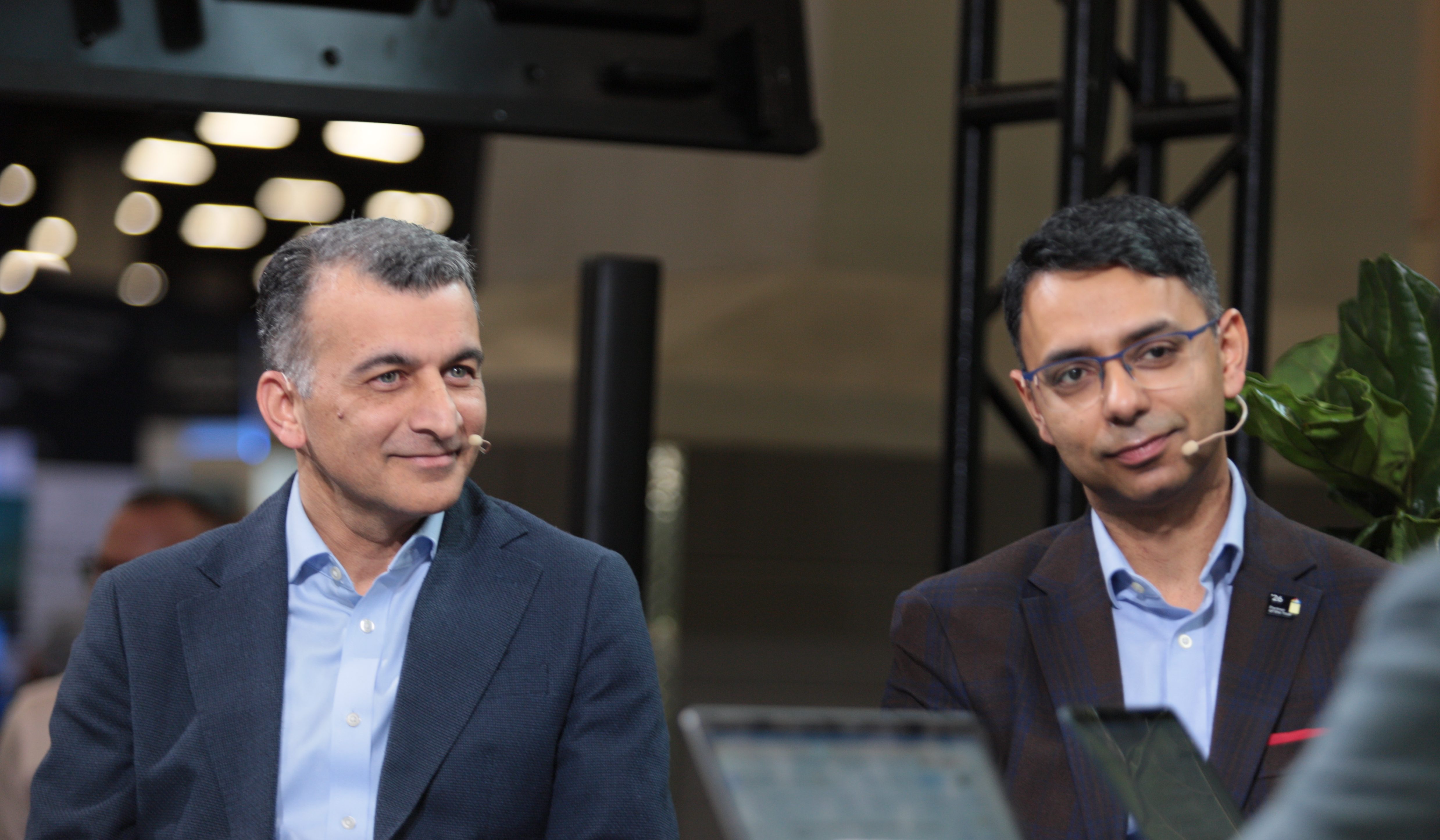
In this interview from Google Cloud Next 2026, Gaurav Syal, vice president and global head of AI, cloud and infrastructure services, EMEA, at Tata Consultancy Services, joins Amit Kapur, chief AI and services transformation officer at Tata Consultancy Services, to talk with theCUBE's John Furrier and co-host Alison Kosik about how enterprises are crossing the divide from AI experimentation to production-ready agentic deployment. As Google's Diamond partner and its top-ranked talent development competency holder, TCS earned five awards at Google Cloud Next 2026, spanning agent development, security and talent. Syal explains how TCS operates as "customer zero" for Gemini Enterprise — deploying the platform internally across 30,000 employees before recommending it to clients. Kapur frames the broader market shift: enterprises are moving away from isolated use cases toward fundamentally reimagining entire workflows on AI, not sprinkling it onto existing processes.
The conversation also explores TCS's approach to cultural transformation, including "AI Fridays" — recurring sessions where employees collectively log 12,000 hours in a single day tackling real-world problems, with 240,000 hours of AI learning accumulated to date. Syal details two standout deployments: an APAC retailer where agentic AI autonomously manages product replenishment by negotiating with suppliers, handling compliance and fulfilling orders end-to-end; and a UK bank that realized $50 million in business value across more than 50 use cases including fraud detection and mortgage lending. Kapur outlines a repeatable engagement model — immersing C-suite leaders in 60-minute hands-on sessions, then delivering a production-ready proof of value in 12 to 16 weeks. From seven Gemini experience centers spanning the globe to the emerging convergence of digital and physical AI in capital-intensive manufacturing environments, the discussion provides a practical roadmap for enterprises ready to move from curiosity to conviction.
Forgot Password
Almost there!
We just sent you a verification email. Please verify your account to gain access to
Google Cloud Next 2026. If you don’t think you received an email check your
spam folder.
In order to sign in, enter the email address you used to registered for the event. Once completed, you will receive an email with a verification link. Open the link to automatically sign into the site.
Register for Google Cloud Next 2026
Please fill out the information below. You will receive an email with a verification link confirming your registration. Click the link to automatically sign into the site.
You’re almost there!
We just sent you a verification email. Please click the verification button in the email. Once your email address is verified, you will have full access to all event content for Google Cloud Next 2026.
I want my badge and interests to be visible to all attendees.
Checking this box will display your presense on the attendees list, view your profile and allow other attendees to contact you via 1-1 chat. Read the Privacy Policy. At any time, you can choose to disable this preference.
Select your Interests!
add
Upload your photo
Uploading..
OR
Connect via Twitter
Connect via Linkedin
EDIT PASSWORD
Share
Forgot Password
Almost there!
We just sent you a verification email. Please verify your account to gain access to
Google Cloud Next 2026. If you don’t think you received an email check your
spam folder.
In order to sign in, enter the email address you used to registered for the event. Once completed, you will receive an email with a verification link. Open the link to automatically sign into the site.
Sign in to gain access to Google Cloud Next 2026
Please sign in with LinkedIn to continue to Google Cloud Next 2026. Signing in with LinkedIn ensures a professional environment.
In this interview from Google Cloud Next 2026, Gaurav Syal, vice president and global head of AI, cloud and infrastructure services, EMEA, at Tata Consultancy Services, joins Amit Kapur, chief AI and services transformation officer at Tata Consultancy Services, to talk with theCUBE's John Furrier and co-host Alison Kosik about how enterprises are crossing the divide from AI experimentation to production-ready agentic deployment. As Google's Diamond partner and its top-ranked talent development competency holder, TCS earned five awards at Google Cloud Next 202...Read more
exploreKeep Exploring
What is your company's partnership with Google — including partner tier, awards and areas of collaboration (e.g., agent development, security, talent development) — and have you deployed Gemini Enterprise internally?add
How should organizations respond to the rapid, disruptive changes in AI (e.g., new models and shifts in the "control plane"), and how is Tata addressing this and helping customers avoid paralysis while reimagining workflows and delivering value at scale?add
How are employees being encouraged and trained to adopt and use AI tools and shift the organization's operating model?add
How should organizations quantify the results of AI experiments and pilots, and what best practices can be used to demonstrate proof of value and drive adoption?add
>> Welcome back to Google Cloud Next, the 26th. I'm Alison Kosik, joined alongside by John Furrier. We've got a great lineup of guests sitting right before us here at theCUBE, with Gaurav Syal, the Vice President and Global Head of Google Business, Tata Consultancy Services. Welcome to theCUBE.
Gaurav Syal
>> Thank you.
Alison Kosik
>> Amit Kapur, Chief AI and Services Transformation Officer, Tata Consultancy Services. Welcome to theCUBE as well.
Amit Kapur
>> Thank you.
Alison Kosik
>> It's great to have TCS back here on theCUBE, but before we get to the big ideas, I would love to hear first, Gaurav, about the partnership between Tata and Google. What's working? Give us your greatest example.
Gaurav Syal
>> Sure, sure. So, we have a great partnership with Google. We are actually the Diamond partner, which is the highest tier partner that Google can have. Having said that, we have also, as you can see, where is it? We have also won five awards, and these five awards are a great testament of us working together. Us co-innovating, co-selling, co-creating these solutions. And to be fair, at times, co-arguing as well, what is best for the customer. And these awards are actually great, because one of them is the agent development, and the world is talking about agentic AI. Second, we heard the keynote as well today. The second part is about the security, which is the backbone, backbone of AI, data, cloud. So, we have won an award for security as well. And last but not the least, for talent development, which is where we are number one competency partner for Google. So, great partnership going on between us. One thing I'll also add onto it, we are also the customer zero for them, for Gemini Enterprise. So, for 30,000 people, Gemini Enterprises, we have implemented. And it's like drinking your own champagne, as they say. So we want to test it out internally in TCS first before we go and sell it to the customers, tell them what is working, what is not working. So, it's been going great .
John Furrier
>> Well, congratulations on the awards and awards, plural, many of them. It's been a great run this year. I got to say from last year to this year, lots changed. Gaurav, talk about the AI piece too, because we have, like Amit, the AI is everything and the enterprise is hot again. Last year was a lot of excitement, enthusiasm, strategy was clear. Infuse AI in your business. Execution, pockets. But with agentic infrastructure coming out, that's going to unlock all that data. What is your strategy? How do you work with Google? What's going on with the rollout of how people are thinking about the agentic? We heard from Google, full stack, security, the Gemini, the orchestrator, all coming together. Give us the state of the market. Give us your take.
Amit Kapur
>> Sure. So, I think if you look at the last 12 to 18 months, you're absolutely spot on. From a lot of use cases, experimentation to wanting to scale it enterprise wide, possibly to the world of agentic. And we see a lot of promises, a lot of excitement towards that. I think what we are clearly seeing as a pathway is when we reflect back on our own ambition. We publicly announced that we'll be the world's largest AI tech services organization. And towards that, we are clearly seeing the pathway to scaling enterprises across customers, across employees, across partners. And without a partnership ecosystem, it's very tough to fulfill the promises that one makes. And our presence here at Google Next 2026 is an example of that, our partnership with Google dates back. Got to just mention about what we are recognized for this year, as well as what keeps us busy, both at customer zero, as well as deploying it at scale for our customers as well.
John Furrier
>> The world has changed. I was joking before we came out about Claude and Gemini. I wrote a post on LinkedIn that went viral. I was just trying to do a keynote, I mean, a summary preview. It's not about the models, it actually had control plane in the title, which I never put the jargon in the title. But the control plane is the game. How do you guys deal with this? Because we hear from customers and your customers and partners, "I just figured it out and then it changed." The speed is so fast, sometimes people get paralyzed. Organizations are trying to transform. I know it's a nuanced point, but explain this dynamic and how you guys are handling that both at Tata and with customers who can potentially maybe get paralyzed by the sheer velocity of the market.
Amit Kapur
>> Yeah. I think if you just pivot it, pivot it to the world of context. Everything and anything that one does as an enterprise is in the line of enterprise context for their customers, for their employees, for their ecosystem in which they operate. You can run a formula one at 3n+1, you can also do it at 3n+1.1. It's a choice you make. Do you want to be in that race of point one, or do you want to do it structurally right for your enterprise for the long run? What we are seeing as partnership with customers is that everyone is moving away from the phase of experimentation of use cases to say that, "Can I fundamentally shift the workflows and processes? Can I get a different path of value and a proof of value demonstrated at scale?" We are doing it across five tranches. Gaurav spoke about being a customer zero. We ourselves took a promise that anything and everything that we do will be reimagined on the back of AI and not sprinkled. So we are putting our bet exactly where it matters and not sprinkling it. Talent is an equally important subject, so we are doubling down on what the future of talent and the talent of future will look like. Fourth is-
John Furrier
>> What does it look like? Tell us what it looks like. Everyone's trying to figure it out.
Amit Kapur
>> I think while it's an evolving situation, one thing is clear, that the ability to drive context will drive the winner.
Gaurav Syal
>> Yeah.
John Furrier
>> Yeah.
Alison Kosik
>> Gaurav, I mean, part of it is just deploying the technology, that's the half of it. And so, how is Tata managing this sort of massive cultural shift when it comes to transitioning to an AI native operating model?
Gaurav Syal
>> Yeah. That's a very valid question, because AI right now is not about technology change. It's about an overall operating model change. And as they say, you can bring a horse to the water, but you can't make them drink. So, while we have given, just giving an example of TCS, we have given all the tools, all the elements you said Gemini, you said Claude, everything to our employees and the huge workforce. We are also telling them how to use it, we are also navigating them how to use it and maneuvering them. Just as an example, we do AI Fridays in TCS.
Alison Kosik
>> What does that look like?
Gaurav Syal
>> What it is, is that it's where people will come together on a Friday evening and for 12,000 hours in one Friday, they'll come together and solve a real life problem. And because it's not a project that has been given, it's a real life problem, it motivates them. And we have clocked 240,000 hours of AI learning. So, it's basically letting them know what's the power of AI, not only giving them the tools, but that cultural shift of making sure they understand how to use it, how to exploit it, and how to make it better for us and the customer.
Alison Kosik
>> So this is on a Friday night, is any beer or wine involved?
Gaurav Syal
>> It can be with beer and wine as well.
John Furrier
>> I mean, they're coding on the weekends, they get addicted to it. One of the things that's come up, and I'd love to get your thoughts on, as the shadow AI has come up a lot in conversations. And we're starting to see shadow IT, which was once a cloud phenomenon, and that was only in IT. Go around IT departments, get your credit card, get something in the cloud, show your boss, get promoted, start a journey. That was the progression, very not that complex and not too nefarious. AI, you're seeing it everywhere. I mean, I'm talking, I see CFOs, chief people officers doing their own shadow AI, building dashboards. The AI proliferation, you're having AI days, Fridays. Like Taco Tuesday, you got AI Fridays. This is a cultural revolution. How does an organization reign this in? Because they can't stop it. You guys are in these rooms. What's the story? How do you guys talk to customers about it? Do you let chaos reign, reign in the chaos? What is the prescription from Tata?
Gaurav Syal
>> Let me say one thing. AI is actually, we are at an inflection point. So, AI earlier was system that converse, and now it's system that act. So, it's not only about conversing. Talk about generative AI. Where it was, it will create a, let's say, a code for you for a product which you want or a product replenishment in a retailer system. And now what it does as part of agentic AI, is it not only create a code, it goes and negotiate with the vendors. It also take the compliance for it. It'll also make sure that the price competitiveness is there and then fulfill the order, and that's what we have implemented with one of the retailer in APAC. Similarly, for one of the largest bank in UK, what we did was we actually had, let's say four or five years ago, first had the foundation right. We had their data moved to cloud, which was Google Cloud again. We also created a COA and advisor function for them, told them how to implement AI. And that was AI at that time, now we are talking about agentic AI as well. So we actually implemented around 50 plus use cases or business cases, fraud detection, mortgage lending. And with that, they have been able to save $50 million of business value, not only unlocking the efficiencies, but also creating new revenue stream. So, all of it coming all together, people are seeing, our customers are seeing the value that agentic AI is bringing in.
John Furrier
>> I love that number. I mean, this brings up the question of quantification. A lot of people are, I see organizations have all these experiments and sandboxes out there and they're destined to fail because there's no coherency to them. Other ones are really disciplined in picking a workload and end-to-end workload they understand. I even saw a clever use case where they just implemented a recent project in the past couple years the old way, and they just basically replicated it, shadowed it, created a clone, and then they compared the numbers. I mean, so there's different mechanisms. That gave them fuel to justify, look it, we just rolled this project, it costs X millions of dollars, we just replicated in parallel the current tools today. Green light. How should people be quantifying the results? Can you share any best practices that you guys are using or have seen? Because this seems to be where the execution's hitting right now.
Amit Kapur
>> Yeah. See, one of the fundamental questions when I took over this role seven months back, in line with what you just said is, most of the enterprises were asking, is AI real? And that was a pivot we made, that this question is essentially a question of curiosity. And how to make it real is essentially the pathway that we should travel. Proof of value is one dimension that one can look at it, but the biggest dimension is around change. So when you do things firsthand, you know the power of the tool. And when you know the power of the tool, you see that, okay, it's something which is far bigger. It's an entire shift in operating model as Gaurav also mentioned. So, what we attempted was making AI real for enterprises. For example, four of us on this table, all of us are insured. We have had our own chances of claiming insurance, and never, ever a pleasing experience. And whenever there's an experience like this, we always say that there's friction. At every moment in time, we feel the friction, and the friction is a frustration. Today with the operating model change is an opportunity for us to make it frictionless, and that's a proof of value.
John Furrier
>> So you target friction. And what about repeatability?
Amit Kapur
>> See, the moment you have a frictionless imagination as an operating model, and you have the change improvised along with the executives right top-down in entire organization, your ability to scale, your ability to welcome the adoption increases, and that multiplication drives the scaling piece of it.
John Furrier
>> So to summarize, one, get the wins, get a win, show the value, make sure you take pain away from people.
Amit Kapur
>> Absolutely.
John Furrier
>> And make their life better.
Amit Kapur
>> Yeah, absolutely.
John Furrier
>> Sounds easy. Now, how easy is it? I mean, take us through some of the use cases, because people are doing, trying to figure this out.
Gaurav Syal
>> It's easier said than done.
John Furrier
>> Of course.
Gaurav Syal
>> As I said, see one thing, what you will have to think about is, and we were talking about John earlier, as a common user, yes, you can go right now and do anything on an AI tool. But as an enterprise user, you need to have the right guardrails, you need to have the right security, and you need to have the right foundation. If you don't have the right foundation in terms of your data, because AI will work on data, your agentic AI need to have the right data to make sure that the swarms come together and do the work for you. So, you need to have the right foundation in terms of data, security, guardrails, and then it becomes easy. So it's not that you straight away jump onto it, but you have to have the right foundation, to make it fair.
Alison Kosik
>> Amit, when making AI real for your customers after everything you've said, what's the secret sauce?
Amit Kapur
>> So, I think take the customer on their journey along. Don't necessarily come back with, "Here's a solution." So what we have attempted to do in the last few quarters, is whenever a customer has asked us a challenge on, "Is AI real?" We make them block 60 minutes. And in those 60 minutes, we make them do things on their own firsthand. And believe me, we do it from CEO, COO, CXOs, the entire CXO suite, and one outcome which comes as part of that exercise is, "Can you do it for my next 200 leaders?" And that drives change. With that change, given that we know the enterprises, we go back to them saying that, "We know that you have these six challenges. Pick one. It's your choice. Pick any one." And we take around 12 to 16 weeks in what we call as rapid build, come back with a production environment of proof of value, and say, "This works for you." That is a conviction with which an enterprise believes in it, and that gets them to the ability to scale. So, immerse yourself with AI, build it with AI, and scale it with AI, is essentially the pathway that we travel.
Gaurav Syal
>> And on the same note, if I may say that for the similar reason, what we have done is we have opened around seven Gemini experience center around the world, out of which one is physical AI center, because AI is now coming out of the screen and out of the browser as well, it's physical AI there as well. So it's for the similar reason, people can come there, touch and feel it, can see and convey what the problem is. We give them a rapid prototyping and give them a solution there and then.
John Furrier
>> Yeah. I'm glad you brought up the physical AI piece because one of the things that's coming out of this era is the full convergence of digital and physical. I mean, any keynote you go to, whether it's NVIDIA, Google, cloud, there's a robotics angle that's physical, not the humanoids yet, but they're coming. The human IoT devices that were once in manufacturing are now wearables. So, you're starting to see that full edge coming.
Gaurav Syal
>> Yeah.
John Furrier
>> Thoughts on that and how you guys see that emerging? Because that changes the game. You're going to have smaller models maybe in the edge, smaller footprints. Are enterprises thinking about the edge right now, or are they just still working to get their core competency locked in?
Amit Kapur
>> I think you have to look at it from a lens of the AI landscape. You can vertically drive it from infrastructure to intelligence, as how we saw it in the keynote as well earlier today, or you can also look at it a landscape of conversational AI to physical AI, and anything that falls in between as a place to operate. And we are seeing the convergence right vertically and horizontally across the entire landscape. Physical AI, given that we started a conversation on that, a huge benefit for manufacturers, a huge benefit for landscapes which are capital intensive, especially on safety as a case in point. Can I make my environment much more safer? Can I be incident free? I think that's a huge win for any manufacturer for any facility, which is into captive operations. Similarly, we are seeing on customer experience on conversational AI. And anything that you see in between is essentially the models, foundational models, the ability to fine tune them, ability to drive content and context on the back of that.
John Furrier
>> Well, a lot of Gemini announcements, a lot of orchestration we're seeing. Again, I've used the word operating system this year more in my life than I have in my entire career, because everything's an operating system now, whether it's AI factories, agentic control planes, domain expertise, it's a systems game now and it's full stack. I love that message. Guys, congratulations on the wins.
Gaurav Syal
>> Thank you.
John Furrier
>> And the partnership.
Amit Kapur
>> Thank you.
Gaurav Syal
>> Thank you, John.
Alison Kosik
>> Thanks for stopping by theCUBE and having a great conversation.
Amit Kapur
>> Thank you.
Gaurav Syal
>> Thank you. Thank you for having us.
Amit Kapur
>> Thank you.
Alison Kosik
>> And you're watching theCUBE, the leader in live technology coverage. We'll be right back.


















 Alison Kosik
 John Furrier