In this interview from Google Cloud Next 2026, Ben Kessler, chief executive officer of 66degrees, joins Brendan Bonthuis, chief executive officer of Gordon Food Service, to talk with theCUBE's John Furrier and co-host Alison Kosik about what it takes to build the agentic enterprise — and why the mission hasn't changed even as the tooling is moving faster than ever. Kessler argues that agentic AI shifts the how, not the why — freeing teams to focus on outcomes while AI agents amplify individual capacity 2X to 3X today, with a clear path toward 10X. Bonthuis credits years of foundational data platform work on Google Cloud, including centralizing data ingestion across formats, as the bedrock that makes today's AI ambitions possible.
The conversation also explores how the 66degrees and Gordon Food Service partnership navigates fast-moving, high-stakes decisions — applying litmus tests around reversibility before committing to major architectural changes. Kessler outlines his three priorities for the next 12 months: deepening C-suite trust, sharpening technical expertise to stay several steps ahead of clients and expanding into business process knowledge across functions like HR and finance. Bonthuis underscores that for legacy enterprises with 150-plus years of operational history, the goal is to use AI to improve what already works — not displace it. Both leaders are candid that no one has a decade of experience navigating this frontier, making trusted, skin-in-the-game partnerships the decisive factor. From building a unified data platform on Google Cloud long before agentic AI entered the conversation to charting a pragmatic, outcome-first path through unproven territory, the two demonstrate how strong data foundations and collaborative partnerships are the real differentiators in the AI era.
Forgot Password
Almost there!
We just sent you a verification email. Please verify your account to gain access to
Google Cloud Next 2026. If you don’t think you received an email check your
spam folder.
In order to sign in, enter the email address you used to registered for the event. Once completed, you will receive an email with a verification link. Open the link to automatically sign into the site.
Register for Google Cloud Next 2026
Please fill out the information below. You will receive an email with a verification link confirming your registration. Click the link to automatically sign into the site.
You’re almost there!
We just sent you a verification email. Please click the verification button in the email. Once your email address is verified, you will have full access to all event content for Google Cloud Next 2026.
I want my badge and interests to be visible to all attendees.
Checking this box will display your presense on the attendees list, view your profile and allow other attendees to contact you via 1-1 chat. Read the Privacy Policy. At any time, you can choose to disable this preference.
Select your Interests!
add
Upload your photo
Uploading..
OR
Connect via Twitter
Connect via Linkedin
EDIT PASSWORD
Share
Forgot Password
Almost there!
We just sent you a verification email. Please verify your account to gain access to
Google Cloud Next 2026. If you don’t think you received an email check your
spam folder.
In order to sign in, enter the email address you used to registered for the event. Once completed, you will receive an email with a verification link. Open the link to automatically sign into the site.
Sign in to gain access to Google Cloud Next 2026
Please sign in with LinkedIn to continue to Google Cloud Next 2026. Signing in with LinkedIn ensures a professional environment.
Are you sure you want to remove access rights for this user?
Details
Manage Access
email address
Community Invitation
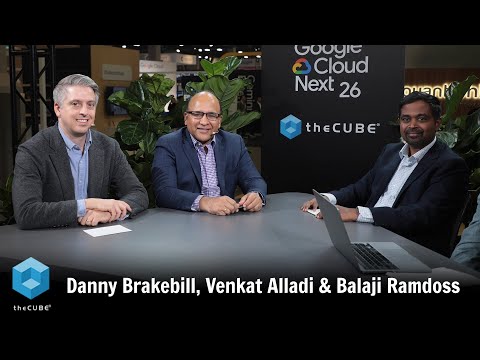
Ben Kessler, 66degrees & Brendan Bonthuis, CIO, Gordon Food Service
In this interview from Google Cloud Next 2026, Ben Kessler, chief executive officer of 66degrees, joins Brendan Bonthuis, chief executive officer of Gordon Food Service, to talk with theCUBE's John Furrier and co-host Alison Kosik about what it takes to build the agentic enterprise — and why the mission hasn't changed even as the tooling is moving faster than ever. Kessler argues that agentic AI shifts the how, not the why — freeing teams to focus on outcomes while AI agents amplify individual capacity 2X to 3X today, with a clear path toward 10X. Bonthuis credits years of foundational data platform work on Google Cloud, including centralizing data ingestion across formats, as the bedrock that makes today's AI ambitions possible.
The conversation also explores how the 66degrees and Gordon Food Service partnership navigates fast-moving, high-stakes decisions — applying litmus tests around reversibility before committing to major architectural changes. Kessler outlines his three priorities for the next 12 months: deepening C-suite trust, sharpening technical expertise to stay several steps ahead of clients and expanding into business process knowledge across functions like HR and finance. Bonthuis underscores that for legacy enterprises with 150-plus years of operational history, the goal is to use AI to improve what already works — not displace it. Both leaders are candid that no one has a decade of experience navigating this frontier, making trusted, skin-in-the-game partnerships the decisive factor. From building a unified data platform on Google Cloud long before agentic AI entered the conversation to charting a pragmatic, outcome-first path through unproven territory, the two demonstrate how strong data foundations and collaborative partnerships are the real differentiators in the AI era.
Ben Kessler, 66degrees & Brendan Bonthuis, CIO, Gordon Food Service
Ben Kessler
CEO66degrees
Brendan Bonthuis
CIOGordon Food Service
In this interview from Google Cloud Next 2026, Ben Kessler, chief executive officer of 66degrees, joins Brendan Bonthuis, chief executive officer of Gordon Food Service, to talk with theCUBE's John Furrier and co-host Alison Kosik about what it takes to build the agentic enterprise — and why the mission hasn't changed even as the tooling is moving faster than ever. Kessler argues that agentic AI shifts the how, not the why — freeing teams to focus on outcomes while AI agents amplify individual capacity 2X to 3X today, with a clear path toward 10X. Bonthuis cr...Read more
exploreKeep Exploring
What does "the agentic enterprise" mean, and how does it affect your company's mission and approach to technology?add
Can you provide an example of AI that is not merely assisting but actually doing the work within your business?add
How does 66degrees, as an "agentic enterprise," use agents and AI to scale its solutions business, increase workforce productivity, and help clients (like Brendan's team) adopt technology, and what role do human consultants play in that process?add
What are the priorities for 66degrees over the next 6 to 12 months?add
How do you approach working with traditional, long-established companies (like GFS) to introduce and gain buy-in for AI and data technologies?add
Ben Kessler, 66degrees & Brendan Bonthuis, CIO, Gordon Food Service
search
Alison Kosik
>> Welcome back to Google Cloud Next '26. I'm Alison Kosik and this is John Furrier. We are streaming live from Las Vegas and we're about to talk about building the agentic enterprise.
John Furrier
>> Yep. And what it takes to get there.
Alison Kosik
>> Yep. Yep. And we've got a couple great interviews before us here. Let me introduce them. We've got Ben Kessler, the CEO of 66degrees. Welcome to theCUBE.
Ben Kessler
>> Great. Thank you for having me.
Alison Kosik
>> And Brendan Bonthuis, CEO of Gordon Food Service. So you've got a great partnership going, but the first question I have for you, and you can jump in, whoever feels like they want to jump in, is building the agentic enterprise. We sort of throw that term around a lot and businesses are different. They have different visions. What does that phrase mean to you?
Ben Kessler
>> Brendan?
Brendan Bonthuis
>> Sure. Yeah. When Ben and I were chatting, I don't know that we have a really great definition yet. I think we're certainly, we're at Next, there's a lot of really exciting technology. And I think it's really important for us to kind of keep coming back to why does technology exist in the first place? And while the tooling changes, kind of the mission and the purpose of creating value for our customers, our employees, and for the business hasn't changed. And so the agentic enterprise is a reminder, and certainly we seem to be at an inflection point when the tooling's changing faster than ever, but the why, I think, hasn't changed. And so as we think about building the agentic enterprise, in some ways, it's another tool in the toolbox. It didn't fundamentally redefine our mission or our purpose. It does certainly change what's possible and how we do it though.
Alison Kosik
>> Ben, what do you think?
Ben Kessler
>> Yeah, I agree with Brendan, and I felt that his point is actually quite enlightening. And Brendan runs a business and the CIO of a business that's a food distribution business. And I run a business that's a solutions business. We help customers like Brendan create solutions that drive to an outcome, and also at its core, help people adopt technology. And so I think when we're thinking about the agentic enterprise, we can get so caught up in how we're building our enterprise and how we're delivering value. But I think what Brendan does with really great clarity is to... It's not all about the how. It's actually about the what and what we're doing. And look, at 66degrees, we spend a lot of time thinking about what it is that we're doing. And what I would say is that as these advances of data technology and these advances of AI technology and even agentic, it's just reinforced for me and for us as a business that there's such a need as there's a need for people to eat every day. There's actually a need for people to learn how to adopt technology and learn how to take this technology and drive and create differences for their business. And so the what remains unchanged at 66degrees. And it's really the agentic enterprise, it's all about the how changes. And it allows us to actually deliver a little bit faster or a little bit more of a certain outcome.
John Furrier
>> Well, first of all, congratulations on getting award from Google Cloud, Partner of the Year, one of many highlights. Congratulations to the team. Great work. Brendan, as you work with 66degrees, where's your grounding point? As you look at the agentic enterprise, there's a lot of hype and a lot of potential. Readiness has come up, data readiness, you kind of feed the beast of AI, whatever that looks like and how it evolves. But first, principles matter. You got a mission.
Brendan Bonthuis
>> Yeah.
John Furrier
>> Outcomes are out on the table again, in a real way. Like, okay, what's our outcome? What are we trying to accomplish? How do you take that North Star mission and then back into the plan? Where do you start? Where are you grounded? And what's your thoughts on this?
Brendan Bonthuis
>> Yeah, I would say one of the things that we're really grateful for is our partnership with 66. Again, what's a little bit different on our side as the customer is, there's not as many reference calls as you can use... There was a project and you could find dozens and dozens of people who had done it before and understand the war stories and the battle scars and learn from those and avoid them. This feels different because no one has 10 years of experience doing this.
John Furrier
>> Your frontier models are called frontier for a reason.
Brendan Bonthuis
>> Right, right. So I think having a partner that can walk with you and hopefully at least a little bit in front of you to figure out what is the plan and how do we approach it and learn together. And that's been really important as we go on that journey.
Alison Kosik
>> Can you give us an example of where AI is not just assisting, but actually doing the work?
Brendan Bonthuis
>> Where AI... Sorry.
Alison Kosik
>> It's not just assisting, but actually doing the work?
Brendan Bonthuis
>> Within our business? I mean, I would say we have a number of different use cases that we're excited about. I think one of the things that was great to hear in the keynote is kind of the hardening of some of these solutions as well, to make them kind of enterprise ready, enterprise grade. So we certainly have, if you use the broad definition of AI, automation and stuff before GenAI, we have several of those use cases, but I think we're optimistic about the hardening of the platforms overall.
John Furrier
>> Take a minute to explain Gordon Food Service, what you guys do, so put some context to how you're thinking about it. Take a minute to explain the service, what you guys are all about.
Brendan Bonthuis
>> Yeah. We deliver groceries to restaurants as we operate a retail business and we have some manufacturing businesses. So our business is food and serving the customers.
John Furrier
>> Yeah. The big North Star is just physical AI, but you have a lot of physical assets in play here. One of the things that comes up a lot, I'd love to get your thoughts on this, is that, okay, how do I think about the trajectory? There's a lot of unproven territory out there. You're plowing the fields as they say. You got to get it right, and there's a lot of wrong answers that come out of AI sometimes. You want to get it right, harden the system. Is there any best practice that you guys use, or is there a playbook or a philosophy that you guys take to make that intentional?
Brendan Bonthuis
>> Obviously our goal is to try to get it right. I think another thing we talked about in terms of readiness is just the good data quality, and this is still a journey for us as well. But I think the thing that we feel confident is the best way we prepare is still to have good architecture and good technical health in our applications and good data quality. And so again, I think it's something where we have to evolve with the tooling and the tooling needs to continue to evolve to become reliable, to be enterprise grade. And I would lean back on our partner community too, to help us figure that out.
John Furrier
>> Talk about the partnership, because you got to cross the bridge to the future, you're building out and crossing to the future. How do you guys define what an agentic enterprise is? What would be the definition? Because let's get that on the table, because enterprise kind of implies there's a CIO element, because they're projects, there's technology involved. It's a people business. Human resources involved, the CFO has to write the checks as a project. So you start to see a lot of involvement. What is that enterprise look like? And you guys are zooming out and saying, okay, define-
Ben Kessler
>> Yeah, I can start. I can start with that. And I'll start with our business and try to bridge it over to GFS. And so for us, what 66degrees is, is a solutions business and we're helping our customers drive to an outcome that allows them to better serve their customers or drive an impact into their P&L. Grow revenue, save on costs. And we as an agentic enterprise, really what we've been able to do is traditionally it's been a limit of people and person hours is only so much in what the driver is of delivery. On the other hand, software businesses, the driver, the cap, the ceiling on that is actually lines of code. What we've been able to do is empower our people with agents and with AI to actually... Eventually, I think we'll 10X their capacity. At this point, we're 2 or 3Xing their capacity. And look, I'm a firm believer that it's not actually doing the same amount of work with fewer people. It's actually figuring out how to actually take your workforce, apply agents, and work with agents in order to make them actually more productive. And I think what we've been able to certainly, as we partnered with Brendan, there's two pieces I would say. A valuable consultant is valuable because he or she has a ton of experience in the context of an environment, having moved data, having built an AI solution, having helped somebody adopt technology. But in addition, the agents and the AI we're delivering with can also learn and can also be better and more productive over time. And so then these two combined actually allow us as an agentic enterprise to help Brendan and his team better adopt technology and implement technology in his business.
Brendan Bonthuis
>> Yeah. And I would go back to kind of the strength of the partnership is we started working with 66degrees long before, but before agentic was a word that was thrown around frequently. And I would go back to, again, some of the foundational work we did, getting our data ready, getting it prepped, making it available, laid the groundwork for kind of the moment we're in right now. So really, really thankful for the work we've done together.
John Furrier
>> What were some of those things you did that laid the foundation? Was it a data lake? I mean, what were some of the things? Take us through some of the specifics.
Brendan Bonthuis
>> Yeah. We built out a data platform, so we would prioritize the ability to quickly ingest data across a bunch of different formats. And so again, I go back to... I don't think there was anything particularly clever about it, but having your data in one spot and having it accessible within GCP is we felt like it was a good idea years ago and we worked really hard on that with these guys and we're really glad it's there now. It certainly doesn't guarantee success, but it's a really important step. And I think that's... As we've kind of progressed on our journey, the number of times we come across something and say, "Oh, this would have helped us move more quickly." It's the same stuff that we've known that we should have done for years. And that's why I keep coming back to, there's certainly different things now, but the stuff that used to be true is still true in terms of good architecture and good technical practices.
John Furrier
>> Were there any good surprises that you're like, "Wow, I'm so glad we did that that way," that you're seeing now come out because we see a full stack coming out of Google Cloud. They're adding models, open models, some choices there. You got the data cloud looking good and they got the agentic defense built in. So you got a lot of elements coming together and they're trying to build scaffolding around the model so you don't get stuck with a model if you need to move or make a change. Is there anything that surprised you from the decision that was a benefit?
Brendan Bonthuis
>> I think when we started our journey to really build out our data platform, it was kind of in anticipation of a moment like this. I certainly wouldn't claim that we had or anyone probably had kind of the prophetic point of view six, seven years ago about where we were going to end up. But I think that's kind of the inherent bet that we were making is that we would be able to tap into emerging technologies like this. So I would say, I don't know if I would call that a surprise exactly, but I'm sure glad it happened.
John Furrier
>> Yeah, you did the hard work. We see examples all the time of companies, even four years ago doing compliance and governance work for the right reasons, but in anticipation that the puck will come to them, and they are seeing benefits. Even on some of the retail examples we've seen at NRF this year, a show in New York, big retail shop, it's a tech show now. The folks that were driving revenue, they did the work, the hard work on making sure identity was in place, making sure that they had governance, they could actually observe the data. And they picked some good use cases that were well known and workflows, but that seems to be the playbook these days.
Ben Kessler
>> Yeah. And I would just come back and say this, is that I think what you're saying is where Brendan had led his team and prior to his current role and his current role is doing the hard work. Doing the hard work, but having always an eye on to say, how is this going to better serve our customer and how is this going to better serve us, set us up for today and then set us up for the future? Whereas we see lots of companies right now and a number of clients that are ready to adopt AI and build the agentic enterprise that haven't done that hard work. And I'd highlight a point that he had made earlier in the conversation that I'm very grateful for is that I think a good partnership is all about walking together. It's all about GFS being open to innovation and partnership and advice, but also really being innovative and willing to take a risk of just saying, "Hey, we're going to put this hard work in. We need your help. How can you actually walk with us, help us look around a corner and then actually serve as a partnership." And so I've been very grateful for Brendan's innovation, ability to work hard, but also his humility to actually be able to take some of our advice.
John Furrier
>> Yeah, that... Go ahead.
Alison Kosik
>> Oh, I was going to ask, based on what you were talking about sort of these future moments, in the next 6 to 12 months, what are your priorities for 66degrees itself?
Ben Kessler
>> Sure. Yeah, great question. I think I would say threefold. And so number one is, I think it's building a trusting relationship. I'm reminded by Brendan saying like, "Hey, we're going to continue to focus on serving our customers." There's an element of trust that GFS has with their customers and there's an element of trust here. So I think number one priority is how do I continue to strengthen this relationship, but also my other relationships with C-level executives because it does come down to trust. Number two is how can we sharpen expertise so that my team can be one or two steps ahead of Brendan's team of actually helping them.
Brendan Bonthuis
>> Feel free to be more.
Ben Kessler
>> Five steps ahead. I don't want to be 10 steps ahead. So we'll be 5 steps ahead.
John Furrier
>> He's 10, he's 10.
Alison Kosik
>> You mean anticipating-
John Furrier
>> But he's not going to tell you.
Alison Kosik
>> You mean anticipating what his needs are going to be, his business's needs are going to be.
Ben Kessler
>> Yeah. And so this will be my third, but my second is really depth of knowledge in technology. And I think this is where we have provided value, where is our expertise and what about these products of building a data warehouse? And even recently with adopting a particular AI technology or adopting an automation technology is how can we be five steps ahead? But then I think the last piece is how can we actually understand some of your business and some of your business challenges or similar people in the space where we say, "Hey, it's not just technology we can help you be an expert, but we can help you decompose a process in HR or in finance." And so I think that's what I would say our three priorities are for building partnerships like this.
John Furrier
>> You mentioned walking together. One of the common cultural things we're seeing in this era is obviously hard work, talked about that, is teamwork and partnership because partnerships are partnerships, teamwork is teamwork. You kind of blend them together. You got the teamwork and partnership, teamship kind of thing going on. Because everything that we're seeing, whether it's NVIDIA's extreme co-design, is a co-design process and that's a fairly new thing. I haven't seen a lot of that in these ecosystems. I mean, clouds, APIs, great, got APIs, got SaaS, you're seeing a lot more collaboration because there's a lot of new things coming fast and you got to be ready, otherwise you lock in, you don't want to be stuck. Wait, it's changed. We made a decision. Amazon calls out the one-way door, Jeff Bezos calling that, Google's got another term for it, but that's just decisions you got to walk back versus building on. How do you guys think about that? Is that something that you guys talk about when you're having coffee here at the show? Because I'm sure you're looking at what's happening here. I'm sure you'll probably talk about those steps. What are some of those coffee talks here that you're having together in the teamwork and partnership? Because the steps are right here, but you got to evaluate them like a project, you got to look at efficacy of the tech. Oh, that's in preview. Do we join? Do we not join? There's a lot of these calls. Take us through the mindset.
Ben Kessler
>> Go ahead.
Brendan Bonthuis
>> I think part of it is exactly what you're articulating is understanding kind of the reversibility of some of these decisions and the implications of those. And I think there's some litmus tests. As an example, I keep coming back to the same point. If this is the first time it sounds like a good idea and it's some sort of big architectural shift and it's counter to how we... We should probably talk about that a little bit more because there's just a pattern of, like if someone came and said, "Oh, you can abandon data quality. It's no longer important." I'd be like, "I don't know."
John Furrier
>> Hold on. Yeah. Show me.
Brendan Bonthuis
>> Yeah, that seems odd. So I think we should talk about stuff like that. So I think there's some litmus tests that we use and I do think part of it is it's not completely known and that's why we do need partners and it's good to have partners who have skin in the game in a moment like that too. So it's not us just kind of making the bet on our own. It's together. And that's where I would come back to, something I'm grateful for in our partnership with 66 is, and there's plenty of times through our relationship where things didn't go perfect. And those are the moments that collaboration, partnership, that's when it matters, right? Because we need folks like Ben who are willing to back up the work. And again, I'm sure we've made mistakes, but sometimes you're making bets and it didn't really... We went down a path and it didn't pan out and now we have to walk it back and we're grateful to have partners like 66 who will stand behind that and make it right so that we can find the right path to go down and keep going.
John Furrier
>> Yeah. So I think that's awesome. Little mistakes come with learning. Big mistakes, catastrophic like data quality, great example. Data quality is obviously huge. Ben, what's your take on this? Because you're steps ahead now. You're seeing all the steps here. Any new steps?
Ben Kessler
>> Yeah. I think if I look back on, we'll get together with Brendan and his team throughout the year, and I think where we've had the most success is where we'll talk about other examples of customers where we've delivered similar technology and we'll come in and walk them through and provide a little bit of insight is to say, "Hey, here's a solution that we're having from Google or from another technology that we think could be helpful. Here's where we've implemented this and here was the result." And how I like to say this is that Brendan has great respect and esteem for the business that he's working for and the family has built prior. And what I like to say is that there's a lot of talk of autonomous enterprises at this point of saying, "Hey, more AI first enterprises."
But I think what's very especially relevant when we're working with GFS and then other customers that are more traditional businesses, it's giving these examples of when they adopting AI and data technology that have worked. Because these businesses, the value in these businesses is that what they're delivering to their customer has been over 150, over 200 years that they... And you don't want to change that with AI. You want to improve that with AI, but there's a ton of value of the people that are working there, the processes, the data, and the more we can show, "Hey, similar businesses that are in your shoes, Brendan, were that have adopted these technologies and been successful, I believe the more we can be not two steps ahead of you, but five steps ahead of you and bring you up to that level."
Brendan Bonthuis
>> Yeah.
John Furrier
>> Well, I agree. Being pragmatic is a great approach and making sure you make the right bets, right experiments, that's the innovation strategy. We appreciate you guys coming on. Thank you.
Alison Kosik
>> Great conversation. Thanks so much.
Brendan Bonthuis
>> Thank you.
Ben Kessler
>> Thank you very much.
John Furrier
>> All right.
Alison Kosik
>> And you've been watching theCUBE, the leader in live technology coverage. We're going to be right back.
















 Alison Kosik
 John Furrier