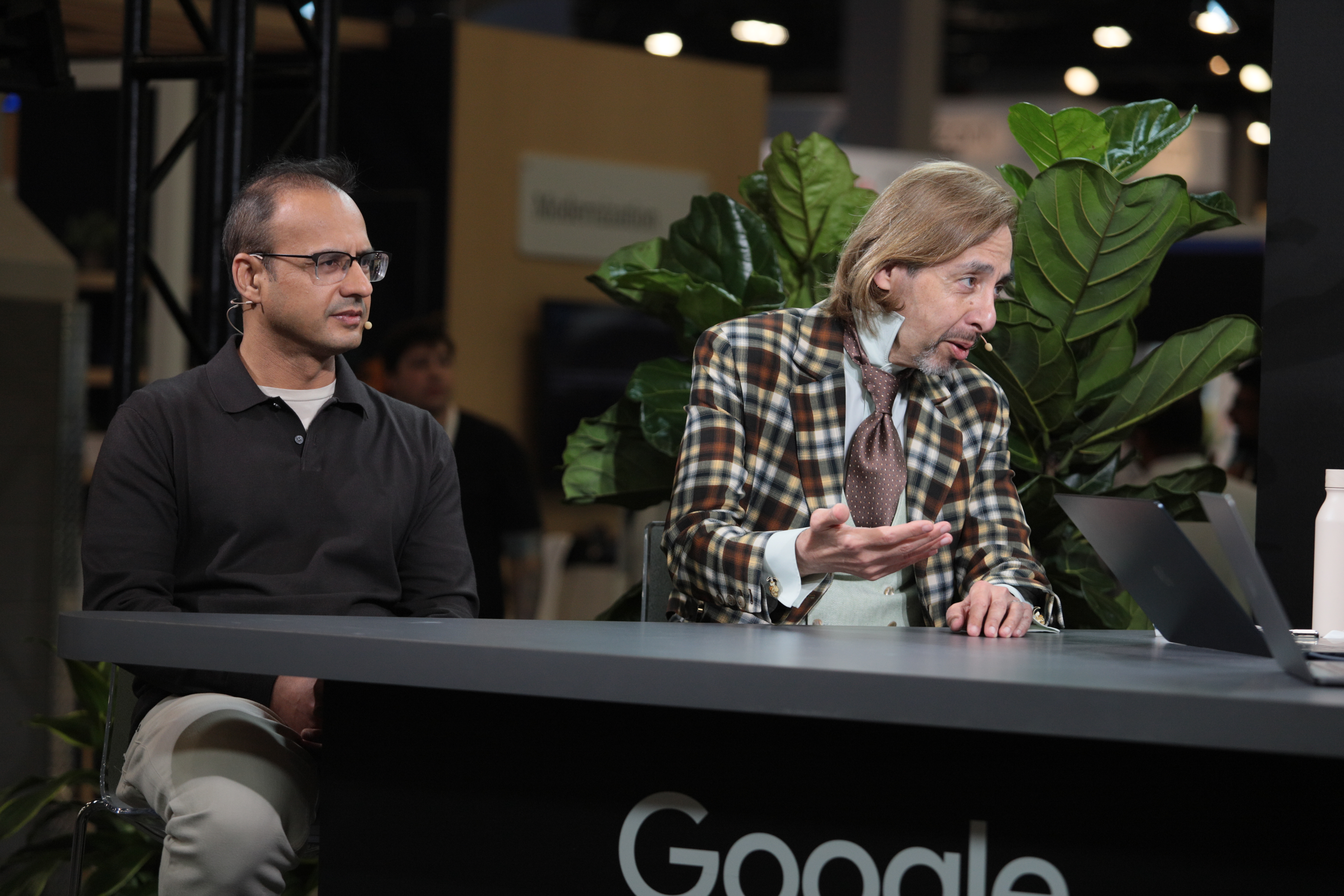
In this interview from Google Cloud Next 2026, Alex Bouzari, chief executive officer of DataDirect Networks, joins Asad Khan, senior director of Google Storage at Google Cloud, to talk with theCUBE's John Furrier and co-host Alison Kosik about how a co-engineered storage layer is enabling enterprises to shift from AI experimentation to production-scale agentic workloads. Bouzari frames DDN as the data engine of the AI economy — the storage-and-software equivalent of what NVIDIA and Google are to compute — arguing that the economics of agentic AI must pencil out for enterprises now processing trillions of tokens per month. Khan adds that Google has seen 4X data growth in just three years, with GPU and TPU saturation emerging as the defining ROI metric. The jointly developed Managed Lustre offering now delivers 10 terabytes per second of throughput — 4 to 20X of any competing hyperscaler solution — and together the two companies have achieved 95%+ TPU utilization for joint customers.
The conversation also explores the real-world business impact behind those numbers. Harmonic achieved 6X GPU saturation after adopting Managed Lustre, while Salesforce and Sony Honda Mobility are using the platform for enterprise-scale AI and autonomous driving workloads respectively. Khan details how joint KV cache optimization — tiering inference context across local SSDs and a remote parallel file system — is cutting the runaway cost of agentic deployments, where per-employee AI spending at some organizations now exceeds $10,000 to $20,000 per month. Bouzari addresses the broader C-suite shift, noting that CIOs and CFOs are no longer operating in budget silos but are jointly accountable for top-line revenue and EBITDA outcomes driven by AI. From edge inference for autonomous systems to cloud-scale training runs and the software intelligence that routes data to where it must be processed, Bouzari and Khan outline why a unified, co-designed data plane is the foundation enterprises need to make the economics of the agentic era work.
Forgot Password
Almost there!
We just sent you a verification email. Please verify your account to gain access to
Google Cloud Next 2026. If you don’t think you received an email check your
spam folder.
In order to sign in, enter the email address you used to registered for the event. Once completed, you will receive an email with a verification link. Open the link to automatically sign into the site.
Register for Google Cloud Next 2026
Please fill out the information below. You will receive an email with a verification link confirming your registration. Click the link to automatically sign into the site.
You’re almost there!
We just sent you a verification email. Please click the verification button in the email. Once your email address is verified, you will have full access to all event content for Google Cloud Next 2026.
I want my badge and interests to be visible to all attendees.
Checking this box will display your presense on the attendees list, view your profile and allow other attendees to contact you via 1-1 chat. Read the Privacy Policy. At any time, you can choose to disable this preference.
Select your Interests!
add
Upload your photo
Uploading..
OR
Connect via Twitter
Connect via Linkedin
EDIT PASSWORD
Share
Forgot Password
Almost there!
We just sent you a verification email. Please verify your account to gain access to
Google Cloud Next 2026. If you don’t think you received an email check your
spam folder.
In order to sign in, enter the email address you used to registered for the event. Once completed, you will receive an email with a verification link. Open the link to automatically sign into the site.
Sign in to gain access to Google Cloud Next 2026
Please sign in with LinkedIn to continue to Google Cloud Next 2026. Signing in with LinkedIn ensures a professional environment.
Are you sure you want to remove access rights for this user?
Details
Manage Access
email address
Community Invitation
Alex Bouzari, DDN & Asad Khan, Google
Alex Bouzari of DDN, CEO and co-founder, and Asad Khan of Google, senior director of Google Storage, join theCUBE Research hosts Alison Kosik and John Furrier at Google Cloud Next '26 to discuss how storage becomes the data engine for artificial intelligence, AI. Khan explains that moving storage closer to processing and maximizing graphics processing unit, GPU and tensor processing unit, TPU saturation are central to lowering total cost of ownership, TCO, and they highlight production considerations such as Managed Lustre performance and key-value cache, KV cache strategies to sustain multi-terabyte throughput. Bouzari emphasizes that a high-performance data engine and tight co-design with cloud partners produce measurable return on investment, ROI, and they cite the Google and DDN integration as delivering multi-terabyte throughput and more than 95 percent TPU utilization in production.
This discussion covers AI infrastructure and storage strategies, including co-design, Managed Lustre performance, KV cache architecture, TPU and GPU optimizations, and approaches for enabling production-scale agentic AI across on-prem, edge and cloud environments. The conversation provides practical insights for architecting cloud storage and data engine solutions that improve utilization reduce latency and lower operational costs for AI workloads.
In this interview from Google Cloud Next 2026, Alex Bouzari, chief executive officer of DataDirect Networks, joins Asad Khan, senior director of Google Storage at Google Cloud, to talk with theCUBE's John Furrier and co-host Alison Kosik about how a co-engineered storage layer is enabling enterprises to shift from AI experimentation to production-scale agentic workloads. Bouzari frames DDN as the data engine of the AI economy — the storage-and-software equivalent of what NVIDIA and Google are to compute — arguing that the economics of agentic AI must pencil o...Read more
exploreKeep Exploring
What did the hosts at Google Cloud Next '26 say about AI infrastructure and the role of storage?add
How is Google Cloud's infrastructure evolving to support Gemini and the data cloud—particularly what changes are happening this year in the data storage layer given new TPUs, NVIDIA collaboration, and other infrastructure investments?add
How does your intentional full‑stack co‑design and partnership (including with DDN) enable delivering high‑performance Lustre on the cloud—such as the announced 10 TB/s (80 Tb/s) throughput—and how does this benefit customers?add
How does software enable AI deployments across the edge, data centers, and cloud — including deciding where to place and process data to meet latency and business requirements?add
Where should data be stored and processed to optimize latency, control costs, and enable agentic AI workloads?add
>> Welcome back to Google Cloud Next '26. We are streaming live right here in Las Vegas. I'm Alison Kosik alongside John Furrier, and we're about to get into AI infrastructure kind of is the new competitive advantage in-
John Furrier
>> Yeah, and storage is the number one thing that everyone keeps talking about because storage network and compute are the three main ingredients in these large scale clusters, and they're being reconfigured differently. And every day the story's still the same, get everything closer to the chips, to the processing. And storage is moving, moving closer. We got two great guests, Google and DDN, to unpack that.
Alison Kosik
>> All right, let me introduce the guests here. We've got Alex Bouzari, the CEO and cofounder of DDN, and Asad Khan, the Senior Director of Storage at Google Cloud. Welcome back to theCUBE to both of you.
Alex Bouzari
>> Thank you for having us.
Alison Kosik
>> Oh, you're welcome. Let's start with DDN, for those who don't know what DDN is in this picture of AI infrastructure.
Alex Bouzari
>> Sure. So, it's very easy. So, DDN is a data engine that powers the AI economy. We are to data what NVIDIA and Google are to compute. You need both to do AI successfully. We help drive business outcome, financial outcomes for enterprises, for nations, for consumers. That's what we do. We're the enabler of AI, the AI revolution. Bring it home, make it happen, deliver value from it.
Alison Kosik
>> Yeah.
John Furrier
>> So, I talk about Google Cloud's news here because one of the things that's jumping out at everyone is the Gemini story. Obviously, it's well-documented, nice and tight, very clean positioning, but the real story is the data cloud and the agentic platform, that's got to be powered by all the storage. So, how is that playing out from an infrastructure standpoint? Because you've got the new TPUs, got NVIDIA leaning in with you guys, so you got a lot of action from the infrastructure, a lot of power. What's going on with the data storage layer? What's actually happening this year?
Asad Khan
>> Yeah. So, I think as you rightly pointed out, there's a lot going on on the Google side. And I think the one thing which truly differentiate is that it is not just about us building something for the customers, Google itself is using the same exact infrastructure to train Gemini and serve those capabilities to the customers. So, all the way from the bottom, if you look at the innovations we have at the TPU, the GPUs, the networking stack that we have, all the way to the Kubernetes clusters and the investments we have in the application framework, that is what differentiates. Now, when it comes to the storage, what you will find interesting is that that is becoming over time the differentiator. And the reason is that we ourself saw 4X more growth on data in just in the last three years because everyone is bringing more and more data because, yes, you can have the processing chips, but what will they process, they will process the data, and that is where the differentiation is.
John Furrier
>> The scale conversation, I talk to practitioners all the time on theCUBE, and the consistent message is, and these are my words, just paraphrasing, "I want to run production workloads at scale. That's our North Star. Everything we do drives towards that." How is that working out in terms of how they think about storage? Because the data growth is massive.
Alison Kosik
>> Yeah.
John Furrier
>> And these systems are getting it done. What does that North Star mean for production workloads at scale for AI specifically? What's changed in the storage equation with AI workloads at scale?
Asad Khan
>> I think it comes down to a very simple thing, how saturated your GPUs and TPUs are, because those are super expensive, hard to find, and that drives a lot of the TCO. And one of the complaints you will hear from a lot of the companies that we work with is like, "I'm not getting the return on my investment because they are overspending when it comes to the infrastructure." And when you go and double-click that thing, you realize that they are not fully saturating the most expensive part of the infrastructure, which is the GPUs and the TPUs. To give you the example, and I'm sure we'll get into the more details, but we were working with Harmonic and they were saying that, "We are not getting the ROI." And they started using the Managed Lustre and the saturation was 6X more, which is crazy. And now you can imagine how much of the money they were investing by not getting the ROI. So, how saturated is your GPU and TPU? It comes down to that. And it is about the network and the storage you are using.
John Furrier
>> Alex, weigh in here, because at GTC, we talked about this on theCUBE-
Alex Bouzari
>> Absolutely.
John Furrier
>> ... and at Supercomputing last year. It's kind of going faster than we see it happening. The data engine, you actually use that word, data engine multiple times, that's a positioning, but it's storage with software. What's different this year as the cloud is continuing to thunder away? There's demand. There's clearly demand.
Alex Bouzari
>> Absolutely. Demand is skyrocketing. I think what's happening is finally the world is evolving from experimenting with AI, trying to figure out what to do, how to do it, how to drive value, to production scale. That is really the pivot that is taking place. Agentic AI I think is making a huge difference. We have customers now who are utilizing internally trillions of tokens per month. Well, that's fantastic. It's helping drive value, but the economics have to pencil out. And so you need a data engine that delivers a number of token per hours where the ROI works out. And I think that's what we're doing. That's what our partnership with Google is enabling. We're able to deliver a data engine that is powered by Google Cloud and it's delivering real value to enterprises, to banks, to hedge funds, to pharmaceuticals companies, manufacturing companies that are finally realizing the benefits of AI and are able to make money out of it, create value out of it because the monetization isn't there. If it's just an investment phase, who cares? That investment has to translate into business value, financial value. And I think that's what we're able to accomplish.
John Furrier
>> Talk about the relationship with Google Cloud because I think this is where we're seeing a lot of action because there's a lot of co-designing going on, a lot of partnerships, teamwork. Talk about the relationship with DDN and Google -
Alex Bouzari
>> So, I think it's an optimization. Google came to us last year and they said, "Well, we have a business opportunity. We have a problem to solve. We believe that the DDN data engine, the DDN data plane can be enabler." We deployed it together. We optimized it together. We started delivering value through that together to organizations, and that business has grown phenomenally. I think it's one of the fastest growing partnerships that Google has had, definitely in the world of data. So, it's resonating with customers because the customers are getting true business value out of it. It's not just, "Oh, I'm trying new things." They're using it in production. It's making banks more compliant. It's helping hedge funds generate better returns for their investors. Pharmaceuticals companies are able to bring new drugs to market faster, FDA approval. It's all of that. It's business enablement.
John Furrier
>> Asad, weigh in on your side. You guys are intentional with the full stack here. It's clear on this event. Talk about the partnership from how that-
Asad Khan
>> Yeah, yeah. So, I think as Alex is saying that we saw the customer demand coming in. We wanted to make sure we have the best tech, and that is where the Lustre could differentiate. But as Alex is saying, it's not about just taking some IP or something. It is co-designing. It is ensuring we are using the right network, we are using the right VMs. There is lot of discussion like, "Oh, C4X is the new VM type coming out. How do we become the first one using that capability?" And that's why even if you look at the announcement, one of the announcement was that we are now delivering 10 terabytes per second, which is a lot of throughput, right?
Alex Bouzari
>> Which is 10 times when it was just very recently.
Asad Khan
>> Which is 80 terabits per second of throughput. That is four to 20X of any hyper cloud is offering because we did not just pick some open source software, we partnered with DDN who has been the primary company this project. So, the other thing which was really good partnership is that if you look at our pipeline for the customer, it is a very nice split where Google is bringing customer, but DDN is also bringing customer because these customers walk in, and they say, "Oh, we are already familiar with them. We were working with them in on-prem, and now it's great that you have this partnership, and we would love to move to the cloud."
Alex Bouzari
>> Customers need the flexibility, right?
Asad Khan
>> Yes.
Alex Bouzari
>> They're doing things on-prem, but then being able to utilize these capabilities in the cloud, in a trusted cloud, such as the one Google is bringing in with the DDN data engine. The other thing is the economics aspect of it.
Asad Khan
>> Yes.
Alex Bouzari
>> TPUs, TPUs are expensive. And so for these services to work out for Google to make money, for customers to be enabled, TPU utilization has to go up. Together, we've been able to achieve 95% plus TPU utilization, which is huge. It's amazing.
John Furrier
>> Yeah. First of all, great to lay that out. I love the performance numbers. Let's dig into that because the machines are only as good as the data feeding them. But you guys bring up a good point: if I'm checking on the weather forecast, I don't want to use the most expensive machinery possible. I wanted my hardest problems being worked by the best Pareto curve, by the best storage speed. So how is that looking? Is that going to be software driven? I'm seeing software-enabled scenarios like policy. How does-
Alex Bouzari
>> Well, I'd say, look, software I think is the enabler because in order for AI to function, in order for AI to deliver value, the data is coming in from everywhere, which means you have to be able to do inference at the edge; autonomous driving, cameras, sensor data, robots. Then that needs to tie into data centers. Some customers have data centers. Then it needs to be enabled in the cloud. All of that needs to work together seamlessly, and so you need a data plane. You need a software layer that is not only driving efficiency, but is delivering the value. You have to be able to plug into the customer's IT infrastructures. Google and DDN together, what we've created is a capability that ties straight into the customer's infrastructure, so it's seamless. You have to be able to please the CIO, non-disruptive, and you have to be able to deliver value to the business owners and the CFO and the CEO. And together, we're able to achieve that better than anybody has done in the past.
John Furrier
>> So, you guys have the intelligence then to figure out where to put the data?
Alex Bouzari
>> Absolutely.
John Furrier
>> That's a key thing.
Alex Bouzari
>> That's very, very important. That's very important because that's how you optimize. That's how you drive value. There are use cases where latency is not acceptable. You have to be able to process data. You have to be able to deliver outcome, wherever it is. The latency part in some cases is very expensive. In other cases, you just cannot. It has to be processed in the location. So, the intelligence of where the data should be, where it should be processed, where it should be delivered is critical. And together, we're able to achieve that. DDN and Google together are delivering that to our customers.
Asad Khan
>> Yeah, one thing I will also add is that you can take a technology which is differentiated, but it is harder to stay differentiated, and I think that is where this partnership is really helping. So, I will take one concrete example. A lot of the companies now are moving into the inferencing thing. Inferencing is like you go to one of your favorite large language model and you are asking questions. It needs to keep that context. And over time, more and more context is being kept around, so that it remembers what you asked or you can throw a lot of code, and it has to pass that and keep that context. Last September, we did a joint blog between DDN and us on how Managed Lustre and Google is taking care of the KV cache. Now everybody's talking about the KV cache and how they're doing, but how we were first to the market and how we were utilizing the local SSDs all the way to the remote storage and the parallel file system to give you the KV cash was a game-changer because it saved so much cost because otherwise people are not realizing that inferencing is very, very expensive. No matter whether you charge $9 or $200, you can't make that money back, so that-
John Furrier
>> And agents aren't going to make it any less critical because they're going to have to have reasoning. It's not a search discovery paradigm. It's not finding the answers. They have to have intent. They have a context.
Alex Bouzari
>> Absolutely.
John Furrier
>> They have to have memory. And so, agents can't just be, "Oh, I got the answer, first one in." They got to actually know the context. That's got to be stored somewhere.
Alex Bouzari
>> Sure. And the industry... Look, the industry is pushing for agentic enablement, which is definitely the new wave. We're seeing it, Google is seeing it. Together we're enabling it, but the costs are now starting to increase substantially. Organizations are now seeing spends by their employees north of 10, $20,000 a month. And so it's great to say agentic, but the costs have to be contained and the value has to be delivered in economic sense that delivers outcomes and value.
Alison Kosik
>> Yeah, I was going to say, what advice do you have to organizations that feel like they can't afford it?
Alex Bouzari
>> Use the best technology that will provide the efficiency that is required for your business outcomes to be real and pencil out financially. That's the critical thing. Agentic is not going away. If you don't use agentic AI, you will not be differentiated, you will not be able to compete. So, you need to embrace it, but you need to embrace it thoughtfully with the right technologies and the right partners. And this partnership, DDN and Google together are delivering that to enterprises, which is lowering the cost and increasing the value.
John Furrier
>> Yeah. And the full stack is you really need to have these integrations. Let's talk about the architecture, because what you're basically getting at is that the architecture's changed. I said on my opening, storage is getting closer to the processing. We're seeing that. Describe what that dynamic is, because storage has always been connected. Why is that such a big deal? We see HBM and we've got NAND pricing is a little high right now.
Asad Khan
>> Skyrocketed.
John Furrier
>> Supply constraints. So, prices are going up. I don't see them going down right now, but they're going to get that supply. But costs are a concern. CFOs are leaning in. What is really happening? Describe this dynamic of how everything's kind of getting closer. And these are subsystems; memory, storage, software.
Alex Bouzari
>> Sure. Well, I think as an industry, what we need to do is we need to ensure that whatever the underlying infrastructure is, the compute, the GPUs, the TPUs, the networking, the storage, the SSDs, all of that, whatever that footprint is, is optimally enabled and enhanced by software in order to drive the business outcomes that pencil out for the CFO. It's really that. So, I think the industry is pivoting from a world where you're looking at infrastructure optimization to business outcome delivery, the software stack, within a given infrastructure footprint. Enterprises will say, "This is the budget I have." It is our responsibility to deliver the maximum value given the CapEx investments that they're making or the cloud footprint that they're able to invest into.
John Furrier
>> Alex, I know you spend a lot of time with CEOs and CFOs, but you've been doing this longer than theCUBE.
Alex Bouzari
>> A little bit.
John Furrier
>> Longer than theCUBE's been around. So, what is that CFO conversation? What are they penciling up? The CFOs are turning into operational people.
Alex Bouzari
>> Absolutely.
John Furrier
>> And you're starting to see the chief people officer when you hear agents are doing work. So, you're seeing the C-suite actually start their thinking shift happening. What is the CFO penciling out?
Alex Bouzari
>> Sure. It's becoming transformational. So, our conversations with CFOs and CEOs help us understand: what are the pain points and what are the business outcomes that you're trying to drive? From that, with an architect or framework that is AI-enabled, that maximizes the value. And we translate that value into financial terms. That's music to the CFO, so it's like, "Oh my God. Finally, somebody who understands that it's all about monetization and ROI. It is not about the infrastructure. I want to eat the sausage. I don't want to know how the sausage is made. Don't tell me how the sausage is made. Just give me sausage, which I love, at a price point which works for me." So, the conversations have really turned into business-driven-
John Furrier
>> But they're seeing the cost go up.
Alex Bouzari
>> They're seeing the cost go up.
John Furrier
>> And they're asking questions. What kind of questions are they asking?
Alex Bouzari
>> They're saying, "Why is it that I have to invest that much money? Why is it... Everybody's saying agentic. What should I do in terms of putting thresholds for our employees within the organization? How much should they spend?" We're seeing organizations where they're saying, "Okay, up to $1,000 per month, every employee can do it. Then above $1,000, you need approval from the manager." And these thresholds are getting implemented, but I think we're in the early stages of it. The beauty of it is the benefits are huge. Benefits are massive. And it's not about cost cutting or firing people.
>> It's not about firing people. It's about delivering more value, and making these organizations more competitive with better services and better capabilities which benefit their customers.
John Furrier
>> Yeah. Actually, some of the data we've been sharing on theCUBE is that CFOs that have been taking that stance have been driving revenue. So, their profits increase, their headcounts stay the same, and so that's their reinvestment strategy. So, they're funding... So, they have to kind of balance the profitability equation with the overall investment thesis.
Alex Bouzari
>> I think the whole C-suite of organizations is now razor sharp focused on business outcome enablement, whereas in the past, well, you had the CEO was worrying about that, you had the CRO who was selling the products and services. Now, the whole C-suite is aligned with that. The CIO is no longer about keeping the lights on and ensuring that all the services are there. The CIO now has these powerful tools and is becoming increasingly strategic within the organizations, and so now he can ask for bigger budgets because his budgets are driving value, top line value, EBIT value, share price value.
John Furrier
>> So, you see the CIO and the CFO gaining power in the organizations?
Alex Bouzari
>> Absolutely. Significantly. And that's why CIOs are worried about, "Well, it's infringing in my territory." No, you're becoming much more strategic than it used to be.
John Furrier
>> They have to team up. They cannot fight.
Alex Bouzari
>> It's a C-suite team. It's no longer silos within the C-suite. Everybody has to come together, and that's what will deliver top line, EBIT and share price.
John Furrier
>> Yeah, this is consistent, Asad, with what we were just talking about with the performance you guys are gaining with the DDN partnership. It's teamwork, partnership, teamship, whatever word you want to use. Teamwork and partnership is playing out.
Alex Bouzari
>> It's alignment.
John Furrier
>> What's on the docket for you guys, who got great numbers on the performance, getting closer to the systems, the TPUs and GPUs? What's next?
Asad Khan
>> Yeah, so I think that we have... There is one thing to talk about the speeds and feeds. Let's talk about the success. So, I think if you go and look at today on Lustre, as I said, the growth has been phenomenal because there is one thing where we can imagine that we do something and customers are coming like crazy. And the interesting part is that you will find customers like enterprises like Salesforce who is heavily using it, but on the other side, you will find Sony Honda Mobility. They are using as a multimodal thing where they're training autonomous driving on top of it. Then you have Resemble AI, which is like more AI native companies and Harmonic. Then you have the academia. They love Lustre and what DDN has produced because they are allowing their students and their PhD people to go and do the experiments and their research on top of it, which is very, very important because that is the place where they are creating the future researchers who will come into the enterprise and then use this thing. So, I think that the partnership is like... Sometimes people spend a lot of time talking about the numbers and speeds and feeds. It was super amazing to see it's not theoretical conversation. It's the business numbers and the .
John Furrier
>> You got all the use case... You got to be ready for anything. You just mentioned, rattled off autonomous driving, physical AI, robotics.
Asad Khan
>> All of it.
John Furrier
>> All kinds of use cases. It's almost a non-deterministic world we're living in. This is what you have to be ready for, so this is kind of where this hits in. What's next for the partnership? Will you guys see anything, share any data? You're a private company, you can reveal some information.
Alex Bouzari
>> I think there are a lot of things that we're working on together. I think it all revolves around: how do we help enterprises, organizations embrace AI, benefit from AI, and grow from AI. So, part of it is around the optimization of the infrastructure, the TPUs and the GPUs that Google has implemented in its data center. Part of it is software enablement and optimization of the software stack from the edge to the data center to the cloud. And stitching it all together will accelerate the adoption of AI, accelerate revenue, and accelerate profitability for enterprises globally. It's happening. It is happening right now.
John Furrier
>> Asad, thanks for coming on. Alex, always a pleasure, and always, as usual, dapper on theCUBE. We appreciate it. Thanks for coming on.
Alex Bouzari
>> Thank you very much.
Asad Khan
>> Thank you very much.
Alex Bouzari
>> Thank you, all.
Alison Kosik
>> Great conversation. Thanks.
Alex Bouzari
>> Thank you.
Alison Kosik
>> And you've been watching theCUBE, the leader in live technology coverage. We'll be right back.


















 Alison Kosik
 John Furrier