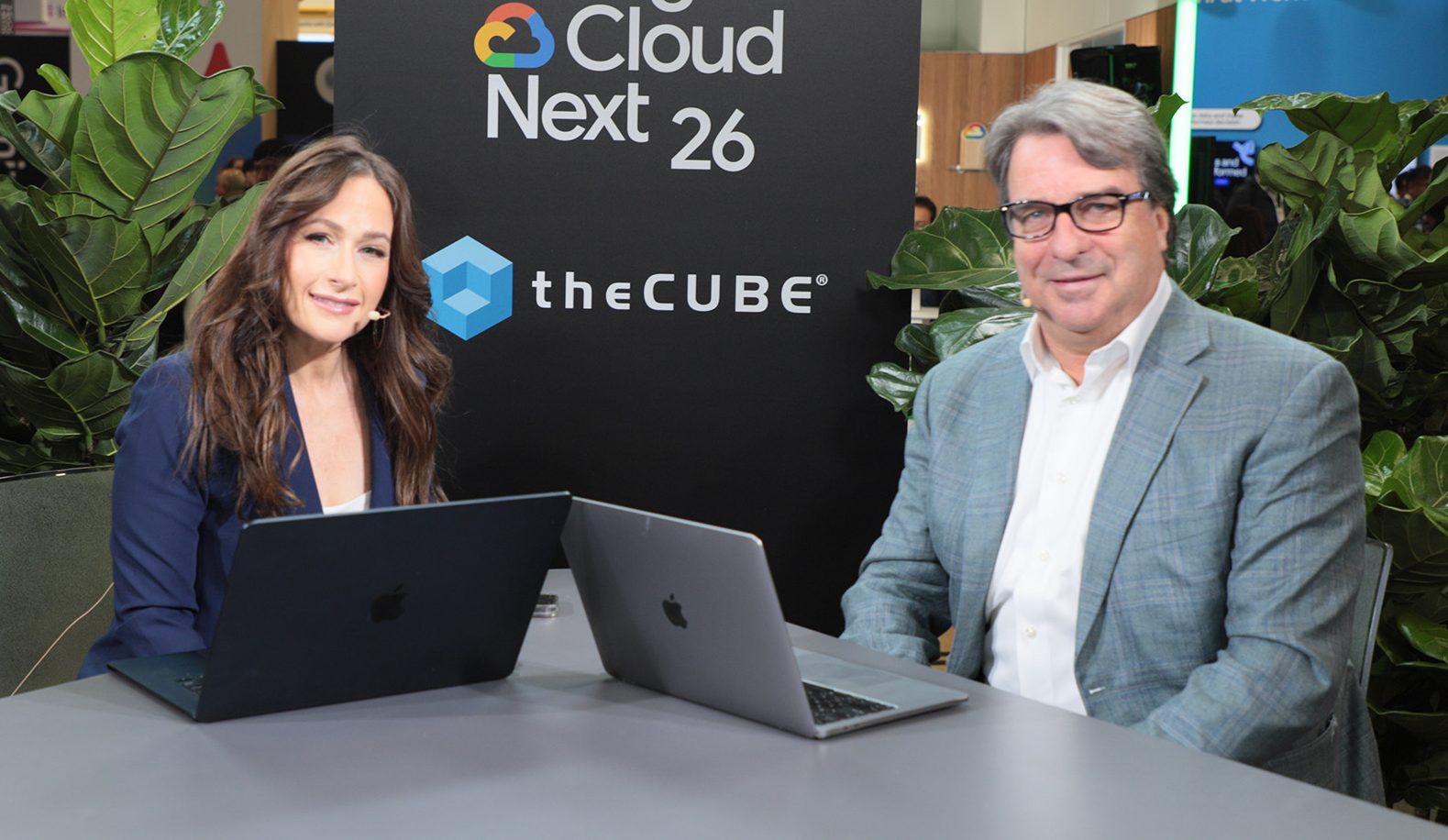
In this keynote preview from Google Cloud Next 2026, theCUBE's John Furrier and co-host Alison Kosik set the stage for three days of wall-to-wall coverage by dissecting Google's strategy to capture the AI control plane — the horizontal connectivity layer that routes data across systems and enables agents to operate at enterprise scale. Furrier frames Gemini not as a standalone model but as an orchestrator, evolving toward something closer to an AI operating system. He cites a Databricks milestone as a marker of how far the transformation has advanced: machines are now writing more code than humans.
The conversation also explores the competitive dynamics shaping the AI landscape, where model-level leapfrogging between Anthropic and OpenAI matters less than who owns the systems those models integrate with. Furrier argues that enterprise adoption — catalyzed first by AI-assisted coding and now being supercharged by agentic workflows — is the defining battleground at this event. The organizational stakes are equally significant: CFOs are shifting into operator roles, chief people officers are being drawn into AI workforce decisions, and tokens are emerging as a new enterprise currency. From Google's TPU investments to the agent ecosystem forming around Gemini, Furrier and Kosik outline what Google must prove this week and why winning the enterprise remains the decisive test of any AI platform's staying power.
Forgot Password
Almost there!
We just sent you a verification email. Please verify your account to gain access to
Google Cloud Next 2026. If you don’t think you received an email check your
spam folder.
In order to sign in, enter the email address you used to registered for the event. Once completed, you will receive an email with a verification link. Open the link to automatically sign into the site.
Register for Google Cloud Next 2026
Please fill out the information below. You will receive an email with a verification link confirming your registration. Click the link to automatically sign into the site.
You’re almost there!
We just sent you a verification email. Please click the verification button in the email. Once your email address is verified, you will have full access to all event content for Google Cloud Next 2026.
I want my badge and interests to be visible to all attendees.
Checking this box will display your presense on the attendees list, view your profile and allow other attendees to contact you via 1-1 chat. Read the Privacy Policy. At any time, you can choose to disable this preference.
Select your Interests!
add
Upload your photo
Uploading..
OR
Connect via Twitter
Connect via Linkedin
EDIT PASSWORD
Share
Forgot Password
Almost there!
We just sent you a verification email. Please verify your account to gain access to
Google Cloud Next 2026. If you don’t think you received an email check your
spam folder.
In order to sign in, enter the email address you used to registered for the event. Once completed, you will receive an email with a verification link. Open the link to automatically sign into the site.
Sign in to gain access to Google Cloud Next 2026
Please sign in with LinkedIn to continue to Google Cloud Next 2026. Signing in with LinkedIn ensures a professional environment.
Are you sure you want to remove access rights for this user?
Details
Manage Access
email address
Community Invitation
Keynote Analysis
This video provides live analysis of the Google Cloud Next 2026 keynote focusing on Gemini control plane strategy and enterprise implications for artificial intelligence, abbreviated AI. John Furrier of SiliconANGLE Media, Inc. and Alison Kosik of theCUBE present analysis and commentary based on theCUBE Research and event coverage. Furrier offers perspective on product and infrastructure competitiveness and they highlight Gemini as an orchestrator. Kosik moderates and they emphasize key research findings.
Key takeaways include Furrier's argument that owning the control plane and agents is strategically important for enterprise adoption. They assert that strong products and infrastructure exemplified by Gemini and tensor processing units abbreviated TPU determine competitiveness. theCUBE Research analysts observe organizational shifts as chief financial officers and chief people officers assume more operational roles and recommend preparing teams systems and token-based workflows for agent-driven enterprise transformation. The discussion also covers agentic AI AI-native applications machine-driven coding TPU deployments and competitive dynamics among cloud and model providers including NVIDIA Anthropic and OpenAI, offering practical factors to consider for enterprise planning and cloud strategy.
In this keynote preview from Google Cloud Next 2026, theCUBE's John Furrier and co-host Alison Kosik set the stage for three days of wall-to-wall coverage by dissecting Google's strategy to capture the AI control plane — the horizontal connectivity layer that routes data across systems and enables agents to operate at enterprise scale. Furrier frames Gemini not as a standalone model but as an orchestrator, evolving toward something closer to an AI operating system. He cites a Databricks milestone as a marker of how far the transformation has advanced: machine...Read more
John Furrier
Co-Founder & Co-CEOSiliconANGLE Media, Inc.
HOST
Dave Vellante
Co-Founder & Co-CEOSiliconANGLE Media, Inc.
HOST
Alison Kosik
HosttheCUBE
In this keynote preview from Google Cloud Next 2026, theCUBE's John Furrier and co-host Alison Kosik set the stage for three days of wall-to-wall coverage by dissecting Google's strategy to capture the AI control plane — the horizontal connectivity layer that routes data across systems and enables agents to operate at enterprise scale. Furrier frames Gemini not as a standalone model but as an orchestrator, evolving toward something closer to an AI operating system. He cites a Databricks milestone as a marker of how far the transformation has advanced: machine...Read more
exploreKeep Exploring
What is Google's main battleground in AI, and why does owning the "control plane" (agents/orchestration layer) matter?add
>> Welcome everyone to theCUBE. I'm John Furrier, your host, with Alison Kosik, here at Google Next 2026, three days of live coverage. A lot of action happening in the AI space from the bottom of the stack all the way to the top. Nvidia calls it the five layer cake. Everyone's talking about AI and agentic. We're seeing the beginning of the transformation. We have crossed the threshold. Alison, great to kick off the show with you. We got three days of wall to wall coverage. We've got Rebecca hosting in a booth behind us. theCUBE has got team coverage here. The analysts are getting all the data. We're extracting the signal.
Alison Kosik
>> I think you extracted into that article that you wrote about how Google's looking to take over, not to just be that control center for AI, right?
John Furrier
>> Yeah. I think Google's here to me is clearly the battleground is agents, the control plane. And I use that in the titles. It's kind of a jargon word, control plane. But I wanted to leave it in the title because the control plane is that horizontal layer that moves data around. And it connects to all the systems that have all this jargon databases and all the systems powering AI have to have this connectivity layer. Think of it like the main nerve center. It's like the backbone-
Alison Kosik
>> And the-...
John Furrier
>> spine of all the systems.
Alison Kosik
>> And whoever owns the control plane wins, right? And why is that?
John Furrier
>> Because you now have the ability to move data around and make the agents work across. Agents are coming. We're seeing that clearly here. Gemini is an orchestrator. That's like the person who's running the orchestra, Gemini. But then you've got all the new applications coming. AI native applications are real. And you're starting to see coding become almost done by agents, 100%. I saw Databricks set a stat that said that now they've crossed over more. Less humans coding than machines, so that's a major milestone. And we started at AWS. Gemini and all these tools, it's tools to an operating system, because it's all operating as one thing. Kind of like a human brain.
Alison Kosik
>> Yep.
John Furrier
>> You got front memory, you get the backend memory. You got all these new things playing out. We've never seen this before, and Google is making a hard run. And they have the technical chops and they have the history, they have the infrastructure.
Alison Kosik
>> The competition is really fierce now. The competition's hot, so how are they operating in that environment?
John Furrier
>> They're just making a better product. If you make a really good product, it'll work. Google was way behind in the cloud game years and years ago. Now they're pushing Gemini, which is a very strong product. And they have the TPU, the new chips. They got to deal with Nvidia. Nvidia's actively flexing here too with Google. They have all the parts and they've just been grinding it out and building out and building better product. And the better product wins. And if everyone's using it, you don't have to slap a logo on it.
Alison Kosik
>> I'm curious, who do you think so far is winning the race?
John Furrier
>> In the AI race? Well, the models are doing great. Anthropic and OpenAI, their product has gotten so much better in the past year. We were here last year talking OpenAI and Anthropic. Anthropic, in the past six months, have been leapfrogging OpenAI. OpenAI leapfrogs Anthropic. It's a constant game of leapfrogging on the model side. But as I pointed out in the article, all the enterprises and all the real action is not what the models, it's what the models are interfacing with. Those are the systems. That's what's happening.
Alison Kosik
>> Right. All right. What do we expect to happen here today? What are we going to have on set?
John Furrier
>> We're going to have the ecosystem come through. We're going to hear from practitioners. We're going to hear from suppliers. We're going to hear from ecosystem partners of Google, and hear from Google themselves on what they think the future will be. They probably won't be as blunt as me saying it's a new battleground and it's a war. But at the end of the day, it's going to come down to who can capture the enterprise adoption. The enterprise adoption is on the table for the first time we've seen AI. We've seen adoption with search. We saw some adoption with some marketing stuff. But coding made a big dent in the enterprise, and that was a huge milestone. Now that agents are coming, coding and agents together are going to create massive value for the enterprise.
Alison Kosik
>> How do any of these companies win the enterprise adoption?
John Furrier
>> They got to change their mindset. It's a whole nother mindset how they operate. We're seeing the role of the C-suite, the CFO is becoming more of an operator. And if agents are going to be workers, HR is involved, so the chief people officer's involved. Tokens are out there. You have a new currency going on with tokens. And that's changing the organizational structures, that's changing how people are organizing their teams, that's changing how the people work. It's a complete reset in the corporate world.
Alison Kosik
>> Yeah. Yeah. All right.
John Furrier
>> We're going to continue to cover it here on theCUBE. Again, we're going to kick off day one. I'm Alison Kosik, be right back after this short break.