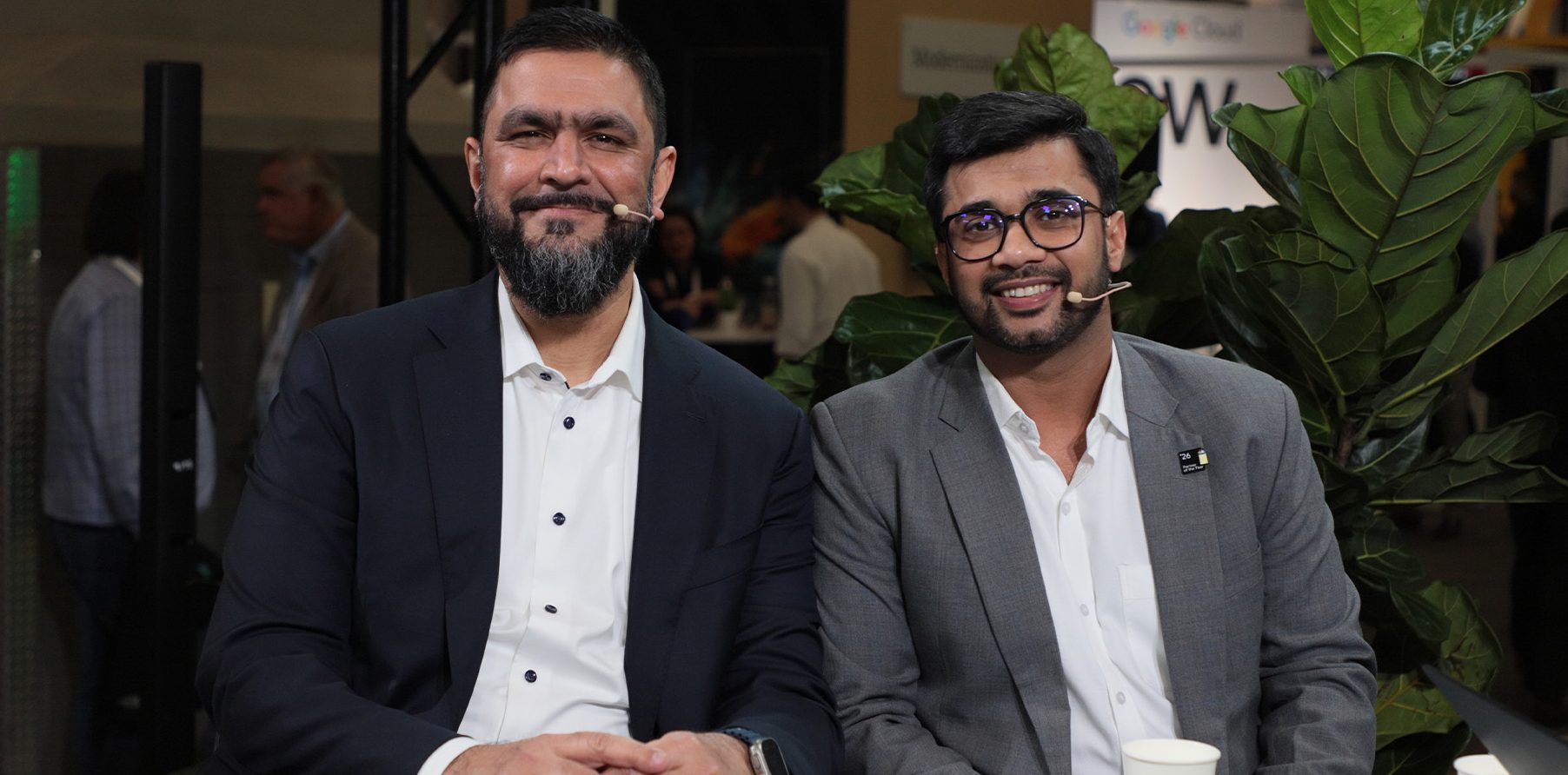
In this interview from Google Cloud Next 2026, Fawad Shaikh, global vice president of business development at TELUS Health, joins Saurabh Mishra, global head of Google Cloud business at Quantiphi, to talk with theCUBE's John Furrier and co-host Alison Kosik about dismantling healthcare's legacy data silos to build a foundation for AI-native operations. Shaikh describes how the industry's tolerance for fragmented data has hit a breaking point — driven by COVID-era lessons and new regulatory mandates including FHIR data-sharing standards from CMS and provincial legislation in Canada. He details how TELUS Health's acquisition-led growth of roughly a dozen companies in five years compounded the challenge, demanding a disciplined unification strategy built on master data management, metadata governance and purpose-built ingestion pipelines. Mishra explains how Quantiphi's Codeaira AI platform automated legacy code migration, enabling the team to operate at a pace traditional engineering alone could not sustain.
The conversation also explores the tangible ROI that emerges once data foundations are secure. Shaikh points to a flagship result: consolidating 11 data sources into a single automated report cut generation time by 80%, saving roughly 15 hours per agent per year. Two AI use cases illustrate the broader potential — automated patient-document matching for e-fax referrals that cut processing burden in half, and a reusable microservice that eliminated a third-party payment processor entirely. Mishra introduces the "launchpad mindset," arguing that enterprises racing to deploy AI agents without first solving their data challenge are skipping the hard part. He advocates for building reusable data products — purpose-built segments aligned to specific business problems like provider performance or employee productivity — as the scalable sandbox on which agents can reason reliably rather than retrieve blindly. From combining top-down leadership alignment with grassroots innovation to rallying an entire organization around a single data mission, both guests provide a practical roadmap for healthcare and enterprise leaders navigating the tension between core modernization and scaling new intelligence.
Forgot Password
Almost there!
We just sent you a verification email. Please verify your account to gain access to
Google Cloud Next 2026. If you don’t think you received an email check your
spam folder.
In order to sign in, enter the email address you used to registered for the event. Once completed, you will receive an email with a verification link. Open the link to automatically sign into the site.
Register for Google Cloud Next 2026
Please fill out the information below. You will receive an email with a verification link confirming your registration. Click the link to automatically sign into the site.
You’re almost there!
We just sent you a verification email. Please click the verification button in the email. Once your email address is verified, you will have full access to all event content for Google Cloud Next 2026.
I want my badge and interests to be visible to all attendees.
Checking this box will display your presense on the attendees list, view your profile and allow other attendees to contact you via 1-1 chat. Read the Privacy Policy. At any time, you can choose to disable this preference.
Select your Interests!
add
Upload your photo
Uploading..
OR
Connect via Twitter
Connect via Linkedin
EDIT PASSWORD
Share
Forgot Password
Almost there!
We just sent you a verification email. Please verify your account to gain access to
Google Cloud Next 2026. If you don’t think you received an email check your
spam folder.
In order to sign in, enter the email address you used to registered for the event. Once completed, you will receive an email with a verification link. Open the link to automatically sign into the site.
Sign in to gain access to Google Cloud Next 2026
Please sign in with LinkedIn to continue to Google Cloud Next 2026. Signing in with LinkedIn ensures a professional environment.
Are you sure you want to remove access rights for this user?
Details
Manage Access
email address
Community Invitation
Fawad Shaikh, TELUS Health & Saurabh Mishra, Quantiphi
In this interview from Google Cloud Next 2026, Fawad Shaikh, global vice president of business development at TELUS Health, joins Saurabh Mishra, global head of Google Cloud business at Quantiphi, to talk with theCUBE's John Furrier and co-host Alison Kosik about dismantling healthcare's legacy data silos to build a foundation for AI-native operations. Shaikh describes how the industry's tolerance for fragmented data has hit a breaking point — driven by COVID-era lessons and new regulatory mandates including FHIR data-sharing standards from CMS and provincial legislation in Canada. He details how TELUS Health's acquisition-led growth of roughly a dozen companies in five years compounded the challenge, demanding a disciplined unification strategy built on master data management, metadata governance and purpose-built ingestion pipelines. Mishra explains how Quantiphi's Codeaira AI platform automated legacy code migration, enabling the team to operate at a pace traditional engineering alone could not sustain.
The conversation also explores the tangible ROI that emerges once data foundations are secure. Shaikh points to a flagship result: consolidating 11 data sources into a single automated report cut generation time by 80%, saving roughly 15 hours per agent per year. Two AI use cases illustrate the broader potential — automated patient-document matching for e-fax referrals that cut processing burden in half, and a reusable microservice that eliminated a third-party payment processor entirely. Mishra introduces the "launchpad mindset," arguing that enterprises racing to deploy AI agents without first solving their data challenge are skipping the hard part. He advocates for building reusable data products — purpose-built segments aligned to specific business problems like provider performance or employee productivity — as the scalable sandbox on which agents can reason reliably rather than retrieve blindly. From combining top-down leadership alignment with grassroots innovation to rallying an entire organization around a single data mission, both guests provide a practical roadmap for healthcare and enterprise leaders navigating the tension between core modernization and scaling new intelligence.
Fawad Shaikh, TELUS Health & Saurabh Mishra, Quantiphi
Saurabh Mishra
Global Leader - Google Cloud BusinessQuantiphi
Fawad Shaikh
GM, Health Data OfficeTELUS Health
In this interview from Google Cloud Next 2026, Fawad Shaikh, global vice president of business development at TELUS Health, joins Saurabh Mishra, global head of Google Cloud business at Quantiphi, to talk with theCUBE's John Furrier and co-host Alison Kosik about dismantling healthcare's legacy data silos to build a foundation for AI-native operations. Shaikh describes how the industry's tolerance for fragmented data has hit a breaking point — driven by COVID-era lessons and new regulatory mandates including FHIR data-sharing standards from CMS and provincial...Read more
exploreKeep Exploring
How are data silos in healthcare changing, and what is TELUS doing to enable better data sharing and outcomes?add
How should data consolidation be approached when building a platform like TELUS Health, and what key capabilities are required?add
What approach should organizations take to develop a successful generative AI strategy, and how does a data-first "launchpad mindset" (as used at TELUS Health) contribute?add
How are you leveraging your data platform and AI agents to automate workflows, increase productivity, and improve patient care (can you give specific examples)?add
Fawad Shaikh, TELUS Health & Saurabh Mishra, Quantiphi
search
Alison Kosik
>> Welcome back to Google Cloud Next 26. We are streaming live here in Las Vegas. I'm Alison Kosik, joined alongside by John Furrier, and we are talking about data readiness.
John Furrier
>> Yeah, I mean, I think data is critical today. We've seen that. All the conversations in this event with the full stack brings it into picture and really highlights the end of, we hope, for data silos. And that's the number one thing that comes in. And of course, when you're crossing boundaries, agents need to be smart and adding intelligence to them is going to make the game change significantly. It's next segment. We'll unpack all that.
Alison Kosik
>> Yeah. Let's open up the conversation. We've got Fawad Shaikh. He's the general manager of Health Data Office TELUS Health. Welcome to The Cube.
Fawad Shaikh
>> Thank you, Allison.
Alison Kosik
>> And Saurabh Mishra, thanks for joining The Cube, global head Google Cloud business Quantiphi. Thanks for joining The Cube.
Saurabh Mishra
>> Thank you.
Alison Kosik
>> So first question for you Fawad, you were just mentioning silos. We've seen healthcare traditionally kind of operate in silos. Payers, providers, employers, consumers are all sitting in these fragmented data sets. As of this year, what's fundamentally changing in this industry and why is this the right moment for TELUS Health?
Fawad Shaikh
>> So first of all, thank you, Allison and John for inviting me to be here. Really stoked, as my kids would say. But I think you characterize the term properly, data silos. It's something that in the healthcare system you typically expected as a cost of doing business. I've talked to health providers over probably 35 different countries, and the problem universally manifests. I think what's changing in 2026 is that that's no longer acceptable. You seen the hard lessons we've learned through COVID, and it's basically puts an ecosystem at its knees when you have those data silos that you have to work with. So I think there's some external forces that are now starting to work with us to start to really enable and support the sharing of data. I think one of those is around legislation. So they're now encumbering, for example, the promotion of how to share data from within the ecosystem responsibly and with privacy. We've seen that leadership in Canada, for example, in Nova Scotia where they've passed legislation so that the citizens can actually access their data through their mobile app and we've been a part of helping that make that happen. And the other thing is that we're just seeing a proliferation of standards, like in the CMS passing the FHIR standard to be able to share data more readily. So for TELUS though, it hasn't been about at all about a technology change. It's really about what our customers are looking for and they're looking for better health outcomes and they're looking for providers to be de-burdened, if you will, around entering data and being able to access data through a lot of friction. So for us, it's a real important change for us to be able to-
John Furrier
>> What's the change? What's been the change in the ecosystem specifically? Because the role of the ecosystem is super important when you have these vertically integrated stacks with a lot of horizontal scale and agents are coming in over the top. The roles change. Compare the old way to the new way. What was broken? What gets fixed? What was in place? What gets abstracted away? Where's that value?
Fawad Shaikh
>> It's a great question, John. And I think fundamentally healthcare likes to look at a patient from each of their own specialist lens. And that's really important because it provides that specialty care that you need to have. But like I said, it's no longer acceptable to... It's still the same patient at the end of the day, right? They're still connected to all these different care requirements that they need to have. So I think that what's really fundamentally changed is the ability for us to actually share data across different silos.
John Furrier
>> So I talk about the consolidation of data because consolidations may not be a bad thing when you have now opportunities with agents, but there's still challenges. Regulation enables some change in the ecosystem. Governance is super important. Guys, talk about this concept because consolidation, I guess, meant a few years ago, four or five years ago, throw out a data lake.
Fawad Shaikh
>> Yeah.
John Furrier
>> We're done.
Fawad Shaikh
>> Yeah.
John Furrier
>> And then interrogate the data lake. Now it's a fabric. They got the lakehouse here. How does this view of data play into this?
Saurabh Mishra
>> That's actually a very good question, John. And I will talk about this entire concept of consolidation of data in context of what we did for TELUS Health. So when TELUS Health came up with this entire business problem around building a platform that can enable a lot of different types of agent, what we realized that it's not just a data consolidation or a data migration project as we used to do earlier. This is more like building a new nervous system for a global healthcare platform, right? So that's how we thought about it. So when we are thinking about a project of this nature, there are three critical elements that come into play. The first aspect is around deep understanding about the data foundation expertise. The second aspect is around advanced platform engineering expertise. And the third, which is the most important, in case of healthcare customers like TELUS Health, is understanding the healthcare ecosystem, because you can't build a healthcare solution without understanding the nuances of PHI, right? Or how the complex, the claims processes, or just more importantly, the criticality of the provider ecosystem in general, right? Now, when we talk about the data consolidation and when we are talking about multiple use cases or multiple sources of data, large amounts of data coming in, it generally takes many years for companies to complete such engagements. But in case of TELUS Health, we had our secret weapon called Codeaira. It's our AI platform for software engineering. Using Codeaira, we are able to, I would say, automate the migration of legacy code, a lot of different data pipelines, and we are able to basically move at the velocity that traditional engineering could not support, especially in context of TELUS Health. Again, when we have to move fast and do it in a secure way, having platforms that leverage AI coding or AI platforms basically really play a big role.
John Furrier
>> Right. Talk about this concept, you mentioned you guys are doing this. Consolidation is the first step, almost a step back to step forward. Scale is huge. You're global.
Saurabh Mishra
>> Yeah.
John Furrier
>> Okay? But also the word that's been most talked about on The Cube, at least...
Saurabh Mishra
>> Yeah.
John Furrier
>> Well, it's not from me, but the guests. I say computer science and operating systems the most word. Unification is the word, right? So how do you take the consolidation as a precursor to full unification and scale? Take us through that in your mind, frame that and scope what you guys did.
Fawad Shaikh
>> Yeah. So unification means really has a very specific meaning in TELUS Health. So one of the things you need to know about TELUS Health is over the last five years, we've gotten about a dozen acquisitions. So we've inherited... Every time you buy a new company, we inherit a new legacy system, a new data silo.
John Furrier
>> Migrations and you're teasing it up right there, connecting the dots in real time.
Fawad Shaikh
>> Yeah, that's it. Exactly right. So that's where unification for us means... Some of the mundane things get left behind when you're looking at doing an integration organizational change to go to market changes, but simple things like reporting and getting a handle on your visibility of your business across the entire organization really becomes important in terms of unification.
John Furrier
>> Different semantics on forms, data pipelines you're inheriting...
Fawad Shaikh
>> And it's compounded by the fact that we're in 200 different countries so that same customer can be across borders, can have different service disciplines. And so you got to be able to establish the language and the definition of-
John Furrier
>> How did you tackle that problem? Take us through that, because I think we see this a lot, whether it's M&A or just re-engineering the platforms.
Fawad Shaikh
>> Yeah. So you know what we did was actually, we started very modest with a very simple use case, just be able to do reporting, for example. But what we did was we started to consolidate all the data into one place. We leveraged things like master data management, metadata management. We actually established a discipline on how to be able to do ingestion really efficiently with the help of partners like Quantiphi to be able to do that repeatedly and was at scale. And so that even meant sometimes building pre-automation connectors to build our data pipelines more efficiently. And I think the biggest key to our success, John, was really dedicating a team, taking the investment to actually dedicate team that did this only as a full-time focus, and that paid huge dividends.
John Furrier
>> The quantification comes up a lot, quantifying the value.
Fawad Shaikh
>> Right.
John Furrier
>> Not to be confused with quantify, but when you have these projects, you got to show the business results. Any thoughts on strategies there? I mean, obviously M&A is an easy one because you got to integrate. That's a milestone. Is there anything beyond that that you guys have seen, because this is a number one issue we're talking about this year, not the strategy risk of AI that everyone knows, infuse AI and everything, it's the execution.
Fawad Shaikh
>> So I think again, a really easy one to point at that I like to... Is when we started modestly on our customer reporting, what we saw is that it used to take 11 data sources and be able to process that manually. We were able to create all one report and apply a lot of automation to it. So we were actually able to reduce the amount of time it takes to generate a customer report by 80%. That translates to about 15 hours per agent per year. So that's a real quantifiable benefit to the business, let alone the delight to the customers. I don't know. Sorry, if you have any other...
Saurabh Mishra
>> Similar to what Fawad just talked about, right? When we are basically doing any AI projects, we establish what the business use case is going to be because some AI use cases or agents are expected to either increase the top line or the bottom line. We are very clearly demarcating what the impact is going to be. So we put together a business case and then once the agents are in production, the adoption starts to happen. We basically measure against the baseline that we have said, because that basically determines whether the projects are successful or not. And that's the real value that businesses get of enabling technology.
Alison Kosik
>> How do you architecture today to ensure that it's sort of future proof then?
Saurabh Mishra
>> So that's actually a very million-dollar question, right? Because in today's world, when the technology is evolving so fast, we don't want to build something that goes absolute the next time a new model or a new feature is launched by likes of Google. So I'll just take an example of, again, TELUS Health as we are talking about with here, right? The approach that we basically took is what I like to call launchpad mindset, right? Where what we made sure is we are getting the data right, because most companies basically try to skip the step around data and jump into the AI bandwagon, start building the AI roadmap. But for a good Gen AI strategy, having a more rock solid data strategy is an essential element. If you handle your data challenge first, you are ensuring you are solving the hard problem of the unification aspect, the governance aspect, the quality aspects, and that basically makes sure you have a foundation on which everything else is built on. And then from there on, you basically make sure that this is scalable by building your reusable data models. And if you build reusable data models and data products across your data layer, then what you're basically doing is you're creating a more safe and scalable sandbox for your AI. And on those sandbox, you are able to build AI agents that are able to once solve self reporting use cases and other use cases that basically cater to both horizontal and vertical usage.
John Furrier
>> Define for us what reusable data models means, because that's an important concept here. Can you expand a little bit more on what that means?
Saurabh Mishra
>> Sure, definitely. So in the previous ways when we were used to basically build data lakes, we used to put all the data together, had data lakes, which would be large, messy, et cetera. Now what we are doing is we are basically creating slivers of data which are catering to a specific unit or a specific business problem. Like for example, in case of healthcare, what we did was we created healthcare segments that are either catering to either the provider performance or employee productivity. So those data products are created for a specific use case, having the right ontology. So we are able to basically reuse them for different types of use cases.
John Furrier
>> How's that working out? Because I think with agents, if you have intelligence, the assumption is it's intelligent, but it's not a search query. You're not finding something and reporting it, you're reasoning, which means memory, means you know what the intent is, you got some context. This is what they were talking about on the main stage today.
Saurabh Mishra
>> That's right.
John Furrier
>> Your thoughts on this because it's huge.
Fawad Shaikh
>> It's actually really cool. Now that we're at a stage where we've actually got our data in a place where we can actually leverage it to train some of these AI agents, the use cases are just exploding. I'll give you two examples that really come to mind. So we've all been in a doctor's office where you've got these E-faxes coming into the inbox, you've got all these document attachments and you're trying to get a referral built up. And so what we did was take that inbox, structure it in a specific way, apply some machine learning algorithms, and we were able to match the patients automatically to the documents that were coming in and be able to build the profile if they didn't exist. That reduces the burden of processing that by a half. That's pretty significant.
John Furrier
>> That's huge productivity.
Fawad Shaikh
>> Huge productivity.
John Furrier
>> And value to the consumer, in this case, the patient.
Fawad Shaikh
>> And the second term-
John Furrier
>> The care goes up.
Fawad Shaikh
>> That's it. And the second example is taking that same methodology, building off the microservice that we built on our data platform, and then apply that in a completely different area of the business where, for example, our provider customers actually often have to upload direct deposit forms or void checks to be able to get paid. So we were able to apply the same kind of microservice capabilities and be able to process payments without actually any intervention. And so we were able to completely eliminate a third party service provider to be able to do that by ourselves.
John Furrier
>> So more efficient process in better care-
Fawad Shaikh
>> And reusability.
John Furrier
>> Reusability. Okay. So I wanted to get that out there because a lot of these agents are just search recovery. It's a search paradigm.
Fawad Shaikh
>> That's right.
John Furrier
>> Okay, you got the answer, but it's not the right answer. It's the first answer they find.
Saurabh Mishra
>> Yeah, it's the first answer they find.
John Furrier
>> Yeah. Okay. Well, you don't know. Quality comes into play.
Saurabh Mishra
>> Yes. And that's why basically making sure we give the right context and have the right guardrails in terms of how we are building the agents become very important because then the agents and the models don't hallucinate and give you the right information that you're looking for.
Alison Kosik
>> All right. So questions to both of you. For other healthcare and enterprise leaders watching who want to embark on a similar journey, what is the one piece of advice you want to offer to ensure that they can successfully navigate the tension between core modernization and scaling new intelligence? Fawad, you go first.
Fawad Shaikh
>> I'll go first. So what comes to mind to me, Allison, is actually a very simple thing that I learned along the way that I think is actually quite profound and at the same time probably applies to most organizational contexts. And that is this idea of doing a top down approach and being leadership led and directed, and at the same time, creating a grassroots level of innovation so that you can actually lease the technology in all areas of your business. What do I mean by that? On the leadership side, we see through conferences like this, the data and AI has to be a conversation at the leadership table and it's the responsibility for them to direct where are the most impactful areas of the business. And in fact, some of the areas that might be the most disrupted. So it's important for them to not only just govern where the direction of the technology is being deployed, but also make sure that in the healthcare context, you're not opening yourself up to unnecessary risk or misuse. So on the grassroots side, you want everybody to be able to access the technology, talk about the technology, and create these birds of a feather capabilities so they can make faster decisions and be able to automate the tasks that they have to do their job more efficiently. And finally, rally the entire organization around a single data mission, because when you get that, you start to see the speed and the intelligence, and that's very addictive and very attractive.
Alison Kosik
>> Yeah. What are your thoughts?
Saurabh Mishra
>> So I'll just build onto what Fawad said. My first word of advice would be that a lot of companies basically start solving point AI, or let's say they start building point solutions for AI applications. I will suggest that they should stall their data challenges first because that's the launch... I'd say that's the right launchpad and have that mindset. So instead of going after one AI application at a time, think about platform or an ecosystem approach similar to how TELUS Health team thought about it because the way we build the TELUS Health platform, if the customers do that in the same way, instead of resisting change, they will be thriving on the change. So that will be the one advice that I will give. Think about solving the data challenges first.
John Furrier
>> Well, guys, great insights. Really appreciate you coming on and sharing the examples and also the strategy of the success you've had. And great to have The Cube in your booth and really The Cube over at Quantiphi's booth. A lot of good content coming out of there. So thanks for partnering and thanks for coming on The Cube.
Fawad Shaikh
>> Thank you very much.
Saurabh Mishra
>> Thank you, John. Thank you, Alison.
Alison Kosik
>> Fantastic conversation. Thanks. And you've been watching The Cube, the leader in live technology coverage. We'll be right back.



















 Alison Kosik
 John Furrier