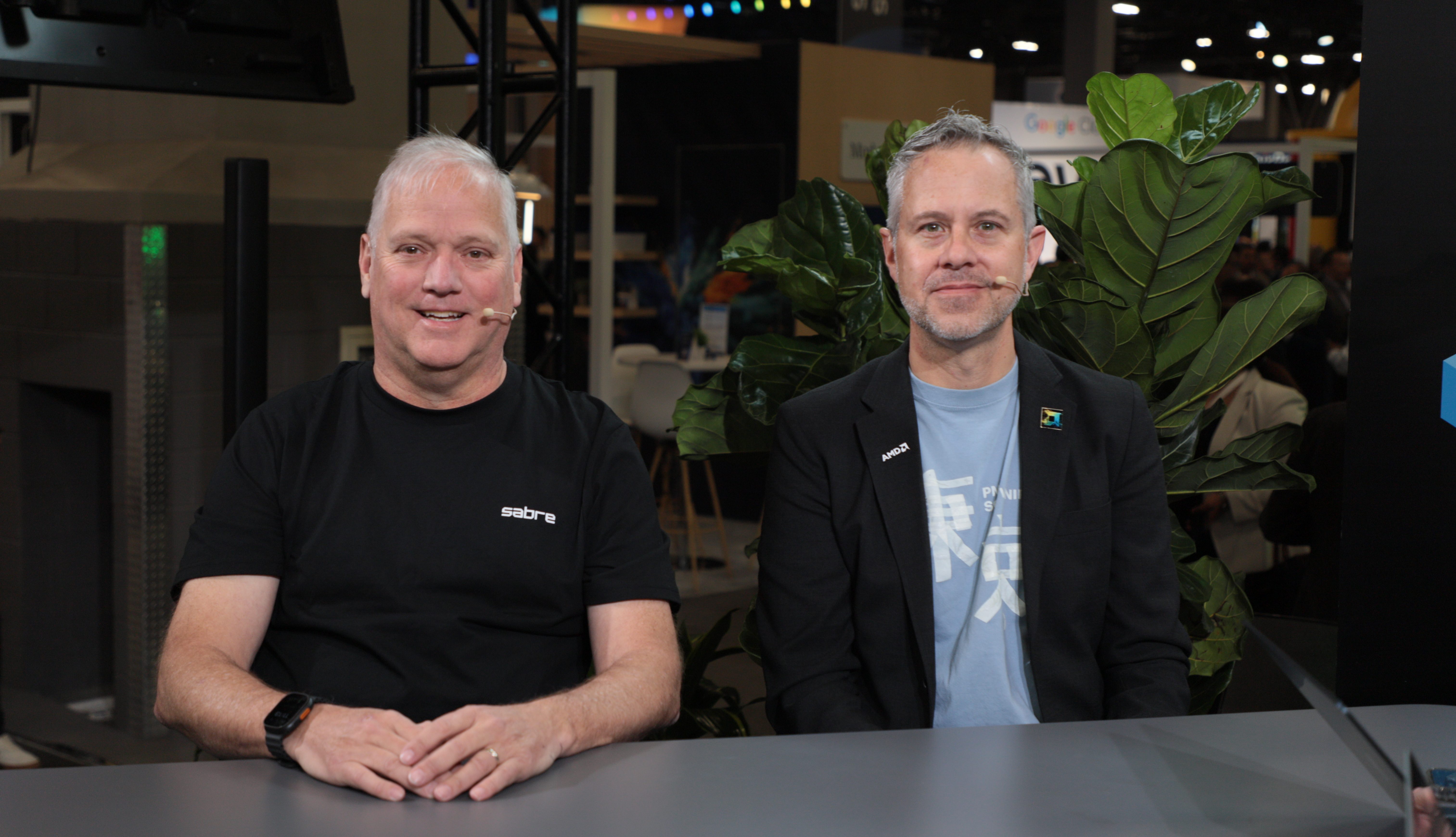
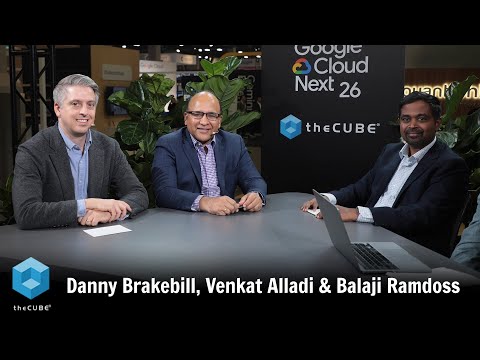
In this interview from Google Cloud Next 2026, Mike Thompson, director of cloud product at AMD, joins Tim McArdle, senior principal of FinOps at Sabre, to talk with theCUBE's John Furrier and co-host Alison Kosik about how compute efficiency and strategic cloud migration are freeing up budget to fund the next wave of AI innovation. Thompson points to the industry-wide shift from model training to inference as the defining compute trend of 2026, noting that surging demand is exposing a long-overlooked problem: many enterprises run servers at only 10% utilization. McArdle illustrates the opportunity firsthand — Sabre migrated a massive CPU-intensive workload to AMD instances on Google Cloud with zero code changes, achieving a smaller footprint, faster performance and immediate cost savings, all while scaling to over 50,000 vCPUs.
The conversation also explores how those infrastructure savings are being reinvested directly into agentic AI development at Sabre, which has moved 99% of its compute capacity to Google Cloud. Thompson details how migrating general-purpose workloads to AMD typically drives 30 to 50% OpEx savings — headroom that enterprises can redirect toward new AI applications without waiting for budget cycles to reset. Both guests make the case for x86-based containerization as the foundation of a resilient hybrid cloud, highlighting its portability advantage over multi-architecture environments. McArdle underscores the cultural dimension of modernization, noting that the real barrier is not learning new technology fast enough — it's letting go of established ways of working. From decades of on-premise legacy infrastructure at Sabre to the emerging discipline of AI FinOps, the conversation maps a practical path for enterprises looking to optimize existing budgets while competing in an increasingly AI-native world.
Forgot Password
Almost there!
We just sent you a verification email. Please verify your account to gain access to
Google Cloud Next 2026. If you don’t think you received an email check your
spam folder.
In order to sign in, enter the email address you used to registered for the event. Once completed, you will receive an email with a verification link. Open the link to automatically sign into the site.
Register for Google Cloud Next 2026
Please fill out the information below. You will receive an email with a verification link confirming your registration. Click the link to automatically sign into the site.
You’re almost there!
We just sent you a verification email. Please click the verification button in the email. Once your email address is verified, you will have full access to all event content for Google Cloud Next 2026.
I want my badge and interests to be visible to all attendees.
Checking this box will display your presense on the attendees list, view your profile and allow other attendees to contact you via 1-1 chat. Read the Privacy Policy. At any time, you can choose to disable this preference.
Select your Interests!
add
Upload your photo
Uploading..
OR
Connect via Twitter
Connect via Linkedin
EDIT PASSWORD
Share
Forgot Password
Almost there!
We just sent you a verification email. Please verify your account to gain access to
Google Cloud Next 2026. If you don’t think you received an email check your
spam folder.
In order to sign in, enter the email address you used to registered for the event. Once completed, you will receive an email with a verification link. Open the link to automatically sign into the site.
Sign in to gain access to Google Cloud Next 2026
Please sign in with LinkedIn to continue to Google Cloud Next 2026. Signing in with LinkedIn ensures a professional environment.
Are you sure you want to remove access rights for this user?
Details
Manage Access
email address
Community Invitation
Mike Thompson, AMD & Tim McArdle, Sabre
Mike Thompson of AMD is director of cloud products and go-to-market. Tim McArdle of Sabre is senior principal of financial operations, FinOps. They join theCUBE Research at Google Cloud Next 2026 with hosts Alison Kosik and John Furrier for a focused discussion on artificial intelligence, AI, infrastructure, hybrid cloud modernization and cloud cost optimization.
Thompson highlights that the shift from training to inference increases compute demand and intensifies the emphasis on efficiency. They note x86-based AMD deployments reduce fleet size and deliver 30–50% operational expenditure savings. McArdle reports Sabre's migration to AMD hardware yields performance gains with zero code changes and enables scalable FinOps practices that support reinvestment into agentic AI initiatives. The conversation examines AMD's collaboration with Google Cloud, containerization and Google Kubernetes Engine, GKE, adoption, hybrid deployment patterns and how platform choices affect performance availability and operational agility for enterprise workloads.
play_circle_outlineHere are three headline options (each ≤20 words):
1) "AI Peak Demand Forces Extreme Efficiency as Many Servers Sit at ~10% Utilization"
2) "Chasing Compute: Extreme Efficiency Strategies Amid Widespread 10% Server Utilization"
3) "Wasted Capacity: Servers at 10% Utilization Spotlight Need for Efficiency During AI Peaks
replyShare Clip
play_circle_outlineFinOps Imperative: AI Token Costs Soar; Sabre Slashes Spend by Migrating to AMD with Zero Code Changes
replyShare Clip
play_circle_outlineAMD Joins FinOps Foundation to Drive Cost-Efficient Edge and Hyperconverged Platforms, Freeing OpEx for AI
replyShare Clip
play_circle_outlineGoogle Cloud's enterprise growth powered by AI (Gemini) and high-performance infrastructure.
Director of Cloud Product, FinOps Foundation Governing BoardAMD
In this interview from Google Cloud Next 2026, Mike Thompson, director of cloud product at AMD, joins Tim McArdle, senior principal of FinOps at Sabre, to talk with theCUBE's John Furrier and co-host Alison Kosik about how compute efficiency and strategic cloud migration are freeing up budget to fund the next wave of AI innovation. Thompson points to the industry-wide shift from model training to inference as the defining compute trend of 2026, noting that surging demand is exposing a long-overlooked problem: many enterprises run servers at only 10% utilizati...Read more
exploreKeep Exploring
How has the shift from AI model training to inference — and the resulting surge in compute demand — changed your business/industry and operations?add
How are you approaching FinOps to manage rapidly growing data and AI-related costs, and what specific measures or successes (for example infrastructure changes) can you share?add
How should enterprises adapt their compute infrastructure and FinOps practices to control rising AI inference costs — deciding when GPUs are necessary versus using general-purpose CPUs (e.g., AMD), and how to allocate fixed budgets across cloud and edge deployments?add
How does the AMD–Google Cloud partnership influence server performance and energy efficiency, and what are the implications for FinOps, infrastructure management, and enterprise adoption (including hybrid cloud) of Google Cloud?add
>> Welcome back to Google Cloud Next26. I'm Alison Kosik, alongside John Furrier. We've got a great lineup right now of interviews. Our first is with Mike Thompson, Director of Cloud Product with AMD. Welcome.
Mike Thompson
>> Thanks.
Alison Kosik
>> And Tim McArdle, Senior Principal of FinOps. And you're an engineer there at Sabre. Welcome to The Cube. Let me start out, Mike, by coming to you first. So before we get to the event and the progress of AI, update us on AMD and the Google partnership.
Mike Thompson
>> Yeah. So AMD and Google Cloud have been working together for many generations, four generations of AMD's products. We collaborate really, really closely together on server design in order to help make sure that the products that Google are bringing to market have leading performance, great cost efficiency and high availability. So we've worked together for multiple generations to bring those products to Google's end customers.
Alison Kosik
>> Talk us through what Sabre does for those who don't know.
Mike Thompson
>> Sabre is really the technological backbone of the travel industry. We have a massive marketplace that brings travel suppliers to a vast array of travel buyers. If you've booked a flight on any airline, on the background you've probably used Sabre technology.
John Furrier
>> I've been using the word "operating system" in a lot of my posts lately because this year is about operating systems. You guys are the operating system for all the flights.>> Yeah.
John Furrier
>> So you guys have a huge backend operation.>> Yes.
John Furrier
>> And it's historic. And this year though, this conversation is all about bridging that transformation. I want to get into that because the theme here is, this is not just tooling anymore. This is operating system, large scale systems. You're a big part of it at the AI infrastructure level and certainly servers, large scale systems, the game has changed. I'd love to get your guys' reaction to this. And we'll get into the FinOps stuff because I think that's going to be a really important conversation as well as when you look at tokens. But explain to us in your mind, what's the biggest change this year and how does this bridge this transformation of bringing these systems up to new capabilities?
Mike Thompson
>> So yeah, good question. Well, there's a couple, but the biggest change this year that I see is simply demand for compute because AI, especially for inference, is becoming more prevalent. We spent years training the model. That's what drove a lot of the economy for the last three, four, five years. Now we have those models ready to take to market so that people can actually use them. So we're moving from training to inference. And that is creating a huge increase in demand for compute in the cloud and on premise. There's some challenges in the market right now around memory, being able to get committed supply in a reasonable timeframe. And so there's a tremendous increase in the amount of demand for compute. And I think actually some of the ways that Sabre, who I would say they're the backbone of the travel industry. If you've booked travel, you've probably used their platform. Having talked to dozens and dozens, probably hundreds of customers, looking at the efficiency of their compute, in many cases, they're only using their servers at about 10% utilization. So 90% of the time it's sitting around idle. So at times like that, when we have really, really high demand, the trend that I see emerging out of that challenge is an extreme focus on efficiency. So be able to get access to the compute. Whereas previously, a lot of the focus would have been just optimizing the cost that it takes to rent or buy servers and equipment in order to be able to run all those applications.
John Furrier
>> Yeah. Tim, the demand he's talking about is coming from people writing software, AI apps, because of the tokens and all the action. How has that changed your world? Because you got this utilization challenge. Virtualization was great. Now you got Kubernetes and you got containers playing a really key role in this next level step function. What's your take on all this?>> So scaling is a real issue. Our traffic demand spikes so wildly and scaling up to meet that demand without affecting the response time of our customers is really critical.
John Furrier
>> Talk about that journey. Take us through the life, a day in the life or weeks in the life, your role, because modernization used to have a nice path. Now the path has gotten wide, a lot more capabilities. Just take us through what that looks like today. What does that cloud modernization journey look like?>> Yeah. We've upgraded substantially and the pace of the modernization is so much faster. The scale of releases of software is... We used to have once a month, now it's multiple times a month. And then like Kubernetes, we're moving a lot of workloads to GKE and it's really exciting, I think, at this time.
John Furrier
>> Mike, take us through the-
Mike Thompson
>> Can I take a crack at that as well?
John Furrier
>> Yeah. Yeah, yeah. Definitely.
Mike Thompson
>> Specifically around containerization, I see it becoming really critical because most of the enterprise and larger customers that I see out there, some of them are digital natives, but a lot of them are running on premise in their own real estate, running their servers in their own real estate, but also running in cloud. We call that hybrid. One of the main barriers to running an efficient hybrid ecosystem or hybrid infrastructure is the ability to seamlessly move between whatever you're running on prem, like the servers you guys might have on prem, and being able to spill that over into cloud is ease of that migration. When you're running containers, that's one of the things that makes it easy. You have a container, it contains everything you need, you can drop it in. Particularly for cases where customers are looking for cost efficiency, there's some other offerings out on the market right now. Basically you have x86 versus ARM. It's really hard to run a hybrid environment with containers on ARM because generally those servers aren't available on prem. So I see containers being leveraged specifically on x86 because of the ease of migration between the two. We were talking earlier, Tim, about how easy it is to move between different x86 platforms. In most cases, it's at the click of a button. If you end up running a multi-architecture environment like ARM plus 86, ARM in the cloud, say, versus with x86 on prem, that becomes a really cumbersome environment to manage. And so containers help solve that when customers choose to go solve their hybrid challenges with x86.
John Furrier
>> And by the way, that's going to be a real prerequisite for agents. Agentic infrastructure will thrive with containers as this is just building on top of cloud or hybrid, hybrid is one. Basically hybrid cloud has won the game.
Mike Thompson
>> Right.
John Furrier
>> There's no more real debate. Cloud is cloud, it's big, it's great, but hybrid is just still cloud node, but it differs.
Mike Thompson
>> Yeah.
John Furrier
>> Okay. My next question is, you hear this in the data world, "My data is growing at such a rate faster than my budgets," of course that's the case. Money comes down to cost as involved in a lot of these modernizations. People are being very aggressive with tokens on the AI side, and there's still modernization on the hybrid side. So FinOps is a huge topic, you guys are directly involved in that. Take us through what's going on. What are the conversations? Because we're going to see the same thing at a major scale level higher with AI because tokens are going to go out of control soon. That's coming. It's happening, but FinOps is very disciplined right now and it's done some good work. Give us an update on where it's at.>> So I think from my perspective on FinOps, one thing that we've been able to do at Sabre is we have a huge application that's just a massive consumer of CPU and we've moved it to AMD. And when we moved it to the AMD platform, we experienced a price benefit. It's faster and we have a smaller footprint and we made zero code changes. So for us, that is a huge win-win-win. So we're able to-
John Furrier
>> Zero code changes.>> Zero code changes. And we were able to take that savings and invest it in the new world of agentic AI. So that has helped us immensely.
John Furrier
>> Was that on the radar, that you knew it was going to be no code change? Was that a north star goal?
Mike Thompson
>> We expected some minor code changes, but through testing, it all worked perfectly. And we're using over 50,000 VCPUs today of AMD based instances for that product.
Mike Thompson
>> Well, and that's why x86 exists. x86 is a standard. That makes it really easy to go between vendors supplying x86 processors seamlessly. In the vast, vast majority of cases, it's really just point and click as opposed to migrating between architectures like between ARM and x86. On ARM, you can get stuck on an island and it can be challenging to adopt. You have to recode, you have to do a bunch of requalification and then when you get there, you don't have so many choices in the market. That's one of the reasons x86 exists.
John Furrier
>> Mike, that's a great point. I would just highlight, most people in the AI world, they're not really talking about it as much because of all the hype and all the goodness that's happening, we're still in a heterogeneous, interoperable world. That game has not changed. That's your point and this is like, the world isn't really radically changing. Yeah, there's some vertical integration here or there, but that's like very specific. The world is distributed, computing.
Mike Thompson
>> And so that's right. So I also sit on the board of the FinOps Foundation and AMD is a member of the FinOps Foundation where we try to help FinOps practitioners understand the appropriate methodologies and what are the new trends that we need to go chase. Over the last year, say in 2025, when inference was really, really growing, costs were spiraling out of control for AI applications. And some of that comes down to a similar value prop to what AMD has in cloud for general purpose compute. Not every AI solution wears a leather jacket. You don't need a GPU for everything. There's some things you need it for, and I don't mean to dismiss that at all.
Alison Kosik
>> that for us.
John Furrier
>> It's obvious use cases, but what we're seeing like at the Edge, we're having a big conversation with the Hyperconverged Edge. Those footprints will have power. There'll be some facility, a Telco tower or a central office. They need compute.
Mike Thompson
>> Yeah.
John Furrier
>> And they don't need to have the monster GPUs.
Mike Thompson
>> Yeah.
John Furrier
>> So the use cases are clear now, you're seeing the role of the system. There's actually more demand for compute, to your point.
Mike Thompson
>> Yeah. And so a lot of times at the beginning of the year when corporations are setting their budget for the year, they get their budget, they fix them at the beginning of the year, and then they go and execute on it. There's so much innovation in AI applications these days that what you decide in January, you're going to have a completely different environment come August. New applications are going to pop up that you just absolutely must have. And so I see a lot of customers doing something similar to what Tim and Sabre did, which is go look at their compute infrastructure, especially for general purpose compute, figure out where is the best place to land these applications. In their case, they said, "Okay, well, let's move from a computing x86 to AMD." And on average, what I see is that drives 30 to 40%, sometimes 50% OpEx savings. And so within an existing budget that's already fixed, you can optimize to reinvest in innovation and that's one of the largest trends I see. And I think FinOps Foundation, that's one of the things we'll be focusing on this year.
John Furrier
>> That's a great use case. A question for you on that point. I love that point. The enterprises who have been struggling with how to figure out how to deploy their data centers on prem, because that's where all the data is. This is a hot AI topic, but no one's talking about the footprint challenges and budgets. So you're saying, "Hey, if you already got a budget, optimize that, get the extra cash."
Mike Thompson
>> That's right.
John Furrier
>> You don't have to change your footprint because they're not-
Mike Thompson
>> Well, in many cases, your footprint gets smaller. So you don't have to change it, but with AMD processes, there's so much higher performance than anything else on the market that you can reduce your fleet size. So fewer nodes, your estate, your cloud estate becomes smaller. You can reduce your instance sizes, so use smaller instances. Folks that use software applications that are licensed per core like SQL Server, for instance, if they can cut their instant size in half, their TCO comes down by 50%. And it's usually the software licensing that dominates the TCO, so those are two of the ways that we see customers doing that.
John Furrier
>> Well, we're here at the Google event, so we have to ask, Google Cloud, obviously the performance they've had in the past year, they've been smoking it with Gemini. Love that action. Big, big shout out to Google. What's the relationship? How does the FinOps, how does the efficiency, how does this infrastructure management equation fit in with Google Cloud?
Mike Thompson
>> So AMD and Google Cloud have cooperated together for multiple generations to make sure that the servers that Google's bringing to market to rent in cloud are as high performance and as energy efficient as they can be. And so really it's around what we were just talking about. Historically, customers using the cloud often think of the compute as a commodity, but if they do that, they're probably spending 30 to 50% too much.
John Furrier
>> Yeah.
Mike Thompson
>> And so the motion now is, hey, think a little bit about what platforms you're choosing to run your applications on so that you can do more with your budget.
John Furrier
>> Well, I think the enterprise growth this year for Google Cloud, like all the other hyperscalers, is going to be massive. This is basically a template. You're a template for other customers.
Mike Thompson
>> Yeah.
John Furrier
>> It's not a consolidation, but it was in a way, but you just created more room, every enterprise that's going to want to connect in a hybrid cloud for their on prem data state.
Alison Kosik
>> At Sabre, we have moved 99% of our compute capacity to Google Cloud. And it just, the scalability and the global footprint has just been amazing for us.
John Furrier
>> Yeah. And you got to manage that load. Any funny stories, fun stories to share about Sabre? We all book our flights. We know it's fun. We don't know what's behind the curtain. I mean, people might not know how massive and how historic the legacy of the brand-
John Furrier
>> I mean, from an IT company that's been around since 1960, right? There's a lot of history.
Alison Kosik
>> You've really had some growth, haven't you?
John Furrier
>> Yes.
John Furrier
>> Tell us a story.
John Furrier
>> I would just say the growth. The growth is our story and we have done a radical change in the last few years, shifting from on premise to the cloud. Our customer growth, the airline consolidation, all of that just plays a role for us.
Alison Kosik
>> Yeah, but the whole technical change must be just massive from 1960 to 2026. I mean, has there been pushback along the way? Has it been smooth sailing the whole time?
John Furrier
>> Well, something funny that I say every once in a while, it's not that you don't learn stuff fast enough, it's that you don't forget things fast enough. Anytime you're saying, "Hey, we did it the old way. This is how we do it," that way is changing, you've got to adapt and flexibility is the key from now on.
John Furrier
>> Yeah, you don't want to hold onto the old dogma of IT.
John Furrier
>> Right.
John Furrier
>> Guys, great conversation and look forward to seeing you in San Diego for the FinOps Foundation event.
Mike Thompson
>> Yeah. I'll see you at FinOps X. I think I'm already on the schedule with the keynote. Awesome.
John Furrier
>> Yeah. Great event, again.
Alison Kosik
>> Tim, great conversation. Thank you. Thanks, John.
John Furrier
>> Thank you very much.
Alison Kosik
>> All right. And you're watching The Cube, the leader in live technology coverage. We'll be right back.
















 Alison Kosik
 John Furrier