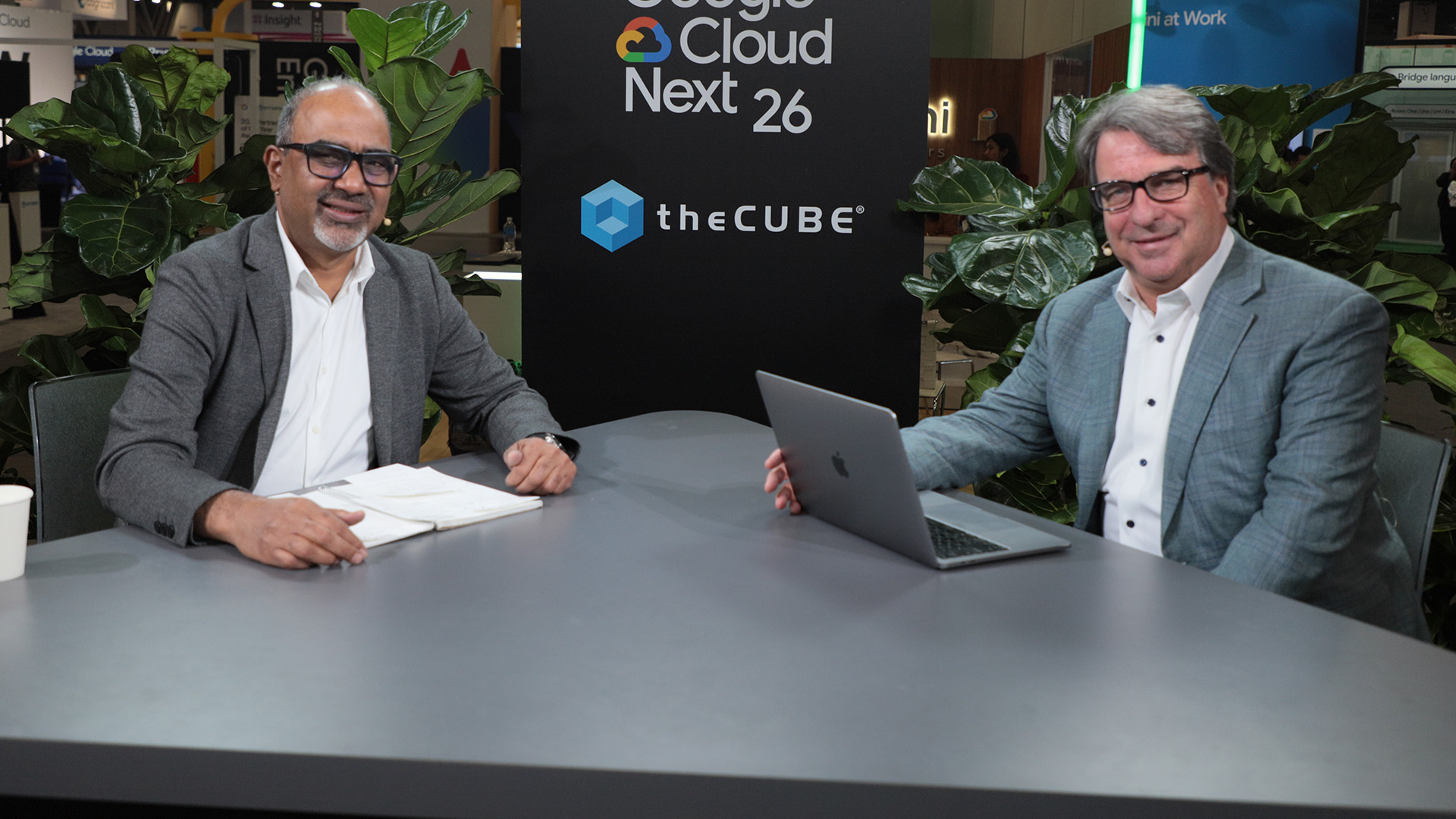
In this interview from Google Cloud Next 2026, Sarbjeet Johal, founder and chief executive officer of Stackpane, joins theCUBE's John Furrier to discuss Google's full-stack AI momentum and what enterprises must prioritize as the industry shifts from AI experimentation to agentic execution. Johal ties Google's sharply improved market standing — stock up 111% over the past year — to its vertical integration advantage: by building its own TPUs, the company avoids steep GPU margins paid to third-party suppliers, giving it structurally better AI economics than most cloud peers. He details two new TPU generations announced at the show, one for training with 2.7x price-to-performance gains and one for inference delivering a 5x latency improvement, underscoring Google's push to own the full hardware stack from silicon to Gemini.
Additionally, Johal shares a three-part framework for matching AI to the right system type — systems of record, engagement and innovation — arguing that generative AI fits most naturally where language, not deterministic outcomes, drives value. The discussion unpacks the rising cost reality of production AI, including hidden token expenditures triggered every time a model is swapped and retested at scale. Furrier highlights open table formats like Iceberg and the data lakehouse as the single highest-leverage point for unifying data feeds and letting agents operate at full speed. Both analysts identify agent governance as the defining wave ahead — mirroring how DevSecOps unlocked enterprise cloud adoption — and flag change management, not technology, as the primary barrier slowing organizations down. From mapping the nascent primitives of an agentic AI stack to developing the "triple threat" skillset of build, operate and invest, the conversation charts a clear-eyed path through the execution risks of moving too slowly — or too fast — in the current AI cycle.
Forgot Password
Almost there!
We just sent you a verification email. Please verify your account to gain access to
Google Cloud Next 2026. If you don’t think you received an email check your
spam folder.
In order to sign in, enter the email address you used to registered for the event. Once completed, you will receive an email with a verification link. Open the link to automatically sign into the site.
Register for Google Cloud Next 2026
Please fill out the information below. You will receive an email with a verification link confirming your registration. Click the link to automatically sign into the site.
You’re almost there!
We just sent you a verification email. Please click the verification button in the email. Once your email address is verified, you will have full access to all event content for Google Cloud Next 2026.
I want my badge and interests to be visible to all attendees.
Checking this box will display your presense on the attendees list, view your profile and allow other attendees to contact you via 1-1 chat. Read the Privacy Policy. At any time, you can choose to disable this preference.
Select your Interests!
add
Upload your photo
Uploading..
OR
Connect via Twitter
Connect via Linkedin
EDIT PASSWORD
Share
Forgot Password
Almost there!
We just sent you a verification email. Please verify your account to gain access to
Google Cloud Next 2026. If you don’t think you received an email check your
spam folder.
In order to sign in, enter the email address you used to registered for the event. Once completed, you will receive an email with a verification link. Open the link to automatically sign into the site.
Sign in to gain access to Google Cloud Next 2026
Please sign in with LinkedIn to continue to Google Cloud Next 2026. Signing in with LinkedIn ensures a professional environment.
Are you sure you want to remove access rights for this user?
Details
Manage Access
email address
Community Invitation
Analyst Notebook | Google Cloud Next 2026
In this interview from Google Cloud Next 2026, Sarbjeet Johal, founder and chief executive officer of Stackpane, joins theCUBE's John Furrier to discuss Google's full-stack AI momentum and what enterprises must prioritize as the industry shifts from AI experimentation to agentic execution. Johal ties Google's sharply improved market standing — stock up 111% over the past year — to its vertical integration advantage: by building its own TPUs, the company avoids steep GPU margins paid to third-party suppliers, giving it structurally better AI economics than most cloud peers. He details two new TPU generations announced at the show, one for training with 2.7x price-to-performance gains and one for inference delivering a 5x latency improvement, underscoring Google's push to own the full hardware stack from silicon to Gemini.
Additionally, Johal shares a three-part framework for matching AI to the right system type — systems of record, engagement and innovation — arguing that generative AI fits most naturally where language, not deterministic outcomes, drives value. The discussion unpacks the rising cost reality of production AI, including hidden token expenditures triggered every time a model is swapped and retested at scale. Furrier highlights open table formats like Iceberg and the data lakehouse as the single highest-leverage point for unifying data feeds and letting agents operate at full speed. Both analysts identify agent governance as the defining wave ahead — mirroring how DevSecOps unlocked enterprise cloud adoption — and flag change management, not technology, as the primary barrier slowing organizations down. From mapping the nascent primitives of an agentic AI stack to developing the "triple threat" skillset of build, operate and invest, the conversation charts a clear-eyed path through the execution risks of moving too slowly — or too fast — in the current AI cycle.
In this interview from Google Cloud Next 2026, Sarbjeet Johal, founder and chief executive officer of Stackpane, joins theCUBE's John Furrier to discuss Google's full-stack AI momentum and what enterprises must prioritize as the industry shifts from AI experimentation to agentic execution. Johal ties Google's sharply improved market standing — stock up 111% over the past year — to its vertical integration advantage: by building its own TPUs, the company avoids steep GPU margins paid to third-party suppliers, giving it structurally better AI economics than mos...Read more
exploreKeep Exploring
How is Google Cloud approaching AI and the cloud ecosystem — are they promoting openness and no vendor lock‑in, collaborating with partners like Databricks and NVIDIA, and building capabilities across the stack (TPUs, distributed compute, Gemini, Lakehouse/open table formats)?add
What hardware did they announce at the show, including details on the new TPUs (inference and training), other processors, networking, and any commentary on storage?add
What is DDN's role and positioning in the AI storage market, including its relationships with Google Storage and NVIDIA, its performance improvements (e.g., reported throughput gains), and its importance for inference (such as KV cache)?add
How are databases (for example, Spanner and AlloyDB) becoming a fourth pillar of IT in the AI‑native/cloud‑native era, and how are the cloud‑native and AI‑native ecosystems coming together?add
What are the practical and financial challenges organizations face when deploying AI on cloud platforms (such as AWS)?add
What single area should a CIO prioritize to enable rapid AI-driven transformation and business acceleration?add
What were the main takeaways from Google Next about AI—particularly regarding agents, infrastructure, data/context/memory/intent, the Gemini control plane, and agent-to-agent security?add
What were the main themes or takeaways from the discussion about Gemini and AI platforms?add
>> Welcome back here to theCUBE's live coverage here at Google Next 2026. This is day three. We're wrapping up the show with our classic Analyst Notebook session with Sarbjeet Johal, who's king of the world, biggest dog in the game and the founder and CEO of Stackpane. Sarbjeet, that was a little editorial plug from the team. You're a regular.
Sarbjeet Johal
>> Thanks.
John Furrier
>> It's like we're synchronized, but I do want to say I really appreciate what you do. We appreciate all the social media collaboration. It's a teamwork, it's a partnership, it's teamship. You put them together. But what I really love the most is that you really do dig in at these events and you get, why I call it the Analyst Notebook. You literally have a notebook, a lot of notes there. You do survey with a critical eye and a optimistic eye as well on what's going on. So great to have you back for the Analyst Notebook, my favorite session of the day. And what'd you find? I mean, what was out there? What stories did you uncover? Obviously when you look at the data, we came through theCUBE here. Lot of partner ecosystem, lot of customers came on. Big time Google execs came on, VP of engineering, head of product and go-to-market, head of SMB. We have all the leaders coming through. Very consistent theme. Very good messaging, I would say, on Google's part, but the full stack is in play for Google. Ecosystem, big play. You've been briefed. We've been briefed on the situation. Now it's time to extract the data. What did you find? Give us your report.
Sarbjeet Johal
>> Yeah. Thanks, John. Thanks for having me. Thanks to the team for that flattering words. Google actually has a lot of traction, right? And the market is rewarding them. Their stock is up 111% in last one year. So they have doubled their market cap and all that stuff.
John Furrier
>> They'll go up higher when the Anthropic IPO hits.
Sarbjeet Johal
>> Exactly.
John Furrier
>> They have a good position in that as well.
Sarbjeet Johal
>> They have pocket in hand over there. They have pocket in hand over at the-
John Furrier
>> Lot of investments are going to come in.
Sarbjeet Johal
>> Musk's stuff, like Space-
John Furrier
>> Starlink, SpaceX.
Sarbjeet Johal
>> SpaceX. Yeah. I mean, market knows, right? So they are actually kind of firing on all cylinders from different angles. But from the cloud and AI side, their models are well regarded, if you will. And they are now collaborating more with other vendors. So they let you consume any other vendor's technology in a seamless way. And then cross cloud, data lake is another example of that. So they're kind of more open. They usually don't say that much.
John Furrier
>> I mean, they were clear in theCUBE. They said no lock-in. They are very heterogeneous oriented. And in fact, the Lakehouse, which is optimized for Iceberg and open table format, very critical product. Databricks is also here and they're partnering. They're doing talks together. So there is no, "We're competing with Databricks," narrative. The TPUs came out. NVIDIA is still here, so they're holding hands in public. We're seeing Nvidia obviously getting, wants more action from Google, but Google clearly doing the Amazon move, building their own stuff. Love that. They have distributed compute cloud. They're going to be selling software to sovereign. So up and down the stack, infrastructure to Gemini. I mean, Gemini is looking really good. It's also orchestrating. This agent layer. The control plane, as we say, is in play.
Sarbjeet Johal
>> Yeah. Actually, at the end of... I mean, I'm an economics major, you know that, right? So at the end of the day, economics matters. When you're experimenting or building solutions in the build phase, at the design time, you can waste some money, during especially hype cycle. But when you put stuff in production, especially if it is at some decent scale, at least their price to performance is number one criteria for procuring any technology. So because they're vertically integrated, they have their own TPUs. They don't have to pay 70% margin to the likes of Nvidia, even though they will say they have Nvidia chips and all that. They have to because of the market pressure and/or there's need as well from many vendors, many of their customers actually, ISVs and bigger enterprises. But in short, they have much better economics of AI, if you will. They also... If you want to take a look at from all the announcements from this show, right? So they did hardware announcements, right? They did two TPUs in this time, right? One for training, one for inference. So the numbers are... I have some notes here. It's 5x latency improvement actually on the inference side with the 8i, right? And ADX better price to performance. So they put a lot of SRAM into that, what Nvidia is doing that too, right? So on the training side, they have 2.7x sort of better price to performance. And they also have their own Axion processor. So they have all bells and whistles. Their network backplane is good. Storage they didn't talk much about this time, but they did talk about storage in the context of data.
John Furrier
>> We had storage, had great numbers. DDN's relationship with Google storage, significant positioning. Alex Bouzari was here. You know him. He's always, he was dressed to the nines. He's a fashion machine. He actually laid down, and Google verified this, there's no storage competition. DDN and Google storage are working together. And their numbers are significantly improved. I mean, like 22% performance throughput, just they're dominating. So I got to give DDN props for that. So good story. They're hiding in plain sight. DDN doesn't do enough to put the word out there. We interview Alex, but they're running the table.
Sarbjeet Johal
>> They are running the table. DDN is like this with Nvidia. Most of the Nvidia stuff, whatever they have in the DGX cloud and all that, they use DDN. DDN is like more like a... We can call it AI storage stack, if you will. So because KV cache is very important, part of the inference side of things, right?
John Furrier
>> All right. So Gemini dominated the headlines, clearly.
Sarbjeet Johal
>> So from hardware, TPUs and-
John Furrier
>> But let's go into the action.
Sarbjeet Johal
>> ... the software side.
John Furrier
>> The data platform. They have things on the open data cloud. AWS, Azure, Google storage, and then any DB or SaaS. AlloyDB was talking about Spanner. We were reigniting conversations. We are living in a four-pillar IT world now, scale world. It used to be the holy trinity, compute storage and networking, but now you got to add databases with an S. Databases are now going to be the key layer at the control plane because AI native has to manage, whether it's PostgreS for vibe coding and other things. You can pick your database based upon what the workload's doing. So if you want high end, you go to Spanner. Graph databases, okay? Spanner or whatever you're using, AlloyDB, Transactional. So you start to see everything kind of coming together as the stack connects to the cloud native. It's almost like two Lego blocks coming together. You have the cloud native Kubernetes and container market that we've been covering in the CNCF from day zero when it started. And that is hardened. Still a lot of work being done and the pioneers in cloud native have set the table. And it literally is coming together with the AI native block and that layer that connects them, call it a DMZ zone or whatever, glue tissue or connective tissue, that is a really key area. And I don't know how big it's going to be, Sarbjeet, yet, but I don't know. But I know that I'm seeing people, my friends and folks that we've also interviewed on theCUBE that are on both sides of those communities coming together. And I know why they're coming together. It's like they're meeting in the woods talking like, "Hey, let's connect." Friends come together, but they're different groups.
Sarbjeet Johal
>> Yeah.
John Furrier
>> Some overlap, but not 100%.
Sarbjeet Johal
>> Yeah. Actually, the computing at the very base of it, zeros and ones and everything works from there.
John Furrier
>> At the end of the day, the AI native coders want to play with the models, build some software. It kind of reminds me of when cloud came out, "Hey, DevOps, just make it all happen. I just want to code." And of course the DevOps team served their friends, which was the developers. And then when security came in, you shifted left, that made the grind of security compliance work. That same movie is happening in AI native, and agents, except that it's not just security, that's already baked in. It's the governance.
Sarbjeet Johal
>> Yeah. We actually-
John Furrier
>> The governance is the worst job on the planet for a developer. No one wants to do governance. Name one developer that says, "Hey, I'll do the governance."
Sarbjeet Johal
>> The governance always comes.
John Furrier
>> It's a different department.
Sarbjeet Johal
>> No, always comes later. In the hype cycle, the governance is on the back burner. I mean, take any hype cycle, internet, internet 2.0, and pick your sort of hype. During that time, security is on the back burner, governance is on the back burner. It's by design. It's not like-
John Furrier
>> In the old ways, it wasn't critical. Security was critical in DevOps. DevSecOps made enterprise adoption happen. In AI, governance is essentially going to make AI native apps happen in the enterprise. But here's the issue, is why I like this layer that's emerging, this control plane, agentic layers emerging. And that's why the Linux Foundation started the Agentic AI Foundation because it's a different community, but it's brother, sister, brother, brother to cloud native. And the governance looks a lot like observability because one, you have to observe the agent. So there will be technologists in that layer, but it's not going to be the developer.
Sarbjeet Johal
>> But there's a controversial thing happening there as well.
John Furrier
>> It's not going to be the AI developer.
Sarbjeet Johal
>> Yeah. The controversial thing is this. In many times in the analyst sessions and other talks from other sessions and all that, they're saying that, okay, the data we used to save in format which is conducive to human consumption, like humans need the data. Now we need to save the data or build the systems which are more like friendly to the agents. And I kind of cringe on that, to be honest with you, right?
John Furrier
>> You do? Why?
Sarbjeet Johal
>> Because on the backend it's good. You can say that different format. But at the end of the day, if you don't have the explainability in systems, that is a big-
John Furrier
>> That's a surface area problem for responsible AI.
Sarbjeet Johal
>> Yes.
John Furrier
>> You got to have the lineage, you got to have the observability data and it's not exactly the same as cloud native observability, but it still is technical. You got to have that in there.
Sarbjeet Johal
>> And agent, like SDLC, what do you call it, software development lifecycle, right?
John Furrier
>> Yes.
Sarbjeet Johal
>> We used to say it's software, but agents are software, right? So agent development lifecycle is in very nascency stage. All three big players announced the registry for agents in April. Or like just now, right? And they are doing the registry for skills as well. So I mean, just very basic rudimentary blocks are being built for AI applications stack to emerge. We are in very early stages of it.
John Furrier
>> Yeah. But one thing about Google Cloud is that they have their own frontier model and it's pretty kick-ass. Okay. You got OpenAI, you got Claude and you got Gemini. Okay. I asked them this direct question. You have your own frontier model and you have the full stack. What does that mean? It means should I be worried? And they're like very upfront. "No, no. We have our own model because we actually have Workspace and CLI interfaces."
So the app also, this is where Workspace is, Gmail, all those services come into play because now they look more like Microsoft Cloud, but they actually have a better cloud. So I would argue that Google Cloud is better than Azure because-
Sarbjeet Johal
>> I always said that.
John Furrier
>> Well, they had potential because they had the deep tech. Google's always had the deep tech. They had all the capabilities.
Sarbjeet Johal
>> Their software chops are unmatched.
John Furrier
>> But you got Gmail, Meet, Chat, Docs, Slides, and Sheets.
Sarbjeet Johal
>> They know scale. They know scale. Actually, I worked for two cloud providers. So from that-
John Furrier
>> What doesn't scale?
Sarbjeet Johal
>> Google knows scale.
John Furrier
>> Oh, they know scale.
Sarbjeet Johal
>> Yeah, of course.
John Furrier
>> Oh, I thought you said doesn't scale.
Sarbjeet Johal
>> If Google doesn't know scale, who does?
John Furrier
>> Google knows scale, but now their focus is laser focused. So their brain's cranked on this and they're going to go vertical, but they're open. So no one can claim they're proprietary because they're open. You can switch anything in and out, but they are domain specific proprietary for their solution, which is the cloud. So they balance that beautifully between lock-in based on capabilities and performance. Their lock-in spec, Google Cloud's lock-in spec is our cloud performs and is trusted, and not lock-in as in hooks. There's no proprietary hook with Google Cloud.
Sarbjeet Johal
>> It's a lot less actually. It's all relative, right? So they are more open than Azure, right? On the openness side, actually AWS is not that like this as well. So I mean, that's why it already has rule of the world. I think in my point of view, AWS and Google are the top two cloud providers and I've been seeing that for the last-
John Furrier
>> So their surface here on their agent platform is CLI, Gemini Enterprise, Workspaces, personal, and any third party. Their runtime layer is agent engine, intelligence, and then naming, identity, observability, policy management, and gateway. You got to have those gateways. And then tools and connectivity is simply these registries, skills, tools, and agents. And then the MCP, not A to A, I saw on the slide. They didn't say A to A, but they did donate that to open source. And then at the bottom of the connectivity tools is DocStore, SaaS, database, and bespoke EP, and of course, any other GCP service. So they're laying it out. They have an architecture that actually will fit a multi-vendor, multi-ecosystem partner, heterogeneous, distributed computing, hybrid cloud environment.
Sarbjeet Johal
>> Yeah. So if you see the growth of cloud in a way, how cloud grew, like from first started with S3 and then everything else was at a compute and then whole other enchilada now, how huge it is, how many primitives are there. So in AI, I think Google has more primitives. They're defining it like they're leading that definition of primitives in AI stack faster than anybody else. And by the way, to use-
John Furrier
>> I would say they're catching up. So Google's catching up. Amazon's got way more primitives than Google.
Sarbjeet Johal
>> No, no, no, no. Just AI stuff, agentic stuff.
John Furrier
>> Oh, AI, okay. By the way, on the AWS front, I will just say, Amazon was way ahead of Google on having a DevOps agent. Their DevOps agent is very good. I think AWS is smarter on how to deal with their services, but again, that's for AWS cloud. They're not building a DevOps agent for-
Sarbjeet Johal
>> They're pro-grade, they are ISV friendly, they are big company friendly cloud, right?
John Furrier
>> Well, the thing that no one's talking about in the hype cycle, and we're just going to put it out here, not to be a wet blanket on the enthusiasm, but the costs are going up through the roof. Every single practitioner has admitted on theCUBE, you can review the videos and our AI will pick it up, including the practitioners and the vendors. The cost to roll out AI with the tokens is high. Everyone's spending their token budget. Everyone's blowing their money. And the thing that came up at it from JetBrains and various other developer oriented platforms was if you... And FinOps, by the way, FinOps leaders, is that one thing that people don't see as a hidden cost, it's the classic shark fin, the iceberg, what's under the water. What's under the water is the fact that if you change a model, you got to test it. If it's in production, you got to then spend more tokens testing. So little bit of a hidden cost there, Sarbjeet. But then again, where's the value? So again, there's a lot of reinvestment going on on budget savings. So that was a theme, saving the cash from the savings, allowing it back in, to pay for more tokens.
Sarbjeet Johal
>> The reality is settling in. It's expensive. You have to test the stuff before you put it in production. And if you're doing anything serious, it is pretty cumbersome. It's becoming heavier.
John Furrier
>> The other thing I'd share with you that I learned on theCUBE this week is that there's two success motions for running AI transformation journeys. And it came from Deloitte and McKinsey, and they both had different contexts. They both do both of these, but they're both different for different reasons. Model number one is pick a small win. And the other one is pick a big hard problem win. And the reason why they're different is that on the first small win, get on base, if you will, or bump the ball down the third base line in baseball analogy, is for organizations that have a lot of skeptics or legacy. So what that is, is that show the momentum, and that's about team formation, getting some momentum, get the small win, get a position and knock it out. If a company's committed to AI, C-suite mandated, full budget. McKinsey pointed out that, and this kind of was new information to me because it didn't make sense, but now it makes total sense. Pick the hardest business problem that drives revenue and throw all the gas at that, gas that up and then look at the numbers. And by the way, they have the workflows, they know the process. So that's where the big money's going is on these big game changing projects. And that's if there's an executive and full team commitment, meaning they have the executives on board, they have the AI team that's cross-functional, multiple stakeholders, and they have developers, they go all in. I mean, they go all in to prove the point. The other one is, "Hey, get the win, see we're working, it's going good." And then that turns into bigger beachhead, AI competency centers, more excitement, and then kind of takes the skeptics out of it because the skeptics are causing paralysis because they could... And then they go into... I asked one guest, "What does paralysis look like?" Multiple projects that are just hanging around and then, "See, it's not working," or like there's a lot of gamification of making it fail.
Sarbjeet Johal
>> There's a lot of conflicting things happen at any typical enterprise. Developers want to polish their resume, right? So they will pick up something quicker, would learn something and all that stuff. It's not meaningful in many ways for that enterprise, but it's meaningful for that developer or team of developers, right? So you have to, as a company, you have to have that good balance of, okay, you don't want to stop them from learning, but at the same time you want to steer them into the right direction, how we want to tackle that. But I want to give you a third frame actually, in addition to what these two you have, like a simple problem or pick a hardest problem.
John Furrier
>> What's the third one?
Sarbjeet Johal
>> The third one is they said map the AI to the type of system you're building. So actually, I used to map the three flavors of cloud to three types of systems, the systems of record, systems of engagement and the systems of innovation. So I can simply put that in the three buckets, but you can create systems of action or systems of intelligence as well, but they can be collapsed into three categories, right? So in the systems of engagement category, gen AI, AI solutions fit so good because those systems are language based, more language based than the number based, right? So they don't need these deterministic outcomes. So when you're writing a marketing copy, you don't need-
John Furrier
>> If you were a CIO, what question would you be asking the vendors here? Google Cloud is the major cloud vendor, and you can put ADBs in that mix too, and the ecosystem is a broad question. So you got the hyperscalers, you got the neo clouds, and you got all the ecosystem. What questions would CIOs want to ask these people? What would be the...
Sarbjeet Johal
>> From the vendors?
John Furrier
>> No. If you're a CEO watching all this play out, what question would be asking the vendors? What proof points, what's the hurdle? Take us through your thoughts.
Sarbjeet Johal
>> Yeah. I will be asking, very first thing, unless I'm greenfield or a new startup, right? A well funded startup.
John Furrier
>> You're an enterprise CEO.
Sarbjeet Johal
>> Yeah. I'm enterprise. So I'll be asking, how do you guys work with existing data centers, right? Do you have good pipe between your neo cloud and my data centers where I am, right? It can be your own data center, private, or it can be AWS or Google Cloud and all that. So the cross-connect is very important, right? So the second thing I'll be asking is definitely about the pricing and price to performance, right? The third thing is like, what is the knowhow you will bring? Like you know when you get money for a startup, it's a dumb money or smart money. So you can get dumb compute or smart compute. Smart compute is when the company which is providing you this stuff, they know the legacy stack as well. Their people know that. They're aware of your problems.
John Furrier
>> Change management's come up a lot in the past couple months. That's a big one. Just getting people on board, herding the cats, bringing everyone together, it's a huge issue. I mean, that's always going to be a problem. That's what I say, you got to get those wins.
Sarbjeet Johal
>> Yes.
John Furrier
>> Little to big and everything in between. Whatever it takes to move the needle and get the support versus paralysis by analysis and which causes slowness and slow loses, speed wins, but the market's speeding very, very fast. So to me, my answer this week coming out of this show is how do you handle the velocity challenge, which is, first of all, it's an opportunity to be fast and you can win big, but there's risk. The risk to speed is, it slows you down because when they move so fast, you're not staying up with it. And I learned this week that the way to do that is to separate the models from these glue layers and these control planes and things like the lakehouses that are open table format. That's going to accelerate a lot of value because like that just makes everything connect the data sets and AI will feed off that like nobody's business.
Sarbjeet Johal
>> It's a market forces or the customers who are asking these vendors to do that because even if these vendors didn't want to separate these layers, they don't have a choice. Nobody will go to the vendors who are collapsing all these things and they say, "Hey, keep it separate." Loosely connected systems are much better systems.
John Furrier
>> If I was a CIO and I had to point at the key point to pressure on and that's going to make everything go up vertical like a hockey stick would be, it's the data model, the data lakehouse, BigQuery, these kinds of systems, but the lakehouse open table formats and aggregating data feeds into that system because then AI takes the ball and goes from there. So to me, I think that's a critical, very nuanced, small little piece, but it's like that one little spot that makes everything blow up big.
Sarbjeet Johal
>> Yeah. Actually, if you can't get your data from your SaaS vendors and your internal data and your data at another cloud provider where you're using them for hosting a lot of other stuff, if you can't put the data in one view, if you will, then you're handicapped. And that's why there's this interconnect, cloud interconnect, these three providers are joining hands. They announced that like last month or so, right? So-
John Furrier
>> Well, Sarbjeet, we got to wrap up, but let's go through and summarize. I'll summarize my notes and then get your thoughts together. This show has been great. There's been many themes. I'll go down my notes from all the interviews, all the analysis of the keynotes and the commentary that's come from our CUBE research team, including Sarbjeet and others. Here's my take. Number one, AI is an execution layer. We've been talking about AI for all this time and now with agents, how does it actually do the work? If this is a shift, it's an ability to execute for developers, for the deep tech capabilities, and also impacting the C-suite. No problem. Everyone's now involved, and some companies hit all three of those areas, some really get forced to the bottom. So it's how you think differently about the software, the business model, and the workflows and the process. AI is the execution layer for all parts of the business. Number two, infrastructure shift is happening. It's being built for agents. Okay? This show proves that this infrastructure is purpose-built for agents, and agents will be a great thing that will feed the AI. And then more under the hood, data, context, and memory was a big theme. We always heard data's important. What's different now is that you got to have context and you have to have intent. These are very specific things that are complex and get right, and so many agents fail because of this. This is a huge deal here at Google Next. And then fourth, the control plane, the Gemini platform is hiding in plain sight, not so much anymore. Gemini is also a control plane platform. It's going to run inside the company. It's going to run in Google Cloud, Google's selling the software to be on-prem. If you commit to this platform, you're kind of in. And then fifth, security. Agent on agent security. Huge topic. We talk about agent security for governance and compliance, but agents are going to talk to agents. That's a big theme we heard a lot here. And then final couple points, impact of the users of AI. We all use it in our work. It's showing up every day. So the consumers are going to use it. And then finally, marketplace and the ecosystem, it's a platform and that's causing all kinds of competitive dynamics from being competitive to frenemies. We got Databricks holding hands with Google Lakehouse. You got all kinds of stuff at the UX side. So it brings it all together. And the bottom line, the reality check on all this is that the execution risk of going too slow or going too fast is the number one thing I'm taking away, Sarbjeet. So that's kind of my report.
Sarbjeet Johal
>> That's a great list actually. I mean, you can even-
John Furrier
>> I have a computer. You have notes.
Sarbjeet Johal
>> You have a lot more because you have a computer with you and-
John Furrier
>> Yeah. The number one thing I'm going to personally research is obviously how companies can be prepared for this shift.
Sarbjeet Johal
>> This is still the best computer.
John Furrier
>> Well, the other thing is that the question that we're going theCUBE and SiliconANGLE is, how do companies prepare for this shift? And we're also going to document the frontier leaders in the companies. We have frontier models, we track that, but we're going to start tracking frontier enterprises, frontier players. People who are this first generation class one, class one of this wave, we have to document these leaders because they're going to be plowing the fields and they're going to be the OGs. Like we had the Clouderati back in 2007, you're going to see this emerge here. So go ahead. Your thoughts.
Sarbjeet Johal
>> Yeah. Actually, a lot is crossing my mind. I can try to explain it with different analogies and all that. I usually say that to my extended family that they say, "What do you do now?" I just say, "I'm like a Shaquille O'Neal of tech world. I played for a long time and now actually I do commentary." Actually, seriously, what do these people do when they sit at the set like this? What do we do, right? Especially analyst role is a little different than-
John Furrier
>> We're in the arena.
Sarbjeet Johal
>> Yeah. So what we do is we analyze players, right? Leaders. We analyze teams, that's companies. We analyze pitches. Like what pitch are you playing? Are you a database company? So those are different pitches, right? We analyze the rule-makers. Game is changing all the time. Even in the baseball, the bat is changing, the gloves are changing because less injury, like helmet is changing in football. So we analyze all aspects of the game, the pitches, the players, and then we also have to keep an eye on the regulators, right? But having said all that, so that's-
John Furrier
>> By the way, I love that analysis of the game, the athletes, of the players, but also for companies, sometimes they don't even know which game they're playing and they're on the wrong field. They're on the wrong field.
Sarbjeet Johal
>> Yes. Yes. Only Michael Jordan could go from one game to other. Not everybody else can do that. And many times people don't know what game they're in. And what are the rules of that game are, because game is so fluid, right? These games are not well-defined as those games we are so used to. But coming back to the sort of reality and we were talking about like one of the jobs of the analyst to take out all this sort of noise that all these tech leaders want to sell their stuff.
John Furrier
>> They're pitching you.
Sarbjeet Johal
>> If you walk into a shop, they'll say, okay, is this garment better than that? They say, "Oh, this is good." And then you pick the other one.
John Furrier
>> Nobody wants a sales pitch.
Sarbjeet Johal
>> Yeah, exactly. But they will try to sell you anyways. They do that. Satya Nadella goes on the stage and says, "We don't need programmers anymore. We don't need coders anymore." And even other leaders said that, not only Satya, right? But then later when they have their developer keynote, they want more developers sitting there. Make up your mind. First of all, number two-
John Furrier
>> Well, there's a lot of cliches around getting that social media hot take viral moment.
Sarbjeet Johal
>> Exactly.
John Furrier
>> "Software's dead."
Sarbjeet Johal
>> I'm sick of that.
John Furrier
>> "Your job's going to be replaced."
Sarbjeet Johal
>> Okay. So as a leader of a tech company or a non-tech company procuring tech, you have to work with people who know different players and they can slice and dice. So I think SIs will play a big role in that. So let me bring back the old analogy I use all the time. Tech is like medicine, right? Every pill has a side effect, right? And there's over the counter medicine and there's prescription medicine. So there's a lot over the counter right now, but less prescriptive like medicine or prescriptive AI. But going forward, I think you have to take the prescriptive AI to address your actual pain points, right? So over the counter versus prescription versus doing a social media . So that's another one.
John Furrier
>> People want prescriptions. I mean, one of the things I like about what you do, you have sharp analysis. You match theCUBE's style. We like to be sharp.
Sarbjeet Johal
>> I can't match you. I mean, not many people can match you, you're wiggly, you're-
John Furrier
>> I'm squirrelly. I can get out Houdini on the questions. But no, we want to be direct and we want to get good answers from our guests. And because they're providing data. And I think this is what's great about these events and as the community's reforming around what an analyst is, what an influencer, what's... I mean, end user contribution on theCUBE has been one of the best shows here. They weren't just end users being like a showcase piece for the Google. They were actually adding data into our content. They brought something to the table. That's like a software developer when they join an open source project. They want to contribute their code.
Sarbjeet Johal
>> Actually, people love CUBE. Actually, before the show, people come to me and say, "You guys are doing great job." They think I'm part of theCUBE. I wish I am actually.
John Furrier
>> You're the king of the hill, big dog in the game.
Sarbjeet Johal
>> But not formally, right? And people love CUBE because the conversations are honest and the whole idea of you guys, you and Dave and other hosts, you're keeping the people who come to this forum, if you will, honest. That's a tricky job actually. You have to keep them honest and still sell the services.
John Furrier
>> At the end of the day, the game is still the same. The media and the web's changing. It's now social web. We see an abstraction with NYSE Wired, our new brand, a line extension and our studio there. We connected to the money and the technology convergence of capital markets. That's C-suite. We have the deep tech, we have the developers. But what's different, Sarbjeet, is that when the community is wired up, like we're doing with the NYSE Wired community, how people get information is different, but the game is still the same. I have a need. I take a progression to discover information to find out what to do and find what I'm looking for, help me figure stuff out, learn, connect with people, find an expert, collaborate, get the idea from an idea into action. And I think one thing about AI that's clear is that ideas are not just a dime a dozen anymore. You can actually take an idea and put it into action very, very fast. So with this AI, that's why you're seeing the startups coming out of the woodwork and rising super fast, is that applies to the enterprise and everybody. So whether it's personal, work or startup or enterprise, ideas can move into value. And that's going to take human engineering, critical thinking, systems thinking, empathy, collaboration, teamwork and partnership, teamship, as we've been coined on theCUBE here.
Sarbjeet Johal
>> And focus on economics. Yeah.
John Furrier
>> And that's the new game. And the new skillset for the athlete, the triple threat is you got to be able to build, operate, and invest. Now when I say invest, not money, but your time and any returns you get in efficiency back into buying more tokens or doing new things. So you got to think about money, value, business value. So invest means think like an owner, business owner. So that's the triple threat in AI and the skillsets to do that. You got to be able to know how to build, you got to know how to operate, you got to know how to see value in which is the money and then reinvest that value into growing it. So very different than I'm the IT guy, I'm the database administrator. All I manage is the Oracle database or I manage this infrastructure. AI, that's not my department. That's over. That's over. That's over.
Sarbjeet Johal
>> If you just change it, it will kill you. If you confront it, you will be, most of the time you'll come out as a winner, but if you are afraid of change, it will kill you.
John Furrier
>> Change management is number one problem that's going to get worked on by the top brains and the companies, and whether it's a vendor or a customer or partner, because they have to do it fast. If you can't handle change, it's like whitewater rafting. If you've ever gone whitewater rafting, level five.
Sarbjeet Johal
>> Especially in tech.
John Furrier
>> Yeah. You're going to get thrown out of the boat. By the way, if you don't paddle together, you are toast. So we are in a high velocity whitewater rapids and whoever gets through wins and the winners take care of the speed. If you go too slow, you miss the boat.
Sarbjeet Johal
>> The base is picking up.
John Furrier
>> You're on the sidelines.
Sarbjeet Johal
>> The game is improving. It's a new game in many ways.
John Furrier
>> Well, Sarbjeet, we're at podcast level time here. We should go for Lex Fridman's record. What do you think?
Sarbjeet Johal
>> We can talk about three, four hours about this stuff and still not be done.
John Furrier
>> Get some cocktails. Great to have you on again. I love the Analyst Notebook, sharing our notes. We've got a lot on theCUBE. You've been out and about scouring the venue, talking to people in the hallways at the analyst session. Dave Vellante did a great post up on his LinkedIn on cuberesearch.com, of course SiliconANGLE has all the covers. Of course, our great production team here. And Alison Kosik, she held her own today. She did a great job. Anchor on CNN for 15 years at the NYSE, joined the team.
Sarbjeet Johal
>> That's great.
John Furrier
>> Frank Fay, the whole team is here just doing job team coverage here at Google Next. That's a wrap from the show floor. Thanks for watching.