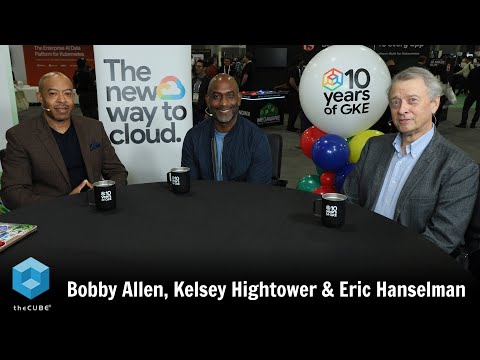
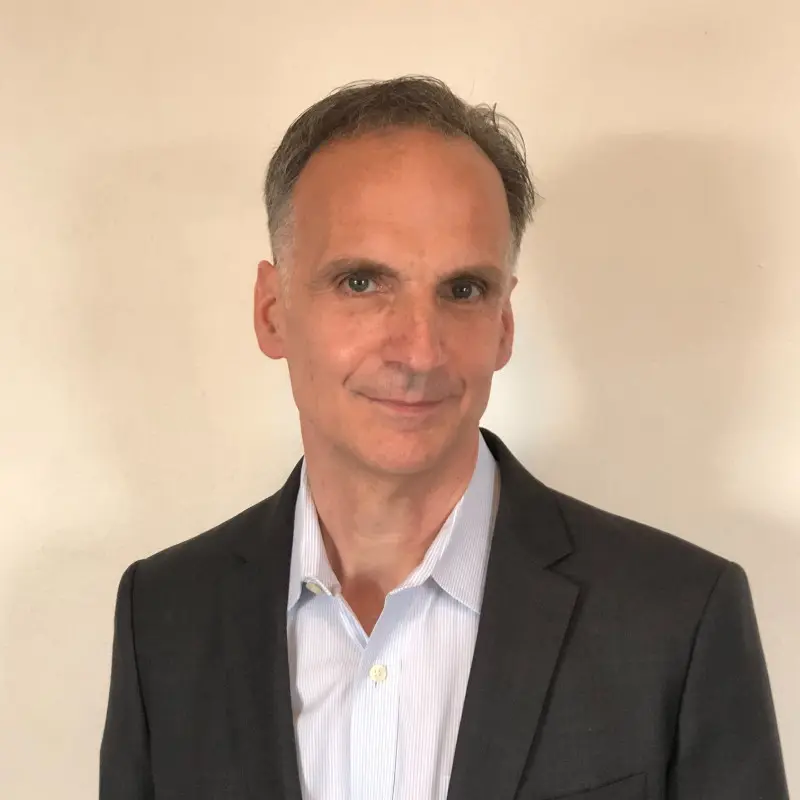
In this conversation at KubeCon + CloudNativeCon North America in Atlanta, theCUBE’s Savannah Peterson sits down with Kubernetes OG Tim Hockin, early adopter Leon Bouwmeester of Signify and Forrester analyst Lee Sustar to mark 10 years of Google Kubernetes Engine. They revisit Kubernetes’ journey from the early “container wars” to today’s packed show floor, as Hockin shares what it’s like to see a whole corner of the industry running on work he helped start and reveals the open source origin story behind the seven-sided ship’s wheel logo, while Bouwmeester explains why Signify moved to Kubernetes in 2015 and how custom metrics became a game changer for scaling latency-sensitive lighting workloads.
Sustar brings a risk and architecture lens, tracing how enterprises weighed Kubernetes against Docker Swarm and Mesos, how he defended it to regulators and leadership, and why he now views Kubernetes as the reference architecture underpinning many AI platforms — with GKE’s latest 130,000-node cluster milestone signaling what he calls “next-generation Kubernetes.” Hockin and Bouwmeester look ahead as Google’s upstream work, mega-scale customers such as Pokemon GO, platform engineering investments, GKE Fleet and emerging AI-driven placement strategies come together to manage multi-cluster fleets, tighten the stack for AI training and serving, and optimize for latency, cost and security as Kubernetes powers the next wave of AI workloads.
Forgot Password
Almost there!
We just sent you a verification email. Please verify your account to gain access to
GKE 10-Year Anniversary Exclusive. If you don’t think you received an email check your
spam folder.
In order to sign in, enter the email address you used to registered for the event. Once completed, you will receive an email with a verification link. Open the link to automatically sign into the site.
Register for GKE 10 Year Anniversary Exclusive
Please fill out the information below. You will receive an email with a verification link confirming your registration. Click the link to automatically sign into the site.
You’re almost there!
We just sent you a verification email. Please click the verification button in the email. Once your email address is verified, you will have full access to all event content for GKE 10 Year Anniversary Exclusive.
I want my badge and interests to be visible to all attendees.
Checking this box will display your presense on the attendees list, view your profile and allow other attendees to contact you via 1-1 chat. Read the Privacy Policy. At any time, you can choose to disable this preference.
Select your Interests!
add
Upload your photo
Uploading..
OR
Connect via Twitter
Connect via Linkedin
EDIT PASSWORD
Share
Forgot Password
Almost there!
We just sent you a verification email. Please verify your account to gain access to
GKE 10-Year Anniversary Exclusive. If you don’t think you received an email check your
spam folder.
In order to sign in, enter the email address you used to registered for the event. Once completed, you will receive an email with a verification link. Open the link to automatically sign into the site.
Sign in to gain access to GKE 10-Year Anniversary Exclusive
Please sign in with LinkedIn to continue to GKE 10-Year Anniversary Exclusive. Signing in with LinkedIn ensures a professional environment.
Are you sure you want to remove access rights for this user?
Details
Manage Access
email address
Community Invitation
Leon Bouwmeester, Tim Hockin & Lee Sustar
In this conversation at KubeCon + CloudNativeCon North America in Atlanta, theCUBE’s Savannah Peterson sits down with Kubernetes OG Tim Hockin, early adopter Leon Bouwmeester of Signify and Forrester analyst Lee Sustar to mark 10 years of Google Kubernetes Engine. They revisit Kubernetes’ journey from the early “container wars” to today’s packed show floor, as Hockin shares what it’s like to see a whole corner of the industry running on work he helped start and reveals the open source origin story behind the seven-sided ship’s wheel logo, while Bouwmeester explains why Signify moved to Kubernetes in 2015 and how custom metrics became a game changer for scaling latency-sensitive lighting workloads.
Sustar brings a risk and architecture lens, tracing how enterprises weighed Kubernetes against Docker Swarm and Mesos, how he defended it to regulators and leadership, and why he now views Kubernetes as the reference architecture underpinning many AI platforms — with GKE’s latest 130,000-node cluster milestone signaling what he calls “next-generation Kubernetes.” Hockin and Bouwmeester look ahead as Google’s upstream work, mega-scale customers such as Pokemon GO, platform engineering investments, GKE Fleet and emerging AI-driven placement strategies come together to manage multi-cluster fleets, tighten the stack for AI training and serving, and optimize for latency, cost and security as Kubernetes powers the next wave of AI workloads.
In this conversation at KubeCon + CloudNativeCon North America in Atlanta, theCUBE’s Savannah Peterson sits down with Kubernetes OG Tim Hockin, early adopter Leon Bouwmeester of Signify and Forrester analyst Lee Sustar to mark 10 years of Google Kubernetes Engine. They revisit Kubernetes’ journey from the early “container wars” to today’s packed show floor, as Hockin shares what it’s like to see a whole corner of the industry running on work he helped start and reveals the open source origin story behind the seven-sided ship’s wheel logo, while Bouwmeester ex...Read more
exploreKeep Exploring
What led to the decision to adopt Kubernetes and how long ago was that?add
When did Kubernetes first come to your attention, and what factors influenced your decision to adopt it as a key platform?add
What strategies are employed to maintain the cultural relevance of an open source project while balancing time management and stakeholder interests?add
What impact did Pokemon Go have on the scaling and operations of a company utilizing GKE?add
>> Good afternoon, nerd fam and a welcome back to beautiful Atlanta, Georgia. We're midway through day two of our live coverage here on theCUBE at KubeCon. Very excited to be bringing you the second portion of our exclusive series with the Google Cloud team as they celebrate 10 years of the Google Kubernetes engine. My name is Savannah Peterson, super pumped up about this panel of absolutely brilliant blokes. I've got Leon, Tim, and Lee, thank you so much for taking the time to be here.
Tim Hockin
>> Thanks for having us.
Lee Sustar
>> Thank you.
Leon Bouwmeester
>> Thank you.
Savannah Peterson
>> This is so fun. Tim, I've got to open this up. You are the ultimate Kubernetes OG, a part of the beginning of the project, an infrastructure celebrity, if you will, in this room. What is it like for you now while 10, 11 years out on the project, looking at this room packed full of things powered by Kubernetes?
Tim Hockin
>> Look, it's overwhelming. It's humbling to look at this and say, "I had a part in this," much less maybe a seed part of it. There's a whole corner of the industry that is betting on work that I did, which scares the pants off of me.
Savannah Peterson
>> I was just going to say, is that kind of terrifying, as much as it's thrilling?
Tim Hockin
>> It's totally terrifying. Don't look too close at it, guys.
Savannah Peterson
>> No big deal. You're only running the biggest enterprises in the world right now, no pressure.
Tim Hockin
>> Right, thanks. Thanks.
Savannah Peterson
>> Did you have any idea it would be what it is today when you were starting out?
Tim Hockin
>> No, I mean, honestly, no. I hoped that it would be a thing that lots and lots of people would use. I expected that it would make a splash. I did not in any way, even this is beyond what I would've hoped for and way beyond what I could have expected, so a once in a career sort of thing.
Savannah Peterson
>> Totally, how cool. I can only imagine. Leon, you were one of the earliest adopters of Kubernetes with Signify. Y'all have done a lot and you've achieved some outstanding numbers, which we'll dig into. But tell me a little bit about how you frankly had the faith that this was going to be the platform or the future.
Leon Bouwmeester
>> Actually, it was born out of necessity. We were using a different platform that was deprecated, and then our technical account manager came up, "We have something cool and something new here. Kubernetes, isn't that something for you?" The rest is history. So that's how we got started with Kubernetes. So we were really one of the early adopters over there in-
Savannah Peterson
>> So was that like 10 years ago? How long ago? Yeah.
Leon Bouwmeester
>> End of 2015.
Savannah Peterson
>> Yeah. Oh my goodness, so you've seen it all.
Leon Bouwmeester
>> We've seen it all.
Savannah Peterson
>> Yeah, well probably in a lot of different ways. Lee, you've been an analyst in this landscape for a long time. Talk to me about when Kubernetes came on your radar and when you realized it was become a real platform for the future.
Lee Sustar
>> About three months after it came out.
Savannah Peterson
>> Really?
Lee Sustar
>> Because I had been in the nonprofit world out of tech for some time, I went into a large financial services organization, smack in the middle of the container wars, so Docker was in the house and Docker Swarm and Mesos and Kubernetes, and I was on the infrastructure architecture team and we had to pick a winner. So we decided, we looked at them side to side, we looked who was behind it and said, "We're going to go with Kubernetes." And it wasn't easy because we had to get the directors on board. I had to write white papers and defend it and that was part of -
Savannah Peterson
>> Oh my gosh, you were really in the trenches.
Lee Sustar
>> Right. It was part of a greenfield cloud deployment, and the question was, even though Kubernetes was some time away after that initial greenfield, the question was we need a platform that can work on-prem as well as in cloud, what's that going to be? So there's kind of white papers back and forth, kind of an academic debate initially, and then some POCs and then they were on their way.
Savannah Peterson
>> So does this feel a little bit like an I told you so moment?
Lee Sustar
>> Well, yeah, because back then I didn't get the hot ticket to come to KubeCon. I didn't actually get to come here until I was an analyst.
Savannah Peterson
>> Oh my goodness.
Lee Sustar
>> As a practitioner, we had Kubernetes come into the shop in my previous role when I was in cyber risk oversight, technology risk oversight at a government-sponsored enterprise. So I had to have that conversation there yet again about, okay, is this going to meet our security compliance requirements? What do the regulators think about this? So I had to be able to defend it at some deep level from an architectural standpoint and also a risk management standpoint. And then when I came on to the scene at Forrester, that's when things were really ramping up in the pandemic era, and clearly it became the reference architecture. And that's when my colleague Charlie Dai and I wrote a piece called Navigate the Cloud Native Ecosystem, which was basically an argument that, Kubernetes is mature, this is the reference point. Everybody go for it.
Savannah Peterson
>> Now is the time. No, that's pretty cool. Wow, I did not realize you're all early adopters up here. I mean, you're the creator. Tim, a little birdie told me that you designed the icon, the logo that we really associate with this movement and this era and the iconic ship wheel. Tell us about that origin story just because I've always wondered.
Tim Hockin
>> So it started as a joke. We were in a meeting or a hallway conversation as we're getting close to the announcement and we said, "Well, every good project has a logo. We need a recognizable logo out there." And somebody said, "Well," the early code name for the project was seven, and so we were like, "We should do a seven-sided ship's wheel," because Helmsman, Kubernetes is what that means. And so I thought that was funny, and I went home and I fired up Inkscape, a great open source tool that I'd never used before and totally hacked my way through it and I got something that's sort of approximating what in my head would be a ship's wheel. And I brought in the next day and I just showed everybody as a joke like, "Hey, look what I did." And they went, "Check it in. That's it. That's our logo." "Oh, okay." So that's how we got it.
Savannah Peterson
>> Okay, so wait, that's actually really cool. So you're using an open source tool, I take it you didn't have an extreme depth of design background?
Tim Hockin
>> I actually went to art school. So I cheated a little.
Savannah Peterson
>> Oh, okay, okay. So this is sounding a little less-
Tim Hockin
>> But I didn't know how to use the tool at all. So I was just gluing together things to make it sort of the shape that I wanted it to be in. And it was not symmetric and it was not perfect in the first iteration of it, but it was enough that I could say like, "Hey, look."
Savannah Peterson
>> Yeah, it was enough of an MVP.
Tim Hockin
>> Right, exactly.
Savannah Peterson
>> And here we are. I mean, there are ship wheels all over the show floor. They're even in your gauges, which I noticed, which is so cool.
Tim Hockin
>> Thank you.
Savannah Peterson
>> Such a wonderful touch. I got little clouds going on here if you can't tell. Leon, I want to ask you a question about practicality since you've been a part of the whole voyage here, I guess pun intended now that we're talking about the ship wheel, what have been some of the features or the releases that really were game changers for you and the team?
Leon Bouwmeester
>> Interesting question, I had to give that a little bit of thought, but one of the things that really stood out for us as a team was the use of custom metrics that came out in 2018, '19 or something like that. So of course when you talk about pods, about Kubernetes, typically you scale based on CPU memory, but our pods, they connect with our bridges, all our bridges in the field, so they have a permanent connection based on web sockets. So it was a manual solution based on scaling on the number of web sockets that we had. So when the custom metrics came out, that really was a life saver for us. So that really helped us going and moving the project forward and took a lot of it out of our hands.
Savannah Peterson
>> And gave you a lot of visibility you probably needed at a big scale moment too.
Leon Bouwmeester
>> Yes.
Savannah Peterson
>> Yeah, I love that. Tim, what about you? What are some of your favorite Kubernetes features?
Tim Hockin
>> I mean, I'm a nerd at heart, so I love the bottom half.
Savannah Peterson
>> You're in good company here.
Tim Hockin
>> Anytime you take a problem and you cut it in half, I like the bottom half. So I love the hardware, I love the machines. I'm super interested in how the API system works. So if I had a favorite feature, it's probably the API system because it's not super coupled to the problem of serving containers, it's actually a really generic API system that you can use, and people do, to serve their own API, their own concepts in a Kubernetes way with the declarative reconciled pattern. And I think it's really neat that it sort of accidentally fell out of the rest of the project, and I think it's just really fun.
Savannah Peterson
>> It is really fun. I think that's one of the cool things about the open source community, you can be building something and there's this wonderful accidental benefit that ends up projecting everything really forward. You mentioned something there that has been a little bit of a theme of the show that I want to talk about, hardware's having a bit of a resurgence. We're talking about physical devices again, I'm an OG hardware nerd. That's my background. And when we think about physical AI, it's going to be Kubernetes on hardware out in the wild that's going to be in hospitals or empowering students or whatever that might be. Lee, I'm curious your perspective on where we're at in the making it real adoption curve for the rest of the world.
Lee Sustar
>> Yeah, I think it's, in Kubernetes speak, I mean we see that the foundation of everything that's happening is Kubernetes, even though there's lots of non-Kubernetes AI workloads taking place. And I think that's a certain amount of comfort level in the enterprise adopter because they know what's underneath it. They know that Kubernetes underpins a lot of powerful AI platforms, and so that's one item checked off. We know where it came from. In terms of the adoption, I think initially there was a move towards the managed services from the big cloud providers because they were there in turnkey. Now the question is, okay, in some cases I want, for either sovereignty or security reasons, I want to shape my own. Where are they going to do that? They're going to do that with Kubernetes, they're going to find either a cloud provider, a multi-cloud container platform provider or build their own. And so we see a certain kind of adoption in that direction too, particularly where people have some sensitivity around security.
Savannah Peterson
>> I think there's a lot of folks with a little bit of a sensitivity around security, especially with the velocity of data movement right now. It's a very good point. Talk to me a little bit about, Tim, I'm curious about the synergy between the mothership, between Google, between GKE and the project, the maintainers. It seems like there's a wonderful mutually beneficial relationship there. How do you keep that up culturally and balance time and stakeholders?
Tim Hockin
>> Yeah, I mean, absolutely. The open source project is critical to the success of GKE and the Google family of products that we built on top of it. If Kubernetes stops being interesting, then all of those businesses stop being interesting, or we become the mainframe of this era. Which maybe isn't so bad, but it's not where we want to be. So Google has a bunch of the open source maintainers who work at Google who are paid to work on the upstream project to do things that our customers need, that the project needs to stay viable over the long term. We focus on areas like keeping the project healthy, just maintainer-ship, but we also focus on the new high-tech APIs, like the DRA APIs, or pushing the scale boundaries. We just put out a blog this week with another level of scale, 130,000, I think was our largest cluster ever turned on now, like holy cow, Kubernetes 1.0 supported 50 nodes, and now we're talking about 130,000.
Savannah Peterson
>> I actually have a sticker on the bottom of my laptop from when it was 65,000 only a year ago.
Tim Hockin
>> Right.
Savannah Peterson
>> I mean, that's double.
Tim Hockin
>> Exactly, exactly.
Savannah Peterson
>> And it's only just going to go, "..."
Tim Hockin
>> That's right. And the demand for this, a small number of people who need it, but they need it. And I can tell from your laptop, you've got HPC stickers, and so you get it. There's no alternative to scale when you need these problems. So for these mega customers-
Lee Sustar
>> And from my perspective, that approach is something I'm calling next generation Kubernetes because that's such a leap, it's qualitatively different.
Savannah Peterson
>> Ooh, I like this, Lee. Yeah, tell us about that.
Lee Sustar
>> And the foundational elements that are coming together in the community are making that happen. And interestingly, as an analyst, when I got here, I expected that some of the biggest vendors and the biggest contributors to kind of maybe have some big feet around the open source community, I have yet to find that and this is my sixth or seventh KubeCon. And I don't feel that it's much more open and dynamic, and there's a sense of, obviously there's competition in other fronts, but when it comes to making this work, it's there. And the way people are coming together right now to try and tackle some of the problems around AI are interesting. We were chatting before, and I'm curious to get your point of view, is you have a loosely coupled stack that was to scale, now you have some pressures to kind of consolidate a stack vertically for AI purposes, and there's a lot of interesting dynamics about that.
Tim Hockin
>> Yeah, I mean, today at the keynote, Jago Macleod from Google talked about how we're working on all these things around the open source project. But one of the really interesting ones is when you have a principally layered system, you tend to have some amount of inefficiency in between the layers because there's abstractions. And for these customers who are training these foundation models, those inefficiencies add up to real money with many zeros at the end. And so we're finding ways now to maybe not break the abstractions, but to make sure that they fit more tightly to what people need. The rebirth of old systems like Slurm, new systems like Ray, finding ways to make those things awesome on Kubernetes, not in spite of Kubernetes, but because of Kubernetes.
Savannah Peterson
>> I think that lexicon you just pointed out there is a really important thing. Everyone was managing a lot of complexity in the early days, there was a lot of different stuff going on, but now if you've adopted and achieved, you can really build out in a way because you have that foundation that's going to last through whatever happens next, which I think is really compelling. We had Jago on the show yesterday. It's fun that you mentioned him. Leon, I have a nice little anecdote in my notes here that's kind of fun. One of the perks of working with somebody like Google is sometimes they're scaling for some of their other customers, and you can reap the benefits of that. One of the most famous GKE customers, obviously Pokemon GO, lots of people have been out there in the wild and touched that, you were able to benefit from that. Tell me a little bit about that.
Leon Bouwmeester
>> I mean, it was quite some time ago that we were facing some problems and we were reaching out to Google, "Hey, we're dealing with some issue here. Can you please help us?" "Yeah, but we have this thing now going on with Pokemon Go. Everybody's using it." And obviously Pokemon Go was also running on Kubernetes. So in the end of the day, we followed in their slipstream in the scale that we have now, so thanks Pokemon.
Savannah Peterson
>> Yeah, thanks to everybody who's played a little Pokemon. No, I mean, I think it's cool, and I like that anecdote because mean Pokemon GO, most people have interacted with it or see someone who has interacted with it, and you realize what it's able to power. It's neat how that consumer market play can enable enterprise and big businesses like you to be really successful. All right, Leon, I'm going to stick with you. What do you hope to do next with GKE?
Leon Bouwmeester
>> Actually, there are three things that we would like to do.
Savannah Peterson
>> Let's hear it.
Leon Bouwmeester
>> First thing is, at the moment, we have various teams all using their own infrastructure. And what we would like to do is unravel that so that we can make a step into platform engineering. So that's one of the first thing that we would like to establish over there. The second is the use of GKE Fleet. So at the moment, we have multiple clusters and managing that, some time ago there was no solution just yet, yet we had to do it, so we had to build our own custom stuff over there, and that's something we would like to throw overboard now and use GKE Fleet really to take that away from our hands. Like the customer metrics story, it's again a similar thing. And the third one is the use of AI. How can AI help us in, for example, positioning where the cluster should be? Because latency is everything for us. The moment you ask Google to turn on or off your lights, latency is everything.
Savannah Peterson
>> It's what makes it all real.
Leon Bouwmeester
>> It makes it all real. So is there a way that AI can help us in where should the clusters be positioned such that we have the optimal latency for the lowest price? Just a small ask.
Savannah Peterson
>> I bet a few other people have that ask, though. I'm not surprised that that's what you're thinking about it. When we talked to Kelsey on the desk yesterday, he said in the early days of GKE and really looking at Kubernetes, I'm sure you were hanging out with him back then, obviously as well. He said they always saw it as a 20-year technology. And I thought that was kind of interesting because when we think about technology hype curves, they're usually not 20 years long, it's shorter than that depending on what it is or how complicated it is. But I'm curious because we've obviously seen an incredible injection of energy through AI into Kubernetes, I feel like it tipped us over the like, "Oh yeah, and this is how we're going to build the rocket ship of the future." What else in the technology landscape do you think may have a great impact on K8s the way that AI has in the last couple of years?
Tim Hockin
>> It's hard to imagine anything having the impact on this same order of magnitude as AI. I mean, it's one of those, forget once-in-a-lifetime things, it's once in a generation things. Time will be measured by before AI and after AI, really.
Savannah Peterson
>> Seriously BAI, I'm going to start saying that.
Tim Hockin
>> Right now, our focus is trying to be awesome for AI. If there's another thing sneaking up on us, I don't know what it is, but it terrifies me. No, realistically-
Savannah Peterson
>> You're so honest, Tim. I love it.
Tim Hockin
>> ... AI has so much possibility. We are just scratching the surface of it, of what it can do, how we can use it, how you can use AI to interact with your Kubernetes clusters like an operator human would, but how Kubernetes hosts those agents and how those agents interact with each other, and then how the serving stack and the training, all these pieces are coming together at the same time. And if you look around the show floor, everybody is talking about this. It's the only thing that's exciting. The buzz is alive.
Savannah Peterson
>> Oh, yeah. No, it absolutely is. Yeah, I like that answer too. It would be hard to have the same impact that we've had so far. Final question for you gentlemen, because this has been an absolute blast. When we're hanging out at KubeCon in Salt Lake City in 2026, or if you're really feeling ambitious, in Amsterdam, next spring, what do you hope to be able to say then, or, what do you hope to see in your case, or even say, that you can't yet say today? Lee, it looks like you've already got an answer. I saw you start to go to start talking, I'll go to you first.
Lee Sustar
>> No, I think just following up on what Tim was saying, I think the question is, do you end up with a unified stack or does it start to differentiate according to different workloads? Because AI is a technology of specificity, there's more and more in... There's a differentiation between inferencing and training and what happens at the edge. And yes, there's always going to be a need for the powerhouse that Kubernetes is, but what else converges with that or runs on it? And I think that's an open question, I would certainly defer to my colleagues here on the panel about how that's going to materialize.
Savannah Peterson
>> Actually, one more for you, because I meant to ask you earlier, is now the return of the infrastructure celebrity?
Lee Sustar
>> Yeah, I think so. I think Kubernetes seemed to be, and Kelsey Hightower said, "Infrastructure should be boring," and Kubernetes was heading that way in a good way because it was just rock solid and reliable.
Savannah Peterson
>> Yeah, it kind of was. You're right.
Lee Sustar
>> And now the question is, well, maybe, like you were saying, maybe there's some engineering challenges now that the community has to take on to meet these new workload demands and so someone's going to have to, it's not one, individuals, groups, companies are going to step in and try to lead that, researchers, academics are going to try to shape this. So that to me is the next thing to start to look for because they're already starting to surface in different papers if you go to some of the sessions.
Savannah Peterson
>> Yeah, no, they definitely are. Leon, what do you hope to be able to say when I see you on the other side of the pond?
Leon Bouwmeester
>> Good question. I wouldn't know, actually. I mean, the world is changing so rapidly.
Savannah Peterson
>> It is.
Leon Bouwmeester
>> I mean, running workloads from AI, what will that bring? What will that mean for Kubernetes in the end of the day? What will it mean for our workloads that we have running, who knows?
Savannah Peterson
>> Well, we'll see.
Leon Bouwmeester
>> We'll see.
Savannah Peterson
>> There will be something new though, you're probably exactly right about that.
Leon Bouwmeester
>> Yeah.
Savannah Peterson
>> Yeah. Tim, what about you?
Tim Hockin
>> I think I'd like between now and then to be able to say, "Of course you're using Kubernetes." That's the obvious answer, and it's because it's awesome. It's awesome for AI because do all these things for you that you don't need to worry about, and anybody who's not doing that is a weirdo. And right now I think we're on that approach, but I don't think we're there yet.
Savannah Peterson
>> Yeah, I think we're getting closer though. I think you're absolutely right about that. That plane is coming in to land on that runway. Gentlemen, this has been fantastic. Thank you seriously so much for taking the time.
Leon Bouwmeester
>> Thanks for having us.
Tim Hockin
>> .
Lee Sustar
>> .
Savannah Peterson
>> I really appreciate it. You're always welcome. And thank all of you for tuning into our two days of live coverage here in fabulous Atlanta, Georgia at KubeCon. My name's Savannah Peterson. You're watching theCUBE, the leading source for enterprise tech news.