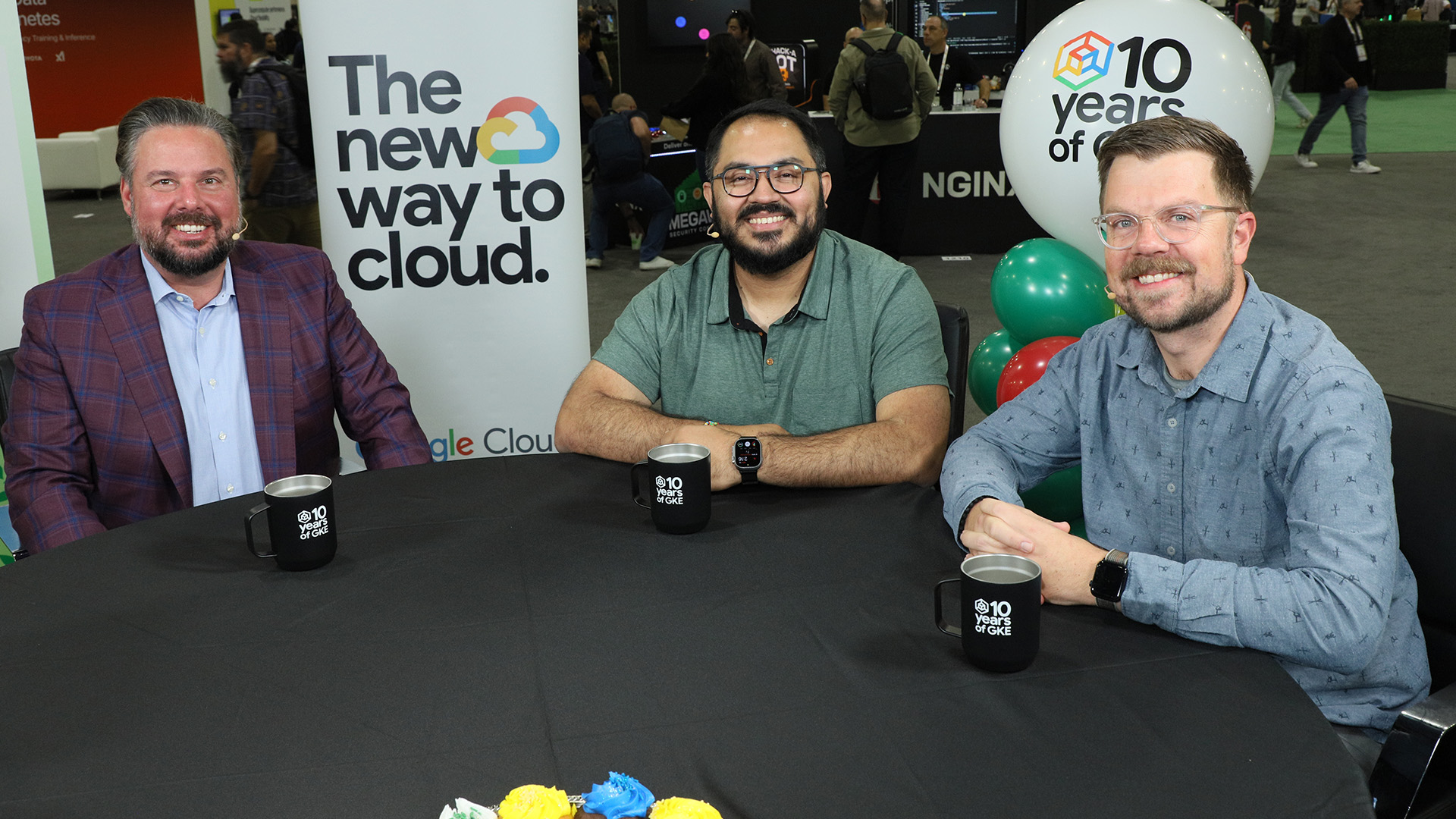
In this KubeCon + CloudNativeCon North America 2025 segment, Google Cloud’s Brandon Royal and Mofi Rahman join analyst Rob Strechay and theCUBE’s Savannah Peterson as part of a special series celebrating 10 years of Google Kubernetes Engine (GKE). The group cuts through the agentic AI buzz by grounding the definition of agents – LLMs with tool and function access – in the realities of Kubernetes, security and infrastructure complexity, highlighting why this community cares about what’s real, not vaporware.
Royal and Rahman dive into Google’s investments in isolation with technologies such as gVisor and introduce Agent Sandbox on Kubernetes, giving teams a secure environment for code execution and “computer use” so agents can browse, test and experiment safely. They explain how sandboxed browser automation, pod snapshotting and fast restore deliver roughly 90% faster cold-start performance, enabling thousands of agents to spin up in sub-second time, while a Python SDK lets AI engineers plug in from familiar frameworks without being Kubernetes experts. Strechay adds why templated, operator-style patterns and reduced toil for platform teams are key to making agentic workflows repeatable, secure and ready for next year’s real-world customer stories.
Forgot Password
Almost there!
We just sent you a verification email. Please verify your account to gain access to
GKE 10-Year Anniversary Exclusive. If you don’t think you received an email check your
spam folder.
In order to sign in, enter the email address you used to registered for the event. Once completed, you will receive an email with a verification link. Open the link to automatically sign into the site.
Register for GKE 10 Year Anniversary Exclusive
Please fill out the information below. You will receive an email with a verification link confirming your registration. Click the link to automatically sign into the site.
You’re almost there!
We just sent you a verification email. Please click the verification button in the email. Once your email address is verified, you will have full access to all event content for GKE 10 Year Anniversary Exclusive.
I want my badge and interests to be visible to all attendees.
Checking this box will display your presense on the attendees list, view your profile and allow other attendees to contact you via 1-1 chat. Read the Privacy Policy. At any time, you can choose to disable this preference.
Select your Interests!
add
Upload your photo
Uploading..
OR
Connect via Twitter
Connect via Linkedin
EDIT PASSWORD
Share
Forgot Password
Almost there!
We just sent you a verification email. Please verify your account to gain access to
GKE 10-Year Anniversary Exclusive. If you don’t think you received an email check your
spam folder.
In order to sign in, enter the email address you used to registered for the event. Once completed, you will receive an email with a verification link. Open the link to automatically sign into the site.
Sign in to gain access to GKE 10-Year Anniversary Exclusive
Please sign in with LinkedIn to continue to GKE 10-Year Anniversary Exclusive. Signing in with LinkedIn ensures a professional environment.
Are you sure you want to remove access rights for this user?
Details
Manage Access
email address
Community Invitation
Rob Strechay, Mofi Rahman & Brandon Royal
In this KubeCon + CloudNativeCon North America 2025 segment, Google Cloud’s Brandon Royal and Mofi Rahman join analyst Rob Strechay and theCUBE’s Savannah Peterson as part of a special series celebrating 10 years of Google Kubernetes Engine (GKE). The group cuts through the agentic AI buzz by grounding the definition of agents – LLMs with tool and function access – in the realities of Kubernetes, security and infrastructure complexity, highlighting why this community cares about what’s real, not vaporware.
Royal and Rahman dive into Google’s investments in isolation with technologies such as gVisor and introduce Agent Sandbox on Kubernetes, giving teams a secure environment for code execution and “computer use” so agents can browse, test and experiment safely. They explain how sandboxed browser automation, pod snapshotting and fast restore deliver roughly 90% faster cold-start performance, enabling thousands of agents to spin up in sub-second time, while a Python SDK lets AI engineers plug in from familiar frameworks without being Kubernetes experts. Strechay adds why templated, operator-style patterns and reduced toil for platform teams are key to making agentic workflows repeatable, secure and ready for next year’s real-world customer stories.
Senior Product Manager, Google Kubernetes EngineGoogle
In this KubeCon + CloudNativeCon North America 2025 segment, Google Cloud’s Brandon Royal and Mofi Rahman join analyst Rob Strechay and theCUBE’s Savannah Peterson as part of a special series celebrating 10 years of Google Kubernetes Engine (GKE). The group cuts through the agentic AI buzz by grounding the definition of agents – LLMs with tool and function access – in the realities of Kubernetes, security and infrastructure complexity, highlighting why this community cares about what’s real, not vaporware.
Royal and Rahman dive into Google’s investment...Read more
exploreKeep Exploring
What event is being covered in the text and what is being celebrated?add
What is the definition of an agent?add
What is the concept and purpose of an Agent Sandbox in the context of code execution and computer use?add
What developments and trends in Kubernetes usage are anticipated for the next year based on observations from KubeCon?add
>> Good afternoon, nerd fam, and welcome back to Atlanta, Georgia. We're here midway through day two of our three days of live coverage of KubeCon on theCUBE. My name is Savannah Peterson. Very excited to be continuing our special exclusive series with the Google Cloud team, celebrating the 10-year anniversary of GKE. Super exciting. Here to help me celebrate all of that awesomeness, our some return victims. Brandon, thank you so much for being back on the show.
Brandon Royal
>> Thank you so much. It's great to be back.
Savannah Peterson
>> It's so good. Mofi, you're a new face, but-
Mofi Rahman
>> First time. Yeah.
Savannah Peterson
>> First time caller, long-time listener. Very excited to have you on show.
Mofi Rahman
>> And you are.
Savannah Peterson
>> Yeah, yeah, it's a little bit of both with us.
Mofi Rahman
>> Yeah, a little bit of both.
Savannah Peterson
>> And Rob, sitting in the analyst to see today. You didn't even have an IFB in next to me.
Rob Strechay
>> I know I'm going without and excited to be here and helping break things down.
Savannah Peterson
>> Yeah, I'm glad you could share your insights with us today. It's interesting, because no one is going to believe me when I say this, but we really haven't talked about agentic that much here.
Brandon Royal
>> It is surprising. I know.
Savannah Peterson
>> Right?
Brandon Royal
>> I mean, well, I don't know if you've walked around the conference today, heard a thing or two about agents.
Savannah Peterson
>> Just a little bit, but I'll be honest, the hype has been a little bit ... It's AI-focused for sure, but I haven't felt, and I say this with so much love, I haven't felt the over-index on agentic that we've been hearing at a lot of the other shows that we've been at. And I think it's because this community is all about talking about what's real and not the vaporware smoke and mirrors kind of style of some of the other events that we all attend. Again, said lovingly, said lovingly. But y'all have been doing a lot of work in the agentic space. I know that Brandon, you and the team have really been working hard on laying the foundation for our agentic future. So get us all up to speed a little bit on where you're off at. I know you made some announcements recently.
Brandon Royal
>> Yeah, yeah. It's been a very exciting week. I mean, maybe we'll just start with the basic definition. What is an agent? Everyone sort of talks about an agent.
Savannah Peterson
>> Let's do that actually, because everyone seems to pretend like they know what they're talking about. I love that.
Brandon Royal
>> Yeah. I think it's worth sort of grounding ourselves in basic definitions here, because I think this is a term that has been sort of stretched and pulled in different directions. And generally speaking, we're talking about providing tool-like capabilities, just like I'm not an anthropologist, but the difference between humans and the rest of the animal species out there is the ability to use tools and agents I think in a big way are it's providing the same sort of distinction. The ability to use tools and not all tools are the same. And we've sort of seen that in the booth here or in the conference here. There's a lot of tools to provide operations and allowing agents to operate Kubernetes and then there's actually running the agents on top of Kubernetes and then providing those agents with the tools. So there's lots to sort of unpack, but I think a lot of this sort of stems from the ability to use tools.
Mofi Rahman
>> Yeah. So when we're talking about agents, we're talking about large language models that have access to function call and tools. So large language models for the most part, once it's trained, it's a static just numbers, it's a collection of numbers. And most of the large language models get trained up to cutoff. You see the word cutoff, like cutoff of August 2024, December 2025, whatever date that is. The moment you have tools, now the model can have ideas of what's current. Google Search is a very classic tool. Go search the internet, find things. The agents and the things we're talking about for Kubernetes, the other thing you mentioned, we're not seeing as much hype around agents here and I think we're doing the work to make agents truly real where next KubeCon, potentially you're going to see the hype around it because you can't just give a large language model access to your computer to do things because that's risky.
Savannah Peterson
>> You just made me feel a little queasy just thinking about that.
Mofi Rahman
>> Yeah, so again, the idea of computer you use, the idea of code execution is very powerful, but at the same time is extremely risky. So the reason I feel like in the community here in KubeCon where people want things to be real, you don't want that much power onto something that is still non-deterministic. So that's where I think a lot of the work Brandon and team is working on is going to become where the isolated environment, I think Brandon is going to talk about very deeply in the next few minutes, but I feel like what you mentioned that, oh, it's not still real, but it is going to be and that's what we're looking at. That's where we're peeking into the future a little bit.
Rob Strechay
>> Yeah. I mean, I look at it just looking at everybody on the floor here and you start to look at all of the different pieces going from chatbots to agents to agentic workflows. To your point, an agent focused on a task needing certain tools, so all the rage back in London was really around MCP. MCP this, MCP that, you get an MCP server, you get an MCP server. My favorite Oprah-ism for MCP, right? Everybody was getting one. And then A2A was put into the public and you guys put it into CNCF and that helps agent-to-agent communication. I think when we start to break it down and you talk to people and I think squishy is a good way or being stretched out.
Savannah Peterson
>> It's like a silly putty era a little bit.
Rob Strechay
>> It is. So people think to that point, think of agents in different terms and I think there's a lot of people who are on their different parts of their journey. I think it's very early and I think this is why the infrastructure portion getting solved is super interesting and important, because it's complex and I think complexity kills, it doesn't enable and that's why it needs to get simpler.
Savannah Peterson
>> I think that's a really good point. We were joking on the last segment about the return of the infrastructure celebrity, so we had Tim on, we had Kelsey on. It's like the nerds are really having this apex moment and it is that core foundation. Brandon, I'm curious when you are figuring out what to build with the team next to ensure that this foundation is as strong as it can be for those leveraging GK and Kubernetes to build whatever their future might be. A, why is Kubernetes so great for this next technology iteration? And then how do you prioritize what to build next to empower that? Because I can imagine there's a lot of demand on you from the community stakeholders, partners internally. Would love to hear what you also have to say about that.
Brandon Royal
>> Yeah. I mean, absolutely. I think in a lot of ways, just Kubernetes provides a great foundation for AI in general. We've seen this adoption. I mean, this is again, not just hype. This is some of the biggest customers that are deploying some of the biggest models for training, for inference, all using Kubernetes because it's so flexible, and it's so extensible. And we've started to see the same exact thing for agents. So you take an agent workload that's doing some of that orchestration, that's calling those different tools via MCP. Kubernetes is really well suited for that. But what we did is we wanted to look at the primitive level, building that really solid foundation. We wanted to figure out, but where are the gaps? Where are the things that Kubernetes isn't as well positioned as it could be and how can we plug in some of those gaps foundationally and allow the community to build on top of it? And that's what Mofi was talking about earlier with things like code execution, computer use. You have a machine, you want an agent to take action on your behalf. Not with a safe read-only API, but with a terminal or with code, like an actual code execution environment. There's incredible power, but there's lots of risk. So this is an area that we've been investing in quite a bit in the open source, investments that we've done in things like gVisor to provide that isolation, but really taking it one step further to make it accessible and easy and fast. That's really where we've been focusing our time and that's really what we've actually been launching this week with tools like Agent Sandbox directly in Kubernetes. Now, you can do a lot of those things directly within those Kubernetes primitives and plug in some of those holes that we've seen.
Savannah Peterson
>> Oh, yeah, absolutely. Use that silly putty to plug in some of those holes.
Brandon Royal
>> Exactly. There you go.
Savannah Peterson
>> Mofi, tell us a little bit about Agent Sandbox and what this means for the community.
Mofi Rahman
>> Yeah. So the whole concept of Agent Sandbox is you want the name agent and sandbox. I want a sandbox environment for my agent to do things. So the two key area that we initially started with is code execution and computer use. Code execution could be anything like I want to run an experiment. My data science wants to run an experiment and that needs to run some Python code or any code that needs to execute an environment. And I don't want that code to run on my local machine, and that's actually goes in two direction. One is the security aspect of it. I don't want to run random code that a large language model generated in my code environment. The other one is actually to have kind of same defaults. Your company, let's say you have certain libraries you want to use. And you can create this sandbox that has those libraries pre-installed and if you try to run the code that, that doesn't follow that guideline, it's going to just fail. And it's much easier and much cheaper to fail in a container.
Savannah Peterson
>> I was just going to say then it doesn't mess up the entire the system and you can keep messing around and kind of etch it, sketch it and just start over again.
Mofi Rahman
>> That's the code execution part of it. The other one is the computer use where let's say you want the agent to take some decision based on internet data. That's like go to this browser, go to our company doc, go to our company website, try it as a user would to give me some insight. Again, trying on your local computer, it would still work, but then you're letting a random LLM access to your browser, which is, again, if you're scared before, you're scared again, so that continues.
Savannah Peterson
>> You're really keeping me on my toes over here, Mofi.
Mofi Rahman
>> No, day two, it's going to wake you up again. So, yeah, so that kind of stuff. Now, we can run things in a sandbox environment. We can spin up like a playwright, headless Chrome browser that can do behave like a user. The demo we were actually running yesterday, we asked a Guru, like an e-commerce website, look for an item and it was ... You can see the LLM's log that says, "I am clicking this button. I'm trying to sort this by low to high because you asked to, find the cheapest item. And the first item I found was not actually type of item, it was a case for the item."
So just doing all this behavior that a user would, and this is actually useful for both type of things where you want the agent to do things, but also you have to test your own applications. Let the agent become this automated tester to go through and find all these things and both of those things with Agent Sandbox now, you can create in a sandbox secure environment where you as the platform and admin can now define these environments, set up these templates for engineers, just have access to it.
Savannah Peterson
>> And it lets more people play and get creative, because that's where we're going to find the cool solutions of the future.
Mofi Rahman
>> Yeah.
Brandon Royal
>> Exactly.
Savannah Peterson
>> It's not going to be the same.
Brandon Royal
>> Yeah. It's embracing the non-determinism of AI and agents. You can say, "Listen, I'm going to give you this sandbox. I'm going to give you enough safe guardrail around that, but then you can go and try to solve that problem, use a browser, go and browse around. Find the information that you need and then come back." And I can be very confident in that security perimeter.
Savannah Peterson
>> I was just going to bring up the security of that too, and that way we know we're not going to expose as much private data because some agent went rogue and felt like turning the lights on in a part of the business it didn't need to, or whatever that might be.
Brandon Royal
>> Exactly. And the other dimension or there a couple other dimensions just to add to what Mofi was saying earlier. The other requirement we see from customers is you need speed, and this should be pretty obvious, you're deploying one agent.
Savannah Peterson
>> I haven't heard that at all.
Brandon Royal
>> Yeah. You're deploying one agent. Okay, fine, you can have a sandbox that starts up a little slow, but you're deploying 1,000 agents, 10,000 agents. Each one of those needs to make its own sandbox calls. Each one of those needs to be completely isolated. We need to think about what is the latency, how do we bring that down to as low as possible? How do we ensure that we can scale these up as fast as possible? Throw them away when we no longer need them. So those are also the primitives that we're working on building, providing that sort of low latency experience and also just providing a better API. Providing an API that makes it really easy for an AI engineer who is not a Kubernetes expert. So they can go and they can plug this in and they can use it on day one. Super easy.
Mofi Rahman
>> And on the agent sandbox, the entire SDK is a Python SDK. So if you are building agents today with ADK, CrewAI, LangChain, whatever framework you can think of, you can just import that library, call to it. As long as your Kubernetes configs are set, it's just going to be able to use the sandbox, spin up an environment for your agent that is written in Python to talk to now, have an environment.
Savannah Peterson
>> It's just smart.
Mofi Rahman
>> Yeah.
Savannah Peterson
>> No, this is really smart. And this low latency, this gives you a 90% performance improvement over a cool start.
Brandon Royal
>> Yeah, we ran the benchmarks at the end of last week.
Savannah Peterson
>> I mean, that's incredibly significant.
Brandon Royal
>> We were all looking at each other like, "Okay, can we just check that again, make sure that's good?" Because, yeah, this is basically taking something that's multiple seconds to execute, which is okay. But if you scale that out, that's a problem. And now, we're bringing that all the way down to sub-second, even hundreds of milliseconds to execute. And if I'm doing a code execution agent, multiple executions, lots of agents scaling out, that latency really adds up. So yeah, so we're really excited about the performance that we're seeing out of the box, which is awesome.
Savannah Peterson
>> Yeah. And the pod snapshot, restoring sandbox memory, it reminds me a little bit. A fun fact. I was a Gmail beta tester 25 years ago.
Mofi Rahman
>> Awesome. Wow.
Brandon Royal
>> You and I have that in common, by the way.
Savannah Peterson
>> I love this for us. Yeah, it's probably the first technology product that I was really ever testing. So I've been a Google fan for a really long time, let's put it that way. And I remember the key differentiator is we shifted to the cloud and document saving automatically and email saving automatically. And it sounds silly now because, duh, we wouldn't lose anything like we used to, but we all remember when we were working on something and a computer crashed or hardware failed and everything fell apart. Being able to do this stuff in seconds, being able to play around and just snap right back, this actually makes a really big difference because setting up these environments is one of the heavier lifts as people start on their AI journey.
Brandon Royal
>> Yeah. And this is just a clear set of requirements. Our customers have come to us and said, "If only I could just snapshot that. If only I could just state the state of that and restore it back. It would be amazing, right?"
Savannah Peterson
>> It's the version history, but sandbox style.
Brandon Royal
>> And we're like, "Wait a second, let's just do that. We have all the pieces." It works perfectly within this agentic kind of experience where we want to say, "All right, this is the exact point in which I always want to start or I want to save this exact point and always restore back to it."
Savannah Peterson
>> And be able to come back to that if I want to.
Rob Strechay
>> But it also gets to the point of what everybody always over-indexes on that MIT report, the 5% and stuff like that.
Savannah Peterson
>> I hate that.
Rob Strechay
>> I know, but to me it's not that 5%. It's like if there's 5% of a million and there should have only been the 5% to begin with because you can snapshot and roll back, and tweak, and move on, and continue to iterate through those use cases that make sense. You get more velocity and you see more success and I think that's why it's important to have these types of features like sandboxes and snapshotting to be able to go back to. Because when you start to look at how you enable it and get the toil. Because right now, the Infrastructure as Code Conference on Monday night and talking to a lot of platform engineers and they're looking at the toil for supporting these AI environments. Not all of them are experts. Some them came from the dev side and are not Kubernetes experts, so they're looking at it going, "Hey, how do I now get to AI faster and more repeatably?" And I think that's what I love about this solution is it really helps.
Savannah Peterson
>> No, this makes a lot of sense and it feels a little bit ... I don't want to say it was a missing link, but it feels like the environment that will benefit a lot of folks as they're ramping up.
Mofi Rahman
>> Also the snapshotting part of it. So of course, this was built with the AI customers in mind first, but this feature benefits everybody.
Savannah Peterson
>> Yeah.
Mofi Rahman
>> If your workload can start faster.
Savannah Peterson
>> Absolutely.
Mofi Rahman
>> If you ask a random person like, "Do you want to wait 3 seconds or 10 milliseconds?" Who would say no?
Brandon Royal
>> Everyone wants faster.
Mofi Rahman
>> "You know what? I want three seconds." The other thing also is about some of the thing with the MIT report failure. Do you want to live in a world where basically we try nothing new so that nothing fails, or we fail on something and get something really exciting things coming?
Savannah Peterson
>> I would like that second world, personally. That sounds far more interesting. I have two final questions for you, Rob. I'm going to open up with this one on you. What do you hope agents do for you in your personal life?
Rob Strechay
>> Oh, I hope they schedule my dry cleaning.
Savannah Peterson
>> So specific, I love this.
Rob Strechay
>> Have an Uber and then tie into Uber that can go pick it up, Uber delivery or Lyft-
Savannah Peterson
>> Or Waymo.
Rob Strechay
>> ... or Waymo or whoever and bring it to my house so I don't have to go do that in the few hours I'm home a week.
Savannah Peterson
>> I was going to say, you're speaking my language. You know I have dry cleaning to do before we flip, turn again to next week.
Rob Strechay
>> I know.
Savannah Peterson
>> Okay. I love that. Mofi, what about you?
Mofi Rahman
>> I mean on Waymo topic, this is the first time I actually took at Waymo. New York doesn't have Waymo yet, so it was exciting. I think it's just taking away toil, right? I think a lot of the things ... One of our engineers, Justin, was talking about we want our engineers to actually just do the creative part of things and let computers, as much as possible, do the toilsome part. So there is fear amongst people like, "Oh, is AI replacing and X, Y, and Z?" But I think it's more about is AI freeing us from doing toilsome work to actually be doing creative work.
Savannah Peterson
>> Yeah. The question, is AI replacing boredom?
Mofi Rahman
>> Yeah.
Savannah Peterson
>> Almost to a bit.
Mofi Rahman
>> And so I think the agentic future basically does a lot of the thing that is boilerplate and toilsome and lets me just focus on creative work and gives me more free time to play board games, honestly.
Savannah Peterson
>> Heck, yeah. What's your favorite board game?
Mofi Rahman
>> Right now, I would say actually play mostly D&D mostly these days.
Savannah Peterson
>> Oh, that's awesome. I just watched an amazing documentary on board games and competitive. They have the World Series of board games. There's a whole documentary on it. You're going to have to check it out. Total side part. Brandon, what about you? What do you hope the agents do for you?
Brandon Royal
>> As much as I imagine as a manager, you love doing reports for all of your direct reports. Being a people manager is hard, but now as an individual contributor, all of our individual contributors, we can be a manager of agents. We can have all of these agents that are doing all of our work, and so I think of that. I'm like, "Oh, okay, I can actually have a set of agents that can go and do this prototyping for me." Like, "Hey, I've got a couple of ideas. Why don't you three go and try that? Try them out and see what happens." Whether it's taking a product spec and coming up with cool product ideas, building cool prototypes and code, coming back. If I can have a whole team of agents that are doing that for me, while I can focus on having conversations like this with you fine people, that is-
Savannah Peterson
>> Well played, Brandon.
Brandon Royal
>> Yeah. I mean, that's the dream, right? I can have a whole team of folks that are doing that work, agents doing that work on my behalf. So that's what I hope for. So hopefully a year from now, when we come back here, we can talk about all the productive work that our agents are doing while we're chatting.
Savannah Peterson
>> How did you know that's always my closing question? It's like you've been on the show before, Brandon. Mofi, what do you hope to be able to say this time next year?
Mofi Rahman
>> All the features that we are in beta has gone too stable.
Brandon Royal
>> So practical, Mofi.
Savannah Peterson
>> Yeah. The earnest answer there.
Mofi Rahman
>> More whimsy answer would be I think. Next year, I want to see that more and more people in the show floors are thinking about how Kubernetes API fits their workload. Every year I come to KubeCon, it's basically for me looking into the future a little bit, where the investment is going and how people are thinking about Kubernetes being. Maybe like two years ago, it was all about platform engineering backstage and all that stuff.
Savannah Peterson
>> It totally was, you're absolutely right.
Mofi Rahman
>> This year, you're seeing a lot more agents, observability of AI workload. So that's a little bit looking in the future. And hopefully by next year, a lot of that vision that people are thinking about, all of that get materializes. And as you said in the beginning of this thing at KubeCon, we are all talking about the reals. So next year agents are real and we're talking about what's next for agents.
Brandon Royal
>> Just add one more thing to that too, given we were talking about all the agent vendors that are here building really cool stuff on Kubernetes. I can't wait to come back here a year from now and see all the folks that have built on top of Agent Sandbox. We really do want to make it that much of a primitive. So if you're building these cool integrations with agents, build it on the primitives that we have. So we're really excited for that and we're already working with the community to make some of that possible, so we're excited.
Savannah Peterson
>> It'll be awesome to tell those stories on here too and talk about what that process looks like and we had greater confidence. Oh, it's going to be stuff on. I'm going to ask you, Rob, because I haven't asked you. What do you want to be able to say this time next year?
Rob Strechay
>> I'm here for the customer story, so I'm really excited. Very similarly, I want to hear how they've simplified the toil out of what they're doing. We're not talking about how we're knitting together the agentic systems, how it's really become more templatized, it's become more operator-based in Kubernetes and that we're not talking about things like LLMD and how all of the distributed functions on top of different GPUs and all of this other stuff is working. We're getting to, "Hey, this was the result. And by the way, start to finish, it was this quick and saved me this amount of toil." That's what I'm hoping for next year.
Savannah Peterson
>> Awesome. I love it. Well, I can't wait to talk about all of that with the three of you. Thank you so much for a wonderful segment.
Rob Strechay
>> Thanks for having us.
Savannah Peterson
>> You're now going to be a returner all the time. You did well, so watch out. We're going to bring you back.
Mofi Rahman
>> success.
Savannah Peterson
>> Final message to you all.
Rob Strechay
>> We'll send a Waymo for you.
Brandon Royal
>> There we go.
Mofi Rahman
>> Yeah.
Savannah Peterson
>> And it'll pick up our dry cleaning.
Rob Strechay
>> Our dry cleaning. Yeah.
Savannah Peterson
>> Oh, by the way, I love this for all of us.
Mofi Rahman
>> Hopefully he does it before it picks me up so I don't have to wait for that.
Savannah Peterson
>> Yeah.
Rob Strechay
>> Very true. Very true.
Savannah Peterson
>> Yeah, exactly. It's like the Jetsons. I've been dreaming of that.
Rob Strechay
>> But it has to look at all our schedules and understand-
Mofi Rahman
>> Exactly. All the time.
Rob Strechay
>> And then do all of that.
Savannah Peterson
>> And it'll do that-
Rob Strechay
>> Then other agent will look at other things.
Savannah Peterson
>> ... in like that amount of time.
Rob Strechay
>> I love it.
Brandon Royal
>> All within reach.
Savannah Peterson
>> I know it's all within reach. Folks, anything is possible. I hope you're feeling as inspired as we are in Atlanta, Georgia, day two of KubeCon bringing you a special exclusive series celebrating the 10-year anniversary of the Google Kubernetes engine. My name is Savannah Peterson. You're watching theCUBE, the leading source for enterprise tech news.