We just sent you a verification email. Please verify your account to gain access to
Google Cloud Next 2025. If you don’t think you received an email check your
spam folder.
In order to sign in, enter the email address you used to registered for the event. Once completed, you will receive an email with a verification link. Open this link to automatically sign into the site.
Register For Google Cloud Next 2025
Please fill out the information below. You will recieve an email with a verification link confirming your registration. Click the link to automatically sign into the site.
You’re almost there!
We just sent you a verification email. Please click the verification button in the email. Once your email address is verified, you will have full access to all event content for Google Cloud Next 2025.
I want my badge and interests to be visible to all attendees.
Checking this box will display your presense on the attendees list, view your profile and allow other attendees to contact you via 1-1 chat. Read the Privacy Policy. At any time, you can choose to disable this preference.
Select your Interests!
add
Upload your photo
Uploading..
OR
Connect via Twitter
Connect via Linkedin
EDIT PASSWORD
Share
Forgot Password
Almost there!
We just sent you a verification email. Please verify your account to gain access to
Google Cloud Next 2025. If you don’t think you received an email check your
spam folder.
In order to sign in, enter the email address you used to registered for the event. Once completed, you will receive an email with a verification link. Open this link to automatically sign into the site.
Sign in to gain access to Google Cloud Next 2025
Please sign in with LinkedIn to continue to Google Cloud Next 2025. Signing in with LinkedIn ensures a professional environment.
Practice Lead and Principal AnalysttheCUBE Research
Dave Vellante
Co-Founder & Co-CEOSiliconANGLE Media, Inc.
HOST
John Furrier
Co-Founder & Co-CEOSiliconANGLE Media, Inc.
HOST
Savannah Peterson
Principal Analyst & HostSiliconANGLE Media, Inc.
HOST
In this video, Dr. Tom Carpenter, a senior cloud analyst at theCUBE Research, explores Google's recent announcements during Google Cloud Next 2025. With a distinguished panel featuring experts from theCUBE, Carpenter provides insights into Google's advancements in AI, financial performance, and strategic innovations in cloud infrastructure.
Viewers gain an inside look into Google's major reveals, such as the Ironwood Tensor Processing Unit, next-generation networking, and multi-cloud capabilities. Carpenter, leveraging their extensive knowledge of clou...Read more
exploreKeep Exploring
What are some of the key themes and announcements you have been noticing at the expo so far?add
What were some key trends and technologies discussed at GTC and how do they relate to the importance of ecosystem development and full stack expertise?add
What are the two main barriers for modernization efforts, according to the keynote speaker?add
What were some key points discussed during a recent presentation on cloud technology and AI capabilities?add
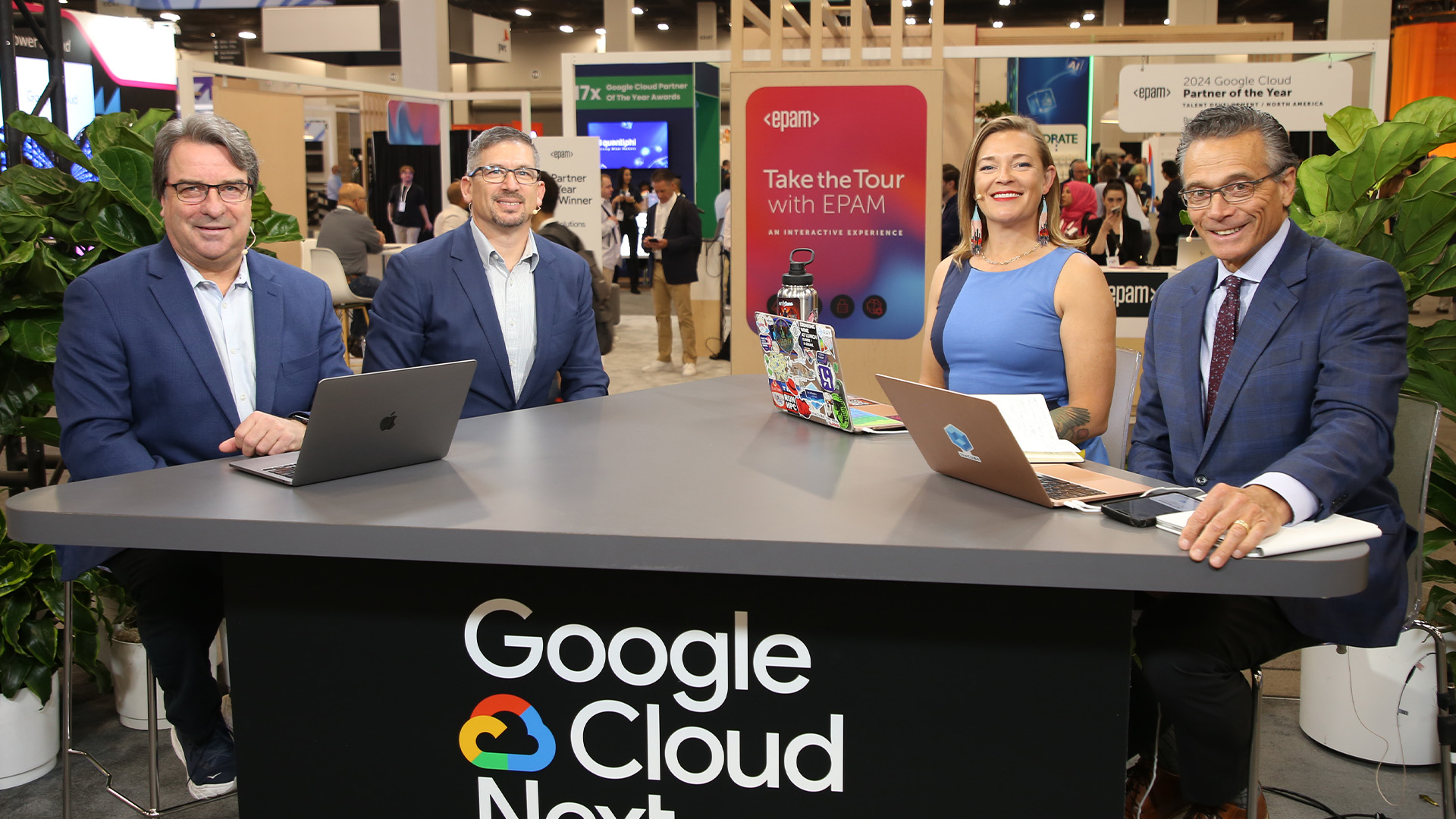
>> Good morning nerd fam and welcome to Google Cloud Next here in fabulous Las Vegas, Nevada. We are here on day one, kicking off our three days of coverage over 30 fantastic segments, upward of 50 guests coming for you this week. My name's Savannah Peterson, joined by the best in the business. On the desk this morning, we've got Dave, we've got John and Paul. Gentlemen, next time text me about the Blue Blazers.>> I know, right?
Savannah Peterson
>> Geeze.>> Blue's the color of the day.
Dave Vellante
>> Oops.
Savannah Peterson
>> Yes, it's all right. It's all right. We'll work on that.
Dave Vellante
>> I hit the thrift shop, by the way.
Savannah Peterson
>> Hey.
Dave Vellante
>> Expensive as hell.
Savannah Peterson
>> Yes. Well, good thrifting can be.
Dave Vellante
>> Can I think I went to the real, real by mistake.
Savannah Peterson
>> Yeah. Well, we'll continue that conversation. We'll get your daughter on and talk about proper thrifting at some point. The show just kicking off here on the expo floor however, there has been a lot of events already. I know the analysts yesterday involved a Wizard of Oz immersion at the Sphere. Paul, you've had the hot takes all week and I know you've been on the ground for a bit. What are you seeing so far to kick us off this week?
Paul Nashawaty
>> Well, I mean it's all about the announcements. Lots of excitement going on right now. The show floor is crazy. 30 plus 1000 of my closest friends are here, so it's pretty crazy. Just walking back and forth to the keynote was an adventure in itself. But AI, of course, optimized AI and platforms top of mind. We have multi-cloud, the Shibdi cloud environments that's also top of mind, and then interoperability. That's a big factor that you're seeing at the show that from a high level, that's really where it's really coming down to.
Savannah Peterson
>> I think you're absolutely right. I think we're going to be having a lot of those conversations here. John, I know you were listening to the keynote and you as well, Dave Keen to hear. What was the announcement that stood out to you the most?>> I mean, to me the big thing was they have a whole vision around the stack of AI and it's basically AI everywhere and all the apps everywhere, all at once kind of thing. All their apps going to be infused with AI. I think last year we said that AI infused everywhere, so that was the kind of one thing that was clear. But the thing was, the Ironwood TPU announcement was the big thing that showed massive investments in CapEx. This year I think they quoted to have, I think 45 billion. This year seventh generation TPU at Ironwood. Next Gen networking, opening up their global distributed network that's Google only to enterprises. That's going to be a big deal, like quoted Citadel and some other customers there that are going to get a 40% reduction in cost of ownership. And then they talk about Quantum, the quantum chips, and so I found that interesting. Also, Jensen wasn't on stage. He did a remote appearance, but I think the infrastructure advancements this year was definitely one that they needed to do. And the rest you kind of got to fill in squint through. There's a lot of little point examples of customers, but for the most part they're like moving the needle inch by inch, but then the big needle mover will be the infrastructure advancements.
Savannah Peterson
>> I think you bring up a good point there, John. I just want to highlight Quantum making its way back into the conversation. We sort of had AI coming up here, then both things then if we look at supercomputing and looking at the real high performance computing going on around the world, frankly, and now it's coming back. I'm curious to see.>> We had an interview last week. People say that you get to a million qubits to kind of get the chip, and so you start to see fabs chips being built with Quantum major milestone in the industry's still not there at full million qubits, but still significant.
Savannah Peterson
>> There's a lot of progress. Don't sleep on Quantum is all I'm saying. I love to hear it. Dave, what about you?
Dave Vellante
>> Yeah, let me set the context if I can.
Savannah Peterson
>> Please.
Dave Vellante
>> I mean, we all know where Google gets its money. It gets its money from search and ads. But Google, this year, our estimates are from theCUBE research that Google will do 54 billion in its overall cloud and GCP, Google Cloud platform.
Savannah Peterson
>> That's significant.
Dave Vellante
>> Yeah, it is. And it'll be about 28% of that. And for the first time last year, Google started to make a profit. It was small, but this year they're making around 15 to 20% operating margins, and that compares to AWS at mid-30s, even high-30s. Amazon. I mean, Azure doesn't report its operating margins, but I'm sure they're right up there. But the point is, for the first time ever now, by the way, Google overall cloud's growing at 30% Google Cloud platform.
Savannah Peterson
>> That's a flip right there.
Dave Vellante
>> Yes. Google Cloud platform is growing significantly faster. So for the first time, Google Cloud platform will cross over 50% of Google's overall cloud. So they're starting to make money. And the reason I bring this up is because Google gets a lot of grief for being number three, how many $54 billion businesses are out there? You're talking about a company that's the size, a business unit that's the size of Cisco, right? That's now starting to turn a profit and they're spending what, $75 billion this year on CapEx? So they're participating in, if you take the big three, about a $240 billion market, and it's rare. Tech used to be a winner takes all or most market. Now, this is an example where the lead AWS and the other lead, Azure they're doing great, and Google number three is also doing great. And the last thing I'll say is AI has been a big tailwind for their business. If you go back to 2023 and look at Google's AI business just from the ETR surveys as a percent of AWS, it was around 70%. You fast-forward to January 2025, it's up over 90% and that has boosted Google's AI.
Savannah Peterson
>> Wow.
Dave Vellante
>> And like you said, John, they got the full stack. Jensen even said it, they have the best full stack for AI of anybody in the business.>> Remember two years ago when we were here, Savannah, you remember we said Google's next is a dark horse. We highlighted some of the critical analysis.
Savannah Peterson
>> Yes, we did.>> Their operational scale-up was challenging because Kurian was getting his sea legs and they were nipping at the heels and just eating the dust off AWS on the growth. But now you've got Sundar Pichai on stage, which is a big notable thing. You've got to mention that earlier because what Google's doing is saying, "No, we're flexing." So Google is seriously flexing. Sundar comes in, gives the whole Google vision. We're at scale opening up to the enterprise, the networking. You start to see Google saying, "Hey, we're going to flex on our power." We've always loved the nerd side of Google, but now they got the blocking and tackling done. They got the ecosystem, they got the marketplace under Steve Orban growing. You start to see those third-party ISVs on Google now. AppDev is in the keynote, GKE was mentioned, the keynote. I've never seen Google mentioned Kubernetes to the level of prominence.
Dave Vellante
>> And Vertex.
Paul Nashawaty
>> Oh, without a doubt.>> That was huge. So again, these are the things that had to do when we were saying. And they're not on a dark horse anymore. They're right there and you see the adoption with AI, Dave, I agree. The product's going to be good.
Paul Nashawaty
>> Yeah. I want to jump in on what both you are talking about here, and I think the big area of growth for Google right now is we're seeing in our own research that 94% of organizations are using two or more clouds. 65% are using four or more clouds. They have to adopt the multi-cloud to hybrid cloud approach. GKE is a way to do this, right? To harmonize this across the platforms, make sure that it's working. We're also seeing in our research that 20% of respondents indicate that application portability is critical for their organization. 67% say it's very important for them. And if they're doing this across multiple clouds, that's how they're going to grow. That's why I think in the last few years you've seen the significant uptick in Google. I really hate to see that Google is number three because it's always kind of the lagger to the hyperscalers in the U.S. Market. But it's definitely growing and it has that capabilities.
Dave Vellante
>> A lot of companies would take that position, I think.
Paul Nashawaty
>> Yeah, for sure.
Savannah Peterson
>> Well, yeah, and I think what's kind of interesting though is it puts them in a unique opportunity where they can really focus on the ecosystem side of this. The data coming from AI is only going to scale infinitely really over the next five to 10 years. So who is winning now, to your point? And I love the data you were sharing earlier, Dave, great contact setting is, yeah, okay, so there was these winners in the first cloud run that we had, so to speak, but what's going to happen next is going to involve not only hybrid cloud. There's going to be a lot. And the reality is these full stacks, these ecosystem partners, we talk about it with Dell as well. It's going to be whoever wins that whole piece of the pie, not just these segments of it in terms of solutions that's going to win in this overall thing.>> I mean I think the ecosystem point, Savannah, is right on because if you're a full stack, you got to do a lot of things I call in between the toes, the details that no one sees. At GTC, we saw a couple of big trends. We talked to Equinix. They have basically the footprint for the on-prem and Edge. But at GTC was things like MVCache that was very buried, but very key instruments around controlling the clusters. Here at Google, you heard things like cluster director, anywhere cash, hyper discs, xapools and then the Pathways. You mentioned GKE Inference, Gateway Pathways, which is distributed ML Pipelining, powering Gemini. They're opening that up for multi-host inferencing. So at GTC it was all about inferencing power and then ecosystem development. I think if you're a full stack, you have to have ecosystem proof points, number one and two, you got to do the hard shit that's in the systems. That's a huge deal. They're doing it.
Savannah Peterson
>> It doesn't matter if the developers don't use it. And I think a lot of this is going to come back to the developer experience, which is what I suspect you might've been ready to talk about.
Paul Nashawaty
>> Of course the developers are going to use it. That's how it's basically being laid out. Firebase studio was another one that came up. So the thing that I found very interesting. Again, I'm going to go back as an analyst, I go back to my research.
Savannah Peterson
>> And we love that about you, Paul.
Paul Nashawaty
>> About a year ago I ran a survey. We found that 18% of production applications are using AI. We ran that survey nine months later, that number jumped to 54%, and I guarantee you that number's much higher today for all production-based applications. When you look at what Google announced with Firebase Studios and the ability to have that development effort across these different platforms using AI in the platform, that's going to be a differentiator, right? Because that's going to accelerate development and allow for that ease of use. When we talk about modernization efforts with CIOs, we see that the two barriers of entry for modernization is complexity and skill gap issues. That's what I was hearing in the keynote today, how to address complexity and skill gap issues. And that's where I think that Google is going to excel.>> And don't forget, they have the eye candy too, they have the VEO too, and at the end he quoted said, we are the only cloud that has all gen.ai and all modalities, which I thought was interesting. I didn't check that because Amazon just made an announcement yesterday and he was at the event. But again, back to the Google kind of doing the work, they're chopping the wood, they're carrying the water while scaling up the infrastructure. And again, the proof's going to be in Vertex and some of the cool consumer and enterprise stuff. And they actually intentionally said that, I don't know if you caught that. It was like we're targeting the consumer and the enterprise.
Dave Vellante
>> Well, it's important because consumer is what drives volume. And what drives adoption and it lowers cost and then it bleeds into the enterprise. We've seen that over and over and over again. But there's two other things that stood out to me. One was, they really aggressively recognized that not all AI is going to be done in the cloud. And they talked about NVIDIA. Dell got a small mention, and so they talked about sovereign AI and bringing the cloud, the AI to the data on prem, which I think recognizes that there is data gravity. There's a lot of data that's not going to go into the cloud. So that's a potential vector of opportunity. The second thing that was notable by omission, I didn't hear anything or very little about security Mandiant.
Savannah Peterson
>> Interesting.
Dave Vellante
>> And the WIS acquisition. Now of course, they probably can't talk too much about WIS.
Savannah Peterson
>> Can't talk about that.
Dave Vellante
>> But security's another big play for them. Now I wonder, is it because they don't want to tick off some of their partners like Palo Alto Networks who uses BigQuery for their AI security knowledge graph?
Savannah Peterson
>> That's a great point, Dave.
Dave Vellante
>> So they didn't really get into security. Google has great security, and of course Amazon always starts with security. I said, I was surprised that they didn't play that out.>> They have to do their own security show. They buried it with compliance sovereignty, that one kind of sound bite. They kind just buried it in one bucket.
Paul Nashawaty
>> And the Gemini agents as well. They talked about security and the Gemini agents as well there. So there's a piece of it. I do want come back to data sovereignty. What we're finding in cloud native research, we're finding that today cloud native development is happening on-prem. At 11% of respondents are saying this. But we ask them about in the next two years where that development is happening and 33% of organizations are going to do cloud native development on-prem. That means they're repatriating back from the public cloud and bringing it back on-prem to do that. So this is a wise move for Google to think about where the development is out of control.
Dave Vellante
>> Maybe it's not repatriation. Maybe they're doing the development of the cloud, but they're bringing the AI to the data that's going to live on-prem.
Paul Nashawaty
>> Definitely not them.
Dave Vellante
>> They're not going to move that data. Say, I think the repatriation narrative is going to flip and turn to bring AI to the data. I think it's a more viable approach. Yeah, there's repatriation going on. Maybe 15% of the workloads are getting repatriated, but it's not big enough to offset the->> To see it up.
Dave Vellante
>> But I just want to make one more point. The skill set point is critical. If they don't have those skill sets on-prem, they're going to go to the cloud.
Paul Nashawaty
>> Yeah.>> Hey, remember the Jensen's analyst talk we discussed? He said, still most of the training and inference is done in the cloud. That's why they're pumping the on-prem. That's where the growth is. They have AI factories. Dell jumped on AI factories. So the question to you is, did you hear AI factory in the keynote today? I mean, I heard a little bit of it. Amin Vadat talked about the Ironwood. It's interesting they call it the AI hyper computer, but he said something that we've been talking about on the keynote. The chips are only one piece of the overall infrastructure, which acts as a system, the AI hyper computing platform. That's basically their AI factory. I mean, they're basically not saying that word but it's a direct overlay for Nvidia. But yet they said, "Oh, we got Blackwell and Vera Rubin coming." So clearly AWS and Google Cloud are leveraging Nvidia and doing their own chips and leveraging their own resources. So the question will be, we'll watch will the cloud get most of that bulk load on market share for the inference? It's going to be very interesting to see if the AI factory or this on-prem motion continues to happen if they don't get software running on it.
Savannah Peterson
>> Well, I think that's where that's a part of the ecosystem in my opinion, is being able to do both.
Dave Vellante
>> So just to give you a sense Floyer, we quantified this in our research and in 2025, the data center market just for AI, the AI workloads were 252 billion, this is 2025, 252 billion. On-prem will be 15 billion of that too. So it's vast majority of the cloud, and the on-prem really doesn't kick up. It really doesn't break a 100 billion, which is still a big number until the end of the decade.>> I mean, are we in POC purgatory still?
Dave Vellante
>> We are.>> When do we break out of POC?
Dave Vellante
>> We are because of the skills.
Paul Nashawaty
>> Yeah, absolutely. And I think to your point, Savannah, on interoperability. The agent-to-agent announcement from Google Cloud today, that was something that kind of dovetails nicely into what you were talking about, the agent builder factory and how they're interrupting these things together. Having these applications talk to each other. This goes, Dave, to your point about security. You got to think of IAM and MIM, right? And is that a way of the past? Is it these agents, the agent-to-agent approaches that are going to take over that security protocol?
Dave Vellante
>> Near Zuck told me a week ago, week and a half ago, that everything we know about security has changed because of AI. He said, "We used to be able to stop 99% of the attacks and that 1% humans could deal with, but because of generative AI, it's impossible now." The adversaries can scale their phishing attacks so much.
Savannah Peterson
>> Oh totally.
Dave Vellante
>> That 1% overwhelms the humans. So the only way to defend it is with AI. So everything has to be rethought.>> If you're Palo Alto, Google's got now the Google and Cloud, when they call, it's their network that they're offering to enterprises. Google's security is damn good. If you look at their security, they got billions and billions of users.
Savannah Peterson
>> Oh yeah.>> And so I would see a security reset. So I think security wasn't messaged mainly because they didn't want to take away from the show.
Savannah Peterson
>> And they also have a security show. I mean, so I think there's->> The Bandian, right?
Savannah Peterson
>> Yeah. Yeah. I mean.>> Well, they kind of collapsed in it.
Dave Vellante
>> Didn't they bring it in?>> No, they collapsed it.
Dave Vellante
>> So it's here, right?>> Maybe it didn't happen this year.
Dave Vellante
>> Maybe it's day two.
Paul Nashawaty
>> Yeah, maybe for sure.>> Remember, Sunil Padhi ran security.
Savannah Peterson
>> I did know that.>> Along with Google. Kevin Mandiant had left, and so that's a big void in the market. So maybe they didn't have their...
Savannah Peterson
>> Because it was in October last year. Anyway, I was->> And don't forget, this was only day one.
Savannah Peterson
>> Right, I know.
Dave Vellante
>> Right, could be day two, right, you're right.
Paul Nashawaty
>> There's a lot coming in the rest.
Dave Vellante
>> Well, maybe that's where they're going to focus on posture management and the whole threat intelligence, which Mandiant brings.
Savannah Peterson
>> Absolutely. Good. One thing's clear from this conversation? We are going to have a lot to talk about all week with all of our fantastic guests. Dave, John, and Paul. No one else I'd rather do it with. Very grateful to share the week with you both.>> Thank you.
Paul Nashawaty
>> Thank you.
Savannah Peterson
>> And with all of our awesome guests, and thankful to all of you for tuning in wherever you might be. We're here in Las Vegas, Nevada at Google Cloud Next day one. My name's Savannah Peterson. You're watching theCUBE, the leading source for enterprise tech news.