Check out Box AI Agent for Gemini Enterprise (Preview): https://cloud.withgoogle.com/agentfinder/product/4701145e-37ff-4f63-9b26-0ab8ad72e85c/
In this interview from the Google Cloud AI Agents in Action event, Yashodha Bhavnani, vice president of product management and head of AI at Box, joins theCUBE’s John Furrier to discuss the paradigm shift from static AI models to autonomous, outcome-driven agents. Bhavnani highlights the massive opportunity in unlocking the 90% of enterprise content that remains unstructured, explaining how Box leverages Google Cloud’s Gemini and Vertex AI to transform messy data (like contracts and HR documents) into structured, actionable intelligence. The conversation explores the strategic depth of the partnership, detailing how multimodal capabilities allow intelligent agents to securely extract context and classify information, effectively turning a company's knowledge base into a dynamic engine for decision-making.
Bhavnani and Furrier also delve into real-world use cases where agentic workflows are redefining productivity, from automating complex insurance claims processing to synthesizing marketing strategies across disparate data sources. Bhavnani emphasizes the critical role of the Agent-to-Agent (A2A) protocol, which allows Box agents to interoperate securely with other business systems, enabling seamless cross-platform automation without compromising data privacy. The segment concludes with a look at how the Google Cloud Marketplace is streamlining the adoption of these tools and Bhavnani’s vision for a future where custom enterprise agents eliminate manual drudgery to accelerate business velocity.
Forgot Password
Almost there!
We just sent you a verification email. Please verify your account to gain access to
Google Cloud: AI Agents in Action. If you don’t think you received an email check your
spam folder.
In order to sign in, enter the email address you used to registered for the event. Once completed, you will receive an email with a verification link. Open the link to automatically sign into the site.
Register for Google Cloud: AI Agents in Action
Please fill out the information below. You will receive an email with a verification link confirming your registration. Click the link to automatically sign into the site.
You’re almost there!
We just sent you a verification email. Please click the verification button in the email. Once your email address is verified, you will have full access to all event content for Google Cloud: AI Agents in Action.
I want my badge and interests to be visible to all attendees.
Checking this box will display your presense on the attendees list, view your profile and allow other attendees to contact you via 1-1 chat. Read the Privacy Policy. At any time, you can choose to disable this preference.
Select your Interests!
add
Upload your photo
Uploading..
OR
Connect via Twitter
Connect via Linkedin
EDIT PASSWORD
Share
Forgot Password
Almost there!
We just sent you a verification email. Please verify your account to gain access to
Google Cloud: AI Agents in Action. If you don’t think you received an email check your
spam folder.
In order to sign in, enter the email address you used to registered for the event. Once completed, you will receive an email with a verification link. Open the link to automatically sign into the site.
Sign in to gain access to Google Cloud: AI Agents in Action
Please sign in with LinkedIn to continue to Google Cloud: AI Agents in Action. Signing in with LinkedIn ensures a professional environment.
Are you sure you want to remove access rights for this user?
Details
Manage Access
email address
Community Invitation
Yashodha Bhavnani, Box
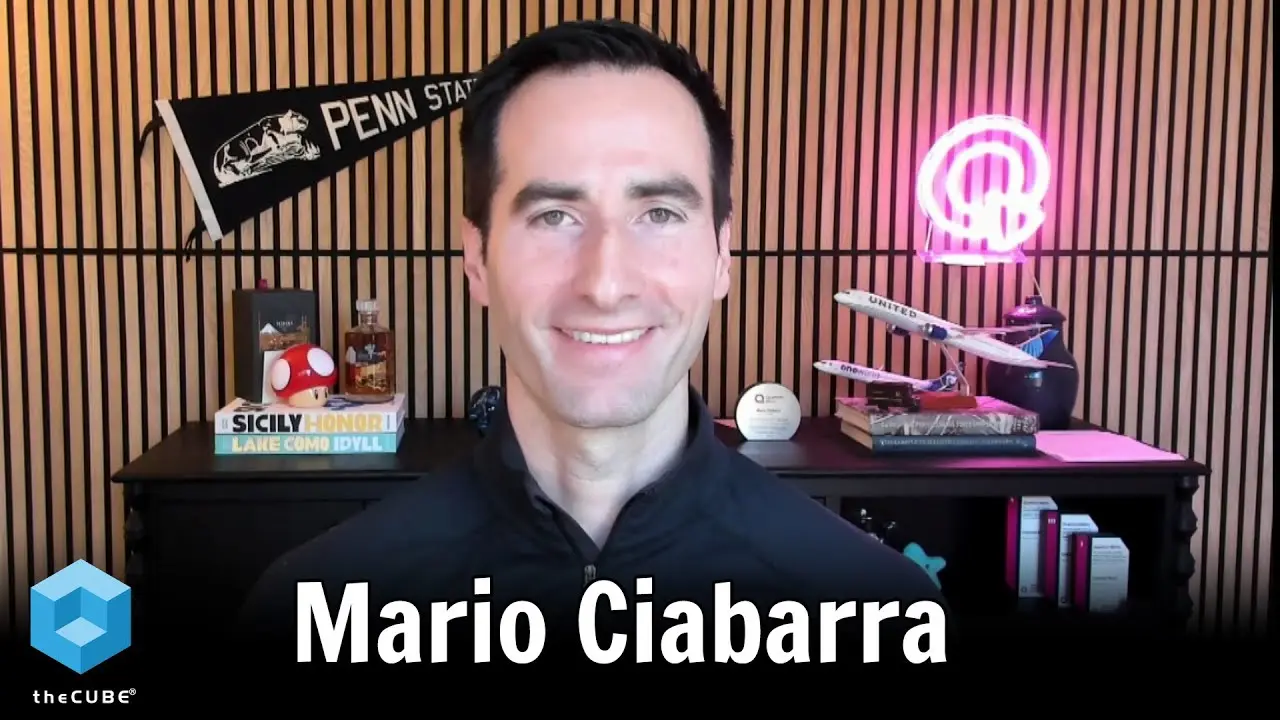
In this Google Cloud AI Agents in Action interview, Quantum Metric CEO Mario Ciabarra joins theCUBE’s John Furrier from the NYSE studio to explore how enterprises are shifting from digital self-service to autonomous, agent-driven experiences. Ciabarra explains how agents are beginning to complete tasks end-to-end on behalf of users – and why “getting digital experiences perfect” matters more than ever as agents have no brand loyalty and will abandon friction instantly. He shares how Quantum Metric is “releasing a new product” to show what agents are doing on company websites, and why precise data is essential to prevent hallucinations as teams use agentic AI to improve customer journeys across banking, airlines, telco, healthcare, gaming, retail and more. The discussion connects directly to Google Cloud’s ecosystem – covering the AI Agent Marketplace, Felix AI built on Google Cloud and how BigQuery and Gemini Enterprise underpin openness, technical depth and trust for agent-to-agent orchestration.
The conversation dives into real enterprise outcomes: moving from probabilistic to deterministic answers (e.g., “Why are sales down today?”) by orchestrating signals across marketing, merchandising, APIs and even weather; evolving employee experiences where a single interface (Gemini Enterprise) executes tasks across multiple back-end systems; and a mesh-style agentic platform that integrates systems such as Quantum Metric and Salesforce while routing through agents instead of point-to-point integrations. Ciabarra shares noteworthy marketplace metrics – about one-third of overall revenue flowing through Google Cloud Marketplace, faster collections for the CFO, and nearly 60% of net-new revenue influenced by GCP – highlighting co-sell momentum. Looking ahead, he describes how websites will personalize and improve themselves autonomously, powered by data on both human and agent interactions, with governance and privacy as core design principles.
play_circle_outlineTransition from AI tools to AI-driven outcomes and autonomous agents in the industry.
replyShare Clip
play_circle_outlineBox's partnership with Google Cloud enhances integrated AI solutions and security measures.
replyShare Clip
play_circle_outlineBox AI Extract agents automate data extraction from complex documents like lease agreements.
replyShare Clip
play_circle_outlineTransforming Industries: AI Use Cases in Insurance, Marketing, and Sales for Enhanced Productivity and Compliance Through Automation
replyShare Clip
play_circle_outlineThe AI Agent Marketplace simplifies access to AI solutions within customer Google Cloud environments.
replyShare Clip
play_circle_outlineGoogle Cloud Marketplace streamlines procurement and supports Box’s global expansion efforts.
In this interview from the Google Cloud AI Agents in Action event, Yashodha Bhavnani, vice president of product management and head of AI at Box, joins theCUBE’s John Furrier to discuss the paradigm shift from static AI models to autonomous, outcome-driven agents. Bhavnani highlights the massive opportunity in unlocking the 90% of enterprise content that remains unstructured, explaining how Box leverages Google ...Read more
exploreKeep Exploring
What is the opportunity for customers as companies increasingly focus on AI and agentic solutions?add
What role does context play in the effectiveness of agents in relation to Box and Google Cloud?add
What tools are available for extracting and classifying data from documents, and how do they function?add
What are some ways that Box AI Extract agents can improve the process of handling insurance claims files?add
What is the significance of the Box AI agent for the Gemini Enterprise AI Agent Marketplace?add
What are the benefits of the Google Cloud Marketplace for customers and how does it impact enterprise content management?add
>> Hello, I'm John Furrier with theCUBE. We are here at the New York Stock Exchange Studio. Of course, we have our Palo Alto Studio and our guest here coming in from Silicon Valley. We're going to talk about AI and the conversation of AI as it's shifting from models and tools to outcomes and autonomy. We're moving beyond applications that just inform to intelligent agents that perform. Welcome to the AI Agents in Action Series, brought to you by Google Cloud, the show where we go beyond the hype and talk to the leaders who are making it happen. We have Yash Bhavnani here, vice president of product manager, head of AI at Box, a company who's leaned in from day one on AI and now agentic, as the business starts to be rebuilding under the agent wave. Yash, thank you so much for being part of the series, our leader series on AI in Action.
Yashodha Bhavnani
>> John, great to be here. Super excited to talk about agents and just what Box is doing and how we're transforming work.
John Furrier
>> We've been following on theCUBE many conversations with you guys, have been leaned in from day one on AI. And obviously, you guys have great impact and your customers. What's the opportunity for your customers as you guys see it right now? Because again, we're moving into that third scaling law that NVIDIA talks about a lot around deep thinking, beyond reasoning. So, you've got this whole nother level we're hitting. What is the opportunity for the customers and the industry?
Yashodha Bhavnani
>> It's massive. This is possibly the most fundamental paradigm shift we're going to see in the way things work. So, first of all, if you just take a thought back in terms of just all the content and all the data that enterprises and customers have. Most of it, in fact, 90% of content that an organization has, whether it's HR documents, whether it's product documents, whether it's financial documents, they're all unstructured. Meaning, that they're not in a beautiful table, they're not easily extractable. Which means that even just accessing your own information, being able to build products, drive workflows, all of that, which the heart of a company that runs on content has been hard to access, hard to use. It requires manual reviews, it requires you to read multiple documents. It requires you to know where things are. And I think AI fundamentally just unlocks this by bringing together this capability of you can now use AI across this 90% or unstructured content that any enterprise may have and extract what are the insights you need for that task? And I think this is just going to drive the next wave of better decision making, higher velocity, and just more of what an enterprise can do now of all the things that they couldn't do before.
John Furrier
>> We just had the closing bell here at the NYSE. We just heard the bell here at the stock exchange on the options side and the numbers coming in from the cloud is looking really good. The ecosystem is changing. Talk about the partnership and the strategic why behind Google Cloud because it's not just agents, there's also the development environments, A2A, Vertex, there's security solutions. Google has that integration piece and this idea of working and integrating in with the platform. Talk about the strategic why with Google Cloud.
Yashodha Bhavnani
>> Yeah, absolutely. There's a couple things we're doing at Box, and this is where the partnership really flourishes. So, first and foremost, fundamentally as you think of the world of agents, what are the best agents? When you think of what are the best agents? The best agents have the best context and Box has that. Box has knowledge, all the knowledge of your entire enterprise. And if you think about that, you can now use AI, build an agent, use agents with this context. And the richer that context is, the better the agents are. And the reason that I'm touching on agents is because it's super, super, super locked in to how we're using Google Cloud on multiple layers. So, first, just Gemini as a model and Vertex AI. One of the tools that we provide and one of the agents that we provide is our Box AI data extraction agent and classification agents. So, these agents, what do they do? I'll walk you through an example. If you had 100 page lease agreement and you had multiple of those and you wanted to drive in and say, "Well, when was this written? When does it end? What's the value of the contract?" Instead of now parsing through 100 pages, the AI can extract that information for you. And this technology is just super key when we think of taking unstructured data and making it feel structured. And so, for this, we use Gemini and Vertex AI and it's a great partnership because Gemini is one of the frontier models that is multimodal in nature, which means that when you're looking through a lease agreement, when you're looking through a document and it has images, text, table. We can use Gemini and the Vertex AI to really power Box AI extraction. So, that's been a huge partnership, very successful. We've had Box AI Extract the API available for standard, as well as Enhanced Extract Agent for a while now and it's one of the most useful tools that our customers have really, really loved from our AI solutions. So, that's one. The second one is at Box, we think of ourselves, and I invite many other companies to think of themselves as a valuable link in the chain. And so, here having the A2A protocol with Gemini Enterprise is just critical because it allows you to use Box and Box AI in light with other agents in the cross-ecosystem. So, this means if you're running a marketing campaign, you can pull in documents from using the Box AI agent and then A2A, go into your marketing records using another agent from another company. And now, you really get to the power of a enterprise can solve problems with datasets from different storages and use the power of AI on top of that. So, that's a Q1 security as Box is known for its security, for making sure data is always secure. It's a principle that we hold. And a big part of this is we also use Google Cloud Security and KeySafe to really control the encryption of keys, making sure AI plus enterprise-grade data is always protected and useful for your collaboration. And finally, I also want to call out just a partnership we've had with Box Google as well as Slalom where you can build an entire solution combining, we have the intelligent content, Google's AI capabilities and the consulting experience to generate a solution that can go across multiple data sets and drive a document generation or actionable insights across contact. So, these are some of the ways that the partnership has been extremely, incredibly valuable, not just for us, but for our customers.
John Furrier
>> We've been covering a lot of these use cases as the AI wave has been going through and it's interesting. Now, we're at the time where even at the top, when I was mentioning, the performance side of it, the work being done by the agents is really what everyone's talking about in the industry. You guys have been setting the table, you've got the platform, you've got all those features, the security and all the, I will say plumbing, but all that work that cuts across the different databases and the data and the content. As we start to see the AI working and the value that's presented, it kind of becomes obvious. So, it's like, "Okay, it's working. It's worth it." What are some of the use cases you're seeing now right now with the agents? Because A2A allows agents to talk to each other. What is Box seeing with the customers on use cases? Because now, you've got next-level agents happening, so they're doing work. And it's not that it's going to replace jobs. I mean some people just don't want to do the jobs. There's a lot of grinding that goes on in a lot of this work. Can you share some examples where you're starting to see really clear lines to value? And then, how does the agents help the work get done or perform?
Yashodha Bhavnani
>> Yeah, and I love that you touched on this point of like, "Oh, is going to replace a knowledge worker?" And my stance is actually it makes a knowledge worker way more powerful because what we've been seeing with AI is not that AI is replacing work, but that AI is enabling you to do the work that you never were able to do before, you never had time to do before, it was too burdensome to do or it was too manual and you were doing it, but not happily. And that's the sweet spot of where we've seen agents come in and bring huge value when they're contextual with the right context for certain customers. And we've seen a lot of these examples. I mean, I can walk you through a few, John. One of my favorite ones is insurance. So, if you think about file claiming, claims files, you have so many claim files that come and it is all unstructured and it may be different. Some may have lots of data, some may have pictures, some may not, and so there's a variance across these documents. Not only that, it's proprietary. It's not something you can share, it's very proprietary data. And so, one of the things we've worked with our insurance customers on is using Box AI Extract agents. So, now, rather than a human manually and begrudgingly having to go through a multiple different claims file, you can use Box AI Extract. And you can even configure this agent to say, "Okay, here are the 1,000 claim documents I have. For each of these, I just need to know five or 10 or 20 things. I need to know the date of the claim. I need to know was the claim accepted? I want to know the amount. What were the parts?" There could be different fields, what we call fields in terms of what's the information you want? And not only that, you can even nuance these fields. You can say, "Well, actually, the end date of a claim is not the end date that is recorded in the document, but 30 days after because that's our policy." And the AI can take that as a prompt and make sure that when it generates these insights or these extractions that's conveyed. And so, we've had a customer that use our AI extraction technology to go through thousands of these claim documents to extract the right fields. And now guess what they can do when it comes time for compliance, when it comes time for reporting, they no longer have to sit there, look through 1,000 documents and make a spreadsheet. They can simply query because now these insights attached to the documents securely in Box, and you can simply ask, "What were all the claims that were filed in the last month over the price range of X thousand?" And that went from hours and hours of work to a few minutes, if that. So, that's something that we've seen extensive value in, which is just taking a bunch of unstructured data, extracting out the insights, and then being able to use that for reporting or just compliance. Another one's marketing actually. So, generating pitch decks or content briefs requires blending data from public, as well as commercial sources. Because you may have your brand details, you may have your brand guidelines in Box, but you also want maybe some commercial data or some other sources from whether it's the web or something else. And here, being able to use this agent-to-agent interaction and say, "Here's Box AI agent, and I'm going to pull in my branding guidelines, my policies and all of that from my Box content that is dynamic and constantly changing." And also, be able to query another database or the web to generate a really sound pitch deck or brief. That's been a huge, huge... Just in terms of marketing and just really up-leveled the type of work that customers have been able to do. So, that's the second one. Don't know if those resonate, but I have a third one for sales, which is really, really also key because every customer, every company in the world has to sell. And so, if you think of the sales flow, you might have contracts in Box securely stored. And then, you might have some other sales records in a CRM. And over time, what you need to do is build a plan using the content you have in Box, the content you have in another data store. And this is where this sort of partnership and building a solution across two agentic frameworks has been super valuable because now you don't have to dig here and then go dig here because the agent can do some of that work for you, and you can just spend your time actually thinking about what the plan is or the strategy should be.
John Furrier
>> Yeah. To your point about the human in the loop, the knowledge worker, they're more productive. I hear you talking about those different examples. In my mind it's like, "Okay, that's a different department. That's a different department. That's a different department." And everything's generative now, so you're cutting across data that you guys have in the platform for the customers, and then the agents are making it faster, runtime assembly, if you will, for getting an answer or getting something accurate. So, this is a time savings. I mean, the unlock is okay, time, productivity. I mean, imagine doing a pitch deck and actually having details from contracts that just closed or a sales pipeline report. This makes everybody faster and almost having a brain ready there for you. I mean, this is where AI is going and you got to set the table because it's not overnight. So, share your thoughts on that because I think a lot of people think they see those stats, "Oh, these AI projects are failing," which I don't buy that survey by the way, but as Thomas Edison said, "I failed 2,000 times before I discovered electricity." But there are use cases where you can get the workflows nailed down. Can you share your experience on the Box side? Because you've got all the documents, you got all the content, and you're building in with Google Cloud. What's the best practice, is the question for setting this up and getting value immediately on the table because the key in all this?
Yashodha Bhavnani
>> Personally, John, I've been just so excited at where we are in terms of Box content and AI. If there's one place where AI can be a paradigm shift, truly help people every single day with the most gnarly things, it's unstructured content in the enterprise with AI, which is personally why I'm so excited about this space. It's truly where I think the rubber hits the road with AI here. And this is the moment for it. So, every day I talk to customers and they'll go through a list of problems like, "All these problems and all these magical AI things that I've been hearing about." And I always start with two questions, which is like, "Hey, what is one of the most gnarly, boring, annoying problems that nobody wants to do that they're doing right now? What's the boring stuff?" And they're like, "Huh?"
I'm like, "Yeah, what's the boring stuff? What's the manual reviews? The looking through 100 documents? The reading 100 things? What's that hard stuff? And can we put some of our Box AI agents on that, whether it's metadata extraction, whether it's some of our other agents?" So, that's always the first question. And the second question is, "Tell me the hardest problem. Tell me the problem you haven't solved yet." Whether that's, to your example, John earlier, where it's, "Well, we want to build a pitch deck, but every day, we're getting new things and the content is dynamic and, oh, hold on, we've got a record over here that we also want to include and our brand guideline is changing and our go-to-market messaging is changing. And how do you do this?" And that's another place where you want to apply AI where it's really hard, we don't know how to do it, so can AI give us a step forward? One thing I will say is you have to have a sense of patience with AI. So, I've seen magic where it's like single, you build an agent, it's awesome, it works the first time. Awesome, that's great. But I've also seen that there is usually a sense of you have to just iterate through it, which is you'll build the agent, "Oh, it didn't give me that exact field that I wanted to iterate on with 90% confidence. So, how do I reprompt it? How do I do it one more time?" So, there is a sense of patience, but it's so worth it because once you unlock with the value of now I don't need to read through 100 documents and have people doing this boring work, just to figure out what was the amount of each document, that's just huge. It's a huge unlock. So, yes, a sense of patience is required.
John Furrier
>> Yeah, and conviction. People leaning into it will win. And we saw that in the pandemic. And last year at Google Next we also started to see the ecosystem where Google Cloud and the partners started to see that integration, that co-design, that work, engineering. This year, I'm sure we're going to talk a lot at Google Next, the next event, the rise of the agentic layer, which is basically A2A, where agents have to talk to each other. There's trust involved. You mentioned security. So, I have to ask you how you see the Agent Marketplace affecting the customers in Box because this extends reach to your customers with more solutions. And we're starting to see the validation of some the hourly commentary. We think agents will talk to each other, models will talk to each other, big models, small models, multimodal models, all kinds of models that turn into actionable software. How has the AI Agent Marketplace changed for you guys and impacted your customers?
Yashodha Bhavnani
>> Yeah, I think it's huge in terms of what you talked about in terms of reach, but it's even like a step forward from reach because when we offer Box AI agent for the Gemini Enterprise AI Agent Marketplace, what we're really offering is we're making it easier and then a lot simpler for our customers to really capture the power of AI with their content, while directly being in their own Google Cloud environments. So, you can go to the marketplace, you can work with your content in Box securely, and you can work with your content in other places securely. So, I think that's just a huge unlock. And it, again, goes to a core principle of Box, which is we are a valuable link in the chain and we truly, truly want to continue being a valuable link in the chain and I think this is just great from a marketplace perspective. The other thing is just using the A2A protocol. We can ensure that the Box AI agent that is tapping into your content is secure, it's interoperable, and it provides a bridge with other agents in Gemini Enterprise, which is also really huge in terms of connecting data stored in Box with business systems. And over time, the unlock becomes, because you can go through different agents that have different powers and they can interact securely without leaking data across each other, you get to a point where businesses can automate workflows, and that's just going to generate a completely new different way of how you work. You don't have to manage a workflow, you don't have to think how data passes. It all goes through these agentic systems that you know are secure. So, yeah, super excited.
John Furrier
>> Yeah. I love the the AI Agent Marketplace, because it's really going to give more faster time to value and also get the adoption up. So, that's awesome and I'm looking forward to having those continued conversations. So, I have to ask about the other marketplace, which is Google has a Cloud Marketplace, that's been of a business driver perspective. We're seeing a lot of growth on the go-to-market that Google does together. Talk about the business opportunity, the business metrics on the go-to-market side for Box and the Google Cloud Marketplace.
Yashodha Bhavnani
>> Yeah, absolutely. I think the Google Cloud Marketplace really enables customers to easily purchase and adopt all of the exciting content and AI experiences and all of the agents that we've been discussing. So, the sheer presence of Box in the marketplace really shapes how companies approach enterprise content management and can they do it at scale? And this really streamlines procurement and these reseller partnerships a little bit more. And Box has started to accelerate its global footprint. So, what you have is you can offer customers more flexible billing options, and this maximizes their existing cloud investments while being able to tap into Box.
John Furrier
>> As the head of AI for Box, I have to ask you to close out, what's your vision as this unfolds? Because again, you guys are in a perfect position with one, the company's core principles, which is content. It is a system of record, it's unstructured, it's structured, it's all over the place, which now feeds the AI. How do you see the vision evolving in the next few years? And what are you keeping your eyes on? What are you watching closely in terms of key things to pay attention to, double down on? What's your focus on that?
Yashodha Bhavnani
>> Yeah, I'd say if I were to think through the vision, what are the step changes you're going to see in the next couple of years? The three that I want to call out and that we're actively driving to make come true, first, is just making unstructured content feel structured. So, nobody ever has to go through the manual process of, "I need to find something for my data. I don't know where it is. I have so much data and I can't find... I have an audit and I can't figure out am I compliant or not because I have to now dig through all this content." So, turning unstructured into structured is just a massive unlock, right? The second one is we know the best AI is contextual and it's tailored. And every business is unique, and we want to actually drive that forward and we want to help customers really tailor AI. And so, a big lean in that we're doing is we're enabling our customers to build agents with their enterprise content securely, using the best agentic frameworks, using the best tools that are out there that can work in their environment, so that truly they can have agents that represent their work. So, that's part two. And then, part three is what we touched on a little bit, which is workflows, right? If you think about just the efficiency gains of agents in workflows, these workflows that have not been re-imagined for many, many, many years, these ones that are manual, they're hard to even ensure accuracy. They require people to do multiple actions across multiple systems. And just being able to not only automate it, but ensure it with agents, with a high quality, a higher efficiency, and maybe even a higher performance than what you're having today, you're unlocking so much efficiency that I think this is what drives business growth because now you have the space to grow.
John Furrier
>> It was great to have you on. Thanks for sharing. And again, Agents in Action, that's the title. And we know the Box employees are all coding their own... Even the CEO's out there, sharing his agents. So, great culture. And again, when people are building agents, it's great to see that result. Thanks for coming on and sharing your perspective and what you guys are doing on our Agents in Action series.
Yashodha Bhavnani
>> Thanks, John.
John Furrier
>> Okay. I'm John Furrier, host of theCUBE. This is the AI Agents in Action series, brought to you by Google Cloud. Thanks for watching.









 John Furrier