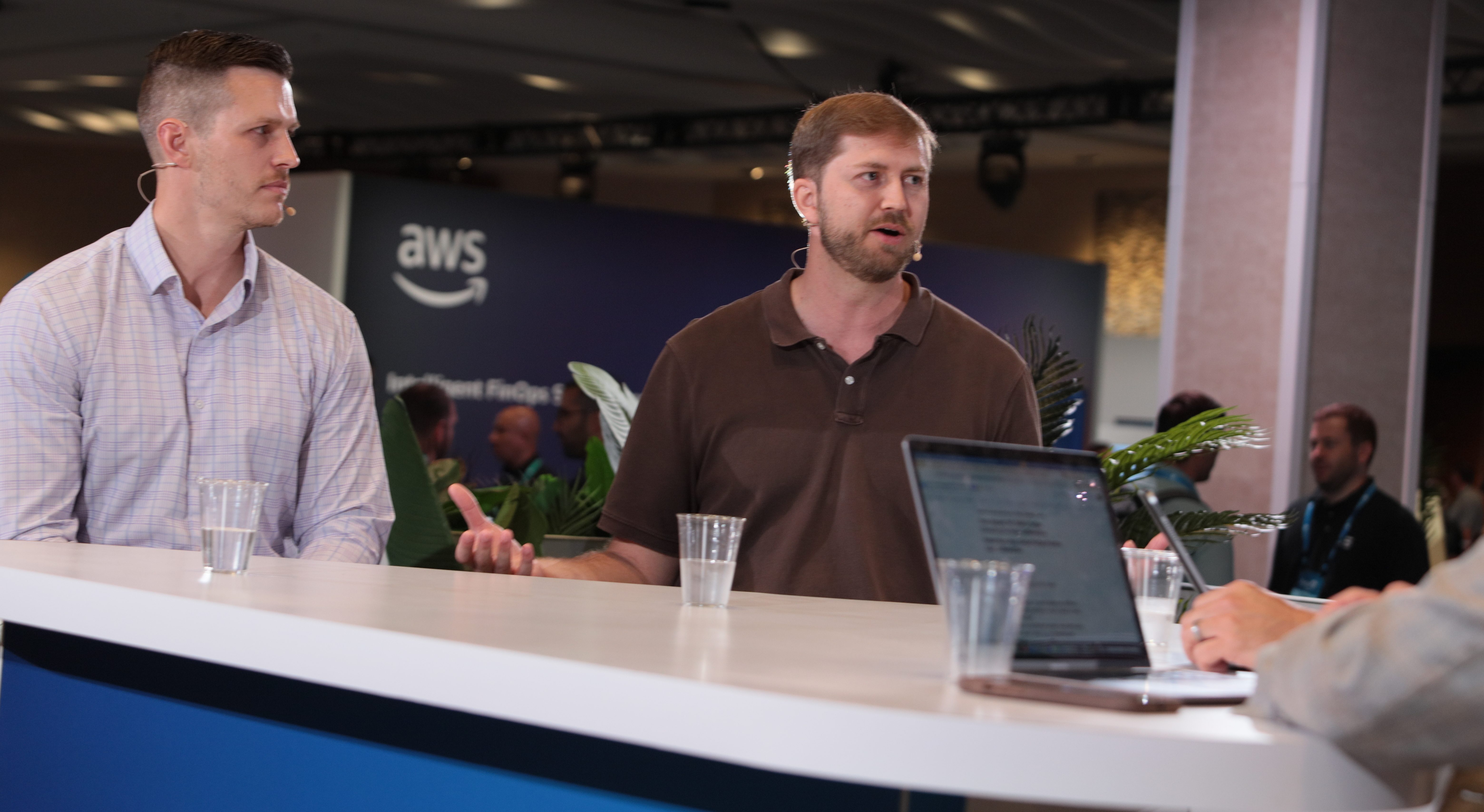
At FinOps X 2026 in Sydney, theCUBE Research hosts John Furrier and Paul Nashawaty sit down with Parker Nancollas of SoftwareOne, global FinOps practice lead, and Trent Allgood of SoftwareOne, vice president IT asset management and FinOps consulting services. The panel addresses FinOps for artificial intelligence, abbreviated to AI, token-based cost models and token economics. It also examines unit economics and model lifecycle management. The discussion highlights the evolving skillsets and cross-functional collaboration required to govern AI costs across engineering, finance and IT asset management, abbreviated to ITAM, and product teams.
Nancollas emphasizes prioritizing business outcomes over raw token metrics and stresses that tokens are only one variable in AI unit economics. They recommend aligning model evaluation metrics with product key performance indicators and embedding cost awareness into the model lifecycle. Allgood emphasizes the need for unified frameworks and cross-functional collaboration between FinOps, IT asset management and engineering. They highlight governance patterns to measure and allocate costs, establish accountable ownership and integrate ITAM with FinOps practices. theCUBE Research observes that organizations must embrace rapid iteration, start with pragmatic practices, measure impact and evolve governance continuously.
Forgot Password
Almost there!
We just sent you a verification email. Please verify your account to gain access to
FinOps X 2026. If you don’t think you received an email check your
spam folder.
In order to sign in, enter the email address you used to registered for the event. Once completed, you will receive an email with a verification link. Open the link to automatically sign into the site.
Register for FinOps X 2026
Please fill out the information below. You will receive an email with a verification link confirming your registration. Click the link to automatically sign into the site.
You’re almost there!
We just sent you a verification email. Please click the verification button in the email. Once your email address is verified, you will have full access to all event content for FinOps X 2026.
I want my badge and interests to be visible to all attendees.
Checking this box will display your presense on the attendees list, view your profile and allow other attendees to contact you via 1-1 chat. Read the Privacy Policy. At any time, you can choose to disable this preference.
Select your Interests!
add
Upload your photo
Uploading..
OR
Connect via Twitter
Connect via Linkedin
EDIT PASSWORD
Share
Forgot Password
Almost there!
We just sent you a verification email. Please verify your account to gain access to
FinOps X 2026. If you don’t think you received an email check your
spam folder.
In order to sign in, enter the email address you used to registered for the event. Once completed, you will receive an email with a verification link. Open the link to automatically sign into the site.
Sign in to gain access to FinOps X 2026
Please sign in with LinkedIn to continue to FinOps X 2026. Signing in with LinkedIn ensures a professional environment.
Are you sure you want to remove access rights for this user?
Details
Manage Access
email address
Community Invitation
Trent Allgood & Parker Nancollas, SoftwareOne
At FinOps X 2026 in Sydney, theCUBE Research hosts John Furrier and Paul Nashawaty sit down with Parker Nancollas of SoftwareOne, global FinOps practice lead, and Trent Allgood of SoftwareOne, vice president IT asset management and FinOps consulting services. The panel addresses FinOps for artificial intelligence, abbreviated to AI, token-based cost models and token economics. It also examines unit economics and model lifecycle management. The discussion highlights the evolving skillsets and cross-functional collaboration required to govern AI costs across engineering, finance and IT asset management, abbreviated to ITAM, and product teams.
Nancollas emphasizes prioritizing business outcomes over raw token metrics and stresses that tokens are only one variable in AI unit economics. They recommend aligning model evaluation metrics with product key performance indicators and embedding cost awareness into the model lifecycle. Allgood emphasizes the need for unified frameworks and cross-functional collaboration between FinOps, IT asset management and engineering. They highlight governance patterns to measure and allocate costs, establish accountable ownership and integrate ITAM with FinOps practices. theCUBE Research observes that organizations must embrace rapid iteration, start with pragmatic practices, measure impact and evolve governance continuously.
>> Welcome back to theCUBE's live stream here in Sydney for FinOps X 2026. I'm John Furrier, Paul Nashawaty with theCUBE Research. We're talking about AI value creation, token analysis, FinOps for AI, AI for FinOps. Got two great guests here who are in the field. Trent Allgood, VP of ITAM FinOps Consulting at SoftwareOne. Great to see you. Thanks for coming on. Parker Nancollas, global FinOps practice lead at SoftwareOne. Thanks for coming on. Guys, big crowd here today. A lot of buzz. Obviously cost controls, AI usage is high. Value creation is high. It's managed chaos. So it's chaotic, but it's being reigned in. What's your thoughts? Trent, we'll start with you.
Trent Allgood
>> Yeah. It's interesting because we're at the FinOps conference, right? And in the past, FinOps was synonymous with cloud, but the FinOps Foundation has purposefully changed that definition over time. The problem has become more complex, the value that FinOps can create is becoming bigger so that's why we're all here now talking about AI. That has been the conversation of today, right? But that's also the conversation more broadly than the industry.
Paul Nashawaty
>> Of course.
Trent Allgood
>> So that's been, I think, the big shift in terms of... And when you say "chaos", that's what we're all trying to figure out now is everybody's been thrown, "Here's AI, go use it, go create value," but how do we now manage the costs that it's also creating?
John Furrier
>> Parker, talk about the dynamic because a lot of practitioners are leaning in and you don't have a lot of case studies, it's unfolding as we speak. How are you guys seeing that and how are people reacting? Because they're jumping in, they have to, the growth is there, the numbers are coming in.
Parker Nancollas
>> It's similar to what they did with cloud. So when cloud was new and people were struggling to manage it, not everyone was doing it perfectly and I think that's okay. I mean, that's really the whole point of FinOps is it's about continuous improvement. The best practices are evolving every day and what we might say is a best practice today might not be a best practice a week from now and that's okay. The point is we do what is best today. We do something and as the industry evolves, as the best practices evolve, we will evolve as a service provider, our customers will evolve and that's great. We'll learn as we go.
Paul Nashawaty
>> Yeah. That's a great point. You have different models, you have different ways of doing things, which applies to your best practices and different ways of doing things. When we look at this, leaders are also thinking about this from the context of looking at token costs across multiple models is often misleading. This is not normal, it's not normalized when you look at it that way. So from a unit economics standpoint, what should practitioners do to look at this to normalize? What are your thoughts?
Trent Allgood
>> So the FinOps Foundation actually put out a great paper and they mentioned looking at just tokens is like looking at the cost of the car by just judging the price of gasoline. That's a misleading indicator. It's an important one, we're talking about tokens as the atomic unit of the AI cost model. But there's so many more inputs into the costs of AI so if you're just looking at, again, tokens, you're missing the bigger picture. I know you're passionate about unit economics as a topic in general, so when it comes to AI...


Parker Nancollas
>> Yeah. So tokens is one variable and it's not that measuring cost per token isn't ever useful. It can be useful, it's very useful if other variables are equal but on big complication with AI is how many variables there are that impact the cost. And so really we should be looking at... It's not a matter of... When we're using AI, our goal isn't just to use a number of tokens. That's not the outcome we're looking for. There's a business outcome that we're looking for, whatever that is. We're wanting to support some process or improve, add some value to some part of our business. That's what we should be looking at so when we talk about unit costs for AI, cost per token...
John Furrier
>> I love the car analogy because that illustrates a mental model of I need gas to run the car, gas is premium, you've got all kinds of levels. In fact, they have a foundation for gas now, it's called Tokenomics Foundation. I mean, you almost look at it that way because that is a lot of the whole sector that's building. It can't be ignored. At the same time, the car is the organization. It's the workflows, it's the use cases. So I think that makes a lot of sense. How would you explain those two organizations? Because you're getting at really where the total cost of ownership comes in, optimization for the business value, they're use case driven. It's a mechanism, it's a lot of moving parts. Explain that nuance between FinOps foundation and agentic. Do you agree that might be a good analogy or how would you explain it?
Trent Allgood
>> When you're talking about that, I'm thinking about the broader picture of technology management. And again, the principles of FinOps are very domain agnostic, but all of a sudden we're having to learn new skills organizationally. The practitioners, the FinOps practitioners are also having to learn the new world of AI and we all are, but we're also seeing a shift in terms of the skillsets needed. Again, a lot of people within FinOps came from a finance background, which is great talking the business value of technology, but we also now, when you're talking about AI, the optimization and the problem set falls far more into engineering as well. There's been a concept within FinOps called Shift Left, meaning really to do more from an optimization standpoint and a value standpoint, we have to get closer to the engineering group making some of these decisions and that's becoming more important than ever for the AI use case as well.
Paul Nashawaty
>> Yeah. I mean, I cover app dev. Shift Left is very common in my world, right? But one of the things that's interesting, and Parker, I want to go back to the best practices statement that you made. LLMs are retiring much faster than traditional infrastructures, right? So establishing a best practice on how to do something, as soon as you establish that best practice, it almost goes away because things are changing so rapidly. How should FinOps really handle the model lifecycle cost and really to stay current with this whole process, how should people evolve and think about it in a way that they can look at best practices that are good enough practices for now until they figure out what the right thing is to move forward?
Parker Nancollas
>> Yeah. I mean, models need to be looked at as a consumable portion of what we're building that's replaceable and will be replaced as we continue to develop applications and make changes to those. It's interesting because part of what you need to budget for and plan for now with the rapid pace of how AI is evolving and changing and new products are coming out is R&D for those new models, updating to those new models, that has to be part of your budgeting and forecasting, not just the ongoing usage of what you've already implemented. And one thing I want to call that too is you also need to be looking at the opportunity cost of not staying up to date, of not looking at the new models and the new products that come out because again, it's now not just about what you already built and what the cost of that is and how that's running, but it's about what is new that's coming out, what's the cost of that? What's the cost if I don't use that? What am I losing out on if I don't use those new products or features?
Trent Allgood
>> I do think it's the pace of change that is also throwing everybody off. We had the on-premises servers that you would CapEx over a three-year period. Then we had our cloud services that you would run for months and years at a time and now we're talking again about models that literally were in production for 60 days and then replaced.
Paul Nashawaty
>> Well, and you also brought up the skill gap issue because now you're trying to learn something and you're putting all the wood behind the arrowhead trying to say, "Okay, I'm going to learn how this works," and then that changes. So most practitioners were trained in the cloud, but like now things are shifting up where there's skill gap issues that you mentioned around SaaS, licensing, data center and AI. Where do you see that converging into this whole model?
Trent Allgood
>> Yeah. I mean, every challenge is also an opportunity, right? And I do love the concept that FinOps can become far more of a business centric conversation and get that executive level support to really make an impact and that's really important. Again, I see that as the opportunity here. So being able to have FinOps collaborate with other parts of the organization they may not. Your ITAM team, which again is part of our background as a services firm. Again, the cloud is still important, still a giant cost driver, but also bleeding into the SaaS use case, the on-premises software. And the important bit is the being governed under a unified framework like the FinOps framework.
John Furrier
>> I mean, that's a great point. I mean, if you see the convergence of all these adjacencies and disciplines, you mentioned engineering, because we saw Jensen talk about Pareto curves and we're talking on Twitter today about premium tokens. You're starting to see the slicing and dicing of service levels of tokens. The infrastructure's evolving, but at the same time, you get the deep tech going on in the C-suite. So that's coming together as like the sandwich, right? You got to talk up to the C-suite because they're concerned, but there's a lot of tech going on and FinOps is in the middle. What's your reaction to that? How would you explain this dynamic? Because it's not your classic FinOps, it looks a little bit different because you still got to go executive, but they want more real time. We're seeing real time be a big topic here. Any thoughts on this trend?
Parker Nancollas
>> I mean, I'll say one interesting thing, one interesting data point that we've got. So we do maturity assessments with our customers and we do that with a big group of different people, we have executives in there, we've got engineers, we've got finance people. And one of the things that we track is when we ask questions, even simple questions like, "Do you have a tagging strategy?", we measure where two or more people in the group disagreed with the rest of the group and if two or more people disagreed, we consider them not aligned there. On average, organizations are aligned on 45% of the topics we ask about and they're not aligned therefore, on 55%. And so it's interesting because with AI, the product persona and the executive persona have always been a persona that FinOps has... It's a persona that we talk about in FinOps, but with AI, they're becoming just even more important where AI is now compared to traditional cloud is it's not as much just engineering and finance. Now there is a big impact on user behavior and that leads to understanding and collaborating with our product teams, but it got talked a lot about in the keynotes today of also the executive interest and involvement in these decisions as well, because it's bigger than just a technical piece. It goes into the business strategy, the product strategy. And so yeah, it's going to require FinOps practitioners to improve the collaboration that we've seen as lacking.
John Furrier
>> It's interesting. Paul does a lot of research on app dev, I do a lot of research on C-suite, CFO, what they're thinking and the CFOs are not the guardian of the books and doing just budget for IT. They're getting very operational. On the app side, it's a feeding frenzy because Cloud Native is the foundational platform. So you have a lot of these new orientations and focus, especially on the CFO, because you're seeing a lot more CFOs acting like CIOs because they got to come in and understand the value and by the way, their businesses are transforming at the same time. So you have a transformational edge, you have the cost edge, you got the app edge going on. So you got a lot of these things popping, do you guys see that too? Or how would you explain this phenomenon? Do you agree?
Trent Allgood
>> Yes. And there's been a lot of discussion around those who figure it out are going to have the competitive edge, that's the strategic advantage. So there's a lot of conversation. Again, I actually think it's really fun that the pace of change is so quick. That's exciting for me in terms of new technologies, new skill sets to learn, new conversations. I think it's a really exciting point to be at within history. Again, best practices being written and then rewritten every month as the playbook changes, but that's part of the fun.
Paul Nashawaty
>> So what John was talking about, I want to double click a little bit there is like, where's the collaboration working and where is it not working? Where's the breakdown? I agree with you, those organizations that can figure it out have a competitive advantage, but the ones that don't figure it out, where's that breakdown?
Trent Allgood
>> Yeah. And talking about our client base in particular, and this is again where I think SoftwareOne has an advantage because we naturally cross these lines on helping our companies and clients collaborate in this manner. So ITAM and FinOps is one that we talk about a lot in terms of, hey, there's value add with both working together and there's actually gaps if you're not that is a force multiplier in terms of the value you're receiving, but there's more than just that answer, right? Again, engineering and FinOps is a big one, working with finance. That's why we have the personas to find within the framework.
Parker Nancollas
>> Yeah. I mean, where collaboration is working? In general it's not working, but when it does work, it's often on topics of like reporting and data. But there's an interesting experience that I had recently where a customer had a FinOps team and an ITAM team and the FinOps team, we saw an opportunity that would require purchasing more licenses of a certain kind. And so we went to the ITAM team and said, they basically recommended that they purchase these licenses and they said, "We don't have the budget to do that." But the impact that would have on the organization as a whole, they're looking at it in silos. The ITAM team doesn't have the budget to do that, but organizationally, if they bought those licenses, the cloud spend goes down even more than what the cost of license does.
John Furrier
>> It's more horizontal collaboration, less silos.
Parker Nancollas
>> Yeah.
Trent Allgood
>> Nobody's looking at that higher picture. It's like, "Sorry, we don't have $50,000 to save a million." Yeah, you have to also take that conversation higher to the CFO who's going to care rather than the silo-
John Furrier
>> This is the ops angle. This is at the edge, the competitive edge is to understand the big picture, the system picture.
Trent Allgood
>> It's so easy to get in those silos.
Parker Nancollas
>> And with AI now being a big topic, the interesting thing is where does AI sit? What part of the organization from a cost management perspective takes over AI? And I think the answer is there's elements in different areas, so they're going to have to collaborate.
Paul Nashawaty
>> Well, yeah, I think when I look at my research, in my 2025 research, we see that 54% of organizations view that collaborations between executive teams and the engineering teams, that collaboration is working, but it's because they have the tool sets in place in order to make it work. So to your point, if you don't have that license, that Slack license or that whatever tool that you're using license, if you don't purchase it, that's shortsighted. It's almost like that's going to help you with your operational efficiencies and if you don't have it, then you're going to have a competitive disadvantage. And that's where I think this... I wanted to hear you say that, from unpacking that, because that aligns nicely with the research that we have as well.
John Furrier
>> Guys, your vision for the FinOps, because I like that operational view because you can spend 50,000 and save a million, that's data sharing internally, that's collaboration as Paul pointed out. But as this goes forward, how does this community, because now you have two foundations, I do now understand the decoupling of Token Economics Foundation from FinOps because I'm going to probably use the gas analogy, but that's for me, but this has got to grow because no one's going to not stop talking about token economics when under the iceberg, under the water, there's all these other impacts to cost, failed projects, bad collaboration, not suboptimized systems. That's IT, that's technology. What's your view of how this evolves forward?
Trent Allgood
>> So also, there's a third one in there too, the ITAM Forum that we're a member of. But again, that is the history, right? You have the classical world of the on-premises and software licensing and ITAM Forum, you've got the cloud world of the FinOps Foundation and then you've got the tokenomics with the new AI world. I'm actually glad that they're under the Linux Foundation umbrella. It means that we're all going to be working together, not siloed as we were just talking about, right? But the reason why those are still distinct is because the skillsets within are still different, right? Again, there's very specific knowledge you have to know for cloud optimization versus AI inference and token optimization versus on-premises licensing rules. But again, that framework overarching where you can be using the same vocabulary, the same KPIs, the same way of speaking and talking about value, that's what I think is key.
John Furrier
>> It's like an operating model for the Linux Foundation, you've got cohesiveness in the elements, good teamwork, working groups, domain expertise in those three areas and then collaborative managed through the same processes, philosophies.
Parker Nancollas
>> Yeah. The other thing I would add to that too is nobody knows yet what the Tokenomics Foundation is going to be or look like. It's a very new thing that's not totally defined yet, so how do we manage these different elements? Well, I think the important thing is, like we talked about before, you need to get started, it won't be perfect and then you improve from there. I mean, what we find so often is the reason companies are immature in certain areas of FinOps is because they're just not doing it and they're typically not doing it because they're continuously planning the right way to do it to the point where they often don't get started and that's-
Trent Allgood
>> Perfect being the enemy of good.
Parker Nancollas
>> Yeah. That's what we so often help with is just let us get you started and it won't be perfect and that's okay. Let us get you started and then we'll...
John Furrier
>> But certainly the hottest conversation right now in the past month or two months is the token economics, the token costs, but I think we're going to see more of this "Spend this to save this," a lot more because holistically they're interrelated.
Parker Nancollas
>> Yeah, yeah.
John Furrier
>> Yeah, you guys are right on. Guys, thanks for coming on theCUBE. Really appreciate it. Again, the economics and the value creation, the cost to create that value will be front and center as an operational opportunity for the winners to have a competitive advantage. We're doing our part to bring you our tokens here on theCUBE. I'm John Furrier with Paul Nashawaty. Thanks for watching.
>> Welcome back to theCUBE's live stream here in Sydney for FinOps X 2026. I'm John Furrier, Paul Nashawaty with theCUBE Research. We're talking about AI value creation, token analysis, FinOps for AI, AI for FinOps. Got two great guests here who are in the field. Trent Allgood, VP of ITAM FinOps Consulting at SoftwareOne. Great to see you. Thanks for coming on. Parker Nancollas, global FinOps practice lead at SoftwareOne. Thanks for coming on. Guys, big crowd here today. A lot of buzz. Obviously cost controls, AI usage is high. Value creation is high. It's managed chaos. So it's chaotic, but it's being reigned in. What's your thoughts? Trent, we'll start with you.
Trent Allgood
>> Yeah. It's interesting because we're at the FinOps conference, right? And in the past, FinOps was synonymous with cloud, but the FinOps Foundation has purposefully changed that definition over time. The problem has become more complex, the value that FinOps can create is becoming bigger so that's why we're all here now talking about AI. That has been the conversation of today, right? But that's also the conversation more broadly than the industry.
Paul Nashawaty
>> Of course.
Trent Allgood
>> So that's been, I think, the big shift in terms of... And when you say "chaos", that's what we're all trying to figure out now is everybody's been thrown, "Here's AI, go use it, go create value," but how do we now manage the costs that it's also creating?
John Furrier
>> Parker, talk about the dynamic because a lot of practitioners are leaning in and you don't have a lot of case studies, it's unfolding as we speak. How are you guys seeing that and how are people reacting? Because they're jumping in, they have to, the growth is there, the numbers are coming in.
Parker Nancollas
>> It's similar to what they did with cloud. So when cloud was new and people were struggling to manage it, not everyone was doing it perfectly and I think that's okay. I mean, that's really the whole point of FinOps is it's about continuous improvement. The best practices are evolving every day and what we might say is a best practice today might not be a best practice a week from now and that's okay. The point is we do what is best today. We do something and as the industry evolves, as the best practices evolve, we will evolve as a service provider, our customers will evolve and that's great. We'll learn as we go.
Paul Nashawaty
>> Yeah. That's a great point. You have different models, you have different ways of doing things, which applies to your best practices and different ways of doing things. When we look at this, leaders are also thinking about this from the context of looking at token costs across multiple models is often misleading. This is not normal, it's not normalized when you look at it that way. So from a unit economics standpoint, what should practitioners do to look at this to normalize? What are your thoughts?
Trent Allgood
>> So the FinOps Foundation actually put out a great paper and they mentioned looking at just tokens is like looking at the cost of the car by just judging the price of gasoline. That's a misleading indicator. It's an important one, we're talking about tokens as the atomic unit of the AI cost model. But there's so many more inputs into the costs of AI so if you're just looking at, again, tokens, you're missing the bigger picture. I know you're passionate about unit economics as a topic in general, so when it comes to AI...
Parker Nancollas
>> Yeah. So tokens is one variable and it's not that measuring cost per token isn't ever useful. It can be useful, it's very useful if other variables are equal but on big complication with AI is how many variables there are that impact the cost. And so really we should be looking at... It's not a matter of... When we're using AI, our goal isn't just to use a number of tokens. That's not the outcome we're looking for. There's a business outcome that we're looking for, whatever that is. We're wanting to support some process or improve, add some value to some part of our business. That's what we should be looking at so when we talk about unit costs for AI, cost per token...
John Furrier
>> I love the car analogy because that illustrates a mental model of I need gas to run the car, gas is premium, you've got all kinds of levels. In fact, they have a foundation for gas now, it's called Tokenomics Foundation. I mean, you almost look at it that way because that is a lot of the whole sector that's building. It can't be ignored. At the same time, the car is the organization. It's the workflows, it's the use cases. So I think that makes a lot of sense. How would you explain those two organizations? Because you're getting at really where the total cost of ownership comes in, optimization for the business value, they're use case driven. It's a mechanism, it's a lot of moving parts. Explain that nuance between FinOps foundation and agentic. Do you agree that might be a good analogy or how would you explain it?
Trent Allgood
>> When you're talking about that, I'm thinking about the broader picture of technology management. And again, the principles of FinOps are very domain agnostic, but all of a sudden we're having to learn new skills organizationally. The practitioners, the FinOps practitioners are also having to learn the new world of AI and we all are, but we're also seeing a shift in terms of the skillsets needed. Again, a lot of people within FinOps came from a finance background, which is great talking the business value of technology, but we also now, when you're talking about AI, the optimization and the problem set falls far more into engineering as well. There's been a concept within FinOps called Shift Left, meaning really to do more from an optimization standpoint and a value standpoint, we have to get closer to the engineering group making some of these decisions and that's becoming more important than ever for the AI use case as well.
Paul Nashawaty
>> Yeah. I mean, I cover app dev. Shift Left is very common in my world, right? But one of the things that's interesting, and Parker, I want to go back to the best practices statement that you made. LLMs are retiring much faster than traditional infrastructures, right? So establishing a best practice on how to do something, as soon as you establish that best practice, it almost goes away because things are changing so rapidly. How should FinOps really handle the model lifecycle cost and really to stay current with this whole process, how should people evolve and think about it in a way that they can look at best practices that are good enough practices for now until they figure out what the right thing is to move forward?
Parker Nancollas
>> Yeah. I mean, models need to be looked at as a consumable portion of what we're building that's replaceable and will be replaced as we continue to develop applications and make changes to those. It's interesting because part of what you need to budget for and plan for now with the rapid pace of how AI is evolving and changing and new products are coming out is R&D for those new models, updating to those new models, that has to be part of your budgeting and forecasting, not just the ongoing usage of what you've already implemented. And one thing I want to call that too is you also need to be looking at the opportunity cost of not staying up to date, of not looking at the new models and the new products that come out because again, it's now not just about what you already built and what the cost of that is and how that's running, but it's about what is new that's coming out, what's the cost of that? What's the cost if I don't use that? What am I losing out on if I don't use those new products or features?
Trent Allgood
>> I do think it's the pace of change that is also throwing everybody off. We had the on-premises servers that you would CapEx over a three-year period. Then we had our cloud services that you would run for months and years at a time and now we're talking again about models that literally were in production for 60 days and then replaced.
Paul Nashawaty
>> Well, and you also brought up the skill gap issue because now you're trying to learn something and you're putting all the wood behind the arrowhead trying to say, "Okay, I'm going to learn how this works," and then that changes. So most practitioners were trained in the cloud, but like now things are shifting up where there's skill gap issues that you mentioned around SaaS, licensing, data center and AI. Where do you see that converging into this whole model?
Trent Allgood
>> Yeah. I mean, every challenge is also an opportunity, right? And I do love the concept that FinOps can become far more of a business centric conversation and get that executive level support to really make an impact and that's really important. Again, I see that as the opportunity here. So being able to have FinOps collaborate with other parts of the organization they may not. Your ITAM team, which again is part of our background as a services firm. Again, the cloud is still important, still a giant cost driver, but also bleeding into the SaaS use case, the on-premises software. And the important bit is the being governed under a unified framework like the FinOps framework.
John Furrier
>> I mean, that's a great point. I mean, if you see the convergence of all these adjacencies and disciplines, you mentioned engineering, because we saw Jensen talk about Pareto curves and we're talking on Twitter today about premium tokens. You're starting to see the slicing and dicing of service levels of tokens. The infrastructure's evolving, but at the same time, you get the deep tech going on in the C-suite. So that's coming together as like the sandwich, right? You got to talk up to the C-suite because they're concerned, but there's a lot of tech going on and FinOps is in the middle. What's your reaction to that? How would you explain this dynamic? Because it's not your classic FinOps, it looks a little bit different because you still got to go executive, but they want more real time. We're seeing real time be a big topic here. Any thoughts on this trend?
Parker Nancollas
>> I mean, I'll say one interesting thing, one interesting data point that we've got. So we do maturity assessments with our customers and we do that with a big group of different people, we have executives in there, we've got engineers, we've got finance people. And one of the things that we track is when we ask questions, even simple questions like, "Do you have a tagging strategy?", we measure where two or more people in the group disagreed with the rest of the group and if two or more people disagreed, we consider them not aligned there. On average, organizations are aligned on 45% of the topics we ask about and they're not aligned therefore, on 55%. And so it's interesting because with AI, the product persona and the executive persona have always been a persona that FinOps has... It's a persona that we talk about in FinOps, but with AI, they're becoming just even more important where AI is now compared to traditional cloud is it's not as much just engineering and finance. Now there is a big impact on user behavior and that leads to understanding and collaborating with our product teams, but it got talked a lot about in the keynotes today of also the executive interest and involvement in these decisions as well, because it's bigger than just a technical piece. It goes into the business strategy, the product strategy. And so yeah, it's going to require FinOps practitioners to improve the collaboration that we've seen as lacking.
John Furrier
>> It's interesting. Paul does a lot of research on app dev, I do a lot of research on C-suite, CFO, what they're thinking and the CFOs are not the guardian of the books and doing just budget for IT. They're getting very operational. On the app side, it's a feeding frenzy because Cloud Native is the foundational platform. So you have a lot of these new orientations and focus, especially on the CFO, because you're seeing a lot more CFOs acting like CIOs because they got to come in and understand the value and by the way, their businesses are transforming at the same time. So you have a transformational edge, you have the cost edge, you got the app edge going on. So you got a lot of these things popping, do you guys see that too? Or how would you explain this phenomenon? Do you agree?
Trent Allgood
>> Yes. And there's been a lot of discussion around those who figure it out are going to have the competitive edge, that's the strategic advantage. So there's a lot of conversation. Again, I actually think it's really fun that the pace of change is so quick. That's exciting for me in terms of new technologies, new skill sets to learn, new conversations. I think it's a really exciting point to be at within history. Again, best practices being written and then rewritten every month as the playbook changes, but that's part of the fun.
Paul Nashawaty
>> So what John was talking about, I want to double click a little bit there is like, where's the collaboration working and where is it not working? Where's the breakdown? I agree with you, those organizations that can figure it out have a competitive advantage, but the ones that don't figure it out, where's that breakdown?
Trent Allgood
>> Yeah. And talking about our client base in particular, and this is again where I think SoftwareOne has an advantage because we naturally cross these lines on helping our companies and clients collaborate in this manner. So ITAM and FinOps is one that we talk about a lot in terms of, hey, there's value add with both working together and there's actually gaps if you're not that is a force multiplier in terms of the value you're receiving, but there's more than just that answer, right? Again, engineering and FinOps is a big one, working with finance. That's why we have the personas to find within the framework.
Parker Nancollas
>> Yeah. I mean, where collaboration is working? In general it's not working, but when it does work, it's often on topics of like reporting and data. But there's an interesting experience that I had recently where a customer had a FinOps team and an ITAM team and the FinOps team, we saw an opportunity that would require purchasing more licenses of a certain kind. And so we went to the ITAM team and said, they basically recommended that they purchase these licenses and they said, "We don't have the budget to do that." But the impact that would have on the organization as a whole, they're looking at it in silos. The ITAM team doesn't have the budget to do that, but organizationally, if they bought those licenses, the cloud spend goes down even more than what the cost of license does.
John Furrier
>> It's more horizontal collaboration, less silos.
Parker Nancollas
>> Yeah.
Trent Allgood
>> Nobody's looking at that higher picture. It's like, "Sorry, we don't have $50,000 to save a million." Yeah, you have to also take that conversation higher to the CFO who's going to care rather than the silo-
John Furrier
>> This is the ops angle. This is at the edge, the competitive edge is to understand the big picture, the system picture.
Trent Allgood
>> It's so easy to get in those silos.
Parker Nancollas
>> And with AI now being a big topic, the interesting thing is where does AI sit? What part of the organization from a cost management perspective takes over AI? And I think the answer is there's elements in different areas, so they're going to have to collaborate.
Paul Nashawaty
>> Well, yeah, I think when I look at my research, in my 2025 research, we see that 54% of organizations view that collaborations between executive teams and the engineering teams, that collaboration is working, but it's because they have the tool sets in place in order to make it work. So to your point, if you don't have that license, that Slack license or that whatever tool that you're using license, if you don't purchase it, that's shortsighted. It's almost like that's going to help you with your operational efficiencies and if you don't have it, then you're going to have a competitive disadvantage. And that's where I think this... I wanted to hear you say that, from unpacking that, because that aligns nicely with the research that we have as well.
John Furrier
>> Guys, your vision for the FinOps, because I like that operational view because you can spend 50,000 and save a million, that's data sharing internally, that's collaboration as Paul pointed out. But as this goes forward, how does this community, because now you have two foundations, I do now understand the decoupling of Token Economics Foundation from FinOps because I'm going to probably use the gas analogy, but that's for me, but this has got to grow because no one's going to not stop talking about token economics when under the iceberg, under the water, there's all these other impacts to cost, failed projects, bad collaboration, not suboptimized systems. That's IT, that's technology. What's your view of how this evolves forward?
Trent Allgood
>> So also, there's a third one in there too, the ITAM Forum that we're a member of. But again, that is the history, right? You have the classical world of the on-premises and software licensing and ITAM Forum, you've got the cloud world of the FinOps Foundation and then you've got the tokenomics with the new AI world. I'm actually glad that they're under the Linux Foundation umbrella. It means that we're all going to be working together, not siloed as we were just talking about, right? But the reason why those are still distinct is because the skillsets within are still different, right? Again, there's very specific knowledge you have to know for cloud optimization versus AI inference and token optimization versus on-premises licensing rules. But again, that framework overarching where you can be using the same vocabulary, the same KPIs, the same way of speaking and talking about value, that's what I think is key.
John Furrier
>> It's like an operating model for the Linux Foundation, you've got cohesiveness in the elements, good teamwork, working groups, domain expertise in those three areas and then collaborative managed through the same processes, philosophies.
Parker Nancollas
>> Yeah. The other thing I would add to that too is nobody knows yet what the Tokenomics Foundation is going to be or look like. It's a very new thing that's not totally defined yet, so how do we manage these different elements? Well, I think the important thing is, like we talked about before, you need to get started, it won't be perfect and then you improve from there. I mean, what we find so often is the reason companies are immature in certain areas of FinOps is because they're just not doing it and they're typically not doing it because they're continuously planning the right way to do it to the point where they often don't get started and that's-
Trent Allgood
>> Perfect being the enemy of good.
Parker Nancollas
>> Yeah. That's what we so often help with is just let us get you started and it won't be perfect and that's okay. Let us get you started and then we'll...
John Furrier
>> But certainly the hottest conversation right now in the past month or two months is the token economics, the token costs, but I think we're going to see more of this "Spend this to save this," a lot more because holistically they're interrelated.
Parker Nancollas
>> Yeah, yeah.
John Furrier
>> Yeah, you guys are right on. Guys, thanks for coming on theCUBE. Really appreciate it. Again, the economics and the value creation, the cost to create that value will be front and center as an operational opportunity for the winners to have a competitive advantage. We're doing our part to bring you our tokens here on theCUBE. I'm John Furrier with Paul Nashawaty. Thanks for watching.