We just sent you a verification email. Please verify your account to gain access to
FinOps X 2026. If you don’t think you received an email check your
spam folder.
In order to sign in, enter the email address you used to registered for the event. Once completed, you will receive an email with a verification link. Open the link to automatically sign into the site.
Register for FinOps X 2026
Please fill out the information below. You will receive an email with a verification link confirming your registration. Click the link to automatically sign into the site.
You’re almost there!
We just sent you a verification email. Please click the verification button in the email. Once your email address is verified, you will have full access to all event content for FinOps X 2026.
I want my badge and interests to be visible to all attendees.
Checking this box will display your presense on the attendees list, view your profile and allow other attendees to contact you via 1-1 chat. Read the Privacy Policy. At any time, you can choose to disable this preference.
Select your Interests!
add
Upload your photo
Uploading..
OR
Connect via Twitter
Connect via Linkedin
EDIT PASSWORD
Share
Forgot Password
Almost there!
We just sent you a verification email. Please verify your account to gain access to
FinOps X 2026. If you don’t think you received an email check your
spam folder.
In order to sign in, enter the email address you used to registered for the event. Once completed, you will receive an email with a verification link. Open the link to automatically sign into the site.
Sign in to gain access to FinOps X 2026
Please sign in with LinkedIn to continue to FinOps X 2026. Signing in with LinkedIn ensures a professional environment.
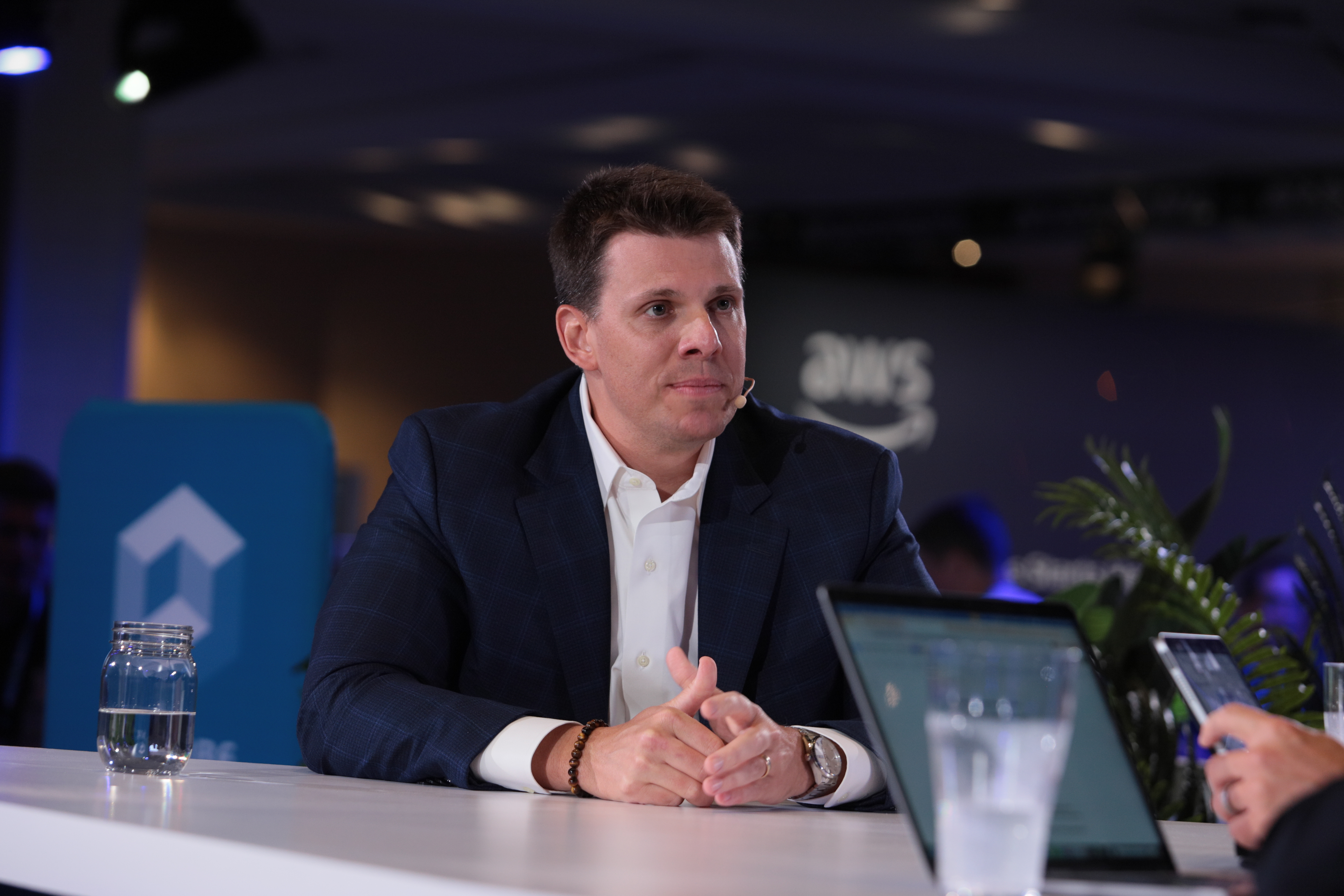
In this interview from FinOps X 2026, Grant Byrum, North America FinOps lead at Accenture, joins theCUBE's John Furrier and theCUBE Research's Paul Nashawaty to discuss how FinOps is evolving beyond cloud cost optimization to manage AI value in the enterprise. Byrum draws a sharp distinction between traditional cloud and AI economics: cloud costs are linear and tied to physical resources, while AI costs are driven by how work is done — tokens, prompts and agent workflows. He explains why this shift requires abandoning historical forecasting in favor of use-ca...Read more
exploreKeep Exploring
How is managing spend different for AI compared with traditional cloud, and how should FinOps adapt (e.g., forecasting and cost drivers)?add
How should organizations prepare for and manage the accelerated adoption of AI—particularly in terms of forecasting, cost allocation, and governance—given that the learning curve is much shorter than it was for cloud?add
What FinOps tasks are best suited to AI (including generative or agentic approaches), and how should human judgment be incorporated into the workflow?add
What has been the biggest change in the FinOps ecosystem, stack, or open-source community over the past 12–24 months?add
>> Welcome back to theCUBE's live stream here in San Diego for FinOps X 2026. I'm John Furrier, host of theCUBE, with my coach, Paul Nashawaty with theCUBE Research. We're exploring the FinOps impact to not only just cloud, but the AI wave that's hitting hard. And it's not going to stop. It's going to be a sustained build out of value creation, value extraction. But how do you value that? You got to know the data, you got to know the FinOps. We got the essential here, Greg Byrum, North America FinOps lead. They're seeing all the projects. They've been through many cycles. Grant, thank you for coming on theCUBE. Appreciate it.
Grant Byrum
>> Absolutely. Thanks for having me.
John Furrier
>> The AI value creation, it's not a strategy risk. Infuse AI is clear. The execution is a big part of it. People are now throwing AI at employees, workflows, agentics on the horizon coming in on big use cases. The value capture is happening, but what's the value? Is there a valuation technique? How much does it cost? Did we get the return on an investment? Is it durable? These are questions that everyone's asking. FinOps is at the heart of that. What are you seeing the FinOps AI equation?
Grant Byrum
>> Well, within AI and traditional cloud, there's some differences that we're trying to thread the needle on. In terms of answering how is managing the spend differently, first, I feel like you got to take a little bit of a detour and look at what fundamentally makes traditional cloud and AI different. In our point of view, traditional cloud is costs are tied to things that are linear, things that we understand really well like compute, storage, license costs. As FinOps practitioners, we've gotten pretty good at optimizing and forecasting for those things. Now, when you try to apply some of those same tactics that you use for traditional cloud to AI, they start to break down. Why? Because in AI, costs are tied to how the work is being done and not physical resources. So think of things like tokens, prompts, agent workflows. And then those things in turn are influenced by how the system is designed and being used. So small changes to prompt size or model selection can have big knock on effects in terms of what that does to cost. So I like to say we are at the precipice, as FinOps practitioners, we're at the precipice of learning the AI paradigm, which kind of makes me laugh a little because over the last 10 years we have been learning the cloud paradigm over how to use cloud over traditional data centers. So to elaborate on this a little more, in conversations that we have, I find that executives are intrigued by AI. They want to invest in it, but there's this atmosphere of concern, maybe even doubt that their teams will be able to deliver on the AI promise. And as we have these conversations, there are some features that we find are starting to bubble to the surface that are helping quell some of that concern from executive leaders like predictability. So think forecasting. In a traditional cloud sense, forecasting was done largely on historical models, historical data points. In AI, you've got to pivot to what I like to call use case forecasting. So now you need to bake into that number of users or number of prompts or interactions, maybe even number of releases that are planned. So that's one area that is giving executives better confidence in diving into AI.
Paul Nashawaty
>> I like that because that actually helps understand, it kind of aligns to my research. When we talk to executives, talk to the C levels of many of these organizations, the two main barriers they run into is complexity and skill gap issues, right? So I love having Accenture on because it's obviously the GSI model is a way to accelerate these AI projects. Now, when we look at that, we see that there's a difference between having a pure distribution. In our research, we see 17% of organizations will set up and stand up a pure distribution of an AI project, but 34% will go for a managed service because it's a faster time to value, faster deployment. When you're talking about these impacts, these prediction models, these ways that executives are feeling like, "Okay, I feel more confident because of this," is it because they know they can see where it's going because you're working with them and they feel confident in your team or is it because they feel like their own teams are being educated on it?
Grant Byrum
>> So I think that this is maybe multifaceted. I think some of it is starting with the right scalability and speed. You can't build confidence boiling the ocean. We've seen that break down many, many times. And so I think the winning model for AI is starting small and chip away at the problem. And that does two things. It not only builds confidence within the FinOps team itself, they start gelling, but it starts to breed confidence with executives once they roll out something and they do it really good. Now let's scale it to two or three proof of concepts and build on that.
John Furrier
>> I love that concept. You said earlier it took 10 years, over 10 years you learn cloud. One of the things I noticed here at the Linux Foundation, FinOps and you got the Tokeneconomics Foundation, you got the Agentic AI foundation emerging, it's highly accelerated. They have more adoption. So the shrinkage of time, just what's your gut feeling say about that? What's your point of view? Because it's going to be a short learning curve and how do you frame it? How do you advise your clients? Take us through that.
Grant Byrum
>> It gives me a really funny visual. It's like with cloud, it's drinking from a fire hose. Now you're going to add two fire hoses, right? Honestly, I think the winning model for setting yourself up for success in AI is having some of those things. And I'll expand on them, having good forecasting or predictability in place, okay? That is going to bring some trust to executives. Having clarity, being able to basically tie back cost to who was spending it and why. Now in traditional cloud, you're tagging physical resources, but with AI, you're having to pivot again and literally reconstruct cost allocation based on activity or attribution. So think of tokens processed or inference calls. And then another thing that is really key is governance. I got to be careful how I say this because governance has been important within FinOps, but at times I've felt that it's been a bit underrated. And the big pivot with governance and AI is you've got to embrace real time, truly the essence of real time visibility and reporting. Whereas in traditional cloud, I think clients have done pretty good with monthly or maybe biweekly reporting to get by, but you can't turn your back on that running meter of AI. You have to watch it every minute, every hour.
John Furrier
>> Three days it could pop.
Grant Byrum
>> Yeah.
John Furrier
>> All right. Next question I want to ask, because every person I talk to, whether it's in networking or here in FinOps, has the same kind of pattern, AI for FinOps and FinOps for AI, which it makes sense because there's two sides of that coin. Take us through your thoughts on how that plays out for the practitioner because you got to use AI and you got to have FinOps on both sides.
Grant Byrum
>> Yeah. It's a bit of a circle. You got to balance both. I go back to the thought process of scaling. Do it in small iterative chunks. So do AI in small chunks and then pivot and do... Sorry. Do FinOps for AI in small chunks and then balance it with something that's AI for FinOps.
Paul Nashawaty
>> So when you look at this, like AI for FinOps, right, we look at it from there's repetitive tasks that you have with FinOps, right? Obviously you want to take advantage of automation, you want to take advantage of AI to do that. What is best suited for AI for generative or agentic or anything you're trying to build up? What do you see as the best kind of approach for human judgment here?
Grant Byrum
>> Yeah. I want to pause and really appreciate the question because if there's anybody on the expo floor that's watching this or at home, like me a year ago, you were asking yourself the same question. When AI entered the stage, what does this mean for me? How is this going to change things in my job or what is this going to do in my job?
Paul Nashawaty
>> Yeah.
Grant Byrum
>> What I like about that question is we start to see a demarcation line of where AI should stop and where the human loop begins. To expand on that, I find that AI does exceptionally well in high frequency, high volume types of activities. So think about activities where the volume is too high for humans like normalizing or cleansing messy data or data from multiple sources or scenarios where the value is really driven by speed and scale like anomaly detection. That's something that I think is the perfect zip code for AI, but the balancing piece of that is you have to have humans that then do the "so what?" They take the data and they make the judgment calls, they make the decisions. There has to be a human leading the loop to balance business value and risk.
Paul Nashawaty
>> But is it a no-like trust process where eventually the human in the loop, which I agree with by the way, needs to be there today? And once the human becomes more comfortable with the process and understands the output, does it become more automated and more gets taken by AI?
Grant Byrum
>> I think that we ... Yeah. I mean, my hypotheses would be that we definitely see more of an integration of AI. I don't know what that means in terms of how much scope it takes from humans, but I've got to believe ... I can't have this conversation without thinking about Terminator, right? Like, self-aware computers. At the end of the day, I think humans are still going to be needed for the judgment and the decisions. You need humans to identify ROI targets and frankly to drive adoption. And especially that last point, I don't see AI driving adoption better than humans can.
John Furrier
>> Grant, when you were talking about scale earlier, I made me think about cloud. Early days of cloud, right? It was cloud infrastructure, so infrastructure. And then the developers all used them, the startups used them, but they didn't crack the code until they nailed security. Then enterprise comes in. So you got AI infrastructure has a similar scale dynamic, high velocity. Security and AI is kind of more like data quality. But you mentioned the volume of data, the fire hoses. So scale and quality security, you mentioned governance. It seems to be almost parallel, but not exactly. What's your view on that? Because you got to have the large scale infrastructure to take advantage of some AI, but you got to get the data in too. Normalizing is a huge thing.
Grant Byrum
>> Yeah. I mean, before you can click the go button and activate AI, you've got to make sure you've got some of the foundational layers in place like not only good data but clarity in the data.
Paul Nashawaty
>> Cleansing it. Yeah.
Grant Byrum
>> So there's data cleansing, absolutely. Frankly, some robust processes, guidelines, rules, honestly, some policies even that help guide what is AI going to be used for. So back to the demarcation line. Where does AI stop? Where's the boundary where humans pick it up so you don't have this messy center?
John Furrier
>> Okay. Last 24 months, let's take 12 months, the year, what's been the biggest change in the FinOps ecosystem or stack or open source community? What's been the biggest change, noticeable change from your opinion?
Grant Byrum
>> So twofold. We've been talking about full stack FinOps at Accenture for the better part of three years. And I think it broke ground at FinOps X maybe two years ago. We still continue to have full stack FinOps conversations, but the conversations have now shifted to unit economics, really getting to that granular level view of cost versus business value. Then to further compound all these competing interests, AI has entered stage left, and that's become the new shiny toy. And so our time is being consumed with preparedness for what is inevitably the AI tidal wave that's coming.
John Furrier
>> Well, I loved your earlier comment about cloud being about mechanisms and AI being about use cases. Put a plugin for what you guys are working on now. What are you working on? What kind of projects? Give us a slice of life in the FinOps lead role.
Grant Byrum
>> I'll give you the straightforward and the obscure answer. So we've got some very intelligent people working behind the curtains. I mean, look, Accenture is its own mega client, right? So not only are we solving AI for Accenture, we're building use cases to then take forward to the market. But I'll leave the rest of that answer to some colleagues of mine that not only our global practice lead who's got a keynote tomorrow where we're going to talk about AI and how that's meshing with executives, but then we also have a breakout session where we're going to deep dive into some of those very things. So come check it out.
John Furrier
>> Grant, thanks for coming on the queue. Really appreciate it.
Paul Nashawaty
>> Thank you, Grant.
John Furrier
>> North America, FinOps lead from Accenture. Obviously they have a lot of big clients. They see a lot of use cases. They got their own technology, their own client zero. This is the churn that we're seeing. People got to get their hands on it. They got to get deep down and dirty and get deep into the tech. Of course, we're doing our part here in theCUBE. I'm John Furrier with Paul Nashawaty. Thanks for watching.