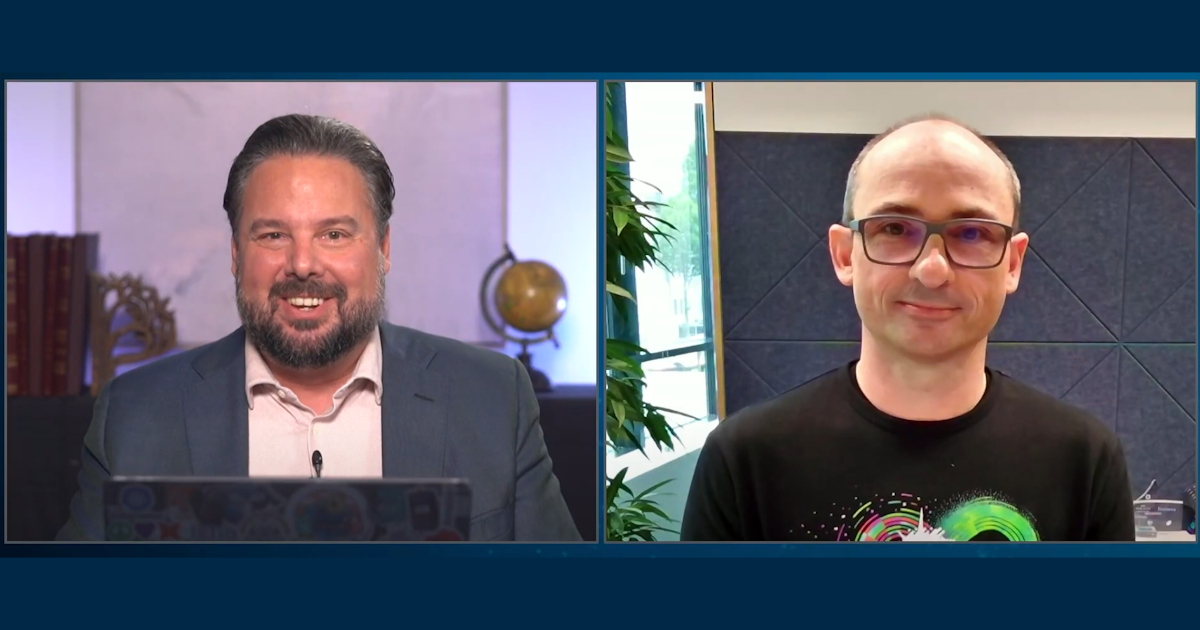
In this episode of the Inside the Digital Business With Dynatrace Series, Rob Strechay sits down with Bernd Greifeneder, co-founder and CTO of Dynatrace, to talk about how Dynatrace is reshaping the future of observability and automation. Greifeneder shares how digital transformation has moved from dashboards to decisions — and why agentic AI is the next logical leap.
Greifeneder speaks about the third generation of the Dynatrace platform, explaining how it’s built to handle the scale of modern digital ecosystems. From millions of containers to intricate microservices, he describes how AI-powered automation turns reactive IT into predictive, autonomous operations — making business agility not just possible, but sustainable.
Throughout the conversation, Strechay and Greifeneder explore how organizations can use AI-driven observability to unlock scalability and resilience. Greifeneder emphasizes the need for smarter, layered insights to guide transformation — and why businesses that embrace this shift are outpacing disruption. It’s a revealing look at what’s driving enterprise innovation from the inside out.
Forgot Password
Almost there!
We just sent you a verification email. Please verify your account to gain access to
Understanding Today's Digital Business With Dynatrace. If you don’t think you received an email check your
spam folder.
Sign in to Understanding Today's Digital Business With Dynatrace.
In order to sign in, enter the email address you used to registered for the event. Once completed, you will receive an email with a verification link. Open this link to automatically sign into the site.
Register For Understanding Today's Digital Business With Dynatrace
Please fill out the information below. You will recieve an email with a verification link confirming your registration. Click the link to automatically sign into the site.
You’re almost there!
We just sent you a verification email. Please click the verification button in the email. Once your email address is verified, you will have full access to all event content for Understanding Today's Digital Business With Dynatrace.
I want my badge and interests to be visible to all attendees.
Checking this box will display your presense on the attendees list, view your profile and allow other attendees to contact you via 1-1 chat. Read the Privacy Policy. At any time, you can choose to disable this preference.
Select your Interests!
add
Upload your photo
Uploading..
OR
Connect via Twitter
Connect via Linkedin
EDIT PASSWORD
Share
Forgot Password
Almost there!
We just sent you a verification email. Please verify your account to gain access to
Understanding Today's Digital Business With Dynatrace. If you don’t think you received an email check your
spam folder.
Sign in to Understanding Today's Digital Business With Dynatrace.
In order to sign in, enter the email address you used to registered for the event. Once completed, you will receive an email with a verification link. Open this link to automatically sign into the site.
Sign in to gain access to Understanding Today's Digital Business With Dynatrace
Please sign in with LinkedIn to continue to Understanding Today's Digital Business With Dynatrace. Signing in with LinkedIn ensures a professional environment.
Are you sure you want to remove access rights for this user?
Details
Manage Access
email address
Community Invitation
Bernd Greifeneder, Dynatrace | Inside the Digital Business With Dynatrace
In this episode of the Inside the Digital Business With Dynatrace Series, Rob Strechay sits down with Bernd Greifeneder, co-founder and CTO of Dynatrace, to talk about how Dynatrace is reshaping the future of observability and automation. Greifeneder shares how digital transformation has moved from dashboards to decisions — and why agentic AI is the next logical leap.
Greifeneder speaks about the third generation of the Dynatrace platform, explaining how it’s built to handle the scale of modern digital ecosystems. From millions of containers to intricate microservices, he describes how AI-powered automation turns reactive IT into predictive, autonomous operations — making business agility not just possible, but sustainable.
Throughout the conversation, Strechay and Greifeneder explore how organizations can use AI-driven observability to unlock scalability and resilience. Greifeneder emphasizes the need for smarter, layered insights to guide transformation — and why businesses that embrace this shift are outpacing disruption. It’s a revealing look at what’s driving enterprise innovation from the inside out.
play_circle_outlineTransforming Digital Business: Optimizing Organizations with Dynatrace's AI-Driven Automation for Enhanced Security and Operational Efficiency
replyShare Clip
play_circle_outlineUnlocking Autonomous Intelligence: The Role of High Data Quality and Contextual Understanding in Effective AI Deployment for Digital Services
replyShare Clip
play_circle_outlineEnhancing Team Collaboration and Productivity: Customers Embrace Third-Gen Platform for Broader Observability Data Access with Dynatrace
replyShare Clip
play_circle_outlineBusiness observability resonates with users, allowing insights into business processes.
Bernd Greifeneder, Dynatrace | Inside the Digital Business With Dynatrace
Rob Strechay
Dir./Principal Analyst & HosttheCUBE Research
HOST
Bernd Greifeneder
CTODynatrace
In this episode of the Inside the Digital Business With Dynatrace Series, Rob Strechay sits down with Bernd Greifeneder, co-founder and CTO of Dynatrace, to talk about how Dynatrace is reshaping the future of observability and automation. Greifeneder shares how digital transformation has moved from dashboards to decisions — and why agentic AI is the next logical leap.
Greifeneder speaks about the third generation of the Dynatrace platform, explaining how it’s built to handle the scale of modern digital ecosystems. From millions of containers to intrica...Read more
Bernd Greifeneder, Dynatrace | Inside the Digital Business With Dynatrace
search
Rob Strechay
>> Welcome back to this episode of Inside the Digital Business with Dynatrace, where we're going to examine the current challenges and opportunities for organizations as they optimize themselves as digital businesses. For this segment, I am joined by Bernd Greifeneder, who's the founder and CTO of Dynatrace, and I couldn't be more excited to have you on, Bernd. Welcome to the show.
Bernd Greifeneder
>> Hey, Rob. Thank you for having me.
Rob Strechay
>> I mean, again, as one of the founders of Dynatrace, I think again, this is so exciting to really dive into how organizations are really adopting and benefiting from your third generation platform. Give a little bit of background and help people understand on the other side of the screen here, what are some of the benefits that customers are seeing from the third gen platform and how you got here?
Bernd Greifeneder
>> Yeah, Dynatrace completely has really advanced from just observability as the first generation of it to its second generation of actually automating all the answers from observability data to automatically create root cause and risk results to actually now with third gen, taking the next big step in automating the operations, automating security, automating business insights in completely new ways. And also with the third gen of Dynatrace, we have laid a foundation for AI to actually make work that we truly drive towards autonomous intelligence to really help our customers automate their businesses and especially the digital services that continue to grow in complexity and scale. So, I mean, think of the second generation of Dynatrace. It was all about how do we reach 200,000 servers? In third generation, it's all about defining also towards scales of millions of containers and digital services that we all process with the help of AI towards helping the customers with the automation of their systems and getting the business visibility they need.
Rob Strechay
>> Yeah, no, I think again, one of the things I love about Dynatrace is I bump into your customers all over the place and get to have great conversations, but I think one of the conversations that's really been top of mind is agentic AI. I think that you guys are sitting in a really good spot with this because I mean, you guys know AI, you've been using AI in your product for decades now here, and I think when you start to look at it, you guys are really out on that forefront. How do you really look at Dynatrace as a platform that's purpose-built to help people in this as they move towards like agentic AI?
Bernd Greifeneder
>> Yeah, AI really has always been a key thing for us. So, even years ago we had already Alexa Skills developed because we anticipated that as human you wanted to interact with an observability platform in a way to get informed even when you're on the roads or also really specific tasks that the system would want to do automatically. And we have really now with third gen actually made this vision to become true and lay the foundation here for this type of autonomous intelligence. Because what you need for AI to properly work is not just the generative AI layer sort of it's way more than a ChatGPT interface sort of, if you will. What you really need for an autonomous intelligence to work and for AI to work is the foundation of high data quality, the foundation of proper accessible memory of how you store all the data in context. Think of it that you need to understand the causal dependencies in the data properly because only then you can provide a reasoning that is reasoning for effects in a deterministic way and not just in a stochastic way as typically large language models do. So, here is what the third generation of Dynatrace platform really lays this groundwork with having a massive parallel processing data lakehouse that really puts all the data collected from those million of services and containers altogether have also a business level of data in there also connected. It truly connects all the dots together that enables AI to understand in real time the business context and sort of understands on the lowest layer the technical behavior, meaning really understands when there is an issue with availability or security flaw, but also on the second layer on top understands how to collaborate properly and help with automating tasks like routing vulnerability to the appropriate development team already with the information at hand to remediate the issue and automating all the tasks to generate the test cases automatically. And on the third level, on top, actually enabling the business leaders to connect all the dots of their business processes because we bring all this data together in context with the causal graph so that in business context they understand which users, which customers are impacted, is the business goal achieved there? Do you need to optimize in the organization or in those digital business processes? So, we all enable this with this strong foundation of AI that is both combining the deterministic approaches as well as the large language models' stochastic approaches. So, this is the key power to actually allow the business leaders to use automation with confidence in especially these complex systems. Because I also think this way, typical environments in our customers have tens of thousands to hundred thousands and more of pods and Kubernetes, container instance is running and now you are adding over the next years even more AI instances. So, alone this will continue to drive complexity up and especially as our customers also use more AI in their digital services that they build all those systems will even more randomly talk to each other, which means you have to have an observability platform that do more than just observing it, but actually learns in real time, understands in real time all those interdependencies and helps you with an autonomous intelligence to actually cope with it and help you automate for reliability basically auto-remediate, auto-protect and auto-optimize that system.
Rob Strechay
>> Yeah, no, I think again, that was a master class in all the different layers of AI. And again, having talked to many of them, they're trying to get that visibility all the way down in there. What have you seen from the customer base that has moved onto the third gen platform and what are some of them saying? Because I think like you said, they need to be able to provide that kind of business level context, which really when you think about traditional platform engineering and observability, it was more down in the weeds, but now they're looking to bubble that up so that the business units who are the ones usually paying for the agentic AI are the ones that need that visibility. What have you seen out of ones that have moved onto the third gen platform so far?
Bernd Greifeneder
>> Yeah, the third gen platform now allows our customers truly to equip a much broader set of employees with value from this vast gold mine of observability data. So, think of enterprises not only sort of like in the past have hundreds to thousands of users equipped with information from Dynatrace but actually move to tens of thousands of users. So, how can that be why that many? And this goes back actually to the layers. So, it's not only that the DevOps and SRE teams use Dynatrace, but also we extend to the left to all the development teams. So, think of thousands of developers to live debugging, log analytics, and people are proactive about deploying into production as well as use Dynatrace to remediate issue and so forth. But it also reaches all the way into then the business users on one hand because business observability is something that really resonates well, and this is because Dynatrace has achieved to put a logical business layer with our business events on top of the pure technical data. And this extends to this group to get business insights about their processes, think order to cash, think online commerce, think logistics in companies, sort of all these different processes need to be optimized for proper outcomes. And then there's another fourth group of end users, and this is empowered all by not just having dashboards from Dynatrace that other users can use to have a more common view of how companies are run, but actually since Dynatrace third gen platform also allow us to create custom apps. We have customers who create completely new use cases on top of the data they already own with Dynatrace because this is such a goldmine of data that they want to use to, for instance automatically control how for instance ship containers in their harbor are being controlled or others how they deal with their financial transactions in new ways we never could have as a vendor thought about. So, I find this is pretty amazing because this allows our customers to basically purchase one platform, but leverages then the data, the AI and analytics then in multiple different forms so that the value actually multiplies.
Rob Strechay
>> Yeah, I think that's what organizations are looking for is how do they get leverage out of all of the different things they're already doing because skill sets and things of that nature, they don't want to have to learn yet another tool. So, I think there's a lot going on underneath the hood of all of these agentic systems to put it mildly as they get there. Now, you just spoke about why the third gen platform really helps customers better now, what are customers telling you and what is kind of the value that they're actually seeing out of the third gen platform that you're hearing back from them?
Bernd Greifeneder
>> So, I hear a lot from customers about how their expectations to AI are really high. So, I have CIOs who expect that in the next three years that 50% to 70% of the engineer's tasks are being automated by AI. So, while I'm not sure it's exactly that percentage, it is that expectation that we absolutely are in the best position to fulfill for our customers because of the ability to have such a long history and experience of understanding automation from effect-based and causal approach and overlay this with agentic AI we provide here the means that you can use automation with confidence. This goes also back to the developers because developers are other sort of audiences in our customer base, and they expect that 80% of all the workload that is not creating new features, that this workload gets actually lesser and lesser through AI. That's exactly also where we are helping because it is those tasks of debugging, of optimization for performance or cost or tasks like security remediation, sort of all of this is what developers get loaded on with shift left, test generation and so forth. There so many things that they have to do and it's getting just even more that this is particularly where Dynatrace's third generation helps them through automatic collaboration processes, integrations into the development environment, automatic test generation and so forth to offload that burden. And this brings that relief for the developers themselves and the engineers also in the SRE teams as well as the executives love it because they look for more productivity because you can never have enough of technical knowledgeable people. And so basically Dynatrace complements then their teams.
Rob Strechay
>> Super interesting, and I think again, this whole discussion has been really, I think, enlightening not only to myself but hopefully to the people on the other side of the glass here. But one of the things I want to jump into is get your final thoughts as these business leaders and tech leaders are really laying the foundation to really get a better understanding of agentic AI, what are some of your final thoughts on how they get started and how they really lay that foundation for this shift?
Bernd Greifeneder
>> Yeah. As the customers all now add more and more of AI services to their digital systems, think of it that their cloud services just not only grow in the number, but also their communication as think of MCP servers talk to other MCP servers, and the agentic to agentic side of communications becomes even more random or probabilistic through AI as before. What this truly means is you have to observe what's going on for compliance reasons, cost reasons, technical reasons even to make sure that the system works at all and provides value. So, this is one clear thing. And secondly, as you continue to also observe these systems, you can't keep the data in silos because what I learned over the years in building AI for these kind of analytics for analytics, for root cause, security use cases, analytics for automation with AI, that the only way to get really solid answers is by bringing all the data actually together, ensure that the data is in context. And this is also, for instance, while we have built SmartScape, which is a directed graph that we also store in the data lakehouse, that gets updated in real time. And this allows actually for a deterministic AI layer that is under the hood then of then the agentic AI layer to assist the reasoning with understanding a true causation to do effect-based decisions and not just stochastic decisions. So, I think this is maybe the other final recommendation here, when you use AI, make sure there's enough of solid deterministic layers under the hood of all those agents because there is enough randomness with all this AI going on, and at the end of the day, you want value from it, and then automation that you can trust and not just the hallucination.
Rob Strechay
>> Yeah, it definitely is I think key. I think this is really enlightening. I think people are going to get a lot out of this and I can't wait because next up we have one of your customers coming on. So, thanks for coming on, Bernd. Really appreciate it. This has been great.
Bernd Greifeneder
>> Thanks for having me, Rob.
Rob Strechay
>> And thank you for watching the first part of this episode. Stay tuned for the second part of the episode of Inside the Digital Business with Dynatrace, where we're going to dive in with one of Dynatrace's customers, TELUS, who's going to help us really explore the perspective on how all of this comes together and how they're leveraging it right here on theCUBE, the leader in technology analysis and news. We'll be back right after a short intermission.