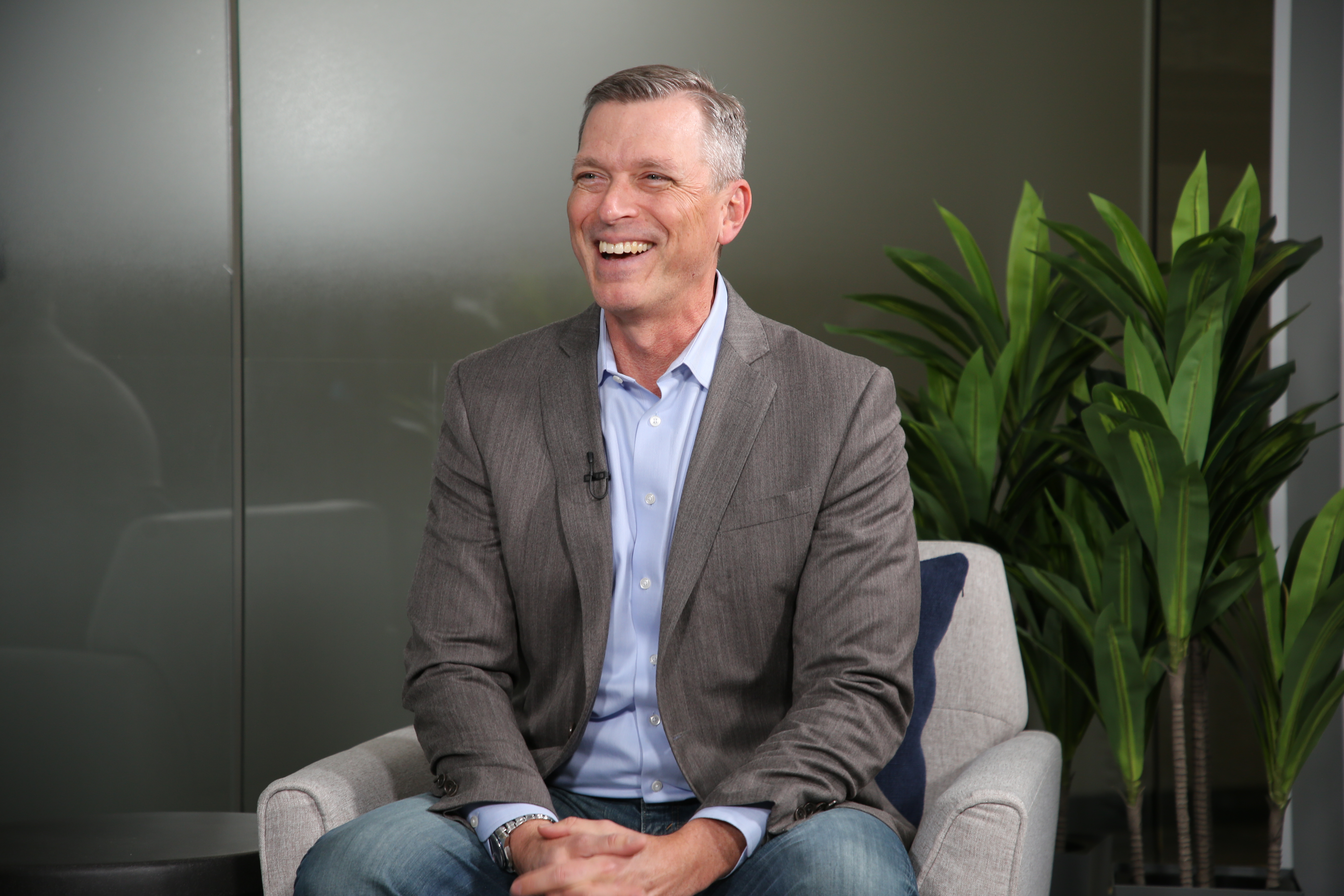
Drew Schulke, vice president of product management at Dell, joins theCUBE's Dave Vellante and Rob Strechay to discuss IT infrastructure advancements in the age ofAI as a part of Dell's "Is Your IT Infrastructure Ready for the Age of AI?" event.
Schulke shares expertise on the evolving landscape of private hybrid cloud and infrastructure consumption within data centers. He emphasizes the shift from traditional three-tier architecture to the promising disaggregated architecture, where infrastructure efficiency and operational simplicity are set to evolve. Schulke also highlights Dell's strategic moves, such as PowerStore's integral role in this new phase of IT infrastructure, underscoring its emphasis on data efficiency and adaptability to meet contemporary demands.
Key takeaways from the conversation include the significance of disaggregated architecture, particularly how it empowers organizations to maximize CPU utilization amid changing licensing schemes, as noted by Schulke. Additionally, he talks about the importance of a multi-protocol, scalable, flexible storage system to support advances in generative AI.
Forgot Password
Almost there!
We just sent you a verification email. Please verify your account to gain access to
Is Your IT Infrastructure Ready for the Age of AI? – NA. If you don’t think you received an email check your
spam folder.
Sign in to Is Your IT Infrastructure Ready for the Age of AI? – NA.
In order to sign in, enter the email address you used to registered for the event. Once completed, you will receive an email with a verification link. Open this link to automatically sign into the site.
Register For Is Your IT Infrastructure Ready for the Age of AI? – NA
Please fill out the information below. You will recieve an email with a verification link confirming your registration. Click the link to automatically sign into the site.
You’re almost there!
We just sent you a verification email. Please click the verification button in the email. Once your email address is verified, you will have full access to all event content for Is Your IT Infrastructure Ready for the Age of AI? – NA.
I want my badge and interests to be visible to all attendees.
Checking this box will display your presense on the attendees list, view your profile and allow other attendees to contact you via 1-1 chat. Read the Privacy Policy. At any time, you can choose to disable this preference.
Select your Interests!
add
Upload your photo
Uploading..
OR
Connect via Twitter
Connect via Linkedin
EDIT PASSWORD
Share
Forgot Password
Almost there!
We just sent you a verification email. Please verify your account to gain access to
Is Your IT Infrastructure Ready for the Age of AI? – NA. If you don’t think you received an email check your
spam folder.
Sign in to Is Your IT Infrastructure Ready for the Age of AI? – NA.
In order to sign in, enter the email address you used to registered for the event. Once completed, you will receive an email with a verification link. Open this link to automatically sign into the site.
Sign in to gain access to Is Your IT Infrastructure Ready for the Age of AI? – NA
Please sign in with LinkedIn to continue to Is Your IT Infrastructure Ready for the Age of AI? – NA. Signing in with LinkedIn ensures a professional environment.
Are you sure you want to remove access rights for this user?
Details
Manage Access
email address
Community Invitation
Dell Storage
Drew Schulke, vice president of product management at Dell, joins theCUBE's Dave Vellante and Rob Strechay to discuss IT infrastructure advancements in the age ofAI as a part of Dell's "Is Your IT Infrastructure Ready for the Age of AI?" event.
Schulke shares expertise on the evolving landscape of private hybrid cloud and infrastructure consumption within data centers. He emphasizes the shift from traditional three-tier architecture to the promising disaggregated architecture, where infrastructure efficiency and operational simplicity are set to evolve. Schulke also highlights Dell's strategic moves, such as PowerStore's integral role in this new phase of IT infrastructure, underscoring its emphasis on data efficiency and adaptability to meet contemporary demands.
Key takeaways from the conversation include the significance of disaggregated architecture, particularly how it empowers organizations to maximize CPU utilization amid changing licensing schemes, as noted by Schulke. Additionally, he talks about the importance of a multi-protocol, scalable, flexible storage system to support advances in generative AI.
Vice President – Product Management, Primary StorageDell Technologies
Drew Schulke, vice president of product management at Dell, joins theCUBE's Dave Vellante and Rob Strechay to discuss IT infrastructure advancements in the age ofAI as a part of Dell's "Is Your IT Infrastructure Ready for the Age of AI?" event.
Schulke shares expertise on the evolving landscape of private hybrid cloud and infrastructure consumption within data centers. He emphasizes the shift from traditional three-tier architecture to the promising disaggregated architecture, where infrastructure efficiency and operational simplicity are set to evolve...Read more
>> All right. Welcome back to Round Rock 2. I'm Dave Vellante here with Rob Strechay and Drew Schulke is here, he's the vice President of product management at Dell. Drew, good to see you again.
Drew Schulke
>> Great to see you guys.
Dave Vellante
>> Thanks .
Drew Schulke
>> We're not at Dell Tech World. We're in our domain now. This is nice.
Rob Strechay
>> .
Drew Schulke
>> Yeah.
Dave Vellante
>> Looking forward to that.
Rob Strechay
>> Well, we're actually in person because we were on recently.
Dave Vellante
>> Virtually. That's right.
Rob Strechay
>> Virtually.
Dave Vellante
>> Yeah. Thanks for coming in. So not much going on out there, is there?
Drew Schulke
>> No.
Dave Vellante
>> We've got a new administration, a lot of business momentum. Yeah, there's some uncertainty out there, but one thing's definitely certain is that customers are leaning all in on modernizing their infrastructure. They're doing a lot more stuff on-prem with their private clouds. What are the big trends you're seeing Drew?
Drew Schulke
>> Yeah, I'd say let's maybe start with sort of that private hybrid cloud landscape. There's been some interesting, I'll call it dynamics, in the ecosystem over the past year, which has really created, in my mind, a brand new inflection point as we think about infrastructure and how we choose to consume it in the data center. And maybe let's wind back the clock maybe 20 years ago. Three-tier architecture. Right? That's what everybody was using. I got some storage. I got some network. I got some compute. And they lived in the silos, and we came along with solutions like converged infrastructure, which is like, well, how do we take some of the unpredictability out of that, but kind of package it up together? Hyper-converged infrastructure came on the scene. That was sort of the last inflection point that we saw. And it helped collapse the silos via the way it was deploying and kind of bringing that compute and storage elements together. And it opened up the ability for our customers to have brand new operating models. So I could actually, with this technology, bust down those silos and think about, okay, maybe I need to reimagine my resources and how I keep this infrastructure up. And so, that prevented tremendous opportunity. And so, as an industry, we've seen that take hold and get a lot of traction over the past 10 years, but we believe firmly we're at the next inflection point of that. And what we're seeing as the model that people are starting to evolve to, we're referring to this as a disaggregated architecture. And some people might say, well, that's just kind of like a throwback to the three tier. Well, not really. And I'll talk about why. But why is this coming as an inflection point? I'll kind of point out the two things. One is that clearly the move to hyper-convergence in the midst of all those operational benefits, you had to have, I'll call it an ecosystem affinity like you were, I was in a VMware ecosystem or a Microsoft ecosystem, et cetera. And look, things have happened over the past year that customers are like, well, maybe I want some more flexibility here. And by the way, that also means besides an ecosystem affinity, it's like in bare metal workloads, what's your answer for that? We never really crack that nut in HCI. So there's kind of like that dynamic. And the other thing I'd say going along with it, and it's somewhat related, is to the extent that I'm getting the most bang for the buck out of the resources that I bought, and look, we've been the leader in HCI infrastructure for a long time. We've got lots of data from how our customers are using it. And one thing is clear is that in that particular model, CPU utilization tends to run lower than in the disaggregated architecture. Why is that important? Well, yeah, you want to get the bang for the buck, but look at the way licensing schemes are evolving with subscriptions and it's all per core. So it's like, well, if I'm going to be paying for software on the core, boy, I want to be getting the most cycles and performance I can get out of each and every core. And so, that's where we see this disaggregated architecture taking hold is let's decouple the storage and compute, allow us to maximize each by the way, I can refresh each of those then on the cycle that they need to refresh and when it makes sense where everything going on right now on the compute side of the house, it's cadence of refresh is certainly at a much faster pace. So we're kind of unleash that. But then I'd say in addition though, beyond that is like how do we bring the operational model to it? So that was the last inflection point. We changed the operational model and this is where we're focused. It's not just kind of like, "Hey, we're decoupling these things." Because we have so much of that experience on the hyper-converge side, we're bringing that in through an automation platform that we're going to be talking a lot about at Dell Tech World coming up about how do we maintain that operational simplicity, but in an architecture that allows us to have that optimization at that compute.
Dave Vellante
>> I like how you went back 20 years ago, because 20 years ago I would also point out that the main cost was human labor.
Drew Schulke
>> Yes.
Dave Vellante
>> And the whole move to HCI addressed that with simplicity. And you're absolutely right now. Software license costs are a much, much higher component of the overall cost than they were before. So we've attacked the human labor problem and then created a new problem.
Drew Schulke
>> .
Rob Strechay
>> I think what's also interesting is HCI created kind of another problem, which was, and I think this goes to your disaggregated comment, where it was scale up or scale out. It was really scale out and the scale up portion of it was really difficult at that point in time, and I know Dell's doing stuff on that side of the house as well. But there's also the fact that to bring in a new technology, you pretty much had to swap out or buy yet another thing. You guys are doing stuff with QLC and other stuff in PowerStore. That has to be another driver from a cost and efficiency perspective, as well as energy perspective, for your end users.
Drew Schulke
>> Yeah, completely. So PowerStore is going to play a critical role in this disaggregated architecture that I'm talking about, just given its applicability across use cases and verticals and so forth. And to your point on the economics of it, data efficiency, I can't overstate this. The single most impactful way you could influence your cost of storing that data is through data efficiency, better deduplication, better compression. It's the gift that keeps on giving in lowering that total cost of ownership, of storing your data. And by the way, that total cost of ownership extends into the power and the cooling and the physical footprint because like I've got fewer disks, I've got fewer systems at the end of the day because we're able to go off and do that. So you'll continue to see us lean heavily into that. We made a big deal at last year's Dell Tech world about our five to one guarantee, no questions asked. I think it's recognized in the industry as best in class for that. We think there's room headroom for that and improvement. We're not done yet in terms of what we can do in software. So we're going to keep pushing on that side, but that is kind of where it all begins. Now, underneath that, we still want to be efficient and look at media types and QLC with the introduction of QLC and make sure that for whatever capacity point you want, we're going to have that best TCO for you.
Dave Vellante
>> So you're saying the next era is essentially preserving that simplicity, that operational excellence that we saw with HCI, but then addressing some of the problems that Rob was talking about, driving efficiency, better for sort of emerging AI workloads. Is that part of the equation?
Drew Schulke
>> Yeah, I mean potentially. In the topic of AI, you kind of think about sort of transactional or primary storage and so forth. There are some use cases depending upon like how you use your vector databases and so forth. So it's not to say that it's completely excluded. There's some use cases. Clearly, there's a lot more focus on the unstructured side for these big models and the training that has to go on and look, we've got a sort of a hot tier of that training data, a cold tier of that training data. It's a really fast evolving space as well. But yeah, certainly a good reason to, if you are engaging in that type of activity to, again, decouple that compute and storage because you might be wanting to refresh that compute on a yearly basis, storage maybe every four to five.
Rob Strechay
>> But logically being able to manage it with that simplicity, whereas again, you go back to the converged infrastructure was almost like you were bolting networking, storage, and servers all together. It's like where do you go?
Drew Schulke
>> And this is where it's like the power of Dell Technologies. I like us being able to do that based upon what we can do across the breadth of our portfolio of the data center. We've clearly got the compute expertise, we've clearly got the storage expertise. We've got a lot of expertise in creating some of the most successful HCI offers. We've got the right DNA here to bring this together and deliver it.
Rob Strechay
>> Yeah, I mean we were talking about it and I think that when you start to look at it, people want that cloud operating model. And we look at cloud as it's not a place, it's an operating model. Are you seeing people lean in, especially with the, I would say the not uncertainty, but the changing dynamics of the hypervisor layer. Are people leaning into this more now because what they're looking for is that cloud operating model?
Drew Schulke
>> Absolutely. Yeah. Leaning in is probably an understatement. I'd say, and I'll kind of hit on another aspect of my portfolio is it was about a little bit over a year ago, some of our larger customers that were using our PowerFlex software defined offering were proactively reaching out to us and wanting to know like, "Hey, so really like this PowerFlex solution, but like we're looking for more hypervisor diversity here." And understandably so, which led to our engagement with Nutanix about kind of pulling Acropolis out of their stack and allowing us to use that with PowerFlex, which we now have in market. It's been an interesting period of time, and yeah, customers are absolutely leaning in.
Dave Vellante
>> Can you paint a picture for our audience of the portfolio? How's it lining up and what's new?
Drew Schulke
>> Yeah, sure. So maybe we'll cover maybe the primary or transactional side of the portfolio. We've got our PowerMax system, which is our crown jewel in terms of mission-critical storage. Still out there, a very loyal customer base. We've got PowerStore, which is our enterprise class storage, which like I said earlier, the broadest reach in terms of use cases, price points, performance know spread that we can support on that side. And then we've got PowerFlex as our software defined offering, which frankly we call it software-defined storage, but really our customers use that to build out their own internal public clouds because it's very easy to scale out and it has that cloud operating model even from an architectural point of view. And then, on the unstructured side of the house, we've got our scale out file in PowerScale, and we've got our scale out object in ObjectScale. So lots of things going on in all of those. PowerStore, I talked about some of the efficiency story, which is still front and center of everything that we do there. But in addition, we had a release here just last month, and PowerStore is essentially powered by software, which means we're going to have this constant stream of capabilities that we're making available to our customers that they just need only upgrade that version to take advantage of these things. There's no buy a new box kind of a model here. Areas that we just kind of addressed recently are really tapping into AI to make the operations and serviceability of these. So we have this thing called Smart Support now, which we use AI to correlate a bunch of data points that we're observing on a system that's operating both on the hardware and the software side to predict a failure before it happens. And so, we're flagging customers to say, "Hey, we're noticing this trends." The correlation says, "You're going to likely going to have a problem here." We can even extend that to the point where we can proactively initiate a support request to dispatch a part where like we feel confident enough that this thing is going to fail, the part's on the way. So huge step forward, but like it's just the beginning of what we can start to do with AI on these systems to bring forward a level of insight.
Rob Strechay
>> Because I think one of the things that you kind of hit on it a little bit there, which I think I said this back when we were talking about PowerStore previously, is it almost buries the lead, the fact that the upgradeability and to be able to take it, you guys have done a lot of work under the hood, maybe ypeople that don't notice it per se, who are out there, or maybe not a customer yet, but the upgradeability has really improved as well. Your partners were talking about that, talk about kind of that, because that to me is really key for people when they're looking at building their cloud operating model and being able to be serviceable and things of that nature.
Drew Schulke
>> Yeah, I mean, I call it investment protection. Call it buying into the long-term benefits of the platform, right? No customer left behind. And look, this is even going to extend as we introduce new generations of hardware. We're not going to turn off capabilities, going back in time. And this is one of the reasons why we made PowerStore. Actually, we don't talk about this a lot, but it's a scale up storage system, but it also has a scale out capability that we can cluster these things together. So when that next generation box comes out, we can put these things together in a cluster, decide where you want your volumes. But from a feature set perspective on either one, completely equivalent, completely equivalent. So there's no penalty that you're paying for doing that upgrade. So yeah, very important. Customers don't want to be stranded on functionality or forced to buy the next box to get that next level of functionality.
Dave Vellante
>> How's it work? I'm hearing I can, there's certain software pushes that I can get that can enhance performance or efficiency and that's there. And then at some point I've got to upgrade the hardware, but you've got licensing terms that allow me to do that in a non-disruptive way and buy into the future. Is that right?
Drew Schulke
>> Yeah, absolutely. Yeah. And let's say you're really happy with that next generation hardware that comes out. Look, let's put these two in the same cluster. So I now have visibility to both of these as a single system. Why would I want to go do that? Because, well that next generation of hardware, likely higher performance just based upon the way this sort of works as hardware gets refreshed and I've got a higher IOPS or throughput capability on here. Let me look at the volumes on that current system. Where would I see the benefit most? Okay, these two applications, let's move those volumes over and now I've got a balanced system, but I'm taking advantage of the new hardware where I can. By the way, the previous box is still there doing its work and you decide how you want to decommission that on your terms.
Dave Vellante
>> Okay.
Rob Strechay
>> Yeah. Excellent. I think that's part of it. And as people bring these new cloud native apps that are Kubernetes based, or VMs, and VMs and Kubernetes, or container-based, are you seeing that they're bringing a lot new workloads that have not necessarily, traditionally you talked about the three tier, but the three tiers now maybe 25 tiers or microservice based and stuff like that. Is that changing the workloads you see on PowerStore as well?
Drew Schulke
>> Yeah, clearly a steady growth in those microservices based applications over time. So we look at things like the kind of scalability metrics that we need to deliver to support those Kubernetes environments. Again, to your point, it's very not the way we looked at scalability in the past in terms of the sheer number of API calls that need to be supported to make these things work well. So yeah, absolutely we're seeing that evolution, but at the same time, you don't want to buy a box only for that capability. And that's where we think the flexibility that we have with something like a store in that disaggregated infrastructure model really plays to its strengths. I don't mean this to come off in the wrong way, but we don't care what's running on the host side. Right? We just want to be there to serve you as best we can based upon what that is, giving you the ultimate flexibility that you have, not having these bespoke infrastructure silos like, this is what I use for data analytics and this is what I use for my high performance databases. Right? Let's get out of that model.
Dave Vellante
>> Yeah, that is a model that we've been kind of been stuck in for a while now. And again, with the kind of back to where we started here, we've seen the evolution. I mean the converged infrastructure piece was sort of short-lived. HCI had a good run. And now, we're entering this sort of new phase where you're seeing renewed momentum in on-prem, no question about that. And it's not so much a repatriation trend, it's just there's a lot of data on-prem that people want to inject with intelligence and they want to modernize that infrastructure. I'll give you the last word. How do you see this era sort of evolving?
Drew Schulke
>> Well, let me pivot off of the private hybrid cloud just to the gen AI space just briefly, like it'd be hard to not cover this. Yeah, I mean, I'll close with that is look at our year. Clearly one of the most disruptive workload we've seen come along to IT infrastructure in my lifetime. I don't think that's hyperbole, right? We firmly believe that the right answer for storage to support that generative AI is a multi-protocol, scalable, flexible distributed system. And by multi-protocol, that means we need really capable scale out file, we need really capable scale out object. So we've got a lot of investment and roadmap work going on there on the PowerScale side for our file systems. Launching a 122 terabyte drive, which puts us in a position that we can say literally we are the densest file storage system in the market. So like most terabytes per rack unit hands down at this point in time. But that's for the hot tier. There's also, we're seeing like this, I'll call it a cold tier of generative AI. Like, "Okay, there's some interesting data here. I may want this for a model later." And so, we're refreshing our hard drive-based PowerScale models as well so we have a good economic point on that and supporting some better latency through some SSD cache to drive ratios and so forth. And then on the objects side, we've launched ObjectScale, so built upon the foundations that we have in ECS as our object platform for a long time, but built in a way that it's ready for this era of AI, so scalable, performant, adding the same sort of high density drives that we have on scale to hit these density points that are becoming really critical, especially as you talked about service provider opportunities that we want to participate in. Like these are won or lost based upon literally like how many terabytes can I fit in a square inch at this point in time. So we're excited about what's going on there as well. So between the cloud and AI, it's a really exciting time to be here.
Dave Vellante
>> Well, Drew, thanks so much for spending some time with us. We really appreciate it.
Drew Schulke
>> Always.
Dave Vellante
>> Thank you. All right, Dave Vellante for Rob Strechay. Keep it right there. We're back for more action from Round Rock 2. Watch the queue.







 Dave Vellante
 Rob Strechay