Exploring Automation and Innovation at Dell Technologies World 2025
Gil Shneorson and Caitlin Gordon from Dell join theCUBE hosts Savannah Peterson and Dave Vellante at Dell Technologies World 2025. They explore the realm of automation and innovative solutions shaping the future of technology infrastructure.
In this insightful session, Shneorson and Gordon discuss how Dell pioneers automation to simplify complex information technology infrastructure. With insights from theCUBE analysts Peterson and Vellante, the conversation covers the integration of Dell's automation platform with private cloud solutions and NativeEdge. Gordon shares how Dell's strategies address dual challenges faced by modern enterprises, such as disaggregated architectures and artificial intelligence workload management.
Key takeaways from the discussion underline Dell's commitment to creating flexible and scalable infrastructure through automation. Shneorson and Gordon assert that the synergy between Dell's solutions is transforming edge computing, making it more adaptive and interconnected with data centers. They also emphasize the vital role of simplification in addressing complex networking and compute environments, enabling businesses to scale efficiently.
Forgot Password
Almost there!
We just sent you a verification email. Please verify your account to gain access to
Dell Technologies World 2025. If you don’t think you received an email check your
spam folder.
In order to sign in, enter the email address you used to registered for the event. Once completed, you will receive an email with a verification link. Open this link to automatically sign into the site.
Register For Dell Technologies World 2025
Please fill out the information below. You will recieve an email with a verification link confirming your registration. Click the link to automatically sign into the site.
You’re almost there!
We just sent you a verification email. Please click the verification button in the email. Once your email address is verified, you will have full access to all event content for Dell Technologies World 2025.
I want my badge and interests to be visible to all attendees.
Checking this box will display your presense on the attendees list, view your profile and allow other attendees to contact you via 1-1 chat. Read the Privacy Policy. At any time, you can choose to disable this preference.
Select your Interests!
add
Upload your photo
Uploading..
OR
Connect via Twitter
Connect via Linkedin
EDIT PASSWORD
Share
Forgot Password
Almost there!
We just sent you a verification email. Please verify your account to gain access to
Dell Technologies World 2025. If you don’t think you received an email check your
spam folder.
In order to sign in, enter the email address you used to registered for the event. Once completed, you will receive an email with a verification link. Open this link to automatically sign into the site.
Sign in to gain access to Dell Technologies World 2025
Please sign in with LinkedIn to continue to Dell Technologies World 2025. Signing in with LinkedIn ensures a professional environment.
Are you sure you want to remove access rights for this user?
Details
Manage Access
email address
Community Invitation
Gil Shneorson & Caitlin Gordon, Dell Technologies
Exploring Automation and Innovation at Dell Technologies World 2025
Gil Shneorson and Caitlin Gordon from Dell join theCUBE hosts Savannah Peterson and Dave Vellante at Dell Technologies World 2025. They explore the realm of automation and innovative solutions shaping the future of technology infrastructure.
In this insightful session, Shneorson and Gordon discuss how Dell pioneers automation to simplify complex information technology infrastructure. With insights from theCUBE analysts Peterson and Vellante, the conversation covers the integration of Dell's automation platform with private cloud solutions and NativeEdge. Gordon shares how Dell's strategies address dual challenges faced by modern enterprises, such as disaggregated architectures and artificial intelligence workload management.
Key takeaways from the discussion underline Dell's commitment to creating flexible and scalable infrastructure through automation. Shneorson and Gordon assert that the synergy between Dell's solutions is transforming edge computing, making it more adaptive and interconnected with data centers. They also emphasize the vital role of simplification in addressing complex networking and compute environments, enabling businesses to scale efficiently.
Gil Shneorson, senior vice president of edge computing offers, strategy and execution at Dell Technologies Inc., and Caitlin Gordon, vice president of product management at Dell Technologies Inc., join theCUBE’s Dave Vellante and Savannah Peterson at Dell Technologies World 2025 to explore how automation is reshaping the infrastructure landscape. Their discussion dives into Dell’s strategic approach to simplifying complexity through edge innovation and private cloud integration.
Gordon outlines how Dell addresses enterprise challenges such as disaggreg...Read more
exploreKeep Exploring
What is the key to successful implementation of disaggregated architectures in the world of appliances and AI workloads?add
What has been the progress made in developing the NativeEdge over the last three years?add
What are the important elements and differences of a composable architecture compared to a traditional HCI architecture?add
What is an example of a large company transitioning from data centers to COLA facilities while also maintaining thousands of stores?add
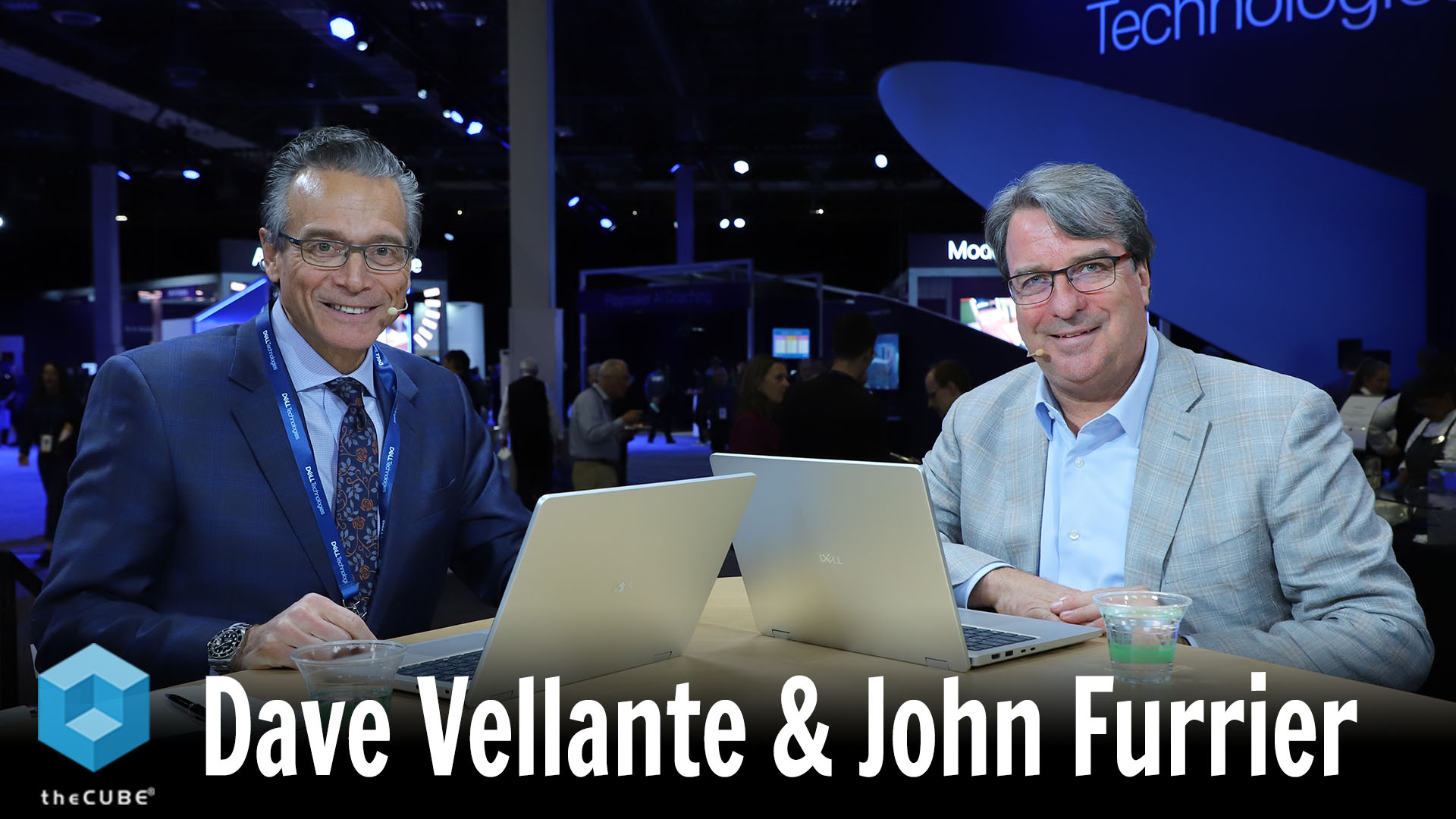
>> Good afternoon, Dell fans, and welcome back to beautiful Las Vegas, Nevada. We're here midway through day three of our live coverage at Dell Tech World. My name's Savannah Peterson, delighted to be joined by Dave Vellante for all the fun. We're fighting the good fight here, man. We've still got voices, our PCs seem to be procreating on the desk.
Dave Vellante
>> I think we're good, yeah. PC heaven here.
Savannah Peterson
>> Yeah, which is a heavenly place for us. Speaking of PC, heaven and smart people, welcome back to the show, Gil and Kaitlyn. Lovely to have y'all.
Caitlin Gordon
>> Thanks.
Gil Shneorson
>> Thank you.
Savannah Peterson
>> Yeah, good to be back. We are very excited about this conversation. We are going to be talking about automation, everyone... A lot of A-words that are very, A acronyms are definitely a thing right now between AI and agentic. But automation is really at the crux of this, Dell making some very big bets on automation. Why? Gil, I'll ask you first.
Gil Shneorson
>> Me?
Savannah Peterson
>> You could chime in, Kaitlyn.
Gil Shneorson
>> Well, we've learned over the years that simplification is the most important thing. And we have a very long history with appliances that created a tremendous SLA by simply figuring out how to turn things on and make them really, really simple. And as you've heard in the show, we believe that the world is shifting towards disaggregated architectures, because of the economics, because the ability to transition between different stacks, because of the AI workloads that are different and demand different. And so it becomes a question, if you're going to do that, you definitely need to simplify. And simplification is all about automation and the ability to define, and then simply orchestrate and run things.
Savannah Peterson
>> I really like that. I hadn't thought about simplification as a synonym for automation in this case, and it totally aligns. What types of things are you automating, Kaitlyn?
Caitlin Gordon
>> It probably is an oversimplification, right? Because it's automation, it's orchestration, and ultimately, it's because our customers have the dual challenges of traditional workloads have been disrupted, and they need to figure out what their traditional hypervisor strategy is. And then they've got this whole little AI thing happening at the same time, which probably is going to be a different architecture. So they only have two different private cloud type architectures that they're solving for both with some similar tenants, the disaggregated is the same, but also some very different ones. You're going to have some very dense compute and complex networking, and a different ecosystem on the AI side. And then on the private cloud side, although it's been disrupted, it's still more predictable. But at the end of the day, what is consistent is none of these companies have more people to address that. So you have to automate, you have to automate the deployment, you have to automate the updates, you have to be able to monitor them. You have to really be able to treat that infrastructure as a pool of assets that you can have the flexibility to also change as your data center evolves. So it is about the automation, but it's really about simplicity and flexibility.
Dave Vellante
>> Kaitlyn, we've known each other for a long time. You're in a new role now, congratulations.
Caitlin Gordon
>> Thank you.
Dave Vellante
>> And Gil, you run the solutions part of the organization, and Edge is part of that. What is the synergy between Edge and Solutions? Is it sort of old DNA? Gil runs Edge, so we'll give them Solutions too. They'll keep Edge, or is there a synergy between Solutions at the Edge and Solutions overall?
Gil Shneorson
>> That's a very good question. So, if you think about it, over the last three years, we've built NativeEdge. We've effectively built an edge private cloud. What did we do? We found a way to securely onboard devices at the edge, that basically means out of a data center. And onboard them with a touchless manner and put some payload on them, as in an operating system and applications. And we started introducing this to customers and people went, "Well, hold on. Why does it have to be at the edge? If you can do that simplification for me, why not the data center?"
And early last year, we brought together this organization that had the HCI portfolio, and our AI portfolio, and our AI solutions portfolio, and our apex platform portfolio. And all of this came together. And you know what happens when you bring a lot of people together, suddenly silos break and you can think again. And so we could take that innovation from NativeEdge, and from our HCI products, and from our AI solution, and really rethink this whole thing, which led to the automation platform and the private cloud. But at the end of the day, in a future state where somebody has a private cloud with multi-stack, or multi-hypervisor, in an edged state they would be running it from the same exact control plane by Dell. So all of this is going to come together, and it is coming together later the summer.
Dave Vellante
>> Okay. Thank you for connecting those dots. So when we saw Lowe's up on stage in day one, that's Edge, right? That's an Edge use case?
Caitlin Gordon
>> Oh yeah, for sure.
Dave Vellante
>> Then it's data center-ish as well.
Gil Shneorson
>> It's really interesting, because we used to say Edge is IOT. So single node, collect data, multiprotocol. But the reality is that all of those devices also move data to some sort of a near-Edge location. Lowe's was great example, many, many other retailers and manufacturers. So in that plant, there is also a mini data center. It's got a cluster of sort, and it collects data and it retains data. And so NativeEdge has graduated and evolved over this last year to offer high availability, and high availability load balancing, and VM snapshots. And so now you can take that distributed cluster that used to be maybe by another vendor, and put it out there and really have your HA cluster, but now can run on a server, maybe clustered commercial PCs, that's very unique in the industry, or precision workstations. And so we can play with the same control plane, same idea of automation, but different price points, different resiliency points. So we get a lot of flexibility there.
Dave Vellante
>> And Kaitlyn, the buzzword today maybe is not a buzzword. The technical angle here is disaggregated, the new architecture. When you did storage, there was a lot of aggregation. What's the importance of disaggregation, and how does it sort of fit into the overall strategy around things like private cloud, automation, and how do you handle that?
Caitlin Gordon
>> Yeah, there's a couple elements to it. I always like to think about as composable for an important reason. But the important difference is that you have the flexibility to have best-in-class compute, best-in-class storage, with efficiency on both, and that you can scale them independently, which obviously is important because you can get five-to-one deduplication on the storage, you can scale compute when you need it, storage when you need it. But it's also important because you can share that storage across multiple workloads. That compute can be used for one hypervisor, and then easily turn into another one. You can't do that in a traditional HCI architecture, which is what our customers are asking for. So it's very open. But the reason why composable matters is that openness is only useful is if you can actually treat it like the pool of resources we were talking about earlier. It has to be a pool of compute nodes that it has a personality today. And then when you're ready, you can essentially decommission it, use that pool of resources to provision a new one. Because then you truly have more of a on-prem cloud experience, and that gives that openness and the flexibility, but without the complexity of that traditional three-tier model. So the composable to me on top of disaggregated kind of gives you that intelligence of the automation of how you actually use that, not only to deploy it, but even manage it in a much more automated fashion.
Dave Vellante
>> Okay. So disaggregated and composable, the problem is composable was a failed marketing term.
Caitlin Gordon
>> That's what the marketing team tells me.
Dave Vellante
>> So they gave it a bad name. So it's like we used to during the internet say paradigm shift, and we stopped saying paradigm for like 10 years. So, composable.
Caitlin Gordon
>> But everything comes back again, right?
Savannah Peterson
>> It does, it does. Everything's back in vogue now. Who knows? New generation wouldn't even know the bad association with composable. So, we'll get to work with some of the coolest customers in the world. Do you have any example of automation and Edge coming together for a great customer success example? Kaitlyn, I'll go to you to start.
Caitlin Gordon
>> I can give you one that I can't share the name of, but it is one of my favorite customers, because it is a great example of a large company that has many data centers. They're trying to exit their data centers getting into COLA facilities, but they also have thousands of stores. So it's a really good example of having these far edge locations where you need a small, simple, secure footprint, but also a real big data center challenge of VMware exits, and modernizing, and building for AI. And we'll just say we spent many hours with them this week because everything we're doing with the Dell automation platform, with private cloud, with NativeEdge, in AI solutions, they are really leaning in, and they see the value of having this way to orchestrate in a very predictable way, but solve these different challenges that their business really has.
Savannah Peterson
>> Yeah. And that's an example that can really leverage the ecosystem. And they need all those different pieces, you're absolutely right about that.
Caitlin Gordon
>> Yeah, absolutely.
Savannah Peterson
>> Yeah, it's exciting. Are you seeing similar things, Gil? Are there any trends in what you're seeing out the gate?
Gil Shneorson
>> We work in the same group, so clearly whatever Kaitlyn sees, I see, and vice versa.
Savannah Peterson
>> But we each have our own set of eyes, right?
Caitlin Gordon
>> I don't have the glasses though.
Savannah Peterson
>> I know. I was going to make a joke about the glasses.
Gil Shneorson
>> Well, if you're going to make a joke, I'm going to record you while we... So yeah, definitely. There's a lot of synergies between data centers and edge locations. And if we had an edge conversation today only on edge, we would probably go into this traditional divide of IT and OT. But the reality is that I've been saying it, I think even on the queue before they're coming together. And more and more IT best practices are leveraged at the edge, and now it's accelerating. And so similarly to what Kaitlyn said happens in manufacturing companies as well. The IT best practices are being merged, and all of the sudden you manage the devices the same way, and you have the same security challenges, the same automation challenges, the same distribution challenges. So, it's really all coming together with, and that's why we're so passionate about the automation platform, and the private cloud, and NativeEdge, and the AI solution automation, because it's the same thing. And so solve one problem and keep expanding. That's what we're all about right now.
Dave Vellante
>> Standardizing the solutions to those problems, which maybe previously were all custom and snowflake.
Gil Shneorson
>> And by the way, you can never go without gene AI. And so in this automation platform we're talking about, there's a gene AI assist that helps you create your own blueprints and a code assist within VI, VS Code, I'm sorry. So as you could imagine, now that we get to introduce innovation, we're going all the way, and we're taking it to the next level as well.
Dave Vellante
>> A customer you might be able to, I saw Keith running around from Nature's Fresh Farm, he's been on a number of times, sent me some awesome tomatoes. And I mean, he is-
Caitlin Gordon
>> I love that. I hear he has great strawberries as well.
Gil Shneorson
>> Did he tell you about the last year's demo? They brought real tomatoes, and they over grew because the lights are on in the show and there's no night. And so they're like a foot longer than they used to be. He used to tie them where every day they on the show, he has to go fix it.
Savannah Peterson
>> Oh my God, I love this.
Dave Vellante
>> That's a great use case.
Gil Shneorson
>> Keith is fabulous. And he's a great example of a customer that's using it at the edge, also an early adapter of a Dell private cloud, and he sees the benefit of both. So, Keith is a great example.
Dave Vellante
>> Yeah, I mean, is a classic edge use case, but tying in with other pieces of it. He came on one time, he gave us the anatomy of a ransomware attack. He's great. I mean, a lot of customers won't talk about that.
Caitlin Gordon
>> It's technology led agriculture, which is very cool. Yes.
Savannah Peterson
>> Well, and agriculture is sometimes not at the focal point of the technology conversation. However, they drive a lot of the innovation, especially at scale.
Caitlin Gordon
>> Absolutely. And he's always been a great early adopter for us and gives us feedback along the way, so we appreciate that.
Savannah Peterson
>> Yeah. What is the feedback loop like for y'all? I mean, especially with the velocity that we are moving right now, how do you make sure you're there for your customers?
Caitlin Gordon
>> He yells at me if I'm not with customers enough. That's a good way. I mean, we have a customer advisory council that we actually do twice a year, so that makes sure that we have a good set of customers that come together, that we have long conversations about where we're headed. We listen to what they need. And it's informed a lot of the things we announced this week. But we are in customer conversations every day, having briefings, really trying to solve those challenges, because they're pulling us in because there's so many relevant challenges that they're facing that we're trying to address, which is a privileged place to be as a product organization. It pulled into these conversations.
Gil Shneorson
>> Definitely product managers need to live with customers. That's the whole point of developing a product. It's for somebody. But we're trying to get engineers to meet with customers, architects to meet with customers. This show is great for us because we have a lot of people here, and they can sit in conversations. But even in between, I think every major campaign, especially new customers, I ask engineers to go and live with the customer for a week. Just live there, just know what's going on. It's really important for us.
Savannah Peterson
>> Seeing is believing, and you can tell it's one of the things that always really stands out to me about Dell, is that community and customer-centric focus. Because the timing, there are no coincidences in terms of timing of things, right? And y'all have a way of being very in time with these technological moments that are happening, particularly right now. Final question for you both, and I am very curious to your answer.
Caitlin Gordon
>> Oh, jeez.
Savannah Peterson
>> Very curious. When we are back on this desk at Dell Tech World 2026, what do you hope to be able to say then that you cannot say today? Gil, I'm going to start with you.
Gil Shneorson
>> Okay. Probably a different answer to what people would expect, but I'd like to be your next year with a new idea that I can't think about right now, because that's how I think. And so what if this innovation led us to new ideas now enabled by this layer we put in, and we couldn't even imagine it last year, and here we are with a new idea. That's what I'd like to see. That aside of business success, and customers, and everybody else.
Savannah Peterson
>> That's a great answer. And that could also be anything. He kind of saved himself with that one. Why'd you let him go first?
Caitlin Gordon
>> He was giving me the right eye contact. No, I mean, I think to me it's a year from now, I'll be really thrilled if we can come and talk about how we've helped enterprises accelerate their AI adoption on-prem, but not just that they can POC faster, but they've actually deployed it, they're operationalizing it, they know how they're going to scale it. They're comfortable with the architecture that they have today and the first couple use cases, and that they know they're going to be able to build into their future unknown ones as well. That's the goal here, is we have done a lot here with AI Factory in just over a year, but in the next year, it's going to be really about that level of simplicity, the easy button, the true easy button for that. Everyone's asking for
Savannah Peterson
>> Everyone's asking for it, while I look forward to telling both of those stories with y'all next year. Thank you so much for taking the time today.
Gil Shneorson
>> Thank you.
Caitlin Gordon
>> Thank you.
Dave Vellante
>> Good to have you, guys.
Savannah Peterson
>> Thank you. And thank all of you for tuning into our three days of live coverage here in Las Vegas, Nevada at Dell Tech World. My name's Savannah Peterson. You're watching theCUBE, the leading source for enterprise tech news.












 Savannah Peterson
 Dave Vellante