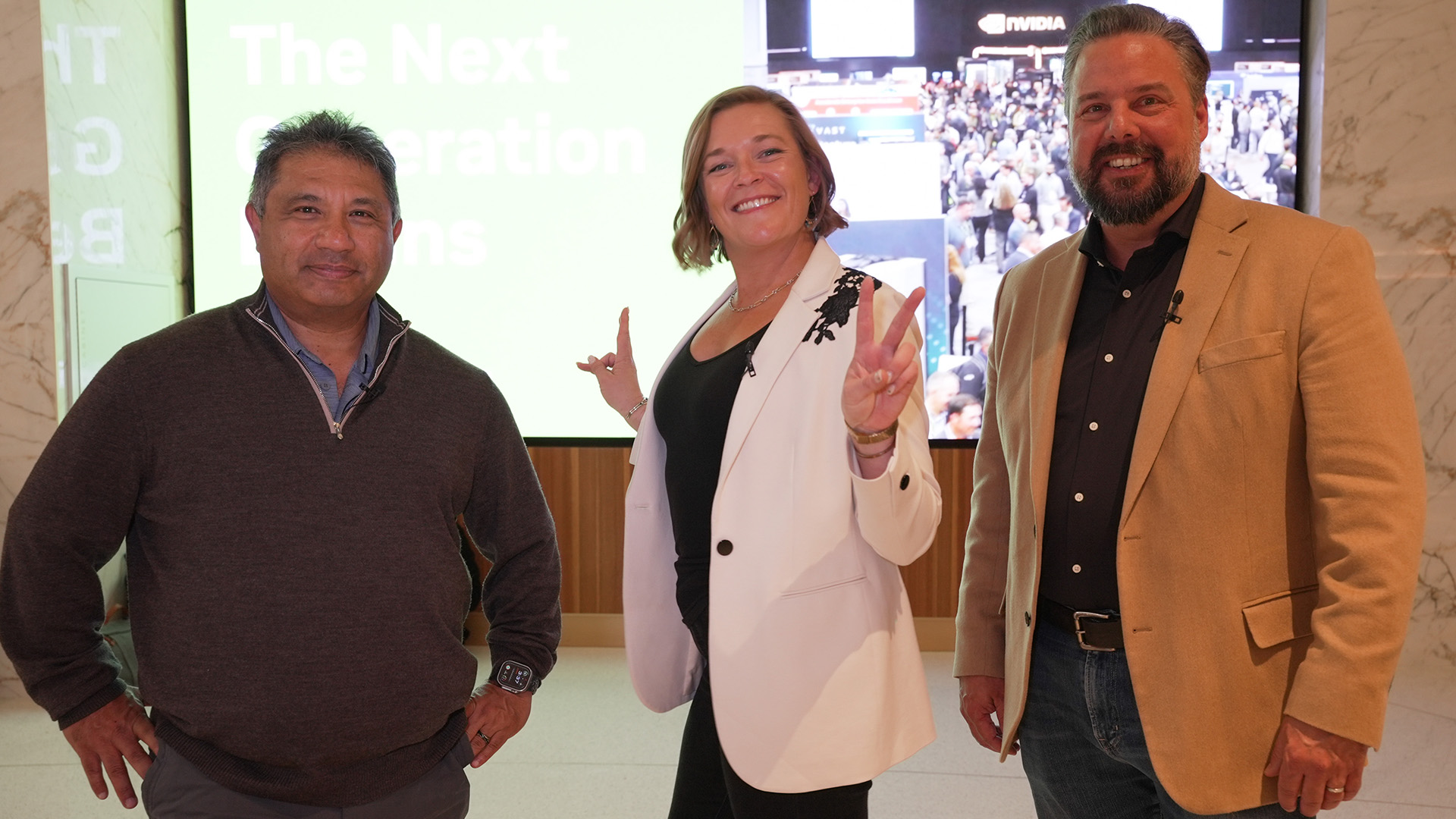
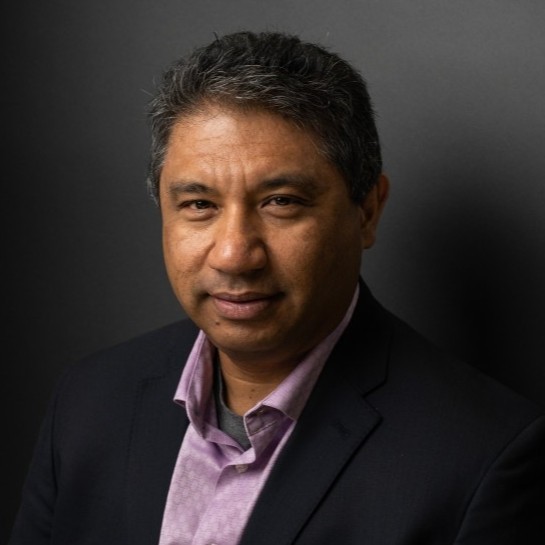
In this segment from CES 2026, theCUBE’s Savannah Peterson and Rob Strechay join Zeus Kerravala to dissect the NVIDIA keynote delivered by founder Jensen Huang. The trio provides a candid critique of the presentation, noting that while NVIDIA demonstrated its continued dominance in AI infrastructure – highlighting the production of the Vera Rubin platform and advancements in physical AI – the keynote lacked a tangible emotional connection for the consumer audience. The analysts discuss how the presentation focused heavily on enterprise plumbing, sovereign AI and partnerships with companies like Mercedes-Benz, yet struggled to bridge the gap between technical specifications and the societal impact expected at a consumer electronics show.
The conversation also delves into the critical shift toward inference and "physical AI," spotlighting a massive $20 billion licensing deal with Groq as a key indicator of where the industry is heading. Strechay and Kerravala analyze the current state of AI adoption, drawing parallels to the early internet era where technology is becoming the invisible, agentic interface for applications. They explore the necessity for 2026 to be the year of ROI, moving beyond theoretical value to real-world implementation in robotics and automotive safety. The segment concludes with a look at NVIDIA’s rapid hardware innovation cycle, including BlueField-4 and new Spectrum networking, and the challenge of translating that compute power into human-centric solutions.
Forgot Password
Almost there!
We just sent you a verification email. Please verify your account to gain access to
CES 2026. If you don’t think you received an email check your
spam folder.
In order to sign in, enter the email address you used to registered for the event. Once completed, you will receive an email with a verification link. Open the link to automatically sign into the site.
Register for CES 2026
Please fill out the information below. You will receive an email with a verification link confirming your registration. Click the link to automatically sign into the site.
You’re almost there!
We just sent you a verification email. Please click the verification button in the email. Once your email address is verified, you will have full access to all event content for CES 2026.
I want my badge and interests to be visible to all attendees.
Checking this box will display your presense on the attendees list, view your profile and allow other attendees to contact you via 1-1 chat. Read the Privacy Policy. At any time, you can choose to disable this preference.
Select your Interests!
add
Upload your photo
Uploading..
OR
Connect via Twitter
Connect via Linkedin
EDIT PASSWORD
Share
Forgot Password
Almost there!
We just sent you a verification email. Please verify your account to gain access to
CES 2026. If you don’t think you received an email check your
spam folder.
In order to sign in, enter the email address you used to registered for the event. Once completed, you will receive an email with a verification link. Open the link to automatically sign into the site.
Sign in to gain access to CES 2026
Please sign in with LinkedIn to continue to CES 2026. Signing in with LinkedIn ensures a professional environment.
Are you sure you want to remove access rights for this user?
Details
Manage Access
email address
Community Invitation
NVIDIA Keynote Analysis | CES 2026
Savannah Peterson, principal analyst and host at SiliconANGLE Media, Inc., along with Rob Strechay, director and principal analyst at theCUBE Research, provides an in-depth analysis of NVIDIA's latest keynote from CES 2026. Joining them is Zeus Kerravala, founder and principal analyst at ZK Research. The session explores the highlights of Jensen Huang's presentation and examines NVIDIA's strategic direction within consumer electronics and AI.
In this video, Peterson and Strechay are joined by Kerravala to explore the significant announcements and discuss their potential impact on the tech industry. They analyze NVIDIA's AI-driven advancements and how they shape consumer applications. The team at theCUBE Research offers insights into the keynote's focus, revealing nuances that may not be immediately evident.
The discussion emphasizes key insights as Kerravala and Strechay evaluate NVIDIA's approach to connecting technology with consumers. Kerravala notes that while the keynote presents substantial announcements, it lacks a consumer-centric narrative, which is significant for a show such as CES. The analysts highlight the strategic partnerships NVIDIA is fostering and discuss the importance of these collaborations in driving future innovation.
In this segment from CES 2026, theCUBE’s Savannah Peterson and Rob Strechay join Zeus Kerravala to dissect the NVIDIA keynote delivered by founder Jensen Huang. The trio provides a candid critique of the presentation, noting that while NVIDIA demonstrated its continued dominance in AI infrastructure – highlighting the production of the Vera Rubin platform and advancements in physical AI – the keynote lacked a tangible emotional connection for the consumer audience. The analysts discuss how the presentation focused heavily on enterprise plumbing, sovereign AI ...Read more
exploreKeep Exploring
What event is being covered in Las Vegas, and who are the key individuals involved in the coverage?add
What did Jensen mention regarding the future of application interfaces and the role of AI?add
What were the observations and feelings expressed about the showcase event by a tech company, particularly regarding its focus and the lack of involvement from consumer founders?add
What are the speaker's thoughts on the emotional impact and audience connection of NVIDIA's presentation?add
>> Happy New Year nerd fam and welcome back to fabulous Las Vegas, Nevada. My name's Savannah Peterson, delighted to be bringing you some exclusive coverage with my copilot, Rob Strechay this week. Covering the consumer electronic show, lots of things happening. First up is a keynote by NVIDIA founder Jensen. We've also got a Cube Collective fan favorite Zeus here on the show. Gentlemen, thank you so much for joining me in Vegas to kick off a fabulous new year.
Zeus Kerravala
>> Yeah, happy new year indeed. Just get back from vacation, got to go to Vegas.
Savannah Peterson
>> I mean, we know the drill.
Rob Strechay
>> We've been here enough, yes.
Savannah Peterson
>> Yes. We know the drill. All right. Real quick, first impressions. Jensen, one of the first people to speak this week. Obviously, lots of GPU and compute conversations happening here. Rob, what did you think?
Rob Strechay
>> I think AI is at the heart of what we're going to hear this week. I think that connecting to the consumer may be a little lacking in this, but it was, I think, really strong in a lot of announcements that they had and where they were going with open models and how they were really pushing for open, which we all love as well.
Savannah Peterson
>> We do. Zeus, what was your first impression?
Zeus Kerravala
>> Yeah, you're right. The connecting the dots to the consumer, you had to do that yourself and understand that AI is going to be at the heart of everything we do, very much like the internet is today. We don't do anything without using some sort of internet service. In fact, Jensen actually mentioned that the interface to every application we use will be AI, will be agentic. However, he just gave a bunch of examples of business applications, Palantir and CrowdStrike. But I do think that if you connect all those dots together, the way the old John Chambers and the way we work with the Lord and play, most of that's consumer. The internet will change, AI will change. So, I think you had to connect all those dots yourself, but it was certainly there. I was a little disappointed in the keynote though that out of the two hours that it took, it took like an hour and a half to get to most of the announcements.
Rob Strechay
>> Yes.
Zeus Kerravala
>> I thought it moved a little slow. Yeah.
Savannah Peterson
>> I would really agree with that. And if we look at hardware historically, consumer does lead the industry. I understand that enterprise is where we see a lot of things realized at scale. But I will say, I found today's keynote to be one of NVIDIA's most lackluster of recent memory. I've been covering TTC last year. Lots of exciting announcements every time. There was a little lean on robots. There was a little lean on the partner ecosystem. There was a little lean on here's our newest, biggest 16 rack setup. But what was missing to me was the connection to impact. We watched a 3-minute video of a Waymo ride. I'm a San Franciscan. I can get into Waymo anytime. That's not...
Zeus Kerravala
>> Unless the power goes out, then they all stop, right?
Savannah Peterson
>> Well, that's any network infrastructure if we're really thinking about it when we're talking about connected and smart devices.
Zeus Kerravala
>> But you see, there was things again you had to pull out. So, the partnership...
Savannah Peterson
>> Is it up to the consumer to pull it out is my question to you all if...
Rob Strechay
>> But he was aimed not at the consumer. He was aimed at...
Savannah Peterson
>> This is a consumer electronic show.
Rob Strechay
>> I understand, but this was more about how the people are going to... The whole front end intro of doing all the gaming stuff were coming from your area...
Savannah Peterson
>> That's NVIDIA's core.
Rob Strechay
>> Correct.
Savannah Peterson
>> Absolutely.
Rob Strechay
>> Coming from their heritage-
Zeus Kerravala
>> Historically, though.
Rob Strechay
>> ... and showing how the new models-
Savannah Peterson
>> Core are actually almost pun intended at this point.-
Rob Strechay
>> ... are really going to go and improve that experience for people. And I think that's how they were trying to, and I think they were trying to your point, weave into health medicine. Health medicine's been a big thing this week. In fact, last night was first look with Samsung, and Samsung's leaning in heavily with AI and with that type of stuff as well. I think what they're trying to do is, there's a lot of what's happening on device versus what's happening back in the cloud or happening in a secure data center. And we did lean into the corporate side, to your point, heavily because he's like, there's a lot of things that we have to keep sovereign. And there was a big sovereign message.
Savannah Peterson
>> Which matters.
Rob Strechay
>> Yes.
Savannah Peterson
>> Which absolutely matters.
Zeus Kerravala
>> And on the automotive side, again, you had to pull up that the partnership with the Mercedes...
Savannah Peterson
>> Yeah, that was actually interesting in fairness.
Zeus Kerravala
>> They're doing the first full stack AV this year, right in the US and then...
Savannah Peterson
>> And the safest vehicle on the road for that keynote.
Zeus Kerravala
>> Yeah. And so, I think from a consumer perspective that is notable, I think in some ways it got buried in all the technical jargon about the open models and things like that. Because what he did was he laid out the fact that NVIDIA has delivered more open models than anybody to date. They've had all these foundation models that created the new uncalled Alpha Bio. And with that one, they're doing it with Mercedes instead of flipping it around and saying, "Here's our partnership with Mercedes. Here's another model we're adding to our stack and oh, by the way, we've contributed more than anybody else." So, he sort of flipped the lead, I thought.
Savannah Peterson
>> And let me even push that farther, Zeus, because I like what you're saying right now. What if they just led with the solution? We worked with Mercedes to design the safest vehicle on the road, then step back from that onto how we did it. But the problem is, and this is an issue I have with the tech industry as a whole right now, there is a discommunication between how the industry talks about AI and the potential impact and the way that the consumer world, which is what we're here talking about this week, all respect to NVIDIA and everybody else, this is not an enterprise show, this is a consumer show. There's a chasm right now between some of the biggest companies in this space and the consumer, and I wanted more. And he came out 13 minutes late and talked about how he hadn't prepared for the speech. And I'm just going to say that it showed. As fellow performers, we can see when someone hasn't really thought about that end consumer message. Now what they're doing is impressive. I understand that when you're playing in robotics and automotive and healthcare and every space, and you're one of the most profitable tech companies on the planet, that there's a lot of pressure to showcase different things. We didn't see any other founders on the stage. We didn't see a single consumer founder come out and talk about how their partnership has done something. We were watching multiple videos that were illustrating a lot of CGI, and this is the one show a year we really get to sink our teeth in and get super hands on, and it just wasn't there for me today.
Rob Strechay
>> Yeah. I think, again, NVIDIA has pulled back, except for the prosumer aspect of where they sell...
Savannah Peterson
>> Oh, it's AI factory roles.
Zeus Kerravala
>> Well, look at much of the revenues driven by gaming today versus before, right?
Savannah Peterson
>> Absolutely, which is super fair. And I understand where they're coming from from a revenue perspective. I was just secretly create, not secretly, openly craving. As a consumer, I wanted to hear about some of the solutions they are helping empower that are driving consumer impact versus this continued focus on the hypothetical value add that we're going to get that we've been hearing for three years.
Zeus Kerravala
>> But they kind of all do. So, if you look at the Vera Rubin announcement, which I thought they crammed way too quickly at the end, is that a consumer play or not, right? Obviously, it's a hyperscaler play, it's a large enterprise play, but it enables a lot of consumer things post-deployment, right? So, again, you're connected not yourself to your point, Savie, but I do think the consumer connection is inferred, or at least should be inferred. But I do think that when you look at what this company has become, it is a large enterprise hyperscaler company that delivers an awful lot of infrastructure, AI infrastructure-
Savannah Peterson
>> Oh, they do it a lot.
Zeus Kerravala
>> ... to the biggest companies in the world.
Rob Strechay
>> But here's, I think, the connection to that. And I've been pushing in this week, one of the things I'm going and trying to understand better is how many of the companies here, the consumer companies are actually doing their own AI, or are they using an API from a Gemini, Azure AI, or from a bedrock where they're using some model there or open AI for that matter, and how many are actually rolling their own? And in fact, when I pushed on Samsung, for instance, because that's the discussion I've had already, they have half-and-half. They have Bixby, which is their own, and then they're also using Gemini from Google.
Zeus Kerravala
>> Over time, I think these companies gravitate to publicly available large language models and augmented small language models and they're all, right? Yeah.
Rob Strechay
>> Yes. I think even Jensen did hit on that. I think he buried that. And I think this is where it comes back to, okay, this is... I mean, again, what is it? It's not going to be in the mechanical dog that's out there on the floor. I already saw it last night that is going to be a pet for you. They showcased it last year and this year it's more AI driven. It's not going to be GPU driven. And I think this is where, to your point, they didn't have that direct connection like they used to with the consumer because the GPU's not in the device, but what is happening is that their models are being updated and inference is being driven into there. Maybe they end up on some of these CPUs that they talked about.
Savannah Peterson
>> Well, you just mentioned inference, and I don't know if they're in a quiet period about this or not, but it's impossible for me to start 2026 without talking about the $20 billion licensing deal that NVIDIA just did with Groq, the LPU being one of the greatest innovations in inference and pieces of architecture making AI real. Congratulations, frankly, to Jonathan Ross and the team at Groq. We've been following them since inception and it's extremely impressive. But that was one of those tools. I know, and I know you both know, and this is why we're all here because we support tech and we support NVIDIA. And I'm not here to be a hater, but when it comes to these moments of communication, especially when we're kicking off a year, you have the opportunity to emotionally connect with an audience. We did not get emotionally connected to at all today by NVIDIA. And the reality is when we think about inference, just as an example, since you brought it up, that's what makes AI grow. I've covered the personalized learning robots that Groq and NVIDIA empower that in itself. Everyone here has learned something. A lot of people here are apparent. A lot of people here have tried to continue their own learning, and there was no mention of what this does in the world. We saw robots moving, we saw cars driving, but there wasn't the, "Hey, this is how it's going to actually impact." And my hope for this show, and I know you want to say something to this, but my hope for this show is I'm actually not interested in AI at the show. I'm interested in the impact of new technology at this show, whether that's AI or ML powered, whether that's sensor powered, whether that's just the iteration and evolution of various products, I'm sick of us talking about what this can do. It's been three years of that in the mainstream and it's been 25 years in the making. Rubber's got to hit the road at some point. And just because you made a bigger server stack doesn't mean that does anything for humanity.
Zeus Kerravala
>> Yeah. Well, I know there's been a lot of parallels drawn to the early news of the internet.
Savannah Peterson
>> Oh, totally.
Zeus Kerravala
>> And I think this is the difference between say a Jensen keynote now and a John Chambers keynote back in the early days, where John would actually come out and talk about how the internet is going to change the way we live. It's going to allow women in Middle Eastern countries that can't work to work for US companies. It's going to democratize...
Savannah Peterson
>> Which it has.
Zeus Kerravala
>> Right. It's going to democratize education, things like that. And they would talk a lot about the societal impact. I think where, and this has sort of been NVIDIA's style, they talk a little bit about it at a high level and then boom, they get down on...
Savannah Peterson
>> Straighten his fees and peace which is fine. And I'm not criticizing that. I just, when you have the opportunity to inspire a year of innovation, take it.
Zeus Kerravala
>> But I think where we are now too is we've had a lot of vision over the last few years. 2026 has got to be a year that this stuff comes to life and that, yeah.
Savannah Peterson
>> That's what I'm saying.
Rob Strechay
>> But I think that was the point that he was trying to say, "Hey, it's already real." And I think with unbeknownst to Jensen, I mean, he's really smart guy, very big company. I think one of the things is why it hasn't really latched on yet is ROI. ROI to the company selling the devices, the companies building out the services. I think this is the year that ROI has to hit for a lot of these different things. And I think people are taking smaller pieces of it in the enterprise, and I think the consumers will do that as well. I think one of the things he did hit on in the Vera of Rubin announcements, and I think the cash and the storage stuff, which we'll go into more in depth in a minute with one of the partners. But I think when you start to look at how they're going and actually announcing a completely new system, it wasn't just a chip. It was a set of systems.
Savannah Peterson
>> Correct. No, it was robust.
Zeus Kerravala
>> Well, they've reinvented the system several times.
Rob Strechay
>> Correct and...
Zeus Kerravala
>> At his point, they've had to.
Rob Strechay
>> But they have to disrupt themselves. And I think that's the great thing about them. And I think Jensen even says that, even though he talked about not doing more than two at a time, which was pretty amusing, and then there was six different chips or something like that. When I look at this, I think one of the things that I pull away from this is, to your point, I mean, he's about the plumbing, the infrastructure and the tech and all of these different pieces coming together. I think they also looked at, and they had all of the partners at the bottom of the slides there that are going to go and make this real out there. But I think that for them, it's also, they want to be seen also as a software company, as part of it as well, not just a hardware company. And I think that was a big piece...
Zeus Kerravala
>> Well, the software is what keeps them ahead.
Rob Strechay
>> Correct.
Zeus Kerravala
>> Right?
Savannah Peterson
>> Absolutely.
Rob Strechay
>> Exactly. Exactly.
Savannah Peterson
>> Well, but the thing that I found to be a stark contrast to ... I mean, we've all been at GTC Keynotes at the conversation they had, I believe it was at CES last year, Bill McDermott was on stage with Jensen. They had multiple different partners come out on stage with Jensen. And I think, as we know, no one gives more social proof to the community than having a customer or a solution come out and tell why you're beneficial for you.
Zeus Kerravala
>> Yeah, no, you're right. They talked about that Siemens partnership. They could have brought Siemens up.
Savannah Peterson
>> Exactly. They talked about Serve Robotics we're going to have on the show this week as well. Be sure and check that out. We've got their CEO coming on with us tomorrow. They talked about all these partnerships, but we didn't get to hear what that's actualizing. And when Jensen said that we're 15 keynotes wrapped into one, I felt like it was one kind of bundling in a pile...
Rob Strechay
>> If you had been there for two hours beforehand to get your seat, they actually had Mercedes-Benz out on stage earlier on and some of the startups there.
Zeus Kerravala
>> They should have wrapped that in though.
Rob Strechay
>> They should have wrapped that. I think that was a miss. I think that was a miss. They could have shut it down...
Savannah Peterson
>> It's not that they're not doing cool things. It just wasn't demonstrated publicly with this keynote in a way that I felt did NVIDIA justice is what I'm trying to say.
Rob Strechay
>> I agree. But I think, again, Vera Rubin really cool stuff. We'll be dissecting for that...
Savannah Peterson
>> Absolutely. Physical AI, very much a big part of the conversation. Jensen kept talking about AI physics. We're clearly moving into a tangible space, which makes this hardware nerd very happy. But I think it's going to be interesting. It's possible they're saving their biggest and best secrets for GTC in March.
Rob Strechay
>> I mean, that's in two months.
Savannah Peterson
>> I know, exactly. I was thinking about that the whole time. It's 60 days away, I'm not surprised that...
Rob Strechay
>> Well, the fact that they're in production of Vera Rubin is pretty impressive at this point. I mean, again...
Savannah Peterson
>> I will say their rate of hardware innovation is absolutely astounding.
Zeus Kerravala
>> Yeah. I mean, BlueField-4 is out now, new spectrum, right? They've got faster network than everybody else on the planet today. Granted, it is in InfiniBand basis, but it's the only way you can get these GPUs to talk to each other align rates.
Rob Strechay
>> Right.
Savannah Peterson
>> Yeah. They're doing a lot of the right things. I just want them to illustrate their value best in a slightly more digestible manner. That's my advice to you, NVIDIA, if you happen to watch this wonderful keynote analysis. Robin Zeus, this was fantastic. Thank you both for your fantastic insights, always over the years on The Cube. And I'm excited to continue to cover the rest of the show with both of you.
Rob Strechay
>> Absolutely.
Zeus Kerravala
>> All right.
Savannah Peterson
>> We're going to have a lot of fun. And thank all of you for tuning in to our exclusive coverage here at CES in Las Vegas, Nevada. My name's Savannah Peterson. You're watching The Cube, the leading source for enterprise tech news.