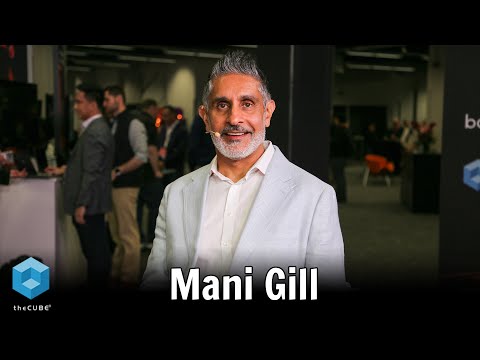
This conversation explores artificial intelligence agents, governance and platform integration at Boomi World 2026 in Chicago. Mani Gill of Boomi, senior vice president product, Vish Annam of Hathority, chief executive officer, and Nanda Damodharan of Hathority, technology executive, join theCUBE Research hosts John Furrier and Gemma Allen for live coverage. The discussion draws on product integration and AI expertise to examine generative AI agents, rapid application development, Boomi platform capabilities and partner-driven implementations such as Hathority's hackathon entry and agent marketplace contributions.
Key takeaways emphasize the central role of validation and governance for agent deployments. Annam states that Hathority's ReleaseShield validates agents against security and operational guardrails before production, and they describe how validation protects enterprise data cloud initiatives. Gill emphasizes rapid scalable deployment on the Boomi platform and the need for unified data and observability, and they note platform integration and developer experience as critical factors to consider. Damodharan highlights organizational trust and incremental wins to expand agent-driven automation and unlock revenue via Customer 360 initiatives, and they discuss governance and partnership strategies for large enterprises.
Forgot Password
Almost there!
We just sent you a verification email. Please verify your account to gain access to
Boomi World 2026. If you don’t think you received an email check your
spam folder.
In order to sign in, enter the email address you used to registered for the event. Once completed, you will receive an email with a verification link. Open the link to automatically sign into the site.
Register for Boomi World 2026
Please fill out the information below. You will receive an email with a verification link confirming your registration. Click the link to automatically sign into the site.
You’re almost there!
We just sent you a verification email. Please click the verification button in the email. Once your email address is verified, you will have full access to all event content for Boomi World 2026.
I want my badge and interests to be visible to all attendees.
Checking this box will display your presense on the attendees list, view your profile and allow other attendees to contact you via 1-1 chat. Read the Privacy Policy. At any time, you can choose to disable this preference.
Select your Interests!
add
Upload your photo
Uploading..
OR
Connect via Twitter
Connect via Linkedin
EDIT PASSWORD
Share
Forgot Password
Almost there!
We just sent you a verification email. Please verify your account to gain access to
Boomi World 2026. If you don’t think you received an email check your
spam folder.
In order to sign in, enter the email address you used to registered for the event. Once completed, you will receive an email with a verification link. Open the link to automatically sign into the site.
Sign in to gain access to Boomi World 2026
Please sign in with LinkedIn to continue to Boomi World 2026. Signing in with LinkedIn ensures a professional environment.
This conversation explores artificial intelligence agents, governance and platform integration at Boomi World 2026 in Chicago. Mani Gill of Boomi, senior vice president product, Vish Annam of Hathority, chief executive officer, and Nanda Damodharan of Hathority, technology executive, join theCUBE Research hosts John Furrier and Gemma Allen for live coverage. The discussion draws on product integration and AI expertise to examine generative AI agents, rapid application development, Boomi platform capabilities and partner-driven implementations such as Hathority's hackathon entry and agent marketplace contributions.
Key takeaways emphasize the central role of validation and governance for agent deployments. Annam states that Hathority's ReleaseShield validates agents against security and operational guardrails before production, and they describe how validation protects enterprise data cloud initiatives. Gill emphasizes rapid scalable deployment on the Boomi platform and the need for unified data and observability, and they note platform integration and developer experience as critical factors to consider. Damodharan highlights organizational trust and incremental wins to expand agent-driven automation and unlock revenue via Customer 360 initiatives, and they discuss governance and partnership strategies for large enterprises.
In this interview from Boomi World 2026, Vish Annam, chief executive officer of Hathority, joins Nanda Damodharan, delivery director at Hathority, and Mani Gill, senior vice president of product at Boomi, to talk with theCUBE's John Furrier about how AI agent validation and data governance are becoming the critical path from automation pilots to production-ready enterprise outcomes. Annam and Damodharan, platinum Boomi partners for a decade and winners of the Boomi World hackathon, introduce ReleaseShield — a validation layer that certifies AI agents before p...Read more
exploreKeep Exploring
Who are the guests and what topics are introduced in theCUBE's live coverage at Boomi World 2026?add
What is ReleaseShield, how does it work (mechanism/architecture and what it tests), and how long did it take to build and pilot?add
How should AI systems, agents, and integrations be validated and governed (e.g., via sandbox testing, LLM-based or pipeline validation, and data governance) before deployment to ensure stability and avoid black-box failures?add
What safeguards, governance, and infrastructure should organizations have in place when using AI-generated code and rapid application development to ensure applications run reliably in customers' environments?add
>> Welcome back here to theCUBE's live coverage here at Boomi World 2026 here in Chicago. I'm your host of theCUBE. Gemma Allen is here with me. She's out getting some stories, of course, covering all the action at Boomi World. As the transformation of AI continues to thunder along, the AI infrastructures continue to accelerate. That is bringing in the age of agents and generative AI at a platform level. Got Mani Gill back on theCUBE, my wingman on this one, Senior Vice President of the Products at Boomi. We got two hackathon winners, but also architects with this big data cloud that they have. Boomi partner. Vish, CEO, Hathority. Thanks for coming on. Good to see you.
Vish Annam
>> Thank you.
John Furrier
>> Nanda, Technology Executive with Hathority. Thanks for coming. I appreciate it.
Nanda Damodharan
>> Of course.
John Furrier
>> So on the intro there, the AI infrastructure is booming and you're seeing a lot of activity with coding now going into generative AI. That platform's starting to emerge. You guys are a platinum partner with Boomi going back 10 years. So got legacy, but now you get the new era upon us. Also, winners of the hackathon. So first, let's get into the hackathon first. I want to get that out there.
Vish Annam
>> Sure.
John Furrier
>> Tell us what you guys did. What was the situation?
Vish Annam
>> Yeah, thank you for inviting us, John, and thanks for Mani. Yeah, with the hackathon, our product there is called ReleaseShield. So think of in a similar way, like just a simpler robot stamping your AI agent before it goes into production. So it's going to validate against all the guardrails, making sure it's not tapping into any of the data. So as we are seeing more and more software as service products and with the evolution of AI, so many AI agents that are in the marketplace. So this is a product that could validate, run against all the test cases, security standards. So think of the way Anthropic has Mythos. I mean, that kind of uncovered a lot of these security bugs. I mean, that's what the ReleaseShield is going to do, like running through all of those test cases and finding where it could break before it go into production.
John Furrier
>> So like a certified agent.
Vish Annam
>> Exactly.
John Furrier
>> What was the mechanisms? What did you guys do? How long did it take? Give us some of the details.
Vish Annam
>> Yeah. So this one is built on AWS suite of different applications in there. So it took us about three months for the proof of concept. So Boomi was the initial adopter of their release management side of it. So we worked with our customers. So whenever the Boomi releases are happening, so we are making sure none of their integrations break because like Boomi is publishing some changes to their UI and to the runtime environment. So we're taking a snapshot of all of their integration data and then making sure they all work after the release happened. So it took us about three to six months depending on the complexity of it. But we piloted with a handful of customers, which was very successful. It runs all the test cases in the sandbox and then before it goes into production, we make sure everything is stable.
Mani Gill
>> Feels like validation is kind of key in this AI world. At work, I call it AI slop. How do we get around the AI slop? And validation becomes a key way, whether it's LLM as a judge or validating pipelines or validating the software, but it becomes so much more important because we don't want it to be a black box environment, right?
Vish Annam
>> Right. Exactly, Mani.
Nanda Damodharan
>> That leads to the strong governance requirements over the agents and all the integrations that we've been talking about. All those while we wanted systems to be connected, but then now they're connected. There's so much data. How do we govern all of that data? And that's when we thought, okay, we had this Microsoft outage a few years back, the blue screen outage. And that's when you thought if that could happen for Microsoft, it could happen for so many other companies.
John Furrier
>> That was the worst, by the way. I went to an airport's, Delta. "Oh my God, the blue screen of death's on the big screen."
Nanda Damodharan
>> Absolutely. Right.
John Furrier
>> Their entire thing. But that just goes to show you resilience is huge. So if you get the governance wrong, man, I want to get into this because this is an example of rapid product development, having agile and scalable cloud and getting governance right, because if you can govern the data agent interaction, that seems to be the theme here at Boomi is that rapid deployment at scale in production is not just a north star, it's gettable. So guys, let's talk about that. What's different this year, because it was a north star last year. Hey, let's get things in production at scale. Coding comes in, everyone loves that. And now that's ushering in the agents because now people are like, okay, I can sling code, not slop, but curate it right. Don't token max, get the cost structures right. How is this bringing in this next era?
Vish Annam
>> So this is where at least as a code with the rapid application development, right? I mean, thousands of lines of code can be generated within seconds. So this is where, even though a lot of governance there, the tools that you have or any of these, but at least the security standards and then you have at the top line, so you have your UI guidelines. And when the applications are like heavy software based application, which is like somebody using as a call center, as an agent. So you want to make sure it's not consuming a lot of your memory on the server and then you are having these scattered calls all over the place. So what we are doing is making sure what the previous application is considering all of the local settings that has in place. So it compares with, okay, this is the memory that the customer has, then your code need to be justified to make sure it's not consuming more than that and then breaking the customer environment. So a lot of those guardrails, not only the software and the data governance level, even to the hardware level, so it is assuring the software vendors that their software is not going to fail in the production. And a lot of companies, I mean, they went bankrupt. Last year, we presented a use case at the Boomi World because they did not have all of these guardrails in place and it's impacting the customers miserably, unfortunately. So this is where we could use that product.
Mani Gill
>> I think it's also a combination of the infrastructure is getting better, right? The models are getting better. If in doubt, just ask Claude. Is this right, can I do it this way, and validate those things. But getting that infrastructure in place, rewind a year ago to your question, that infrastructure customers were just contemplating it. Now once you have it in place and you have that data in place, and you can combine it with the coding agents, then you've got a running start and you can continue to improve it as you go. Key message that Ed left the crowd with this morning was activate today now. And so that's part of the journey. It's not like, "Hey, let's wait a year, year and a half, but infrastructure in place, let's continue to iterate, validate, and move forward."
John Furrier
>> Yeah. What do you guys think about that? Because one of the things Steve Lucas said on stage yesterday that hit home with me was two things. One, if you want to go faster, make the car lighter, kind of using a metaphor with driving. I thought that was kind of interesting because it's like, okay, what does that mean? You got to consolidate features. But Vish, you were just talking about a scenario that abstracts away complexity. He also said they want to make it simpler.
Vish Annam
>> Right.
John Furrier
>> It's not getting less complex, but there's tools now to make things easier, abstracted away, and the speed game. So it brings up consolidation in a good way, not in a bad way. So whether it's companies coming together with M&A or product lifecycles changing, abstract away complexity and reduce the heaviness in the app. What's your reaction to that?
Vish Annam
>> Yeah, no, I think that's definitely the trend that we are seeing in the marketplace as well. I mean, people need it right away if not yesterday. So with the way Boomi is also helping our customers, like with the reducing the complexity and at the same time, like giving them with a unified platform experience, like with the customer that where we have been working on, so they wanted a unified customer view from their call center and all the way to their field operations. So where they would deliver natural gas tanks or like propane tanks in particular. So there are like different touchpoints, like there are thousands of these touchpoints. So without a tool like Boomi, which can orchestrate and then also like tapping into the untapped data, which is like by activating the data sources. And then on top of that, these micro agents that are there, so call center agents data to create that talking to their Salesforce agents and then making sure they get that customer agent. So at least I think the vision that Boomi has, I mean, it's definitely spot on with the market demands right now. So that's where like, so with Mani, Ed, and Steve, their vision is driving the unified customer experience so for the better results.
Nanda Damodharan
>> While we are talking about that, I mean, you said all of the solution has to be simple with all the complexity involved in it. And then with the speed at which we are traveling with all these changes happening to the infrastructure, the AI, the development, everything, there's a need for this trust that Steve talked about yesterday. How do we trust all of these agents to take decisions on behalf of the human beings who've been doing this for years and ages. And that's where the data governance and all of this comes into play. And we've been focusing on a lot of that to help our customers to see ... I mean, the humans are still going to be there, but we still need to trust our agents to do as near perfect to what they've been doing, because with all of the supply chain automation we've been helping our customers with, there needs to be reliable data and there needs to be reliable agents to take decisions because all of these decisions with the propane distribution, there's a lot of risk involved in all of these.
Mani Gill
>> Also-
John Furrier
>> .
Mani Gill
>> Speak over you, sorry.
John Furrier
>> No problem.
Mani Gill
>> It's also organizational transformation. So part of it is infrastructure foundation, et cetera. I did a talk a few weeks ago at HumanX and it was really to take the learnings that we've had with our early customers and how they've evolved processes. And one of the common themes that kept coming up was that they had to show wins along the way to gain that trust, gain that trust of the organization. And so you don't need to go full autonomous, but let's say you're reconciling a set of data. Well, that data can get reconciled to a point where then there's a human review that then gets pushed into your benefits system as an example. Once the organization gets comfortable with that, then we can fully autonomize it. So I kind of look at where we are in the industry and a lot of it is the friction of just human transformation.
John Furrier
>> Guys, talk about that culture piece because he brings up the transformation point, which is it's not an IT project anymore, it's a business project. And you're starting to see the deep tech mojo that Boomi brings and others merging in with the C-suite. It's not just the CIO or what we've been calling the super CIO now, and the CISO, it's the CFO, chief human resource officer. You start to see the personas coming into the mix. So, okay, trust. How are people earning that trust? Are they going for the big wins out of the gate for revenue? Are they doing cost takeout? What do you guys see with your customers? Because IT is, the playbook's been clear, "Oh, you knock down cost, get some efficiency." No, no, no. Revenue is on the table now. I mean, I've seen a lot of transformation products, but revenue is the top line driver, not much in IT.
Vish Annam
>> So actually that's a great question, John. So the way that with the Customer 360 experience that we had, so which materialized them to tap into some of the untapped market. So this customer, they had about 120,000 customers. So it's a lot of customers that they had. There is a missing gap in the middle, like some are on the enterprise side, so where they're having a concierge support. So they're always handhold and kind of making sure they're getting served. So on the lower end, I mean, they do have the SMB market reps. But they're missing the sweet spot in the middle that they're hardly contacting the customers. So we are able to tap into that market and then prove them. Okay, so by using the products and the solutions, we are able to find about 60% of their customers never received an email. And they're not complaining about any service, but they were never contacted. So for any upsell opportunities. So for any new opportunity that they could tap into like with these customers. I mean, not only adding new services. So this is directly turned out to be a revenue generating tool for them by showing with the exact metrics. I mean, these were like never been communicated.
John Furrier
>> Well, you guys have been around many ways. Mani, you too. And we've seen that IT doesn't think about that piece, and this is where the domain expertise in Boomi's narrative and others that are focused on this is it's not just horizontal scalability with the data, it's the domain experts who will say, "Hey, if we just followed up, the funnel increases and then sales people can go to town on it." So this is like where the action is.
Mani Gill
>> Yeah. And this is great where our partners like Hathority come in. They are doing these projects for many, many, many customers. And so you see these opportunities and you'll be able to take these opportunities, understand how it's benefiting. Because at the end of the day, once you put the Customer 360 in place, it's going to save money and it's going to drive top line revenue. It's just understanding what the ambition can be and communicating and pulling the right parties in those organizations so that they can actually participate in that.
John Furrier
>> Yeah. It's a great win. Guys, I want to go talk about your business because I love what you guys are doing. I love the data cloud concept. I love the narrative of self-driving enterprise. And I have a question here, so bear with me. I wrote a post two days ago and a video and it was talking about shadow AI because we were just talking about transformation. Shadow IT was pretty basic. IT, we go around the boss, we'd put their credit card down, go to AWS, get a prototype, show the whole team, "Oh my God, that's great." Get their hands slapped by the boss and then say, "You now run the project." So that kind of created the flywheel for cloud native. Shadow AI is hitting every department. The CFO, they're closing the books early. So everyone's tasting that dysfunctional but functional innovation. So you got that ... Well, my post was shadow AI is like a 16 year old, everyone's like 16 years old driving at the same time and they're like, "Stop sign. I didn't go to driver's ed." So you're seeing a lot of behavior fast and loose. And you got some good drivers, but technology is the car and the drivers are the human, and then agents are the autonomous piece. So what's your reaction to that? How should people think about the shadow AI opportunity as a feature not a bug?
Nanda Damodharan
>> Definitely because I mean there's always this trial thing, Because everybody at this time is scared of AI, looking at it's going to replace humans and stuff. But when I look at it, it's like it's going to benefit all the humans. It's going to bring in more features that humans were never able to, or it's just going to make things that humans were doing all this while just a little more better than how they used to be. And also at this time, it's also greater opportunity for all the organizations, all the different teams within the organizations to work with each other because the businesses were operating separately. The IT department were operating separately. We wanted all the ITs to be connected, the applications to be connected and we did have Boomi. We introduced Boomi to a lot of customers. They're very happy now. They have connected systems and now we are introducing AI. Let's connect the business processes as well along with them. And this gives the opportunity for them to come together. Okay, let's trust the business. This is the process we've been doing so far. This is the IT technology we have behind it that could support all the businesses now. And so that's the growth of this AI product which can automate or self-drive the supply chain or the industry from top to bottom. Reducing customer churn, increasing ROI, all of that is based on all of this happening, coming together at the same time. So I believe this is a great opportunity for humans because shadow AI, yes, that's happening and people are making advantage of it and there's no-
John Furrier
>> I think it's a great marketing tool because everyone can see the value faster.
Nanda Damodharan
>> Right.
John Furrier
>> CFOs, here's your budget and where's the ROI? Now they can taste it.
Nanda Damodharan
>> Yeah. It's here.
Mani Gill
>> I think I take the aggressive side on this. Let's make sure that the data is activated. Let's say it's auditable, let's say it's a governed, and then let's let the business grow.
John Furrier
>> Drive. Yeah.
Mani Gill
>> Let them drive. And once they drive, they will know what they can do with it. And of course we've got the guardrails in the back end so that we don't let them off the road.
John Furrier
>> Exactly.
Nanda Damodharan
>> And the trust automatically built in.
Mani Gill
>> Yeah. But, I mean, we can't put the brakes because then what we're doing is we're actually fueling shadow AI because then they're going to go outside of the guardrails that we've actually put.
John Furrier
>> That's where guardrails come in. Again, the F1 movie, Drive to Survive, my son's favorite show about F1. If you get it right, you can really drive the business. I think this is a key point. Guys, thanks so much. We're at time, but I want one final question. What are you guys up to next? When you leave Boomi World, what are you going to work on? What's the focus? What are you guys optimizing for?
Vish Annam
>> So Hathority, we trademarked the Hathority AI data and cloud. So with that, with the mission of combining where Boomi falls in with the data stream. So we are building a lot of innovative solutions on top of Boomi and with the master data hub, and providing all of these metrics by using the power of AI. So we have launched about 25 agents in the Boomi marketplace already. So we are trying to hone on those solutions, can improvise it, and make it more specific to the customer use cases. So that's our goal for the next year or so.
John Furrier
>> Thanks so much for coming on. Mani, thanks for coming back for celebrity appearance.
Mani Gill
>> Yeah, thank you.
John Furrier
>> Appreciate it.
Mani Gill
>> I like the sound .
John Furrier
>> My new co-host, Gemma, watch out. Gemma Allen's not here. She's out getting the stories. I'm John Furrier, your host of theCUBE. We'll be right back after this short break.














 John Furrier