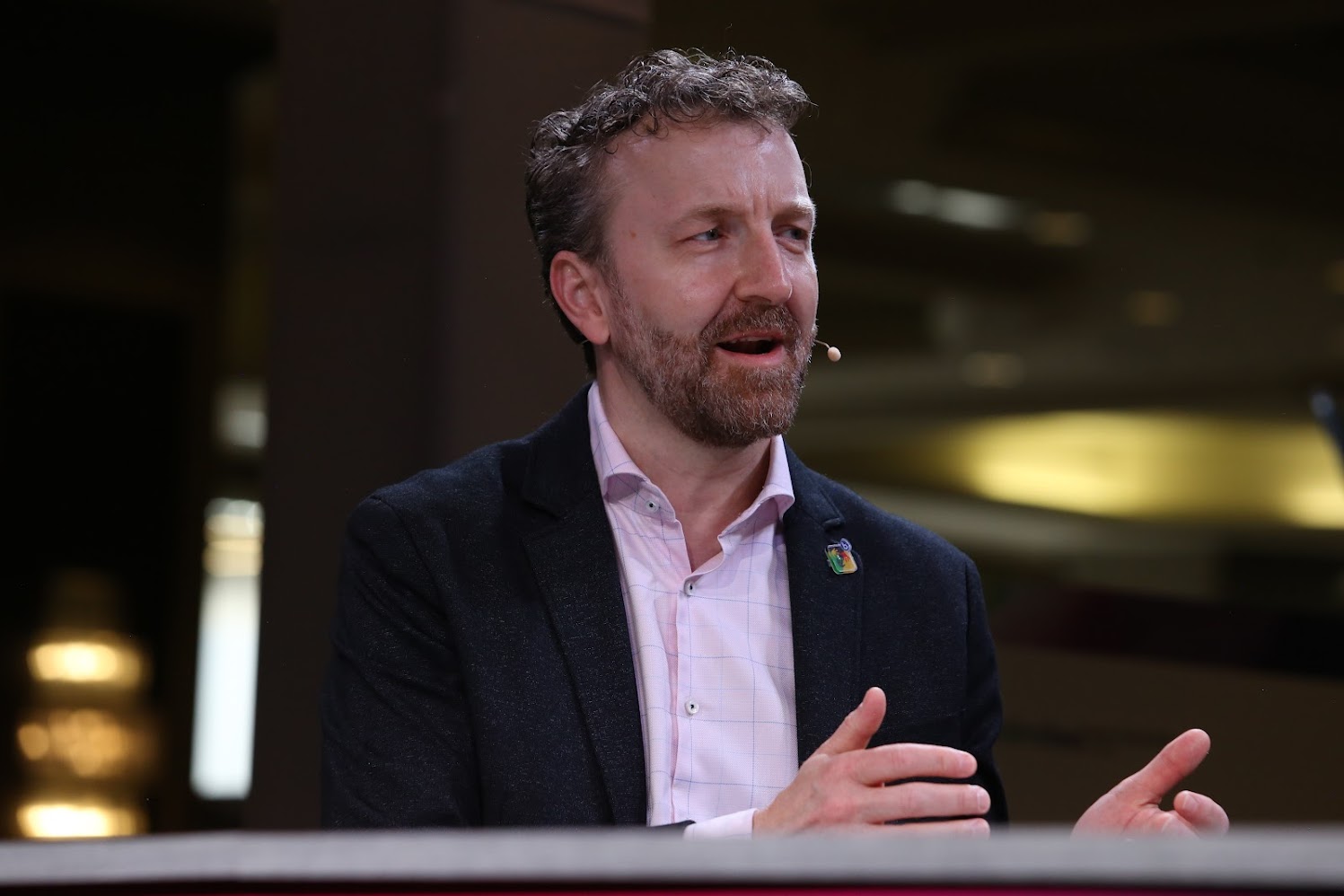
Matt McLarty, CTO of Boomi, joins Savannah Peterson and Paul Nashawaty of theCUBE Research at Boomi World 2025 to discuss the tech transformations shaping the enterprise landscape, including how organizations are redefining success by aligning business problems with practical technology adoption.
Boomi is leading in a time of accelerating innovation, particularly in AI and generative AI, McLarty shares. He stresses the importance of clear intent when implementing AI, urging companies to start with specific business goals rather than chasing hype.
For organizations evolving beyond prototypes, he offers candid advice: experimentation matters, but execution is everything. There is a need for strong interoperability and strategies to tame complexity in a multicloud, multi-tool world, according to McLarty.
Forgot Password
Almost there!
We just sent you a verification email. Please verify your account to gain access to
Boomi World 2025. If you don’t think you received an email check your
spam folder.
In order to sign in, enter the email address you used to registered for the event. Once completed, you will receive an email with a verification link. Open this link to automatically sign into the site.
Register For Boomi World 2025
Please fill out the information below. You will recieve an email with a verification link confirming your registration. Click the link to automatically sign into the site.
You’re almost there!
We just sent you a verification email. Please click the verification button in the email. Once your email address is verified, you will have full access to all event content for Boomi World 2025.
I want my badge and interests to be visible to all attendees.
Checking this box will display your presense on the attendees list, view your profile and allow other attendees to contact you via 1-1 chat. Read the Privacy Policy. At any time, you can choose to disable this preference.
Select your Interests!
add
Upload your photo
Uploading..
OR
Connect via Twitter
Connect via Linkedin
EDIT PASSWORD
Share
Forgot Password
Almost there!
We just sent you a verification email. Please verify your account to gain access to
Boomi World 2025. If you don’t think you received an email check your
spam folder.
In order to sign in, enter the email address you used to registered for the event. Once completed, you will receive an email with a verification link. Open this link to automatically sign into the site.
Sign in to gain access to Boomi World 2025
Please sign in with LinkedIn to continue to Boomi World 2025. Signing in with LinkedIn ensures a professional environment.
Are you sure you want to remove access rights for this user?
Details
Manage Access
email address
Community Invitation
Matt McLarty, Boomi
Matt McLarty, CTO of Boomi, joins Savannah Peterson and Paul Nashawaty of theCUBE Research at Boomi World 2025 to discuss the tech transformations shaping the enterprise landscape, including how organizations are redefining success by aligning business problems with practical technology adoption.
Boomi is leading in a time of accelerating innovation, particularly in AI and generative AI, McLarty shares. He stresses the importance of clear intent when implementing AI, urging companies to start with specific business goals rather than chasing hype.
For organizations evolving beyond prototypes, he offers candid advice: experimentation matters, but execution is everything. There is a need for strong interoperability and strategies to tame complexity in a multicloud, multi-tool world, according to McLarty.
Matt McLarty, CTO of Boomi, joins Savannah Peterson and Paul Nashawaty of theCUBE Research at Boomi World 2025 to discuss the tech transformations shaping the enterprise landscape, including how organizations are redefining success by aligning business problems with practical technology adoption.
Boomi is leading in a time of accelerating innovation, particularly in AI and generative AI, McLarty shares. He stresses the importance of clear intent when implementing AI, urging companies to start with specific business goals rather than chasing hype. <...Read more
exploreKeep Exploring
What is the process for companies to admit that they are behind in adopting new technologies and how can they start applying AI to solve their business problems effectively?add
What are some ways organizations can become more experimental and embrace interoperability in enterprise architecture decision-making processes?add
What is the difference between the evolution of AI and historical tech stacks?add
What are some strategies for empowering a diverse team to continue moving at a high velocity and effectively communicate and collaborate, especially in relation to the future of AI?add
>> Good afternoon Boomi community and welcome back to smoking hot Dallas, Texas. We're here with two days of power-packed coverage. My name is Savannah Peterson, here with Paul. Paul, what a great start to the day.
Paul Nashawaty
>> It really is a great start. I mean, a lot of announcements to go over, a lot of things to think about.
Savannah Peterson
>> And who better to tell them than straight from the mouth of the C-suite here? Continuing our tour of the C-Suite, welcoming back to the show for the second year in a row, Matt. Matt, thank you for coming to hang out again.
Matt McLarty
>> It's my pleasure. Great to be here.
Savannah Peterson
>> Yeah, it's an absolute joy. So you and I have kept in touch a little bit over the last year, which has been really nice. Talk to me a little bit about how much has changed because it feels like an entirely different world than when I talked to you just 12 months ago.
Matt McLarty
>> Yeah, let's not get into that. But yeah, it is entirely Canadian too. But anyway, let's talk technology. Yes, the technology world has changed drastically over the last year. I think from our perspective, and this is a really good sort of bookend moment for me to be here at Boomi World because last year Steve set out a vision in the keynote and we're excited to be here showing how much we've been able to realize that vision, notwithstanding the fact that everything did change in the interim. So I think credit to Steve, we were kind of ahead of the game on the whole age agentic thing. So we started off with people being last year like, "Oh, agents? Okay, well that's interesting," to this year being like, "I'm so sick of agents, but I still don't know how to use them."
Savannah Peterson
>> Somebody's waving at us right now. I can hear in my ear.
Matt McLarty
>> Oh, there you go. Oh, there he is. Everything's changed. We have a baby. We had a baby.
Savannah Peterson
>> It's been just long enough.
Matt McLarty
>> I'm not sure the gestational period of a robot, but yes, we did have a baby.
Paul Nashawaty
>> Hey, robot.
Matt McLarty
>> But we were able to realize this vision, and I think what I like about where we're going with stuff is as much as there's explosions of technology, innovation, everything that's going on out there, customers, our customers, organizations are still kind of like, where do we start? Where do we start with GenAI?
Savannah Peterson
>> So many people still in the very early stages.
Matt McLarty
>> Where do we start with agents? How do we get started? So a lot of what we're putting out here is like, here's a simple-to-use platform, allows you to build your agents, build tools that can be used by agents, but also here's examples of agents that you can actually build with the platform.
Savannah Peterson
>> Talk to me a little bit. I think you're spot on to say that, and I feel like people overemphasize the maturity of where companies are at right now. A lot of people still really trying to figure everything out, just barely getting out of the MVP stage or figuring out where they're going to realize value, whether that be AI or GenTech or the combination thereof. I think it's kind of interesting. I mean, I'm sure you interface a lot with the community. How are you helping them navigate that first big step? I feel like that's probably the hardest part.
Matt McLarty
>> So honestly, there's kind of a process with companies where they feel like that everyone's further ahead than they are and they're afraid to admit it. So admitting it is the first step.
Savannah Peterson
>> That's a great point.
Matt McLarty
>> I mean, some of them are like, "Hey, look, we're nowhere on this stuff." And then that's a different process to get them. But I think just sort of come into the understanding that yes, there's a lot of hype around, I did a talk yesterday at our partner summit and the message was, there's a ton of hype. It's legitimate hype. This stuff's going to change everything, but it's okay that you're back here. That's okay. I think a big part of the problem is it's like anything with a big new technology innovation, you got this new hammer and everything's a nail, but people don't know where the real nails are right now. So we do spend a lot of time focused on let's not put the cart before the horse. Let's look at what are those business problems that you really need to solve right now, and especially of those, what are the ones you just couldn't before? Because that might be a candidate for AI. And also to get people to understand that although the future may be Skynet and agent swarms and robots doing everything for us, we're not anywhere close to that now. Even if you just take a little bit of the functionality that you can get out of agents and layer it on top of the stuff that's running your business right now, you can get so much value out of that.
To talk about some of the automation cases is a good place to start. Even the exception handling, maybe you've got automated processes today, but when it goes into the exception handling bucket, everything goes off the rails and you spend all sorts of time and do ad hoc processes. Maybe you start there, maybe some of the functionality you can do with reasoning and situational awareness can be applied and make huge value. So it's really that process of finding the place to apply it and even let's forget about AI for a minute. Just look at those problems, know that you have some new arrows in the quiver, and then we'll go back to it. And it's not about AI, it's about the business outcomes.
Paul Nashawaty
>> Yeah, you are key when you're talking about starting with the business problem first. And regardless of your level of maturity in your organization, there's a number of areas that Boomi that I started on a keynote and what Boomi was really kind of driving towards, which is AI agents is really the next generation of where AI models were. But to Savannah's point, there's maturity where some organizations are just even at the infancy of AI models and where they're trying to move to those agents. Now there's also, I like what you said, I understand the business problem because what I was thinking about that I was thinking about the context of how rapidly the tech stack is changing and because it's changing so rapidly that organizations are kind of a little bit gun shy to say, "I'm going to go jump in and commit to this way of doing things," like say MCP or A2A or whatever it may be, which is the right protocol? Which is the right way to go? And when you look at it from that lens, what advice do you have for organizations that are saying, "There's so much out here, it's going to change in six months. What do I do?"
Matt McLarty
>> Yeah, well, you go with Boomi because we're going to be your insulation against them. No, but in all seriousness, this is one of the problems we have in the industry as well is we love reinventing wheels. So as technologists, technologists are building all this new technology and technologists love technology, so they're not necessarily wired to be focused on the business problems. So they will come up with 15 protocols for one purpose and things like that. I think there is a real adjustment that companies have to go through to be, this is moving at a pace that we haven't seen since, I would even say the early days of the web, you could say is on a magnitude the same. We haven't seen a magnitude of change like this, but that was nowhere near the speed that we're seeing now. Things just couldn't move.
Savannah Peterson
>> The velocity's the same.
Matt McLarty
>> The velocity is crazy. You couldn't move it as fast back then. You would have time periods. So there is a matter of, I think organizations need to become more experimental. They just need to embrace experimentality and being like, "Yeah, okay, we're going to try it out."
And sincerely, with what we do with Boomi, we've always been about interoperability and being shock absorbers in the enterprise architecture. So we have the same decisions to make. We'll be like, "Do we support MCP or do we support ACP in the agent space or A2A for agent-to-agent communication? And we just say yes because we don't know how it's all going to play out. And I think the way, there's ways that you can architect the system so that you, A protocol is a protocol. It's on the surface. I think if you take MCP as an example, so I asked the room yesterday how many people have heard of MCP and all the hands went up. I said, "How many people had heard of MCP four months ago?" And a few hipsters put up their hands who were, I don't know if they'd heard about enough. They didn't want anyone to think they hadn't heard about it. Sorry, people if I'm picking on you. But I think the point there is the reason there's so much excitement around MCP, isn't because it's like the greatest protocol, but it's the promise of MCP. It's like, "Hey, you can connect to all your services in one place and hey, it's this big normalizing thing."
It's like the USB adapter. You could literally take blog posts from six years ago about GraphQL and say search and replace. But MCP, the promise of it is the same. The reason for that is because the interface is the interface. The protocol is the protocol, but what's behind it, those deep tentacles into the organization, that's actually the hard stuff. So being able to switch protocols is not that hard of a problem. Definitely for us, that's kind of the business that we're in. But being able to deliver on the promise of it, I think is the thing that is the reason we try and reinvent the wheel again, because hard to deliver on that whole promise.
Paul Nashawaty
>> Yeah. And I like where you were going. The evolution of AI is different than historical tech stacks. Because tech was about the practitioner doing a deployment and it's like, "Hey, this new technology allows you to get to this new destination quicker." Cool, but with AI, it's a business decision, and it's not just about the tech stack, it's about the business operations. And now it's less about, "Hey, let me write this code to make this work." It's about, "Let me get to this objective and how do I get to this objective?" The challenge I have with the model context protocol, and it's funny, I was talking to somebody recently and they're like, "Oh, you mean multi-cloud protocol?" I'm like, "No, I don't mean multi-cloud protocol," but it was just because it's so much confusion.
Matt McLarty
>> The danger of three-letter acronyms, remember?
Savannah Peterson
>> Oh my goodness, right.
Matt McLarty
>> It's crazy.
Savannah Peterson
>> We all suffer from that virus.
Paul Nashawaty
>> But the challenge with, and I think from a Boomi perspective is if you kind of put your cart on a horse and then there's a number of horses out there and you're like, "Okay, which one am I going after?" It kind of fragments your approach, but you want to be open to everyone that's delivering. What are your thoughts on that?
Matt McLarty
>> Yeah, I mean, we've lived in this world for a while. I lived through the, I'm an old guy. I lived through the SOAP versus REST, and I lived through the REST versus GraphQL and gRPC and all these, there's always these debates, but I'm going to talk about this later. I have a talk later. Tech isn't biodegradable. It doesn't break down and we never really remove anything. Nothing ever goes away.
Savannah Peterson
>> You're absolutely right about that. It's a good point.
Matt McLarty
>> We might say, "Ah, REST beats SOAP. REST beats SOAP." There's still SOAP services running out there. We're helping people with-
Savannah Peterson
>> Yeah, I was going to say, the legacy systems would have something different to say about that. Yeah.
Matt McLarty
>> They're out there. So I mean, I think there is an opportunity here where we don't go crazy. There have been protocols that have died out when there's been protocol battles. Even now agent-to-agent stuff, I think that there's a bit of, there's land-grabbing going on, there's sincere community efforts going on there, and then there's people trying to assert their place in the ecosystem. I think usually the developers win. So developers are building apps that need a protocol to connect to these tools, I'm just sort of playing it out in my mind. Do I want to switch protocols if I need to delegate a task to an agent versus delegating a task to, I'm probably going to want one protocol to do that. Now, there's other areas of the protocol. There's the runtime execution protocols versus the design time discovery and management protocols. Maybe there's some divergence there. We just don't know what's going to happen. So we are legitimately in the place of, if you really understand how things are going to function, the life cycle of agents, the actual interactions of agents and tools and knowledge bases and memory and so on. If we model those correctly from a semantic perspective, then the tool, the protocol is secondary. Even though what's selling the protocol may be all the other stuff. It's like the protocol is a protocol we can probably adapt pretty quickly.
Paul Nashawaty
>> Yeah, you're abstracting the protocol so the developers, organizations don't have to think about it. You can say whichever protocol you choose to go after, that's the way you're going to want to move towards.
Matt McLarty
>> And going back to the developer always wins. MCP was created by these two developers at Anthropic who are IDE developers. They were working on the cloud desktop, and they're like, "We need a way to plug stuff into this." So their frame of reference is IDEs. It's not these enterprise scale agents that are going to be running distributed. That's not to say MCP can't do the job, but it's always good to know the origin story so you can think about where the blind spots are and you can address those things, but we're a long way away. The good news is we're actually having the protocol conversation as opposed to this just being a bunch of walled gardens built by everybody doing things differently. At least we are having this conversation. There's clearly all this energy behind it. We're embracing MCP, but we're embracing everything else. We joined the agency consortium, which is led by Cisco and has a number of members like Langchain Lambda Index, which is really exploring the whole protocol space. So we're very open-minded at this point.
Savannah Peterson
>> It's that standardization though that's going to help everyone continue to keep up with this velocity, which it makes a lot of sense that everyone's collaborating, collaborating moreso than I think than we've seen historically out the gate when we have a new technological shift. I feel like there's a lot of minds coming together to do this. Actually, speaking of minds and diverse minds, I want to ask you about your pin. Can you tell us about your pin?
Matt McLarty
>> Sure. Yes. This is the ERG pin for the Black Network Alliance that we have at Boomi, so it's one of our ERG groups where we celebrate the diversity of the organization, and I'm a co-exec sponsor. I love it. We have great activities, great engagements, and very proud to be working for Boomi.
Savannah Peterson
>> Yeah, I love that. And you know what I also love? I love that Boomi is still embracing and celebrating diversity and empowering, especially if we're talking about our AI future. If we don't have diverse minds coming up these solutions and thinking through everything, we're going to find ourselves in a pretty tough spot.
Matt McLarty
>> We're seeing, there's lots of evidence of that in some of the tooling that's coming out. Well intentioned, but just things that are overlooked.
Savannah Peterson
>> It's blind spots. It's what happens. I know y'all are fairly remote in terms of a team. You're in Canada, the squad's all over the place. How are you empowering the team to continue to move at this velocity and continue communicating and collaborating and then prioritizing what you're hearing from the customers? There's a lot. There's a lot going on. I feel like you're holding a lot of things in the air.
Matt McLarty
>> It is a constant challenge because it's this contention between velocity and coordination. And so far, it kind of goes back to the philosophy of how complexity is seen as this evil thing I think sometimes in our industry. I just have a totally different mindset. To me, complexity is the greatest thing in the world, but you have to learn how to work with complexity and this is what we help our customers with. They've got these complex environments where, "Well, yeah, it's going to be complex. You're going to have SOAP over here and REST over here, whatever. We're going to make everything work together." It's the same right now. Speed really drives up the impact of that complexity. So communication at this point, it gets kind of like it's not going to be perfect, but we're all going to move in directions, but we all communicate. And so we started even a couple of years ago, shortly after I joined, there was all this AI activity going on in different pockets and we're like, "It'd be good if we all talked to each other and shared what was going on." And out of that process, we would have stuff that was going on with our internal IT team that we'd say, "Hey, you know what? That could be useful for our customers," or things that the engineering team was working on and we're like, "Hey, you know what? We could deliver some of that here as a recipe in the marketplace." So that type of communication is the only way I think you can keep up.
Paul Nashawaty
>> I think complexity is a necessity of the business, but I also find in our research that 67% of organizations are hiring generalists over specialists, and because of that reason, they're really looking for-
Savannah Peterson
>> Good data point.
Paul Nashawaty
>> Yeah. It really is because they're really looking for vendors like Boomi to come in and simplify that complexity, even though complexity is a necessity. So I agree with what you're saying that you definitely need to have, don't shy away from complex solutions.
Matt McLarty
>> You don't like chaos, but I think the management of complexity, I was using the term dance with, you have to be able to dance with complexity and make it work for you. Because if you think about we're solving these incredibly complex problems, that's the power of technology. The beauty of technology is look at the complexity we can build and the solution side of it. And there is this essential, there's a whole paper on this from the '80s by Brooks who talked about these types of complexity. There's this essential complexity that's part of the solution. You have to learn to work with that. The accidental complexity that comes in afterwards. That's the stuff that you want to minimize and get rid of.
Savannah Peterson
>> And that's a really great delineation. It's not about challenging things or multiple pieces. I mean, look at you guys. You are the ones who decrease the complexity for the rest of the world, so of course you like the complex problems, but I think it's that accidental complexity. I love that. I'm going to appropriate that from you moving forward because that was a really great phrase.
Matt McLarty
>> That's Brooks. I think that the actual title of the paper is No Silver Bullet.
Savannah Peterson
>> Right, right.
Matt McLarty
>> It's a brilliant piece.
Savannah Peterson
>> No, I think that's really interesting to think about because that's what, especially with these MVPs and then you go to scale it, you're bumping into stuff you might not have even known was going to be an issue.
Matt McLarty
>> I mean, MCP is one letter away from being an MVP. I think that's kind of where it is right now. There's a bunch of stuff around authorization and delegated authorization and other things that are going to come out that we're going to work it on, but hey, it takes a village. We've got a whole community working on these things now.
Savannah Peterson
>> You have a whole brilliant community. It's so fun getting to hang out with all your friends. Does it feel good to see everybody this week?
Matt McLarty
>> It's great to see people. I've been working with people for years that I'm meeting for the first time face to face, so it's awesome.
Savannah Peterson
>> Oh, that's so fun. All right, well, final question for you, Matt. I wish I had asked you this last year. I don't think I had a chance to, but since so much has changed over the last year since the last Boomi World, focusing on the exciting technology stuff and not the global chaos of stuff, what do you hope to be able to say when you and I are hanging out next year here at Boomi World 2026 that you can't yet say today?
Matt McLarty
>> That's a great one. Ooh, I got to think about that. Maybe it's like, "See? It wasn't so hard." I think maybe that's the one that, because I think people are like last year was just getting their arms around the vision. Now it's like dealing with the FOMO of, "What if everyone else is doing stuff that I'm not doing?" I think that notwithstanding all the ethical dilemmas that come in with AI and all the data sorting and everything, maybe we sit it down here and people are saying, "Hey, it wasn't so hard after all."
Savannah Peterson
>> What a beautiful way to sum that up. I look forward to us getting to tell those stories. Maybe we can bring a customer or one of your community members up with you next year and we can talk about how easy-
Matt McLarty
>> Would love to do that.
Savannah Peterson
>> ... you made it, or at least reasonably easy.
Matt McLarty
>> Love to do that. And it will be a human customer. It will not be a robot. Yes. Okay. Awesome.
Savannah Peterson
>> Absolutely. Matt, thank you so much for coming to hang out with us again.
Paul Nashawaty
>> Matt, a pleasure.
Savannah Peterson
>> And thank you, Paul. Appreciate it. I hope all of you are enjoying these candid conversations about everything from robots to MCP to tariffs and the situation with our friendly neighbors to the north. I'm joking. We are here at Boomi World 2025 in fabulous Dallas, Texas. My name is Savannah Peterson. You're watching theCUBE, the leading source for enterprise tech news.















 Savannah Peterson
 Paul Nashawaty