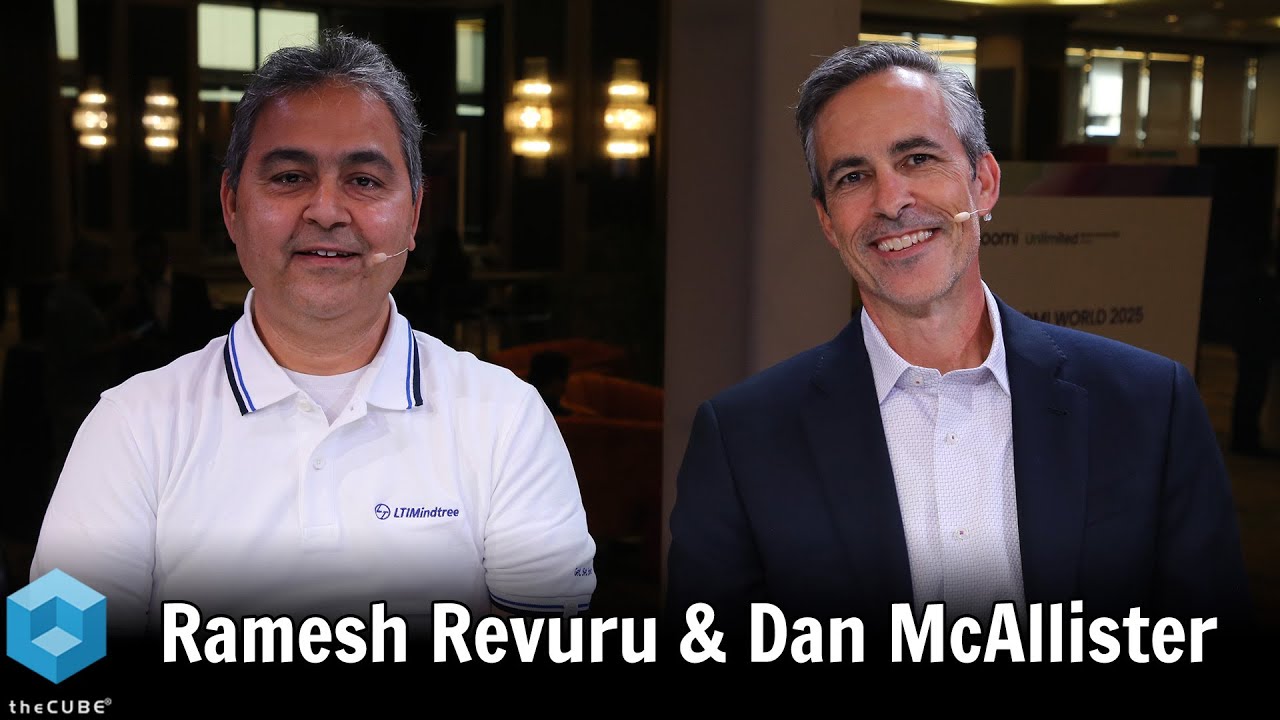
At Boomi World 2025, theCUBE’s Savannah Peterson and Paul Nashawaty sit down with Dan McAllister, SVP for global alliances and channels at Boomi, and Atif Khan, principal director at Accenture, to explore the evolving landscape of digital partnerships. McAllister shares how Boomi's ecosystem approach is accelerating innovation, while Khan talks about Accenture’s perspective on aligning strategy and delivery in a fast-changing tech world.
McAllister and Khan talk about the synergy between Boomi and Accenture, revealing how their collaboration is redefining AI integration across industries. The discussion also turns toward the practical, how automation, legacy systems and customer expectations are shifting.
Next up, they speak about execution, with McAllister emphasizing the need for flexible frameworks that can scale AI initiatives. It is likewise important to solve for data quality and governance at the outset, according to Khan. Together, they frame this alliance as a blueprint for meaningful, measurable transformation powered by intelligent integration.
Forgot Password
Almost there!
We just sent you a verification email. Please verify your account to gain access to
Boomi World 2025. If you don’t think you received an email check your
spam folder.
In order to sign in, enter the email address you used to registered for the event. Once completed, you will receive an email with a verification link. Open this link to automatically sign into the site.
Register For Boomi World 2025
Please fill out the information below. You will recieve an email with a verification link confirming your registration. Click the link to automatically sign into the site.
You’re almost there!
We just sent you a verification email. Please click the verification button in the email. Once your email address is verified, you will have full access to all event content for Boomi World 2025.
I want my badge and interests to be visible to all attendees.
Checking this box will display your presense on the attendees list, view your profile and allow other attendees to contact you via 1-1 chat. Read the Privacy Policy. At any time, you can choose to disable this preference.
Select your Interests!
add
Upload your photo
Uploading..
OR
Connect via Twitter
Connect via Linkedin
EDIT PASSWORD
Share
Forgot Password
Almost there!
We just sent you a verification email. Please verify your account to gain access to
Boomi World 2025. If you don’t think you received an email check your
spam folder.
In order to sign in, enter the email address you used to registered for the event. Once completed, you will receive an email with a verification link. Open this link to automatically sign into the site.
Sign in to gain access to Boomi World 2025
Please sign in with LinkedIn to continue to Boomi World 2025. Signing in with LinkedIn ensures a professional environment.
Are you sure you want to remove access rights for this user?
Details
Manage Access
email address
Community Invitation
Dan McAllister, Boomi & Atif Khan, Accenture
At Boomi World 2025, theCUBE’s Savannah Peterson and Paul Nashawaty sit down with Dan McAllister, SVP for global alliances and channels at Boomi, and Atif Khan, principal director at Accenture, to explore the evolving landscape of digital partnerships. McAllister shares how Boomi's ecosystem approach is accelerating innovation, while Khan talks about Accenture’s perspective on aligning strategy and delivery in a fast-changing tech world.
McAllister and Khan talk about the synergy between Boomi and Accenture, revealing how their collaboration is redefining AI integration across industries. The discussion also turns toward the practical, how automation, legacy systems and customer expectations are shifting.
Next up, they speak about execution, with McAllister emphasizing the need for flexible frameworks that can scale AI initiatives. It is likewise important to solve for data quality and governance at the outset, according to Khan. Together, they frame this alliance as a blueprint for meaningful, measurable transformation powered by intelligent integration.
At Boomi World 2025, theCUBE’s Savannah Peterson and Paul Nashawaty sit down with Dan McAllister, SVP for global alliances and channels at Boomi, and Atif Khan, principal director at Accenture, to explore the evolving landscape of digital partnerships. McAllister shares how Boomi's ecosystem approach is accelerating innovation, while Khan talks about Accenture’s perspective on aligning strategy and delivery in a fast-changing tech world.
McAllister and Khan talk about the synergy between Boomi and Accenture, revealing how their collaboration is redefin...Read more
exploreKeep Exploring
What is the history of software development partnership with Boomi and how has software development changed over the years?add
What challenges are companies facing today in terms of legacy code buildup, increasing pressure, and the introduction of new technology like AI?add
What are some common obstacles preventing proof of concepts from becoming production-ready within organizations?add
>> Good afternoon Boomi fans and welcome to Dallas, Texas. We're here at Boomi World 2025, midway through our first day of two days of power-packed coverage. My name's Savannah Peterson, bringing you all the latest with Paul this week. Paul, we have just toured the Boomi C-suite.
Paul Nashawaty
>> We did. Absolutely. With everybody talking about the tech and all the new advancements that's happening, it's really, really cool.
Savannah Peterson
>> It is really cool. And we had two Canadians on, which is always fun.
Paul Nashawaty
>> We did. The partner stuff is equally powerful. I think it's-
Savannah Peterson
>> This stuff is super cool and I'm really excited for this next conversation and it's very data-driven, which I know you are going to love.
Paul Nashawaty
>> ... Absolutely.
Savannah Peterson
>> Atif and Dan, thank you so much for coming and hanging out on the show today.
Dan McAllister
>> Yeah, our pleasure. Thanks for having us. I enjoyed the Partner Summit as well. Yeah, thanks for coming. It's very good.
Savannah Peterson
>> Yeah, this must be an exciting week for you guys.
Dan McAllister
>> Yeah, absolutely.
Savannah Peterson
>> Yeah, absolutely thrilled to be here and be part of the summit here again, and looking forward to have a conversation here.
Savannah Peterson
>> So we're in the midst of what we can all agree is the most dramatic and wild technological revolution of probably our young lives at this stage. Everyone's moving at an incredible velocity. How are you guys... Talk to me a little bit about the partnership. And Atif, I'll start with you and Dan, you can chime in. Talk to me a little bit about the partnership and how Accenture is working together with Boomi to help meet the customer demand at this incredible velocity.>> So from an integration, from a software development perspective, we actually work very closely with the partners they know we are clients. And when which it comes to integration and software development, Boomi actually has been a partner with us for integrations all the way from inception of Boomi. We actually have worked with Dan's team closely. And then from a trends' perspective, software development actually has changed quite a bit over the years. It was more deterministic and it has actually changed a little bit over time, and we are looking forward to actually basically working with them on AI front and see what are the possibilities and how we can actually change the client paradigm and how we can actually create value for them.
Savannah Peterson
>> That's awesome. I didn't realize we'd been working together since day one of Boomi or in the very early days. That's super awesome. How important are partnerships like this with Accenture for you, Dan?
Dan McAllister
>> Oh, it's fantastic. It's just hugely important. That relationship is fantastic. I'll just back up a little bit about the question you just asked and how we're working together and somewhat the why.
Savannah Peterson
>> Yeah, please.
Dan McAllister
>> And so the pressure on companies today is massive, right? First of all, they're feeling the legacy code build up year after year after year of implement new applications, solve crisis du jour, add another layer of reintegration, potentially put my organization at more risk. Get further and further behind on the demands on the business with smaller budgets and yet more pressure and higher expectations from customers. Now enter AI as even more pressure on these organizations that, hey, you've got to react. You've got to respond. How do I take advantage of this new technology even though we're not really sure what that technology's going to do for us? There's just tremendous, tremendous pressure. The good news is though, that we can leverage AI to start solving some of those problems and all that legacy code that's built up over the past several decades. And the reason why we love our partnership with Accenture so much is because they've been with us as well as all of the other software companies over the last many decades, and they understand the enterprise like nobody else. They are in the business, they're in the industry, they have the functional knowledge of the office of finance, the office of HR, supply chain, retail, all of the industries, et cetera. And so there's few partners out there that can give that breadth of knowledge to then take advantage of the integration capabilities that we have, and the automation capabilities we have, and the AI governance capabilities we have. So it's a perfect marriage from our standpoint and we try to contribute to the overall customer value that Accenture provides.
Paul Nashawaty
>> Well, when you look at Accenture, Accenture's at the forefront of the digital transformation initiatives and they have that core kind of delivery as a service delivery partner. It really is powerful when you look at it. It makes a lot of sense when we start looking at the future of the application landscape from the business perspective. But when you look at agentic AI, according to your research, this is your research. Now I'm a data guy, I am an analyst is what I do. But your research is saying that 78% of business leaders are looking at technology systems to be built for agents as equal as to humans. What are your thoughts around that? Why do you think that?
Savannah Peterson
>> So I think if you look at the traditional software development, I will explain it a little bit in easy terms. You have a web application front end, you actually have data access layer. You actually have a business logic in there. This business logic has been now confined within that application in the monolithic applications for over the years. Now if you take a look at how the AI is going to basically change, that's in the business logic, it's going to not be deterministic. It's going to be more agile, more AI friendly. And I'll give you an example. For example, if you have your engineering company here in U.S., it needs to actually order parts from U.S. partners, and Chinese partners, and from Singapore, and other parts of the world. I'm pretty sure they're going to have an inventory agent. An inventory agent is going to actually go and figure it out. I need these parts to be ordered at a certain date. And once you actually go into that, they'll actually basically reach out to the partners in an agentic manner, not through human. They'll actually basically say, "Okay, what is the pricing? What's the lead time?" These agents are going to basically collaborate with shipping agents to understand what the lead times are, what the shipping rates are. They will also actually understand the context of how many orders and what they need to be filled from an orders agent's perspective into the organization. So these agents are basically pulling information, they're orchestrating information and they're also basically now submitting transactions on behalf of the companies. And if you actually give them a little bit more memory, agentic memory, they will actually go figure it out that, "I need to actually order this much quantity from this partner, and this much quantity from this partner to maximize the profitability of my organization." So fundamentally we are seeing a change is the architecture needs to be updated for these organizations for all these softwares. And AI is going to be in the forefront of this thing. And you'll actually basically see a lot of these machine-to-machine communication. And what that actually means is it'll actually basically be more integration-driven. And all of these processes need to be exposed as services, as APIs, not within the organization, but outside the organization as well.
Paul Nashawaty
>> It's important to note here that this is not just theoretical. What we find is 77% of executives are saying AI agents are reshaping their business. And from a Boomi perspective, that's an important distinction because when you look at the heritage that you have of the infrastructure and the integration, and bringing that to the next generation of what's happening for agent development, that really harmonizes the data sources and everything in the back end.
Dan McAllister
>> That's right.
Paul Nashawaty
>> If you don't have that harmonization, it's very siloed. What are your thoughts around that?
Dan McAllister
>> Yeah, well, again, fascinating stuff, amazing times that we live in.
Savannah Peterson
>> Truly.
Dan McAllister
>> It's the next evolution of systems talking to each other. So we provided that integration for a long time. You even have trading partners, supply chain partners, banks already communicating with each other without agents. That's just data transfer. We do that all day long with Accenture. Companies can do that on themselves. What we're doing now is adding context and understanding maybe thinking, and choices being made by the agents which are actually going to take action based on what they're saying, not just provide data back and forth, but actually make decisions. And I think that's really fascinating. It's also going to change the interfaces we need to create because up until that time, decisions were being supported by a human interface, and we think that will still exist.
Paul Nashawaty
>> That should be, and will still exist.
Dan McAllister
>> But you'll have to have an additional interface. So you'll continue to modernize the interface from what was once a green screen to then a GUI interface to then a phone, to all kinds of different ways where we interact with our applications, and the data, and the companies, and the governments which we interact with. But now you're going to have this other third-party called an agent do things for you as well. And so we have to create an application interface for them as well. And so I think that's, again, what's amazing about Accenture is they're at the forefront of this thinking and how that should look and act.
Savannah Peterson
>> Yeah. Well and best practices, I mean, you wouldn't be delivering these solutions at the scale that you do if it wasn't for the best products that make that all easy to work with.
Dan McAllister
>> Correct.
Savannah Peterson
>> So I'm curious because you're both on the front line so to speak, of helping customers adopt and adapt and grow right now in this unique time period. If you could wave a magic wand and dispel a myth or educate the entire industry right now on something that has to do with integrations and what's going on here, what would you love to debunk?
Dan McAllister
>> I don't know if it's a myth or people just haven't awakened to the concern I have yet. Is that agents represent massive amounts of risk for organizations. Certainly data risk is out there already. We've seen many, many examples of data leakage, et cetera. Companies have huge problems and it impacts their earnings, impacts the customer trust. So that's just when data's flowing freely if they've been hacked. What if somebody embeds an agent in your organization that makes decisions and takes action while you're not looking, and while you're not monitoring why you're not managing?
Savannah Peterson
>> It's hard to say.
Dan McAllister
>> So from our standpoint I would say first of all, I guess there is a myth in there that will not happen. That is for sure going to happen.
Savannah Peterson
>> Absolutely going to happen.
Dan McAllister
>> Because people use-
Savannah Peterson
>> It's probably already happening.
Dan McAllister
>> ... methods of deploying software today. Of course they're going to deploy agents, and of course those bad things need to be accounted for. And so that's why we're so proud about the announcement we've made about putting a governance and control tower in place. Take it to not only govern the agents you create in Boomi, but all agents. So you can now discover agents no matter what platform they're deployed on, be that Amazon, be that Azure, be that Salesforce, be that ServiceNow, be that SAP, and provide an enterprise security layer and governance layer for all of the agents that are surely going to be deployed across every organization.
Paul Nashawaty
>> Again-
Dan McAllister
>> So kind of a myth and a reality there, and I hope people don't think it's a myth that that will happen because it for sure will happen.
Paul Nashawaty
>> ... Yeah, the harmonization of the ecosystem that you're working with is obviously an important part of the delivery of the next generation of what you're doing. Data quality is also incredibly important. So protection and governance and regulations obviously comes into play. And I know Accenture had some information around where executives were looking at data quality. What are your thoughts around data quality? And to this point of if you inject problems into the agents, how is that going to impact the future?
Paul Nashawaty
>> A funny thing is actually we had a stat somewhere, 70% or odd, right? Sorry. The POCs that are actually going on within the organizations, they don't make it to production. And I was like, "What is driving that?" It basically primarily comes to two different things. One is data quality is the first one. And the second one is security and governance and biasness in the data itself. The data has to be accurate, the data has to be consistent, it has to be complete. It needs to actually be timeliness of the data actually needs to be there. And I think the bias mitigation actually that needs to be there as well within the data. The power of GenAI is in just not in LLMs actually. It is data-driven. With a good data quality, you can actually take LLMs from a storyteller into a trusted advisor, which actually basically can take into more... You can explain why the action was taken and you can actually audit it, and you have compliance around it and you have trust basically built in to actually basically be comfortable to actually basically put it into production. I think those are the things that we are seeing that are some things which need to be addressed within the AI adoption.
Dan McAllister
>> I think Atif brings up a good point, and maybe this is another myth, and maybe I'm not seeing the myth because I'm so deep in this. But I think there is a natural assumption that my data's fine. My organization works well together, and it's just not true. I mean, there's so many studies that have been out there that most organizations have hundreds of applications out there, and at least a dozen different integration tools, let alone data movement tools, let alone ETL and governance.
Savannah Peterson
>> You don't even know what they have.
Dan McAllister
>> Exactly.
Savannah Peterson
>> All of the same.
Dan McAllister
>> Exactly.
Savannah Peterson
>> Yeah.
Paul Nashawaty
>> I was just going to say, I mean recent research for what that I just did.
Savannah Peterson
>> You did a point on this.
Paul Nashawaty
>> 75% of the respondents said that use six to 15 different tools in the silos to identify these.
Dan McAllister
>> That's right.
Paul Nashawaty
>> Yeah. So you're absolutely spot-on.
Dan McAllister
>> That's right.
Paul Nashawaty
>> This is a problem. And those organizations that responded, 52% of them indicated in 2025 they want to remove those tools in favor of a unified platform.
Dan McAllister
>> That's right.
Paul Nashawaty
>> So that's the vision, the goal, the direction, and it makes it easier that way.
Dan McAllister
>> And so if you think about what Atif just said about we want our LLMs to become trusted advisors. How can that possibly happen unless we have the data foundation layer in place?
Paul Nashawaty
>> Agree.
Dan McAllister
>> So again, opportunity for Boomi opportunity to work with a company like Accenture to help rationalize that back end, help customers migrate to a proper data foundation layer that is now organized, and clean, and connected to then feed the AI engines that will fuel their business going forward.
Savannah Peterson
>> What's that interaction when you're educating someone on the fact that maybe their data isn't as clean as they might think it is?
Dan McAllister
>> Oh, you're in the front lines of that all the time, but yeah.
Savannah Peterson
>> It is tricky. You can't be like, "Oh, this is so messy. Oh my gosh." You going to have to-
Paul Nashawaty
>> They're like... Well, go ahead.
Dan McAllister
>> Exactly.
Savannah Peterson
>> ... I am curious.
Dan McAllister
>> I think a lot of organizations actually understand this has been the problem for decades for them. Anytime you actually have to basically do analysis on data and they have to do reporting, the data cleansing is the first thing. A lot of these transformations actually failed due to data conversion issues. It's not a new thing, but I think it's an eye-opener that how does your data or bad data basically can influence, it can basically increase hallucination. So that is a little bit of education, but I think most of the leaders actually understand the fact that data is important.
Dan McAllister
>> I think there is a fear of getting started. It's like what exactly is under the next layer?
Savannah Peterson
>> I have been hearing that on the . We had a couple of conversations about this that were a little like, "Ooh, a little unsure I wont even open that door."
Dan McAllister
>> I think that's exactly right. We've now leveraged AI to help customers convert legacy code and business logic to a single platform in Boomi. And so that helps them along the way. And what might've taken multiple years to get them into their starting point only with the modern platform. Well, now they can do that in six, nine months.
Paul Nashawaty
>> Or sooner.
Dan McAllister
>> In massive enterprises. Yeah, so you'll hear customers of ours talk about that this week.
Paul Nashawaty
>> No, that's great. I mean, that's something that came up earlier too, is the fact that reducing the complexity allows for organizations to hire more generalists and specialists. And what we're seeing in our research is 67% of organizations want to hire generalists over specialists, not because they can't hire specialists, because they can't find them. And so they either work-
Savannah Peterson
>> Yeah, that skills gap.
Paul Nashawaty
>> ... and get generalists gap. Yeah, skill gap's a big issue. The other thing is they're looking at exactly what you said is turning to vendors that reduce the complexity for them
Dan McAllister
>> 100%.
Paul Nashawaty
>> And that's what you're hitting on is acceleration of their digital initiatives, either by working with reducing the skill gap with a generalist, or working with a service delivery partner to get it done.
Dan McAllister
>> Correct.
Paul Nashawaty
>> So we're seeing that across the board with our research. So it's spot-on for what you can-
Dan McAllister
>> Agreed.
Savannah Peterson
>> It's spot-on and that trust, one of the things that's great when we talk about you all is everyone always talks about the trust that they have. I mean, it's always been a business critical feeling for people to have to work with you, but it's way more important now as we're thinking about what we're about to unleash and unlock with the potential particularly of agentic. I have one final question for you both.
Dan McAllister
>> Sure.
Savannah Peterson
>> And I'm very excited to hear your answer about this because I think it's going to be very interesting. When we're hanging out at Boomi World 2026.
Dan McAllister
>> Yes.
Savannah Peterson
>> What do you hope to be able to say then that you can't yet say today? Dan, I'm going to start with you because you're making eye contact with me.
Dan McAllister
>> Okay. All right. That's fine.
Savannah Peterson
>> And I see you trying to deflect.
Dan McAllister
>> I'm sure he is got much better answer, but I'll start. Look, where I hope we are next year is that we start to realize the value of all the promise of AI. Right now we think it's coming. We see bits and pieces of it. I see every customer experimenting in little ways across the board, and I hope we earn that trust, that we give them the comfort that this is going to be okay. We can actually get started. We can start using AI responsibly. We can start deploying agents responsibly, and they can actually start getting the value out of it. Because if you look at some of the studies, I'm sure you've produced, I know Accenture's produced, everybody's saying, "I need to deploy AI now, but I'm scared as heck that something may go wrong, or I'm not sure what to do with it, or I'm not seeing the return."
Savannah Peterson
>> There's that fear. You're absolutely right there.
Dan McAllister
>> If we can show them return in a responsible way that doesn't expose them to unnecessary risk, that's where I hope we'd be.
Savannah Peterson
>> Yeah. Well, we look forward to telling that story, Dan.
Dan McAllister
>> I will be here.
Savannah Peterson
>> What about you, Atif?
Dan McAllister
>> Yeah. I think it comes down to value for the customers and how we actually can basically change customer experience for their customers, and how we can actually basically change the employee experience within the organization. So I think those are the two use cases. And hopefully we can actually get to a point where we actually can put these agents into production. We have enough good data to actually basically go train them and hopefully we actually have a governance frameworks and agent communication where we actually can bring in multiple different agents and hopefully are in a better position where we are today from delivering on the promise of AI.
Savannah Peterson
>> Awesome. Well, y'all heard it here first. We're going to be talking about that next year. Very excited. Thank you both for taking the time, knowing what I'm sure is a very busy week.
Dan McAllister
>> Awesome. Our pleasure. Thank you.>> Thank you very much.
Savannah Peterson
>> And thank you, Paul, for joining me all week. This is fun. We're having a great time. I hope you're having as much fun as we're clearly having over here in Dallas, Texas at Boomi World 2025. My name's Savannah Peterson. You're watching theCUBE, the leading source for enterprise tech news.













 Savannah Peterson
 Paul Nashawaty