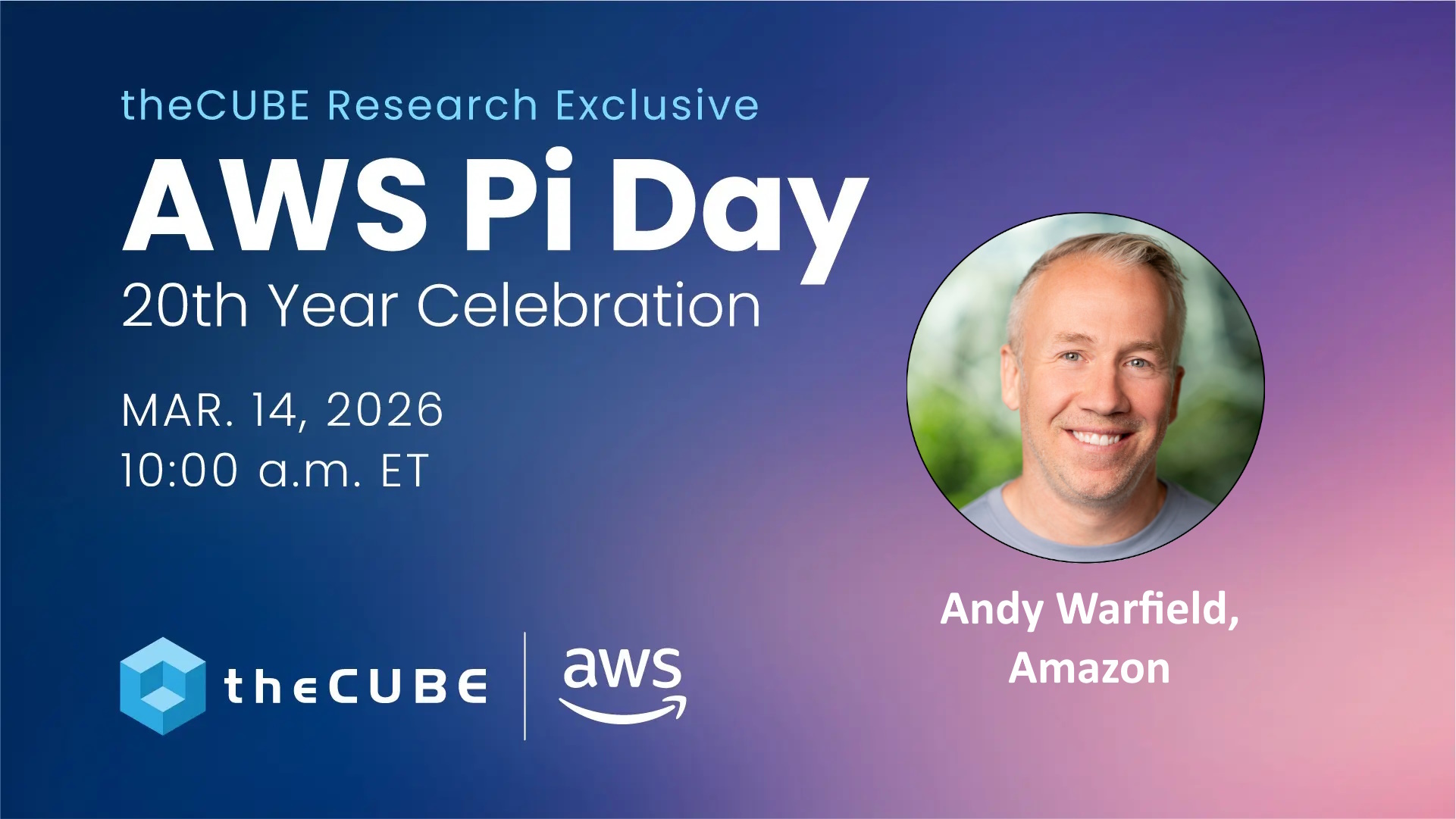
In this AnalystANGLE from the AWS Pi Day 20th Year Celebration 2026, theCUBE's Dave Vellante and Rob Strechay mark the 20th anniversary of Amazon S3 and explore how the service has evolved from a simple object store into a foundational data substrate for the AI era. Drawing on Rob's recent conversation with AWS vice president and distinguished engineer Andy Warfield, the analysts trace S3's arc from its 2006 launch — when it turned storage into an API and eliminated the fragmented islands of on-premises infrastructure — to a service now handling over 500 trillion objects and a quadrillion requests per day. Engineered from day one with 11 nines of durability, S3 abstracted storage away entirely and redefined how developers think about scale.
The conversation also explores the pivotal moments that transformed S3 from a storage endpoint into an application-layer platform. Milestones such as the Hadoop S3A connector, strong consistency, event notifications processing 300 billion events per day, and Intelligent-Tiering — which has saved end users more than $6 billion — each expanded what developers could build on top of the service. With over a million data lakes now running on S3, the discussion shifts to what comes next: S3 tables, vectors, Iceberg integration and a growing role as the durable data layer for AI training checkpoints, RAG pipelines and analytics workloads. From replacing FTP servers two decades ago to feeding GPUs at cloud scale, Vellante and Strechay outline why S3 is no longer just a bucket but an essential part of the modern data platform.
Forgot Password
Almost there!
We just sent you a verification email. Please verify your account to gain access to
AWS Pi Day 20th Year Celebration. If you don’t think you received an email check your
spam folder.
In order to sign in, enter the email address you used to registered for the event. Once completed, you will receive an email with a verification link. Open the link to automatically sign into the site.
Register for AWS Pi Day 2026
Please fill out the information below. You will receive an email with a verification link confirming your registration. Click the link to automatically sign into the site.
You’re almost there!
We just sent you a verification email. Please click the verification button in the email. Once your email address is verified, you will have full access to all event content for AWS Pi Day 2026.
I want my badge and interests to be visible to all attendees.
Checking this box will display your presense on the attendees list, view your profile and allow other attendees to contact you via 1-1 chat. Read the Privacy Policy. At any time, you can choose to disable this preference.
Select your Interests!
add
Upload your photo
Uploading..
OR
Connect via Twitter
Connect via Linkedin
EDIT PASSWORD
Share
Forgot Password
Almost there!
We just sent you a verification email. Please verify your account to gain access to
AWS Pi Day 20th Year Celebration. If you don’t think you received an email check your
spam folder.
In order to sign in, enter the email address you used to registered for the event. Once completed, you will receive an email with a verification link. Open the link to automatically sign into the site.
Sign in to gain access to AWS Pi Day 20th Year Celebration
Please sign in with LinkedIn to continue to AWS Pi Day 20th Year Celebration. Signing in with LinkedIn ensures a professional environment.
Are you sure you want to remove access rights for this user?
Details
Manage Access
email address
Community Invitation
AnalystANGLE
This 20th Amazon Web Services Pi Day celebration features Andy Warfield of Amazon Web Services, vice president and distinguished engineer. The conversation reviews the evolution of Amazon Simple Storage Service, abbreviated S3, from object storage to a foundational data substrate that supports analytics, security lakes and artificial intelligence, abbreviated AI workloads.
Rob Strechay of theCUBE Research hosts the discussion and Dave Vellante of SiliconANGLE cohosts the AnalystANGLE segment. Warfield describes S3's cloud-native architecture, engineered durability and innovations such as strong consistency, event notifications, Storage Lens and intelligent-tiering. They explain how S3 becomes the underlying substrate for data lakes, analytics, security lakes and emerging AI pipelines.
Key takeaways emphasize S3's shift from a simple object store to a critical data layer that supports analytics, security lakes, cost-efficient checkpoints and AI pipelines. Warfield states that continued work on tables, vectors and open table formats boosts throughput and performance. Strechay and Vellante note that abstraction, engineered durability and strong consistency enable developers and enterprises to scale cloud-native applications.
This episode highlights S3 features such as Storage Lens and intelligent-tiering and explores the role of S3 in modern data platforms, including data lakes, analytics and AI-driven workloads. The discussion addresses operational and architectural factors to consider for storage durability and performance and the implications for security and cost optimization.
In this AnalystANGLE from the AWS Pi Day 20th Year Celebration 2026, theCUBE's Dave Vellante and Rob Strechay mark the 20th anniversary of Amazon S3 and explore how the service has evolved from a simple object store into a foundational data substrate for the AI era. Drawing on Rob's recent conversation with AWS vice president and distinguished engineer Andy Warfield, the analysts trace S3's arc from its 2006 launch — when it turned storage into an API and eliminated the fragmented islands of on-premises infrastructure — to a service now handling over 500 tril...Read more
exploreKeep Exploring
When did S3 evolve from being just object storage into a platform that supports an application ecosystem?add
What innovations in S3 have most changed how developers build applications?add
What do recent S3 innovations and integrations (for example, CloudFront integration, S3 Storage Lens, Intelligent‑Tiering, S3 tables/table buckets, and Security Lake) mean for buyers and practitioners, and how should they think differently about storage?add
>> Hello, and welcome to the special AnalystANGLE. I'm Dave Vellante with Rob Strechay. And on Pi Day, Amazon S3 turns 20. Of course, this is the service that turned storage into an API and set a new era in motion as cloud infrastructure became a utility. Now, two decades later, S3 has evolved beyond the allure of simple GET/PUT syntax for object storage. Rather, S3 has become a foundational data layer for analytics, security, compliance, and more recently, AI-era workloads. Rob recently sat down with AWS VP and distinguished engineer, Andy Warfield, to unpack the history and future of S3. Rob, good to see you. Let's start at the beginning.
Rob Strechay
>> Oh, wow.
Dave Vellante
>> It's been 20 years. It's hard to imagine, isn't it?
Rob Strechay
>> It is. I think, again, when Andy and I were talking about it, both of us were on the end user side of S3 when it came about. And now to think about 500-plus trillion objects being stored and over a quadrillion request per day through that API layer, it's just amazing.
Dave Vellante
>> Yeah. So let's go back to 2006. AWS launched S3 with the vision of any developer, any amount of data, anytime. From your conversation with Andy, Rob, and your own experience in IT and cloud, what was the problem? If you go back 20 years, what was the problem that S3 really was solving back then?
Rob Strechay
>> I think when you look at it, and we still talk about it today, with the islands of automation, and we talked about cloud was really going to help doing that. And in particular, there was islands of storage all over the place. I know because I was buying storage back in the day, and you would sit there and you'd buy from one vendor, you'd try to drive down the cost on that in that frame. And then you tried to figure out, "Okay, well, now I need a DR site. Now I need another site. Where do I go with all of this?" And I think doing that at elastic web scale-type of infrastructure that allowed you to then buy once and use APIs, was really just game-changing, to put it mildly.
Dave Vellante
>> It's interesting you bring that up, because I remember pre-Amazon Web Services, you had hosting companies. And when you would go and tour those facilities, you had one of every vendor's box because they were essentially servicing those shops, whether it was storage vendor A, B, C, or D, and they required that kind of compatibility. S3 changed all that, didn't it?
Rob Strechay
>> Yes, it did. It definitely changed that.
Dave Vellante
>> All right, so one thing that stood out in the interview that Rob did with Andy Warfield, was how S3 fundamentally rethought storage architecture. So when you think about the S3 design, what made that different from traditional storage systems?
Rob Strechay
>> I think when you look at it, it was cloud-native from the start and I think when you start to look at the different availability zones, so it was redundant to start. Back then it was eventually consistent. Now it's strongly consistent. But when you look at the durability engineered into an S3 or into that storage service, it's just architected from the start because they never wanted it to go down from what they were doing with 11 nines of durability from the beginning. When you start to look at the storage, simple rest API that was delivered, and ultimately, it became something about scale and then throughput. And when you start to look at how it was designed for that and to keep up with all of the services that were being built on top of it, it was abstracting the storage away so you didn't have to worry about it anymore. And that was the big key to it.
Dave Vellante
>> Would you say that was really the one thing from a customer perspective that changed it? We were talking about the stovepipes before, the fragmentation. Was that really the one impact that S3 had from a customer standpoint?
Rob Strechay
>> Yeah. Ultimately, it was the fact that you abstract that storage away and you were able to understand that you could scale pretty much indefinitely when you got into that cloud view.
Dave Vellante
>> When would you say that S3 stopped being just kind of storage, object storage, and became this platform for an application ecosystem? You heard new language emerge in the catalyzed initiatives. You heard things like governance and life cycle management, analytics, and of course, there were traditional capabilities like replication. But what was that moment that people started to realize that it was more than just object store?
Rob Strechay
>> Yeah, Andy and I riffed on this a little bit because we both were looking at it and saying, well, if you look at how many data lakes, for instance, are built on top of S3, there's over a million in there right now. And when you start to look at things like the Hadoop S3A connector, which allowed Hadoop to actually utilize S3 as the underlying storage, that was a big change in how it became more than just a storage and started to add these connectors that were the underlying storage and underlying fabric or data fabric for these other storage applications and data applications. And then if you look at it, you know from our discussions with other people, that all of the SaaS vendors that have built on top of this, where they're not building a storage application, they're building an application that utilizes that as storage, as well as all of the ones in there. And I think that when you start to look at things like media production and others, genomics research, they're using that as a part of their workflows. So they've now built workflows on top of that. So I think for at least the last 15 years, you've seen different API sets come out that have allowed people to leverage that greatly, turning it from more of just from a storage endpoint into parts of the application stack.
Dave Vellante
>> So of course, the cloud was all about developers, and because there's so much other tooling in the cloud, the innovations around S3 are different than the typical storage box. You'd have features in traditional storage, which were, okay, faster, obviously things like replication and snapshots and things like that. But the developer affinity actually changed the way in which we thought about storage, and S3 specifically. So S3 has launched dozens of capabilities over the years, things like multi-part uploads, you've got strong consistency, event notifications. What innovations in your mind, Rob, really changed how developers build applications?
Rob Strechay
>> Yeah. I think, again, like you said, the strong consistency allow people to build those real-time cloud-native applications. That helped them really be in there and understand that we're not losing data and this is part of that fabric. The event notifications with over 300 billion events processed per day is really one of the pieces that I think allowed them. It's not only just the sheer scale of it, but the throughput and volume that could be put in there. I would also say the integration with CloudFront, where you started to look and it became part of that application stack, really helping people develop entire ecosystems. One of my favorite that came out was really observability, was S3 Storage Lens. When they brought out S3 Storage Lens, you were able to understand what was going on. And Intelligent-Tiering, Andy and I talked about this, I think over its life cycle, it's over $6 billion saved to end users. And it's helping them reduce, ongoing, their usage from a cost perspective. That helps developers use more of it, because if the price goes down, you obviously want to use more of that.
Dave Vellante
>> Those are great examples. So essentially, what we're seeing here is S3 becomes a foundational layer. I love Security Lake, is another example that's built on S3. So it supports security, durability. Cost optimization became a big thing in 2022 when we had the tech downturn. Simplicity is obviously always there. I want to come back to your experience as an end user, as a practitioner. What does that all mean to buyers? How do they think differently about storage in that context?
Rob Strechay
>> Yeah, I think, again, when you start to get in there, and again, it will lead us into some other things, but when things like table buckets and S3 tables and table buckets, when you're able to go in there and interact with it in a different way, it simplifies the language that you need to use. And now I'm interacting with it through Iceberg tables versus interacting through the other APIs, the S3 APIs and GETs inputs, like you said. And when you start to look at how I use that, and for me, when I go in there and use it, I remember all the way back to, "Hey, you're going to use S3 buckets instead of FTP." And that was entirely changing when you could use a URL instead of using an FTP server, and being able to have security on top of that and encryption by default. Just the simplicity of that changed things like distributing content for help desks and things like that, where we've built on top of that and used that integrated into things. Like, Salesforce and others, ServiceNow, and a number of other different things, that, "Hey, here's the workflows where all of the content lives in S3, but the workflows on top of it are now integrated into those other SaaS systems."
Dave Vellante
>> Ever since I've been in the storage business, Rob, and you have too, observed this business for a long time, three things were always kind of immutable. It's like Jeff Bezos says, "I like to think about what's not going to change versus what is going to change." But people want storage to be rock solid, lightning fast, and dirt cheap. Okay, that doesn't change, but S3 has become more. So we're going to close by riffing on the future of S3. The first 20 years, of course, we're about building a storage layer for the internet. If we fast-forward to the AI era and look at the role that S3 is playing for things like AI pipelines, training data, feature stores, lake houses, RAG data, checkpoints, which are super important when you're doing training, how do you see the role of object store generally, but S3 specifically in the next decades?
Rob Strechay
>> I think S3 is absolutely critical as part of that fabric of AI going forward. I think that when you start to look at things like the S3 vectors, the tables, S3 tables, Iceberg, and all of the different open table formats, it's really becoming that data substrate for AI and analytics, where you're going to have a lot of it. Is it going to also work with things like file systems? Absolutely, and I think they go hand-in-hand. And in fact, a lot of the file systems that are cloud-native now actually sit on top of things like S3 from various different vendors, not just from Amazon. So I think when you start to look at how it's being utilized, and I think that Andy put it really well, is like, how do we make it even more performant? You still have, again, a read penalty that they would call it, that people would normally call it, but that can be overcome. And I think what Andy and Andy's team and the team at S3 is really working on is, how do you make it even more performant? How do you make it more scalable and give you more throughput, not just to go into the file system space, but to offer something different? Like you were saying, the checkpoints. If I'm doing a big training run, I may have all my data actually in GoFAST storage to really feed those GPUs. But I still want those checkpoints to be kept economically. S3 buckets become really key to that because I can do it economically, and oh, by the way, I can index it, I can do all of that good stuff about it. And you have immutability in there as well with that as part of it.
Dave Vellante
>> So you've got native capabilities in S3. We even call it a bucket. And a bucket implies I'm going to put stuff in it and I'm going to get stuff out of it. I expect that parlance is going to change. I hesitate to call it a data platform, because it's not a data platform like you would think of a data store or a database, but it is more than just a bucket. It's becoming this kind of substrate. And the conversation is not necessarily about storage, it's about data, it's about feeding accelerators, keep them busy, making sure that the caches are most efficient. So it's much more than just a bucket, isn't it?
Rob Strechay
>> Yeah, it is. And I think it's the massive durability data layers that it offers is key to why people look at it as that. To your point about not being a data platform in the traditional sense, it's part of a data platform. I think that's what we're going to see is that, that storage layer, that storage services layer, and even up into the GRC and metadata layer, they're starting to play in that when you see what they're doing with tables and with vectors and other things. I think as they start to continue to innovate on top of that, they're going to keep pushing up. One day it may be a full data platform in there as well, and I think that entire market is evolving, as we know very well.
Dave Vellante
>> Rob, thanks. Great interview with Andy. Thanks for spending some time today on this AnalystANGLE. Appreciate it.
Rob Strechay
>> Much appreciated.
Dave Vellante
>> All right. And thank you for watching this special AnalystANGLE covering Pi Day and the 20th anniversary of Amazon Web Services and S3. I'm Dave Vellante for Rob Strechay. Thanks for watching.