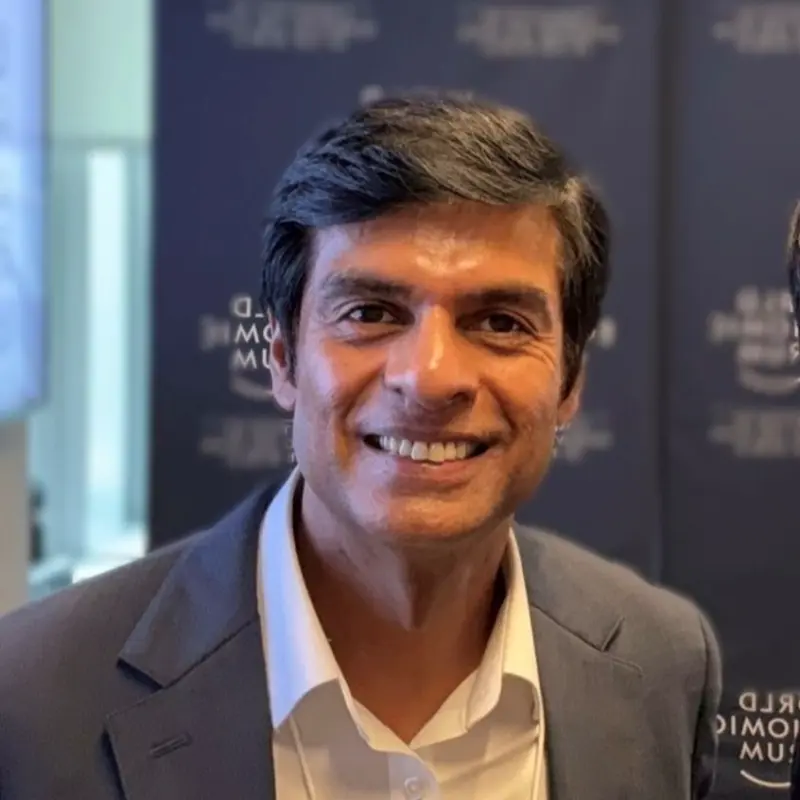
Rajaram R. K. of Infosys, vice president and head of sales for banking and financial services, discusses artificial intelligence, AI-driven transformation and enterprise scaling strategies at the Amazon Web Services, AWS Financial Services Symposium 2026. R. K. explains agentic AI, the Topaz platform and the AI factory concept in an interview with Rebecca Knight of theCUBE and theCUBE team, and they describe how banks and payments firms reimagine operations, customer experience and business models to move beyond pilots and scale solutions enterprise-wide.
Key takeaways, according to R. K., include moving from pilots to enterprise-grade platforms, adopting a human-in-the-lead design and managing token economics alongside security and responsible AI. They highlight Topaz and Infosys’s AI factory as practical models for building and governing agentic agents and urge financial services firms to build moats around customer data and intelligence to capture new value.
Forgot Password
Almost there!
We just sent you a verification email. Please verify your account to gain access to
AWS Financial Services Symposium 2026. If you don’t think you received an email check your
spam folder.
In order to sign in, enter the email address you used to registered for the event. Once completed, you will receive an email with a verification link. Open the link to automatically sign into the site.
Register for AWS Financial Services Symposium 2026
Please fill out the information below. You will receive an email with a verification link confirming your registration. Click the link to automatically sign into the site.
You’re almost there!
We just sent you a verification email. Please click the verification button in the email. Once your email address is verified, you will have full access to all event content for AWS Financial Services Symposium 2026.
I want my badge and interests to be visible to all attendees.
Checking this box will display your presense on the attendees list, view your profile and allow other attendees to contact you via 1-1 chat. Read the Privacy Policy. At any time, you can choose to disable this preference.
Select your Interests!
add
Upload your photo
Uploading..
OR
Connect via Twitter
Connect via Linkedin
EDIT PASSWORD
Share
Forgot Password
Almost there!
We just sent you a verification email. Please verify your account to gain access to
AWS Financial Services Symposium 2026. If you don’t think you received an email check your
spam folder.
In order to sign in, enter the email address you used to registered for the event. Once completed, you will receive an email with a verification link. Open the link to automatically sign into the site.
Sign in to gain access to AWS Financial Services Symposium 2026
Please sign in with LinkedIn to continue to AWS Financial Services Symposium 2026. Signing in with LinkedIn ensures a professional environment.
Are you sure you want to remove access rights for this user?
Details
Manage Access
email address
Community Invitation
Rajaram R. K., Infosys Limited
Rajaram R. K. of Infosys, vice president and head of sales for banking and financial services, discusses artificial intelligence, AI-driven transformation and enterprise scaling strategies at the Amazon Web Services, AWS Financial Services Symposium 2026. R. K. explains agentic AI, the Topaz platform and the AI factory concept in an interview with Rebecca Knight of theCUBE and theCUBE team, and they describe how banks and payments firms reimagine operations, customer experience and business models to move beyond pilots and scale solutions enterprise-wide.
Key takeaways, according to R. K., include moving from pilots to enterprise-grade platforms, adopting a human-in-the-lead design and managing token economics alongside security and responsible AI. They highlight Topaz and Infosys’s AI factory as practical models for building and governing agentic agents and urge financial services firms to build moats around customer data and intelligence to capture new value.
Head of Sales, Banking & Financial ServicesInfosys Limited
In this interview from the AWS Financial Services Symposium, Rajaram R.K., vice president and head of sales for financial services at Infosys, joins theCUBE's Rebecca Knight to discuss how financial institutions are moving from AI pilots to platform-scale execution. R.K. argues that AI has evolved from an innovation challenge into a fundamental scaling and operating model problem across the industry. He walks through Infosys's four-pronged client approach — efficiency augmentation, full operational rewiring, AI factory deployment and AI-native transformation ...Read more
exploreKeep Exploring
How are clients being helped to adopt and scale AI across their organizations?add
Can you describe, without naming clients, some customer engagements you've undertaken to help organizations adopt agentic AI and AI factories and explain the results achieved?add
>> Hello everyone and welcome back to the Cube's coverage of the AWS Financial Services Symposium here in New York City. I'm your host, Rebecca Knight. I would like to welcome to the show Rajaram R.K., VP head of sales and banking and financial services at Infosys. Welcome, Raj.
Rajaram R.K.
>> Thank you, Rebecca. Thanks for the discussion today.
Rebecca Knight
>> So you work with some of the largest banks in the world and what feels like a pretty fundamental shift in terms of how they operate and how work gets done. Set the scene for us. What is Infosys focused on right now and what are you hearing?
Rajaram R.K.
>> Yeah. So I think the great question, Rebecca, what we are seeing is AI is no more an innovation problem or a technology or a tool problem. It is actually a scaling challenge for enterprises and financial services and an operating model challenge. And by that, what I mean is we have seen organizations in the past doing a lot of pilots and seeing some successes with agentic AI. And the pivot and the successful organizations which we are working with and many of them we are helping, they have recognized that it is not about pilots, it's about a platform, it's about scaling and it is about not just limiting themselves to efficiency alone, but there is an opportunity to reimagine the entire operations. In fact, reimagine the entire customer experience. And some of them who are at the cutting edge are already thinking about how agentic AI could change the fundamental nature of the business model and how the value is being created in financial services. Because if you just zoom back and look at what financial services is all about, it is about trust. It is about managing customers. It is also about a strong balance sheet and how we are able to now give the right products. But I think there is a significant re-imagining of that basic business model is also happening. So we are seeing a whole range of adoption. The leaders are looking into re-imagination. They're looking into both their processes, their engagement, and they're taking a platform approach. And they're working with partners such as ourself to truly get into that scaling, not just in the pilot. And the way we are helping, I would say clients is fourfold. We have a platform which is Topaz, which is a AI platform which has all the elements built in, responsible AI. It has the securities, it has the guardrails, it has the token economics, it has all the capabilities that an organization would need. And we either have our clients adopt it or we help them to shape their own platform. And we start from, if you look at it, an organization, right? First, we have augmented many of our services and their services with AI. So that's the efficiency play. Next, what we have done is for a specific bank, we are actually working to reimagine the entire bank itself. And that means all their processes are becoming agentic AI, both the internal processes as well as some of the customer engagement. Thirdly, we are scaling this up with what we call as AI factory. These are factories very similar to, I would say, the old sort of manufacturing facility or NVIDIA's AI factory, right? How NVIDIA calls themselves as an intelligence factory. This is an AI factory where Infosys engineers along with AI tools are creating AI developed software or AI developed agents, or sometimes outcomes. So that's AI factory. And the last one is where we are looking at significant transformation where some of our clients are asking about how do they become an AI native company or for example, agentic e-commerce or agentic advisors, et cetera, where we are re-imagining the entire value chain or how value is created for financial services. So it's a very exciting time for us. We are working across the value chain. And we are seeing organizations adopt AI more and more significantly and purposefully.
Rebecca Knight
>> So let's get into some of that without naming names. Can you talk a little bit about some of the customer engagements you've had and what the results have been?
Rajaram R.K.
>> Yeah. So for a bank where we have engaged in a very big way, very strategic way, we were able to fundamentally take the bank and break it down into 24 plus domains. An example of a domain could be consumer lending or fraud, or it could be something around commercial banking, et cetera. So we broke it down. And then each of these domains had dozens of processes. So for example, a commercial and loan underwriting could be a process. It's a big process. And then that gets broken down into agents which are working together. And we have also started moving away from what we call as human in the loop to actually the human in the lead. That means the human owns the entire process, irrespective of whether there is a human step or not as part of the process. Once we break it down into all these agents, we are now in a position to see the patterns of the same agents or the same capability appearing, and start implementing in a very deliberate and a very phased approach. And that means the processes of the bank slowly gets rewired from human processes which sometimes has some automation to now an agentic AI first process. This means a bank operating at 60% efficiency or a 55% efficiency now has an opportunity to significantly change the economics of their efficiency. Number two, they could also launch products or give a different experience to their customers. That's one example. The second example, this is a payments company. And what they wanted to do is they do a lot of payments processing from merchants, et cetera, and some of the other enterprises as well. We were able to look at all their processes again right from the customer, work from the customer backwards. And reimagine and go and say, "Okay, these processes can be agentified." And that fundamentally meant a completely new way of looking at various transactions, whether it is a fraud or a dispute resolution or any such thing. So I think this is the way we have been able to look at a significant type of transformation. And in order to power this, you can't do it in project mode. I'm doing five more agents. It has to be powered from a factory. And that's where I mentioned about the AI factory where our engineers along the tools are able to do this at scale in a very protected or a controlled way because it's all running on a platform which their customer controls. So that's the two examples I would call out.
Rebecca Knight
>> So final question, when you are looking at where customers are investing and where they're executing, what has the most momentum and where do we go from here?
Rajaram R.K.
>> See, I think the most momentum is picking up that Rebecca's invested in a few pilots and then they stalled because they didn't have a platform approach. They took as few pilots, they got some successes, they know it is working, but it's not going to change their enterprise. So it has stalled. But we have seen it before in cloud and other journeys where people start and then stall, and they don't have a better approach. And that's where our suggestion is if you could call it a set of best practices or patterns to follow. I think the first thing is it's very important to move from pilot to platform. Make sure you have a proper agentic AI platform, which is enterprise grade, where you can slowly roll out this. And the second one is look at human in the lead, as I said, not just human in the loop. Because as long as you can look at the entire process and make sure there is a human who's designing it and being in control, I think that makes it safer. The third one, be careful about the token economics also, because the economic model is important along with while the platform will take care of security, hallucination, and the responsible AI, token economics has to be controlled as well. I would also say one of the key things is we have to recognize that there is a lot of prediction that AI will expand the GDP of the world, right? I think it's 80 trillion, it probably becomes 160 trillion or so. The question is, what value of the new value and the existing value will financial services industry capture? Is it all going to be the new AI platform companies? Is it going to be infrastructure companies? And I think it's very important for them to recognize it. And our suggestion is to build a moat where the customer data, the intelligence and able to apply AI to get new experiences is going to actually be more important as a moat, than just having customers and have strong balance sheet. And I think if they're able to do that, they will capture the value, rather than an AI firm capturing the value and just being a system of record or something, the financial services. So that's how we guide our clients in financial services to take this journey.
Rebecca Knight
>> Great insights, Raj. Thank you so much for coming on.
Rajaram R.K.
>> Thank you so much, Rebecca. Thank you.
Rebecca Knight
>> I'm Rebecca Knight, stay tuned for more of theCUBE's coverage of the AWS Financial Services Symposium.









 Rebecca Knight