We just sent you a verification email. Please verify your account to gain access to
Cloud AWS re:Invent Coverage. If you don’t think you received an email check your
spam folder.
In order to sign in, enter the email address you used to registered for the event. Once completed, you will receive an email with a verification link. Open this link to automatically sign into the site.
Register For Cloud AWS re:Invent Coverage
Please fill out the information below. You will recieve an email with a verification link confirming your registration. Click the link to automatically sign into the site.
You’re almost there!
We just sent you a verification email. Please click the verification button in the email. Once your email address is verified, you will have full access to all event content for Cloud AWS re:Invent Coverage.
I want my badge and interests to be visible to all attendees.
Checking this box will display your presense on the attendees list, view your profile and allow other attendees to contact you via 1-1 chat. Read the Privacy Policy. At any time, you can choose to disable this preference.
Select your Interests!
add
Upload your photo
Uploading..
OR
Connect via Twitter
Connect via Linkedin
EDIT PASSWORD
Share
Forgot Password
Almost there!
We just sent you a verification email. Please verify your account to gain access to
Cloud AWS re:Invent Coverage. If you don’t think you received an email check your
spam folder.
In order to sign in, enter the email address you used to registered for the event. Once completed, you will receive an email with a verification link. Open this link to automatically sign into the site.
Sign in to gain access to Cloud AWS re:Invent Coverage
Please sign in with LinkedIn to continue to Cloud AWS re:Invent Coverage. Signing in with LinkedIn ensures a professional environment.
The coverage at AWS re:Invent 2024 highlights the innovation wave in the gen 2 cloud. Commvault's cyber resilience and backup solutions seamlessly integrate with AWS technologies like S3 and Dynamo. Their recent feature, Backtrack, ensures easy data recovery from S3 with impressive scalability up to 60 billion objects. Clumio's team played a key role in developing this feature using S3 primitives for data durability. Early access for Backtrack is obtainable through a simple request on Commvault's website. The team plans to extend this feature to other data so...Read more
exploreKeep Exploring
What are the advantages of the partnership between Commvault and AWS?add
What is the history behind the development of the Clumio Backtrack service, and how does it provide cyber resilience and backup for Amazon S3 on Amazon with an AirGap service?add
What has been the evolution of storage technology since 2010 and how has it continued to play a significant role in the advancement of technology, particularly in relation to metadata and innovations like one-click recovery?add
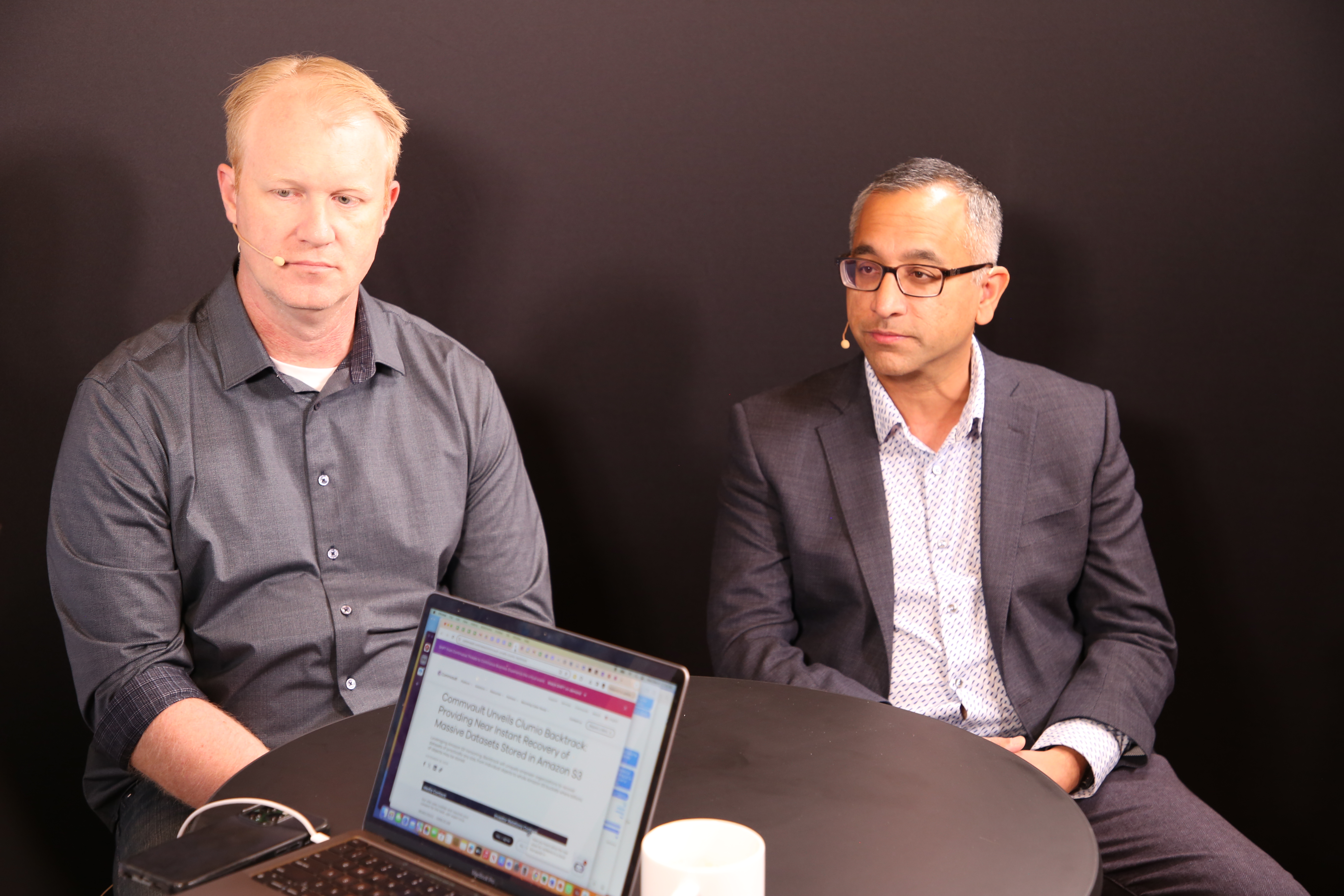
>> Welcome back, everyone, to theCUBE's coverage here in Las Vegas for AWS re:Invent 2024. I'm John Furrier, host of theCUBE. It's our 12th year covering re:Invent. It's been fun to watch the innovation wave just continuing as we go on to the, I call it, gen 2 cloud. You're starting to see the real innovations up and down the stack, from infrastructure, data, and, of course, at the agentic level, which was presented today. But a lot of great stuff, all about the data. We've got two great guests. Poojan here is the Chief Product Innovation Officer at Commvault, former Clumio. Great to see you again. And Paul with AWS S3. Guys, welcome back to theCUBE. Thanks for coming on. Congratulations.>> Thanks, John. Nice to meet you back.>> A lot of action going on over at Commvault, and congratulations on the transition there. So let's get into the whole storage piece here, because if you look at Amazon getting back to the basics, as Matt Garment said, it is an S3 party here. A lot of action, new formats coming out new S3, then it's just showing that we still need the storage. We've got to have everything. It's got to be in the storage. And the data lakes are evolving. So you're starting to see that infrastructure enablement come up. Talk about the relationship between you guys. You guys are at the center of it. What's the relationship between Commvault and AWS this year? Give us the quick update.>> So, obviously, Commvault and AWS go a long way. Commvault has been a premier platform for cyber resilience and from a breadth of coverage, if you look at it, I think there's no other vendor that does a phenomenal job in terms of the number of workloads Commvault covers. With Clumio, now, at Clumio, were always completely focused on AWS and we have gone really deep on building our resilience for AWS technologies with S3 and Dynamo and other services that we supported. Now these two things come together. So now we have the depth that we had built with Clumio and with the breadth Commvault already had and the reach that it has. It's a fantastic story together.>> Paul, you're on the product management side. Obviously, these guys bet hard on cloud. I remember our first conversations when the company started. You starting to see the benefits come from that bet, even the pre-COVID bets. Certainly, if you were at Amazon pre-COVID, you came out winning. You're starting to see that cloud benefit coming on. What's the key here with Clumio?>> With Clumio, I've been working with Poojan and his team for a long time, and they're just really great operators in the cloud. And so I think that that's really paying off now as you see more and more mission-critical workloads coming into the cloud out of on-prem. Clumio, Commvault now, is just in an excellent position to go protect that stuff with enterprise-grade protection.>> So you guys announced Backtrack, and this is a topic that's near and dear to my heart because we've been preaching on theCUBE, "You got to define resilience in the Gen A." I said, "No. That's a little downstream, but we're getting there." But resilience and storage, this has been a big conversation, front and center, security, recovery, ransomware out there. We've seen all that stuff, but now the word resilience is becoming almost re-casted because the aperture of the data and the potential for that recovery is key. Give us a quick highlight of what's going on with Backtrack.>> Yeah, a little bit of history. Again, as Paul mentioned, we've been working closely, the teams have been working closely for many years, and we had launched an S3 backup service long back, and this is before the whole AI thing and so many more Gen AI applications and all built on top of S3. We made the build pretty early because we knew that S3 is going to become the default substrate and storage for the next generation applications built in the cloud. And so with S3 backup, we launched this service where we can, at any scale, it doesn't matter. We'll basically go and deliver a cyber resilience and backup solution for Amazon S3 on Amazon with AirGap service. And then, when in fact, I was just thinking about it, last time I was at theCUBE with Paul a couple of years ago, we had taken it to the next level with giving instant restore capability where, if somebody has a really large bucket, a large number of objects, you cannot wait to copy the whole thing back in the event of a cyber event. And so in that scenario, we released Instant Restore. That was the other thing that customers were asking for, and we went and released that. Now, in the last couple years since we came up with that announcement, the other thing that happened is a lot of our customers, like Amazon we listen to our customers very intently, and they were basically like, "Okay, we love this feature that S3 has called versioning." In fact, our own data says with the buckets that we see that people have 60%, 70%, 80% of the buckets that we see have versioning turned on. So they use this feature already where you keep the old versions of the objects in the event of software doing something or a user error or whatever it might be. But the thing is, when that event happens, going back to a previous version, especially in large scale environments, is just super hard. And what we did with Backtrack is we made it one click. So essentially, I want to go back to my bucket 8:00 p.m yesterday, and with a click of a button, we can essentially, with our technology go back and get that bucket to 8:00 p.m. yesterday. So that's really what we did with Backtrack.>> Can you scope the recovery size? What are we talking about here, millions of objects, billions? Is there a limit? I mean, give us a scope of the impact on this feature.>> So I'll tell you, our largest customer runs this with over 60 billion objects. This is a 50, 60 petabyte environment.>> And they're one click recovery.>> It's one click recovery, one click can just go back in time. It's like saying your laptop with the time machine functionality, you can go back to any time yesterday or whatever. Something similar is what we basically did. So it's like you use, you love versioning, you really want to be able to go back in time. And so here you go, Backtrack goes and does that for you.>> So you guys are enabling with versioning this feature. What's this mean from an S3 perspective? Any changes for my configurations? What do I do?>> No. I mean, the beauty of this is that it relies entirely on S3 primitives, and so we focus very intently on data durability. We spend a lot of time. We consider this to be one of the fundamentals of S3. We never want a customer to have to worry about this. And so we do all kinds of things behind the scenes like integrity checking and redundant storage and multi AZ data distribution, stuff like that to make sure that when Clumio or when Commvault reaches for a backup that we have in S3, we're able to deliver that data every time. And these primitives like versioning that we've provided for customers over the years have been put to use and Clumio just saw an opportunity to innovate on top of those primitives and just did some great software development.>> Yeah, I learned over the past 12 years covering re:Invent, you speak Amazonian. They have a term called blast radius they talk about, when you stay with the primitives, you get a lot more agility, but also stability when you have these opportunities to either understand the impact of scale. You're talking about billions of objects, that's a huge number. I mean, that's a large recovery. It's not obvious that you could do that with one click. I mean, how hard is it? I mean, take us through the tech and what's the thinking around that? Because it sounds like you guys have really nailed this one because this is something that, obviously, whether it's ransomware or any kind cyber resilience, this is a feature that must be in high demand.>> Absolutely. And again, none of this happened overnight. This has been a culmination of many, many years of R&D, and what we had essentially built is an architecture that is a Lambda based architecture. It scales. It has the ability to take the S3 partitions and really work and throw Lambdas at it so each Lambda can go work on a partition and so on and so forth. And so we built a lot of the technology underneath and essentially what we saw was an opportunity where previously we were like, "Okay, take a copy of the data and keep it separate. That's what you need." But there's a class of data, the type of customer that says, "No, I don't want to necessarily keep a copy of this particular bucket, but I have versioning for this bucket. Can you use the same primitive and the same scale and the same way you built your air gap backup and you can apply it and go back in time?"
So that's what we did. Of course, making it easy, but essentially all the stuff that we had built over the last few years is what we applied, and so we are literally the only solution that does this and the way we do it, literally, you go to our UI, you pick your bucket, you pick a date, you pick a time, and you can go back.>> What's the demand like?>> I just say the team took me aside to show me this feature recently when they tell me they were going to launch it, and I was waiting for the demo to start and they were just done. It's such a cool feature.>> It's almost too good to be true.>> Yeah, it's really cool.>> I mean, you hear stories like this when, again, you mentioned primitives. I want to come back to that because this is the value of this idea of at scale the blast radius and understanding how fast you can move. It's almost too good to be true to say, "I can move that much recovery at that size." The question I have for you guys is, on the S3 side, obviously, it's the primitive, as you mentioned that. Am I limited on the data? Now you've got agentic workflows coming in. What's your vision around how this extends out as new data starts coming into S3. S3, got the table formats. They announced today a lot of new stuff, a slew of announcements with S3. So there's all new data. Is it data agnostic? What's the answer to that question? People might ask that one.>> No, definitely. I think right now we're doing it for S3. The goal would be to go and expand. In fact, now switching a little bit to Commvault, Commvault just recently announced this offering called Cloud Rewind. Again, that similarly goes and looks at the application point of view and goes and takes your application running in AWS, go back in time. All your configurations, all your ELBs, all your load balances, everything you can go back in time. So I think that's the mindset we are basically going and building. This is for S3. We have Cloud Rewind for taking an application point of view, and we'll go after other data sources and services and do the same thing.>> Backtrack's the killer. Clumio feature, obviously. You guys built that.>> Correct.>> Here's a taste of some of the use cases that people have been using this where they had the wow factor. Obviously, the demo, you fell out of your chair. Obviously, you virtually fell out of your chair because you liked it, but I mean, this almost sounds too good to be true. But give me an example of customers that said, "Wow, I had this up and running. Full recovery.">> And I'll give you examples, in the sense, there's customers who have had because of a software bug, due to which it went and deleted some objects, and sometimes you don't even know which objects got deleted, but you knew that everything was fine and that bug got introduced maybe three hours ago or last night or whatever it is, and just being able to go back and with one click. That's the power of this.>> Is it mostly about convenience or just from backup perspective? Is there a ransomware aspect to this? What's the main? I'm trying to get into where I would need this in a criticality sense.>> Yeah, I mean, there is situations in ransomware also this might be useful, but in ransomware we typically say, "Okay, you need a different copy of the data." That might be more useful because if it's a very sophisticated ransomware attacker, they might actually go and double click and even go delete the versions and stuff. So in a ransomware situation, you typically try to keep another copy of the data, but yes, there's a lot of other situations where this just does the job.>> Okay, so news went out in November on this feature. Is it available?>> Yes.>> Shipping generally available?>> It's an early access.>> Early access.>> Early access, right.>> And it's based on the versioning, that's the key.>> Correct.>> Anything else we should know?>> No, that's it. I think this really takes it to the next level. We are super excited about going and enabling it. As I said, versioning is used. From our perspective, the data we see, it's pretty much used everywhere. And so now we're taking that to the next level and really making it much more usable by just going back in time.>> Okay, so I'm sold. You sold me on the idea. How do I get involved in the early access? What do I have to do on my side if I'm an enterprise?>> Oh, just go to commvault.com, send us a request, and we'll email it for you.>> Anything to do with S3? Any configuration changes?>> No, S3 as it is. Nothing.>> Just no impact, no disruption on my side?>> No. I would just say this is an example of Clumio's experience building against us. What they're really doing here, we talk about billions of objects operation and it seeming too good to be true, I mean, we have more than 400 trillion objects in S3. And so what they're really doing is just taking advantage of our scale in order to move fast and build cool stuff.>> Well, congratulations. What's next? Where do you go from here? To get it available to everybody, that's job one.>> Absolutely.>> What other things do you see coming down the pike? You mentioned applications because I'm going to love this with my customer. Where does this extend for me?>> Well, I can't talk about some of the details, but again, there's so many interesting announcements that came out just this week from Paul's team, and so we are definitely looking at that and looking at what customers are going to do with those things and really go provide resilience with all the new formats and everything coming up.>> We had some former Amazonians come on theCUBE this week and other techies that it's like the holiday season's always here. The gifts keep giving. Of the announcements, which ones do you like the most?>> I think the new table formats is something I'm very excited about.>> Same.>> We're really excited about tables. We think it's going to make a big difference.>> What should I ask Andy Warfield when he comes on about the table formats? Because analytics, fast analytics is going to be a big piece there. I see that being a huge upside. Obviously, extending out some of the resilience piece is going to be fantastic.>> Yeah/ I mean. There's the simplification that tables adds, but what you should really ask Andy about his metadata. He's great at geeking out about metadata.>> S3 Express.>> S3 Express has come a long way as well. Tons of innovation on there, yep.>> Well, you guys are doing a great job. S3, obviously, as you said, substrate there. How's things going at Commvault? Give us a quick update on the status there. Obviously, new to the fold, October. I thought it was the spring. I forgot all about it. Maybe I knew earlier. But take us through the transition.>> It's been fantastic. It's been a little over two months and what Commvault has done for us is really expanded our reach. Just the last two days, the number of customers I've met and the scale customers I'm meeting with, again, petabyte environments, tens of petabyte environments. That's the kind of scale as a small startup we did not have. So again, the same tech, same product, but I have so much broader reach to go after now.>> Yeah. When we started theCUBE 15 years ago, you'll appreciate this, Dave Vellante and I started working together. Obviously, we covered storage heavily. I said on theCUBE, "Storage is sexy." And then Joe Tucci at the time from EMC said it, "Storage is sexy." It was tongue in cheek, but the point is that the big data wave was just starting at that time and you guys were getting your sea legs at S3 and scaling up. But if you look at what's going on with storage since 2010, even earlier, go back even mid-2000s, but say 2010, when we started theCUBE, it's been every year storage was supposed to be boring, but it never was because everything that has happened since then had a storage enablement piece of it. And even here, at AWS, it's front and center. It's storage. But now at Gen AI, it becomes even more powerful. And then you mentioned metadata and having the innovations like one-click recovery, which even go back 10 years, if someone said, "Hey, I want to have Restore," a lot went into it.>> Paul and his team, I think credit to them. Again, S3 was built, I don't know, one of the early services, super early, one of the first services . But again, it has come such a long way and just working with Paul and his team last few years, the innovation and obviously riding on that innovation from our end and adding to it, I think it's been fantastic. And so it is not boring. I think getting more and more interesting.>> All the innovations that it's enabling and the developers we're seeing with the no-code, low-code, the democratization here with Q for developer and Q for business. That's going to allow non-technical users to get and start doing things that used to be through console or through coding. Those coders are going down lower in the stack to squeeze out where the value extraction is, which is performance and these innovations. So you're starting to see a full circle back like to the '90s where I've heard on theCUBE assembler. I'm writing assembler. I'm doing kernel level. These are ISVs. It's not hardcore. So you're starting to see that coding because of the code assist. So more and more action coming down to the physical and the hardware levels have really been going to quite a renaissance. Great to have you guys on. Favorite part of the show so far besides S3 because you're biased. What have you guys liked so far when you're coming out of re:Invent?>> Well, I've been busy with a lot of meetings, honestly. I've not caught up with all the announcements. But again, I think just all the announcements that have been at least quickly browsing on the Gen.AI side I think has been fantastic.>> How about your meetings? What's been the conversation there? Just the product, the news, what have you been talking about?>> With Commvault, I would say, I think already the breadth of workloads that Commvault's covering has been fantastic. Now, adding to that, we have a cloud-first cloud resiliency story with Clumio Backtrack and the Clumio solution in general and Cloud Rewind. So all of these things coming together, we are very focused on a cloud-first world.>> Sanjay must have a spring in a step. Paul, what about you? What do you like about the show?>> Oh, I just love coming to see customers and partners here. I mean, I just am very intentional about my schedule. I pack it solid for the whole week and just go back to back to back and back, and the energy has just been fantastic.>> And what's been the top conversations you've been ever with customers?>> So the launches have been a top conversation. Obviously, we've been talking a lot about AI, a lot about analytics. Analytics is really moving very fast as well.>> Well, I appreciate your time coming on theCUBE and sharing insights. Great to see you. Congratulations on everything.>> Thank you.>> And great product. Again, what could have been a five-minute segment, it's just one click. Everyone loves it. Just get it. Thanks for coming up.>> Appreciate it.>> Thank you.>> Great to have you on. Okay. I'm John Furrier with theCUBE breaking down wall-to-wall coverage here at re:Invent 2024, our 12th year. The innovation just continues, and we're hitting next-level, legit, practical AI, practical hardware that's going to be high-performing. Again, it's price performance continues to thunder away value, and that's going to create more developer action. We're bringing all to you here in theCUBE Factory here at AWS re:Invent.