We just sent you a verification email. Please verify your account to gain access to
Cloud AWS re:Invent Coverage. If you don’t think you received an email check your
spam folder.
In order to sign in, enter the email address you used to registered for the event. Once completed, you will receive an email with a verification link. Open this link to automatically sign into the site.
Register For Cloud AWS re:Invent Coverage
Please fill out the information below. You will recieve an email with a verification link confirming your registration. Click the link to automatically sign into the site.
You’re almost there!
We just sent you a verification email. Please click the verification button in the email. Once your email address is verified, you will have full access to all event content for Cloud AWS re:Invent Coverage.
I want my badge and interests to be visible to all attendees.
Checking this box will display your presense on the attendees list, view your profile and allow other attendees to contact you via 1-1 chat. Read the Privacy Policy. At any time, you can choose to disable this preference.
Select your Interests!
add
Upload your photo
Uploading..
OR
Connect via Twitter
Connect via Linkedin
EDIT PASSWORD
Share
Forgot Password
Almost there!
We just sent you a verification email. Please verify your account to gain access to
Cloud AWS re:Invent Coverage. If you don’t think you received an email check your
spam folder.
In order to sign in, enter the email address you used to registered for the event. Once completed, you will receive an email with a verification link. Open this link to automatically sign into the site.
Sign in to gain access to Cloud AWS re:Invent Coverage
Please sign in with LinkedIn to continue to Cloud AWS re:Invent Coverage. Signing in with LinkedIn ensures a professional environment.
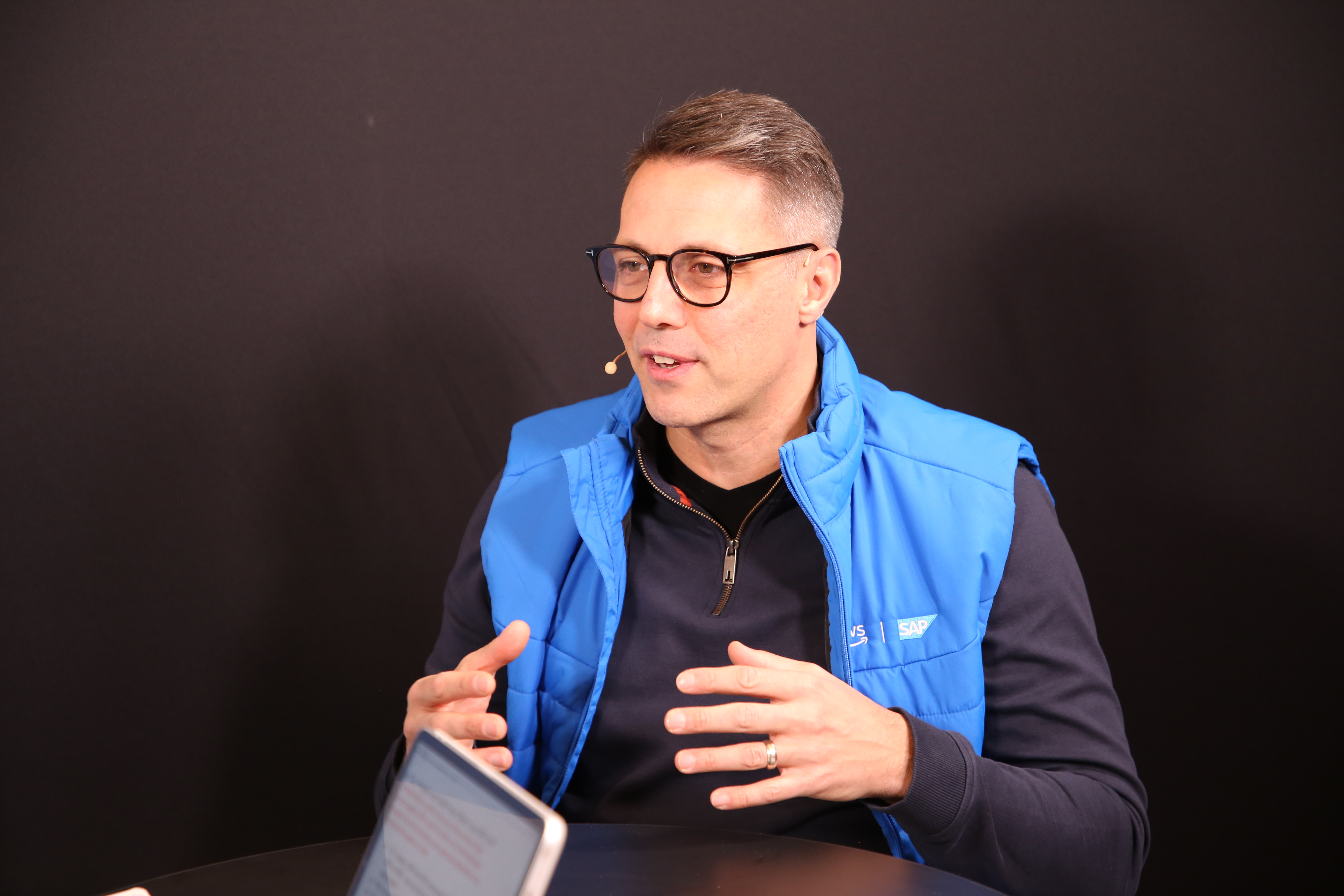
Jan Gilg, President and Chief Product Officer of CloudERP at SAP, discusses the launch of GROW with SAP on AWS marketplace. S/4HANA public cloud solution is offered through a private listing for partners to showcase the product, conduct demos, and facilitate purchases on AWS marketplace. The goal is to help fast-growing companies access innovation, reduce ERP management costs, and enhance agility in adapting to changing industry requirements. The conversation touches on AI automation, with a focus on Joule, SAP's digital AI assistant. Joule assists users in n...Read more
exploreKeep Exploring
What is SAP responsible for in terms of their CloudERP product portfolio?add
What exactly was announced in regards to GROW with SAP on AWS?add
What is Joule and how does it work as a digital AI assistant for SAP applications?add
What opportunities does being a day zero partner with AWS provide in terms of utilizing Nova for building AI cases in CloudERP?add
>> Hi everybody, my name is Dave Vellante. Welcome back to our wall-to-wall coverage of AWS re:Invent 2024. This is actually my first day of covering. John Furrier has been holding down the fort and really super excited to Jan Gilg here. He's the president and chief product officer of CloudERP at SAP. Welcome to theCUBE, welcome from Germany to Las Vegas and re:Invent. Big show.
Jan Gilg
>> Yeah, thank you. Thanks so much for having me.
Dave Vellante
>> No, you bet. So tell us a little bit about the role and the focus on CloudERP?
Jan Gilg
>> Yeah, so I'm responsible at SAP for our CloudERP product portfolio. I would say front and center is our flagship ERP solution that is S/4HANA public cloud, as we call it. But we do have a lot of complementary solutions there as well from the finance domain, but also from the supply chain domain, some industry specific solutions and so on. And we are offering our ERP solution in two options basically. One is a private deployment, the other one is a true SaaS solution. Our go-to-market motion is called GROW, GROW with SAP. So we are really addressing fast-GROWing companies with that SaaS ERP solution. And now we made it available on the AWS marketplace.
Dave Vellante
>> So I want to get into some of the opportunities that you guys have because of course SAP touches so many different types of businesses and parts of the business and different use cases. And when we talk about the possibility of AI and agents and it just opens up a whole new vector of GROWth for firms like yours that have done so much of the hard work and the plumbing, if I can call it that, over the years. And so we maybe have time to talk about that. But on day two, I think it was, on Tuesday, you announced this GROW... So SAP and AWS announced GROW with SAP on AWS. What exactly was announced?
Jan Gilg
>> So basically we are taking our ERP solution, our SaaS ERP solution, which is S/4HANA public cloud, and basically make it available for purchase on the AWS marketplace. As you can imagine, an ERP solution is not something necessarily that you just buy and then activate. So it is a private listing so to speak. You can find it, but then you basically can request to get more information on the product. And those requests, they go directly to our partners because we do have a pretty substantial set of partners that are GROW partners for us, but they are also AWS partners. So they will then receive basically the lead, if you will, and then they work with the customer, show the product, do demos, explain everything, and then once the customer decides to buy it, that happens then actually through the AWS marketplace and the solution gets deployed on top of AWS infrastructure.
Dave Vellante
>> Is the complexity that there is specialized infrastructure that has to be created, or is it just the nature of ERP that you have to really map it to your business and your business process? That's obviously not trivial.
Jan Gilg
>> Yes, so it's the latter because the first one, of course in the SaaS world we made it much, much easier and AWS is helping here tremendously to remove some of the technical barriers. It's all managed by us actually on top of AWS infrastructure. But it's really what you said, in terms of the inherent complexity of ERP. So you have to map it to business process, as you said. We ship actually what we call best practice processes already out of the box with the solution where we say, hey, over the last 50 years we've done quite a few ERP implementations with customers, and based on that we know how standard processes typically work. And that's what we ship with the product. So it can be up and running rather quickly and then the customer can actually adjust to their own needs.
Dave Vellante
>> So I'm interested in what the conversations with customers are like around moving their ERP to cloud because a lot of the mission-critical workloads have not moved to the cloud because there's risk and it's complicated and people say, "It's working and we're making a lot of money on these, so don't mess with it." But at the same time, they don't want to keep investing the whole undifferentiated heavy-lifting narrative that AWS puts forth. So when customers talk to you about moving to the cloud, why CloudERP? What do they get out of it?
Jan Gilg
>> I think first and foremost, they do get access to innovation. And what we have seen in the past and as a company, we come from an on-premise world where customers basically install the ERP solution and then they're fully in charge for it. But we have seen customers struggle with upgrading, so therefore they fall back, they're sitting on all their releases and with that they have no possibility to consume any innovation that we are shipping as part of our regular innovation updates that we provide, like any other SaaS company. And that is actually from my perspective, one of the key drivers. The other one of course is cost. So really reducing the cost of running and managing an ERP solution, which can be quite costly, especially when we talk about larger customers. So that's another big motivation. And the third one I would say is really agility because what we are seeing is that there is a lot of change out there and industries change, requirements change and customers have to adjust all the time. Traditional on-premise ERP system is not necessarily very nimble and adjustable. So it usually takes a lot of time to change processes, activate them, then bring them into production. And that is much, much easier in the cloud, especially if you follow those best practice processes that I mentioned before.
Dave Vellante
>> So on the first item that you mentioned, the upgrades. So you do a new release, it's got all this great new function in it, and it's like my iPhone, I don't want to download the new iOS. I'm like, "No, not yet. Not yet." So I know you have to, at some point I have to. They're going to force me. And it's the same.
Jan Gilg
>> That's the thing.
Dave Vellante
>> But there's also in the back of my mind a security angle here because if I'm not the latest and greatest, because there's always some kind of security patching going on, and so you want to keep up to date on that. So you're saying on the CloudERP that just happens automatically?
Jan Gilg
>> Yeah, exactly. So the security updates anyway, they happen all the time, especially in the cloud, obviously we do this constantly. And then on the functional level where you talk about features and functions, that is then something as well that we bring to our customers. To your point, it's always then the question, how much can customers consume? How much do they like those upgrades? So we give a certain flexibility, but at the end of the day, yes, they have to consume it, if you will, or you could say they can consume it because that gives them always new possibilities actually on how to optimize some of the business outcomes.
Dave Vellante
>> Now customers plan for that too. They know when they sign up-
Jan Gilg
>> Exactly....
Dave Vellante
>> that this is part of the deal. What is Joule? Tell me more about Joule, what's that all about?
Jan Gilg
>> So Joule is really our digital assistant or digital AI assistant if you will, that comes as part of anything you buy from SAP. So if you buy an application from SAP, Joule is deployed with the application. By the way, the same for GROW. So if a customer buys now GROW in AWS marketplace, Joule will come with GROW. And that will from my perspective, become really over time the primary interface for many, many end users to really ask the assistant questions and natural language. And the assistant can then basically pull in data, can look up data inside of the ERP solution, can bring up purchase orders, sales orders, and you can do certain things like remove restrictions, change order quantities or whatever it is, and you do all this inside of Joule and then send it back to the underlying ERP solution. And you mentioned AI earlier, obviously what we are working on now is the next evolution, it's really to provide agents as part of the Joule framework. So those agents then take on a lot of the workloads that otherwise the end user would have to do and go into multiple applications inside of the ERP solution. Joule and the agents behind it, they take care of a bunch of those tasks and going forward in an automated way.
Dave Vellante
>> Okay, I am glad you brought this up. Okay, so Joule, you called it a digital assistant. You didn't call it an agent, but it's setting up the agent framework.
Jan Gilg
>> Yes, exactly.
Dave Vellante
>> Okay. So first of all, thank you because there's a lot of agent washing going on. A lot of people are talking about, "Oh, agent this." And most of them are just like single co-pilots or very rudimentary or essentially digital assistants that you can talk to and they do some stuff, but they're not what we think of as Agentic.
Jan Gilg
>> Yeah.
Dave Vellante
>> And Agentic, everybody throws that term around, but it's a very complicated situation to actually have agents do what humans do and do so with governed processes and step-by-step and doing so accurately. And so I think you very well understand this. Having said that, this is a opportunity. So when you think about the potential for automation and all the workflows that we have automated a lot of workflows with SaaS and commercial off-the-shelf software. And of course there's custom mods, but there's so much more that's non-automated and that's really where Agenta comes in. But it's not easy. And so I wonder if you could give us your point of view and give us a little roadmap.
Jan Gilg
>> I think you're absolutely spot on, and we have been talking about automation in the ERP context since the inception, back in the nineties. But still when I see customers, a lot of those processes, they are not really automated, they're barely digital and certainly not fully automated. So I think AI will help significantly here in many ways by taking out certain process steps or automate certain things so you don't have to go in manually and do something in the system because the data is actually available and the system becomes more intelligent and understands what an end user tries to accomplish or tries to achieve and becomes much more proactive so it can make suggestions. In Joule, as you said, when we talk about agents there, it's really more something like a dispute management case. So somebody sends an email and says, "I do have a problem with my invoice, I don't think it's correct." And if you think about what that triggers typically in a company, somebody has to then look up, "Okay, who's this customer? What are the invoice he's referring to?" Pull this up, then do an investigation. Why is this wrong? Is it wrong? Then maybe I then issue a credit note. Can I do that? What's the company policy on this? So there's many, many steps that exist. Yes, they are digital, but they're not automated. It's all happening manual, you have to collaborate and so on. And that's where I believe agents will do a lot of this heavy lifting. And it is complex. So you have multiple agents, everyone is specialized on a certain discipline, they do the handovers of the task and as a framework then eventually come back to the end user and say, "Hey, by the way, your customer sent this email to us. We checked everything and we would recommend to issue a credit note. Should I do it for you?" So they have done everything in the background already, and the end user at the end of the day just has to decide yes or no. And of course they can check then what has happened, what were the steps that those agents went through. That's in my mind really where the true power comes in that lies behind Joule as the digital assistant, which is more of the front-end.
Dave Vellante
>> And those steps, there may be many, many dozens or even hundreds sometimes. So what you're talking about now is I think critical to understanding, at least beginning to understand the whole Agentic conversation, because what you just described is what I would call exception handling. So the agent has some job to do and the agent can do it very well as long as it's within whatever steps that have been established. But then there's this exception. And then I think what you're describing is that the agent over time will get smarter by learning from the reasoning traces of the human, observing what the humans have done to resolve that exception. And then the next time it comes through, the agents will handle it. That is like nirvana and it's tricky to do.
Jan Gilg
>> And keep in mind, I think where we have really a benefit at SAP, we have 10,000 of customers that run the ERP system in the cloud and we have access to this data. So customers give us consent that we can use this data in the automated way, and that's over 33,000 customers that have done that already. So this is the data pool we have access to. And then of course you can identify through AI, all those patterns and then also extract basically the best possible path, so to speak, and bring that back. And I think that's one of the big benefits in the cloud as well. If you look only into the data that you have as a customer in your single system, it's very limited, also in terms of the insights that you can drive. But if you expand this lens and say, "Hey, now I have access to 33,000 customers, they all run similar processes and I can really be pretty clear on what is the best practice and how ideally this should be handled." That is very, very powerful.
Dave Vellante
>> So there's a couple of things that have to happen, and I'd love to get your perspective on this as a leader in this complicated business. You've got to have the data ... The data has to be harmonized in a way such that, I always use the example, revenue means revenue. It doesn't mean NRR, ARR, quarterly revenue or annual revenue or fiscal year. We sit around a debate in a meeting, where did this data come from? So it has to be harmonized. There also has to be a governance framework. We call it the agent control framework if you will. And so these are sort of new pieces of the stack. You also have to be able to think not in just in terms of data, but also processes. You have to be able to encapsulate those processes. And so I'm curious as to how, first of all, is that sort of a right way to think about it? And how does AWS fit in? They just announced this wonderful stuff around new and improved SageMaker and Bedrock. Is it heavily embedded? So with all those wonderful model gardens, so that's going to play a role here. So help us understand all that complexity if you would.
Jan Gilg
>> Yeah, so I think it starts with business process, as you said, and the advantages that we are shipping now, best practice processes to our customers, and we say as long as you stick with those processes, you have of course advantages because we believe those are the most efficient ways of doing things in a company. Those processes then generate the data. And to your point, SAP has a very comprehensive data model along very long end-to-end processes. And we have a broad set of applications as well. So those processes, often they spend multiple applications, but we know the semantics of that model, which is really, really powerful. And so we can then also help customers clean up and harmonize their data. And we basically provide the underlying data platform on which this data can be stored and so to speak. And now we are building the AI on top, and there's different ways of doing this. One is through Joule where we develop use cases ourselves and leverage the Agentic framework that's in there and build use cases that we ship to the customer. Customer has also the possibility to do this themselves. So we offer a technology, it's called the Gen.AI Hub. It's on top of our technology platform, business technology platform, that by the way also runs on AWS. And then customers can actually tap into any large language model that's out there because our strategy is to be really agnostic to the large language model of providers. And to create the link now to AWS and also the announcements around Nova, we are basically a day zero partner now to also provide access to Nova directly to our customers. So already today, they can actually now build AI cases leveraging Nova and extend then certain capabilities of our ERP solution. And what we will do then over time by developers, so to speak, when they build use cases inside of Joule and they can also tap into the Nova model. The customer doesn't know that, of course, because they don't necessarily care what model is being called in the background. But for us, it's another very powerful opportunity now to tap into the innovation that AWS provides.
Dave Vellante
>> Okay, so in CloudERP, I can tap all those wonderful innovations that AWS provides, and as they innovate, I can tap those as well.
Jan Gilg
>> Yes. Exactly.
Dave Vellante
>> And this is exciting because it's all about business transformation. Erik Brynjolfsson, who's a former MIT professor now he's at Stanford, he draws the power law of automation. This is what we talked about. So much of our work is non-automated. And this is how we get to 10X in the future, but it's going to take a while. It doesn't happen overnight.
Jan Gilg
>> And it is a transformational effort. And I think for a long time, ERP has been looked at very technical and upgrades have been looked at very technical. And even moving into the cloud, if you only look into, yeah, instead of running it on my own hardware, I now run it on a hyperscaler. You have certainly already advantages, but you haven't done really a transformation to the way you work and to the way you run your processes. And I think that really comes then when you start looking into your business processes, look into business process re-engineering, look into standardization where it's commodity, and then think about where do I differentiate as a company? What's my secret sauce and how can I actually then extend the standard software to bring out that secret sauce? And that is where there's so much possibility nowadays with the technology available based on AI, the large language models and so on. So that has changed fundamentally compared to even 10 years ago.
Dave Vellante
>> Right. And are so cool. They're amazing, but they're trained basically on public data or sometimes private data, but hopefully they don't have my data, my enterprise, that's where you guys come in.
Jan Gilg
>> Exactly.
Dave Vellante
>> So much great, exciting opportunity, Jan. Thanks so much for coming to theCUBE, really appreciate having you.
Jan Gilg
>> Yeah, thanks so much. It's great.
Dave Vellante
>> Good luck with the launch. All right, keep right there. More action from AWS re:Invent 2024 from Las Vegas. My name is Dave Vellante. John Furrier's here. We're right back, right after this short break.