We just sent you a verification email. Please verify your account to gain access to
Cloud AWS re:Invent Coverage. If you don’t think you received an email check your
spam folder.
In order to sign in, enter the email address you used to registered for the event. Once completed, you will receive an email with a verification link. Open this link to automatically sign into the site.
Register For Cloud AWS re:Invent Coverage
Please fill out the information below. You will recieve an email with a verification link confirming your registration. Click the link to automatically sign into the site.
You’re almost there!
We just sent you a verification email. Please click the verification button in the email. Once your email address is verified, you will have full access to all event content for Cloud AWS re:Invent Coverage.
I want my badge and interests to be visible to all attendees.
Checking this box will display your presense on the attendees list, view your profile and allow other attendees to contact you via 1-1 chat. Read the Privacy Policy. At any time, you can choose to disable this preference.
Select your Interests!
add
Upload your photo
Uploading..
OR
Connect via Twitter
Connect via Linkedin
EDIT PASSWORD
Share
Forgot Password
Almost there!
We just sent you a verification email. Please verify your account to gain access to
Cloud AWS re:Invent Coverage. If you don’t think you received an email check your
spam folder.
In order to sign in, enter the email address you used to registered for the event. Once completed, you will receive an email with a verification link. Open this link to automatically sign into the site.
Sign in to gain access to Cloud AWS re:Invent Coverage
Please sign in with LinkedIn to continue to Cloud AWS re:Invent Coverage. Signing in with LinkedIn ensures a professional environment.
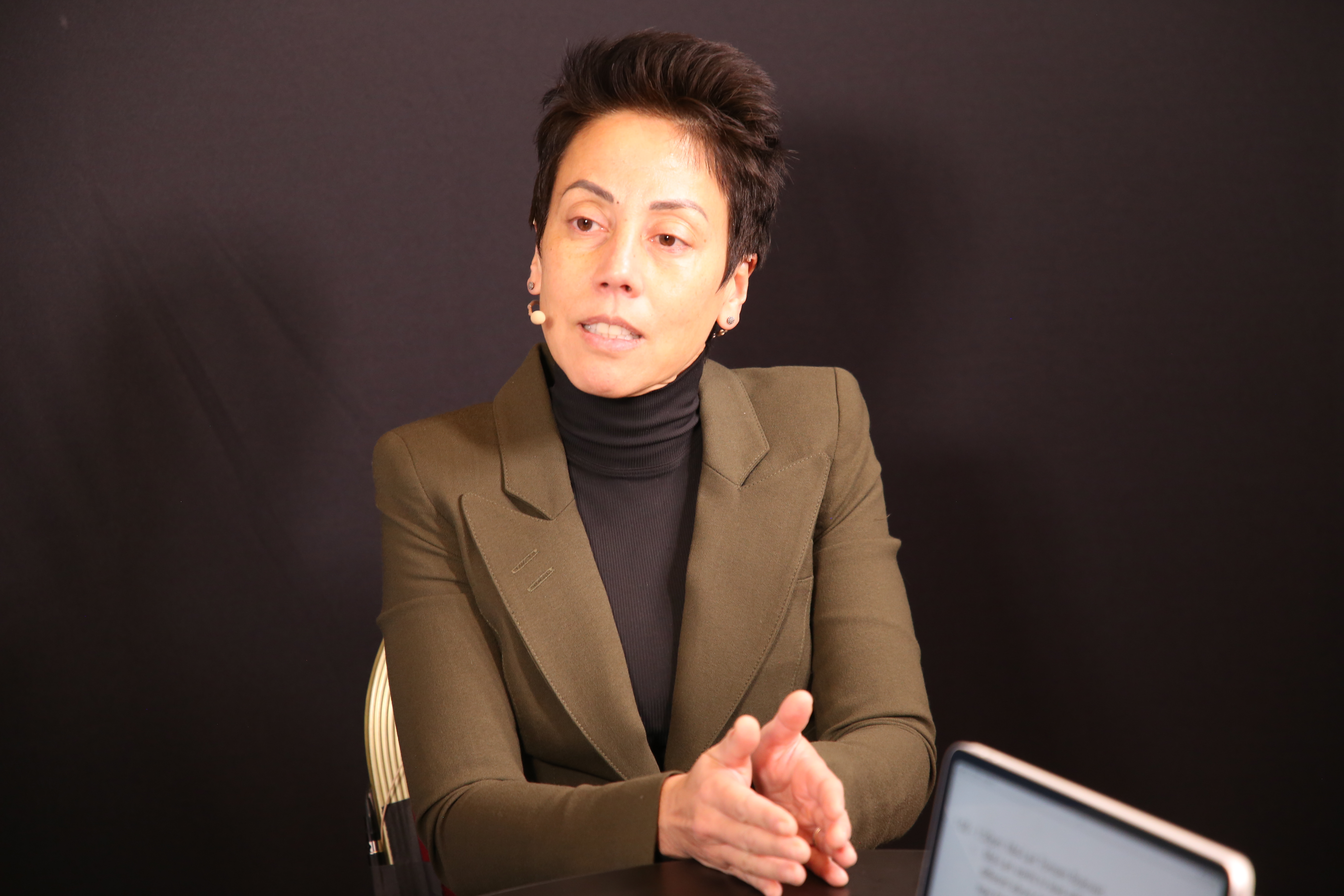
Mai-Lan explains the capabilities of the Q Developer for transforming Windows, .NET, VMware applications, and mainframes. Customers seek to modernize and cut costs by migrating to the cloud. The varying difficulty levels for each platform are detailed. Successful application migrations using AI-driven tools like Q Developer are highlighted. The importance of effective data estate management is emphasized, with new capabilities simplifying data storage. Integration with tools like QuickSight and SageMaker improves data visualization for business users. The fut...Read more
exploreKeep Exploring
What technology does Q Developer offer to help with Windows licensing cost avoidance and application migration?add
What challenges do companies face when moving Windows, VMware, and mainframe applications to the cloud as part of their migration strategy?add
What are some challenges associated with transferring VMware applications to AWS and how can AI help simplify the process, particularly when it comes to networking complexities?add
>> Hi, everybody. Welcome back to re:Invent 2024. You're watching theCUBE. I'm Dave Vellante. Mai-Lan is here, theCUBE guest, theCUBE alum. Great to see you again. Thanks so much for coming on.
Mai-Lan Tomsen Bukovec
>> Thanks for inviting me, Dave.
Dave Vellante
>> It's been a while. What's new? What are you up to? What's exciting you at re:Invent 24?
Mai-Lan Tomsen Bukovec
>> Well, there's so much to hear and to learn about at re:Invent. But in my area, we are all about changing how people think about solving problems. And we're doing that in two ways. We're doing that in data and we're doing that in migration of Windows applications, VMware applications, and even mainframes.
Dave Vellante
>> Okay. And maybe we'll have time to talk about data, but let's talk about this Q Developer. We're super excited about it. First of all, changing the whole software development. Life cycle is really exciting. Bringing in AI. What specifically are you targeting for transformations? You mentioned three, mainframe, .NET, and VMware. How should we think about those?
Mai-Lan Tomsen Bukovec
>> Well, individually, each one of them is different because we're talking about different technologies. But let's just take Windows as a starting point. We have so many customers that want to do cost avoidance on Windows licensing that what we've done is in the Q Developer experience, we've built the ability to help you migrate your Windows framework applications to Windows .NET Core that you can now run on EC2 Linux. It is transformative. And so we have customers. We have Signet, which is a financial company that is-
Dave Vellante
>> Yep....
Mai-Lan Tomsen Bukovec
>> out in Europe, and they started using an early version of Q Developer, the transformation capabilities this summer, and they were able to migrate a Windows framework application that they had estimated would take them eight months, and they were able to reduce it to just a few days. And so that type of capability, when you think about it and you think about what AI gives you, which is the ability to do many of these migrations in parallel, you can think about that, how that just fundamentally transforms how you think about going from Windows to .NET Core and Linux.
Dave Vellante
>> So what's the customer motivation there? It's modernization, it's simplification, cost? What are they telling you?
Mai-Lan Tomsen Bukovec
>> Well, it's two things. Windows, VMware, and mainframes all have similar threads. So in all of these cases, it is part of a company's strategy to move to the cloud. And moving to the cloud for Windows, VMware, and certainly for mainframes is actually a complex and hard task. And so what they tell us is that, "As part of my overall migration strategy, I don't want to leave anybody behind. I don't want to leave any application behind." And now what we've given them with Q Developer is a way to bring along the applications that were some of the hardest ones to get out of your data center and now just take them to the cloud.
Dave Vellante
>> Okay. So you mentioned there's varying degrees of difficulty for each. Help us sort of rate them, if you will. So is the Windows piece a little easier than VMware, a little easier or a lot easier than mainframe? Is that the correct sequence?
Mai-Lan Tomsen Bukovec
>> You're pretty close. The thing about Windows is that you have a lot of Windows applications. You probably don't have as many VMware applications-
Dave Vellante
>> ....
Mai-Lan Tomsen Bukovec
>> but you have a lot of urgency to get them over to AWS right now, don't you? And for those VMware applications, the hardest thing is networking. The VM network and any other network is quite different. And so what we've brought is we're bringing AI to the team. So in the past, we've talked about how AI helps the individual productivity. With Q Developer and our transformation capabilities, we're bringing AI to the team. And by our AI, and Q Developer knows VMware networking, knows VPC AWS networking, knows EC2. It's a unique skillset to know all of them. And it takes something that is so complex and it turns it into a matter of minutes or days to do. And we think customers have told us, and our early testing has told us that just that super complicated part about networking for VMware, we reduce the time to do it by 80 times. It's a huge benefit. So again, Windows got a lot of Windows applications. VMware, you probably get fewer, but you have a very complex step here about the networking. Mainframe, it's a whole different ball game. It's not a lot of mainframes out there, but the original monolith is actually the mainframe. And the projects that involve mainframe takes years. And from our early testing, what customers tell us, we can reduce that by up to 50%.
So I'll give you an example. We've worked very closely with Toyota Motor Group North America. And if you think about their supply chain, most of their supply chain is running right now on mainframes that are over 40 years old. And when they evaluated what it was going to take to take this mainframe application, bring it to the cloud, they were told it was going to take years and billions of dollars.
Dave Vellante
>> Yep.
Mai-Lan Tomsen Bukovec
>> And what we've done with Q, is that we've brought AI to the table, we've brought AI to the team. And what they can do now, and they've used our Q Developer to do this, is they can document what they have. And for anybody who runs a mainframe out there, that is a huge deal because there's not too many people left to understand the mainframe.
Dave Vellante
>> Because it's all COBOL. Yeah, it's like-
Mai-Lan Tomsen Bukovec
>> Because it's all COBOL. So not only can Q Developer take millions of lines of COBOL and move it to Java, but it can also document, "What is the business logic of this legacy application that you have and how do I decompose the architecture, the monolith into different modules so I can go ahead and put together a real plan?" And that's what Toyota is doing now. And they said that just the definition of those COBOL modules, the documentation and the migration plan for them would've taken months and now it's down to days.
Dave Vellante
>> Interesting. I mean, you're right. It could be anywhere from two to five, even one and a half to five years to migrate. So maybe you don't go after the five-year migrations first. But those one to two years, maybe you can take them down to inside of a year, inside of even maybe a couple of quarters. And if you can, then that makes sense because typically, you're freezing an application. And like you said, the business impact is not necessarily worth it. But you mentioned VMware, there's a motivation to do that. You actually have a lot of VMware customers with VMware cloud on AWS. That was actually quite successful. And then essentially, that world has changed. So they need a path now. So that seems to me to be a pretty attractive offering for customers. Give me just a little tidbit on data. You and I, we used to talk about storage. But years ago, we started talking about it's not about storage anymore, it's about data. And AI really shines a light on that, the importance of really having your data estate in order. So give us the bumper sticker on what you're seeing with customers.
Mai-Lan Tomsen Bukovec
>> Well, we have well over a million data lakes running on S3. And as you know, I've worked on S3 now, Dave, for over 10 years. And one of the super fun parts about what we do is we watch and we talk to customers and we ask them what they want to do in the future. And, Dave, we talk about 90% of our roadmap comes from customers telling us what they want. I'll give you an example of that. For S3, we raised the bucket limit to one million. And that is an example of customers saying, "Well, I would like to have more buckets." And now we give them up to a million buckets per account. But then 10% is what we intuit what customers name. And that's what we launched here at re:Invent. We launched S3 Tables, we launched S3 Metadata. And the reason we launched these capabilities is because the world is starting to move to thinking about, "How do I standardize both data storage and data access in the largest data lakes?" And many of our customers use Apache Parquet and Apache Iceberg to do that. And so what we've done is we've looked at that and say, "How do we make that so easy and so cost-effective that customers can move to it and just get the benefits built in automatically using S3 storage?" That's S3 Tables.
Dave Vellante
>> No, I'm super excited about S3 Tables. Basically, these are managed Iceberg tables and it dramatically simplifies. And the reason why it's important is because the world wants to bring any compute engine to their data. They don't want to be locked in. And they can use so many choices out there. But here's the thing, if I understand it correctly, is when this goes GA, it's not GA yet, it's in preview, I think.
Mai-Lan Tomsen Bukovec
>> Actually-
Dave Vellante
>> Actually-...
Mai-Lan Tomsen Bukovec
>> the S3 Tables are GA. Metadata-
Dave Vellante
>> Right....
Mai-Lan Tomsen Bukovec
>> is in preview. Now, metadata .
Dave Vellante
>> Okay.
Mai-Lan Tomsen Bukovec
>> And so if you think about all the data that you have, the semantic meaning of the data, like your data classification, where the data came from, how the data's being used, that's all what I call data understanding. Data understanding often lives at the application layer, in different places. And so customers build these huge systems to manage this very rich semantic understanding of the data. Now they have it built into S3. And so S3 Metadata is in preview. But I will tell you, as we add more and more custom metadata, which is customer metadata and system metadata, we're adding it in a managed Iceberg table. And the next generation of data lakes, Dave, they're going to be on object metadata because customers are going to run SQL queries to find the data they need for AI. They're going to need to find the data that they need for knowledge bases or analytics. And that is going to be the next generation of data lakes.
Dave Vellante
>> And I think I'm correct in that when that goes GA, not only third-party clients will not only be able to read from your Iceberg tables, but they'll be able to update as well.
Mai-Lan Tomsen Bukovec
>> That's right.
Dave Vellante
>> And so I'll be able to use whatever governance systems I want. I'll be able to read and write to those tables. So truly open format, which is what customers want.
Mai-Lan Tomsen Bukovec
>> That's right. These are all Apache standards, which is why Spark open source works right now with it. One of the really interesting things I'm excited about is that Q for QuickSight, which is incredibly popular with customers these days because you can use natural language to ask a question of your data, we are in preview now of that working with S3 Tables. And so you can put your Parquet data. We bring you the Iceberg-managed table capability, and then your business users can build the most beautiful dashboards and they can understand the data they need so easily and simply with these new modifications.
Dave Vellante
>> And I know it's not your swim lane, but the new improved SageMaker, if you start to think about how that simplifies the environment, getting your data act in order is so critical before you can really take advantage of AI and-
Mai-Lan Tomsen Bukovec
>> That's right. And S3 Tables now is a data source-
Dave Vellante
>> Right....
Mai-Lan Tomsen Bukovec
>> because we integrate with Glue and we integrate with the next generation of SageMaker. We're a data source in that whole world.
Dave Vellante
>> All your metadata is there, unified technical metadata, business metadata, operational, feeding up those agents. This is an exciting future. Mai-Lan, I know you got to go. Thanks so much. I was so glad that we could spend some time together. Great to see you.
Mai-Lan Tomsen Bukovec
>> Great to see you, Dave.
Dave Vellante
>> All right. Thank you. All right. Keep it right there. John Furrier, Dave Vellante, we're in the house here at AWS re:Invent 2024. We'll be right back right after this short break from Las Vegas. You're watching theCUBE.