We just sent you a verification email. Please verify your account to gain access to
Cloud AWS re:Invent Coverage. If you don’t think you received an email check your
spam folder.
In order to sign in, enter the email address you used to registered for the event. Once completed, you will receive an email with a verification link. Open this link to automatically sign into the site.
Register For Cloud AWS re:Invent Coverage
Please fill out the information below. You will recieve an email with a verification link confirming your registration. Click the link to automatically sign into the site.
You’re almost there!
We just sent you a verification email. Please click the verification button in the email. Once your email address is verified, you will have full access to all event content for Cloud AWS re:Invent Coverage.
I want my badge and interests to be visible to all attendees.
Checking this box will display your presense on the attendees list, view your profile and allow other attendees to contact you via 1-1 chat. Read the Privacy Policy. At any time, you can choose to disable this preference.
Select your Interests!
add
Upload your photo
Uploading..
OR
Connect via Twitter
Connect via Linkedin
EDIT PASSWORD
Share
Forgot Password
Almost there!
We just sent you a verification email. Please verify your account to gain access to
Cloud AWS re:Invent Coverage. If you don’t think you received an email check your
spam folder.
In order to sign in, enter the email address you used to registered for the event. Once completed, you will receive an email with a verification link. Open this link to automatically sign into the site.
Sign in to gain access to Cloud AWS re:Invent Coverage
Please sign in with LinkedIn to continue to Cloud AWS re:Invent Coverage. Signing in with LinkedIn ensures a professional environment.
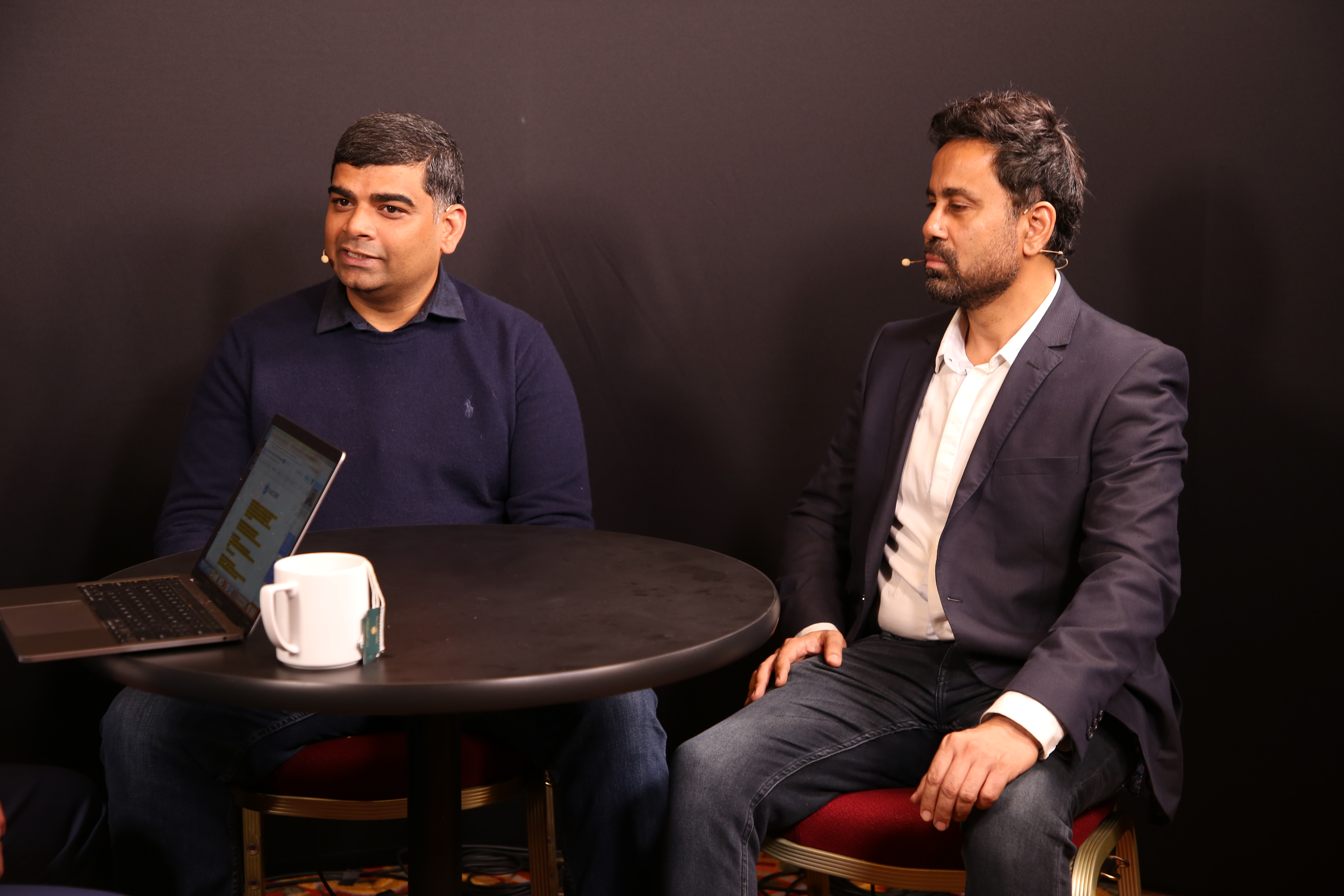
Nitish Shrivastava & Pradeep Sharma, Persistent Systems
Nitish Shrivastava
Head of Products BusinessPersistent Systems
Pradeep Sharma
Chief ArchitectPersistent Systems
At AWS re: Invent 2024, John Furrier interviews Nitish and Pradeep from Persistent about their platform SASVA, which stands for service-as-a-software virtual agents. They discuss how AI is changing software development and engineering, with a focus on making it more affordable, secure, personalized, and accountable. They share examples of projects with European software companies and BFSI customers that have benefited from their AI-driven approach. The conversation touches on the importance of systems architecture and how technology should seamlessly integrat...Read more
exploreKeep Exploring
What led to the creation of the SASVA platform and how does it aim to address the evolving landscape of software engineering and AI technology?add
What are the four foundational pillars on which the platform discussed in the text is built?add
What is the background of Persistent and the advantage they have in building products, and how did their journey with AI begin?add
What are some considerations for ensuring that new technologies effectively solve business problems, specifically related to writing software faster, migrating to the cloud quickly and affordably, preventing bad code, and ensuring auditing?add
What are the two main focuses of AI at Persistent?add
Nitish Shrivastava & Pradeep Sharma, Persistent Systems
search
>> Welcome back everyone to theCUBE's coverage. I'm John Furrier, host of theCUBE in Las Vegas for AWS re:Invent 2024, our 12th consecutive year covering Amazon's journey through the cloud growth. Now we're hitting the next inflection point. Obviously everyone's talking about generative AI, but there's really the renaissance of hardware infrastructure, software powering this next generation, which means a tsunami of new kinds of software is going to be built. Obviously, agents and many other kinds. We've got two great guests here. I'm talking about Nitish and Pradeep, both with persistence, you run head of product and business over there. Great. And the technology experts here. First of all, you guys have been on theCUBE many times with us and you guys are always doing some cutting edge projects. You got a lot of big customers, you guys help. But the AI side has been something that you guys have been focused on for a while. You have the new kind of word that you guys came up with, SASVA, S-A-S-V-A. Did I say it right? SASVA?>> Yes.>> SASVA. What is SASVA and what led to this? Because this is a platform you guys have created.>> Right. So SASVA came out from Sanskrit vocabulary. This is one of an ancient Indian language. So the philosophical side of it is, it means timelessness and relevance, something that stays relevant in the changing times. As you look at how AI, this is probably the fifth wave of AI, right? We wanted to look at a technology that sort of stays constant while we see lots of innovation around all of it, and we will talk about it in a minute. So that's on one side. While when we were looking at this particular name, we were also looking at how the software engineering is evolving from a traditional product engineering approach to something where the virtual agents are going to collaborate. And that is where we spin this thing as a service-as-a-software enabled by virtual agents. So it is service-as-a-software virtual agents, that's the technology sort of full form of SASVA. Now you asked about an interesting space, like, what led to this journey? This is the same time as we were looking at the evolution of the whole generative AI space and how it is affecting the way software is built, the product engineering is done for ages. How does it disrupt that market? And when we were looking at a problem, we encountered an issue where while generative AI is good, we needed something more deterministic along with generative science to start delivering a valuable outcome. And that's when we realized that we have to bring these two signs together and form a platform which can use any tool, which can use any model, but it can constantly deliver high value contextual to a domain that we are dealing with. So that's basically the foundation of SaaS where we started with embedded, we expanded it to different space and now we are covering all industry verticals. And this is a platform which is not only doing product engineering, but right from it is doing from a product requirement, gathering, grooming, creating user stories, assisting developers, assisting the quality initiative all the way to taking it down to a CI/CD pipeline.>> Got it. And Pradeep, and you look at the platform side of it. He mentioned engineering, get deterministic AI in there. The AI is not just a business thing, and wave AI, just throw AI at it. It doesn't mean anything. But you brought up this engineering of it because data's involved. It's systems. It's a systems architecture. Customers need to know that you can't just build a silo piece of software. You got to have a system. How is this product working, SASVA, helping a technology folks who are going to roll out either faster infrastructure or write new software?>> Sure. So in SASVA, basically we are trying to solve a complex business problem. So if you look at generative AI, it's like a horse which is just going openly very fast in any direction. That's a generative technology, right? But if you want to put it for actual use, you need to bring determinism into it, just like putting that blinkers on top of that horse so that you take it in the desired direction. So we will get into more detail, but we have deterministic approach at various levels so that it is very useful and we are able to solve an actual complex problem.>> What are some of the AI-driven software challenges today? You mentioned it's a software service. You're seeing Copilots out there, Q for Developer, Q for business here at AWS. As you look at this AI-powered software development, first of all, I'm not one of these people who think that software development is going to be out of business. Believe me, trust me. Money is software, right? It's just that it's going to change the tiering of how software is generated. I was talking to a friend first time I saw a 3D printer, I'm like, "Oh my god, is that real?" There's kind of an AI moment for that. Okay, it's someone will write code for me, maybe help me. But people getting lower right in assembly code now, you've seen. So there's still engineering coding to do.>> Sure.>> And so it's just a progression for engineers. So I see actually more engineering coming into the fold.>> That's the thing.>> Then not. So that means AI-driven software is going to be big.>> Right. Right. Right. And one of analogy that we use in our daily conversation is as you look at what AI is bringing to the table, it is empowering all of us to have a crew under us. When now I look at an individual, it is that individual powered by various agents. They're assisting him to do something better, faster, cheaper. So now look at the product journey. When we hire people to come together and look at a particular piece of requirement and try to build a product around it, we expect that particular person to collaborate with so many different personas from someone who understand domains, someone who has historical context, and then you bring that science together and build something, right? So there is a time lag that it'll go through. Every iteration, you get new insight and then you collaborate all that pieces together. What AI is doing is bringing all of it with that individual every single time. So when now I'm writing a code, there is no more iteration that I have to send it to a domain expert to understand or someone who has a historical context. These agents are going to do that job for me. So then my job as a programmer is strictly around making sure that I bring the best of the technology together, but then there are people around me, these virtual agents, that are helping me do it faster, better actually. And that's where we believe that every person is going to get empowered. But you're right, I don't think software engineering is going to go anywhere here.>> Pradeep, I mean, you must have an opinion on this.>> Yeah, I would just like to add that what is going to happen is that maybe the repetitive kind of things will be taken over by AI, but whenever you have something really valuable, let's say you are creating a new algorithm, that will essentially be still be driven by humans. And we'll be doing bigger and better and more complex things in a much more efficiently. That's how I see it.>> How does someone get a competitive edge on this? Because this is one area we're seeing gen AI. And if you do all the foundational things correctly, new value will be created. How does a company look at what you guys are doing to help them build the competitive edge?>> Right. Very good question. I mean, AI is becoming commodity. Models used to run on GPUs are slowly getting into CPUs, right? We have seen how in last one year, there are big changes around technology. So what keeps us relevant? The whole meaning of SASVA that we talked about. So our foundation is built on four things. There are four pillars. We start with something that is affordable. So if I'm bringing AI, it should be affordable for the business problem basically as we can't be spending millions on building an infrastructure. So affordability was one of the big things. Security. Our models can run on-premise in my private deployment. I don't have to send my code to common, anything outside of my premise. That unlocks potentially in sensitive domains like BFSI, healthcare, and all. So that's our second pillar. We bring the third pillar, which is more about personalization, that whatever I am doing, it is all getting into the historical context. I'm not creating a new piece of code. I create something that follow your style. It follows your architecture, your pattern. So how do you bring that personalization into the equation? That is our third pillar. And then finally, we always talk about something which has a trail. We call it like a responsible AI. So if my agents are writing code the same way we have the physical and digital trail for every individual, I could go and do your background verification, I know where you are downloading a code from, the same way these agents that are writing code, the AI that is producing code, AI that is producing any algorithm, I should have a trend to all that. So our whole platform is built on these four foundational thing. We are probably the only one that can run on CPUs, can deliver the best possible outcome with absolutely no context limits.>> So give some use cases of things that you guys have done with customers that have transformed how they're doing software engineering.>> So we take an example of one of our largest software company in Europe, Europe being highly sensitive when it comes to data. It was a big challenge. How do you bring AI? So they have a team of about 550 people producing a volume and they wanted to get productivity into everything that they are doing. Now, productivity is not about doing the same work with 350 people. It is about bringing technology and help these 550 to deliver maybe a thousand people worth of job, right? So in that particular case, the idea was to infuse a model where if they hire people, the team that they bring, the new guys who come into their ecosystem can become productive on day one. They're going to start making significant contribution. There's no ramp up time anymore. So that's one good example. There is one, another example. One of our largest BFSI customer, they had requirements that they wanted to do a modernization that was earlier planned to take about 18 months, but they wanted to hit market in three months. There's absolutely no way it can be done with just humans. You can't just throw people to solve that problem. That's where AI brings a real value. We were able to deliver it in three and a half months of what was planned earlier for 18 months. And then there are some other things. Talk about one extremely powerful story. So you talk about maybe that compatibility problem because that's so very technical, so very deep that a general purpose AI system can never look at it from that perspective. And this is one of a reason why AI is making wave. The results were not so very encouraging as people started adopting all of it. And we have solved one problem that basically gave us even further motivation to->> Tell me about the problem you get solved.>> Yeah, sure. So if you see, products are not built in silos. And we come from a microservices world, so there are lots of components that need to come together to deliver something. At various level, they share something in between. They need to be compatible. The libraries that you're using in a specific component, they need to be compatible with each other. And in many cases, even these components need to be compatible with each other as well. So basically what needs to happen is that whenever we are generating a new code, we need to make sure that we are not breaking this compatibility. And it's a very, very complex problem. We are talking about a really, really deeply rooted tree of hundreds of thousands of branches. And when you're going from one version to another version, how do you make sure that you don't break this compatibility? So what we do is that we actually mine millions of repositories that is available publicly as well as privately. And we come up with our own data set so that we know that what are the things that are compatible with each other across the stack from operating system, kernel, software, et cetera. And whenever any new code is being generated, we make sure that it remains compatible.>> Yeah. The DevOps movement really changed software engineering. Obviously, before that, it was waterfall based. Everyone kind of knows what happened there. It changed everything. Now I want to get your guys' perspective on gen AI's structural change to software engineering, not the discipline. And we talked about the people side of it. But I'm working on engineering systems and we're in a systems revolution right now. I mean, we're old school computer science guys. I mean, I had a degree from the '80s and I remember we did all the work. We had to do everything. But it seems like we're back to the systems. So it's more like an operating systems mindset where there's consequences for certain decisions. So knowing which tool to use for the jobs should be taken into context. We're hearing that all the time on theCUBE. So I want to get your thoughts on if the engineering of the system, is the system going to enable the apps?>> Yes.>> How are customers looking at this? How does this help them? Because I want to roll out platforms that's going to make me go faster, make you more efficient.>> They're a need.>> But is it a system? Does it fit into my system? What's your guys' reaction to that? Comments and opinions?>> Yeah, so one of the most important thing is the change management for any technology. How do you bring that technology fit into your everyday's world? And the more desperate it becomes, the more challenges it sort of brings in. This is why some of the best systems struggle to get into a streamline. So from our perspective, and I'll give a simple example, you might have heard today everyone talking about how modernization is one of the most important thing from a generative AI standpoint. How generative AI is helping modernize faster, write a code or build platforms that are far more scalable with absolutely no debt, right? Now, as you look at a modernization, you just cannot create a completely different system that works independent to what was done earlier. It has to augment, it has to compliment the original system. So from our perspective, we believe that no matter what platform we bring to the table, as long as it fits into the paradigm of how people are building things, just providing a very simple example, you look at Q, if it is part of a ID for a developer, it's not you take a code somewhere, get AI to do some job and then bring it back into ecosystem. It has to be seamless from that standpoint. So we have seen customers adopting technology faster if it is a seamless experience for them from their traditional approach. Maybe you want to add something?No, I think you covered all the things.>> Well, I mean this is back to, but the end of the day, what are you building? You want applications. And I love Matt Garman's point today because he said, "It's just another application." All the work is going to get done under the covers. That's where I think what you guys have with this system is interesting because at the end of the day, you guys are learning. Take a minute to explain what you guys have done of Persistent that gives you this advantage, because the vision, love the vision. Okay, you sold me on the vision. Take me through how you got there, some of the learnings. Because one of the trends we're seeing, you're seeing with Nvidia, you're seeing it certainly with AWS, when you hit a certain scale, you see things and you get things develop faster because you're at scale. So you have an at scale advantage. You guys have a lot of that going on at Persistent. You see a lot of customers and you guys are strong engineering-wise. So take us through how you got here and what's next.>> Okay. Yeah, very good question. So look at what do we do in Persistent. We write software, we build products, right? We have been doing it for many, many years just building products. We don't do anything else. We just build products. So there is this whole heritage of understanding how a typical enterprise-grade products can be built. But there are two parts to it. On one side you are dealing with companies who are extremely technology savvy, they understand in and out about it, the likes of Amazon, likes of Google's. And on other side you are dealing with enterprises, absolutely ad-hoc. People like the traditional banking system and all. We have been doing work for both of them. At the same time, Persistent has a line of business where we build product and we sell. We are like an Amazon. We are like a Google in our own space where we build products and we are selling products. We have many, many customers. If you fly one of the largest airline today and you go to the ticketing system, the ticketing system is running on one of our products. You go to a bank or an ATM, the ATM is running on one of our products. So we have been dealing with complex business problem for many, many years. And our journey of AI started much before ChatGPT was announced. So sometime around in 2021, we were dealing with a problem of an embedded software. And the challenge was, you get the team to come and then work on something so very technical, how do you get that skilled team? It was very, very difficult. And that's when we first started reading. So this was a time when we hit Google research paper, attention is all you need, and our AI journey started.>> Interesting. You got some unsupervised machine learning going crazy. That horse is reigned in, you got your horse not running around the track.>> Yeah. So that's when the foundation was put up. And then from that point to today, we have seen so many changes. So you talked about one very interesting thing. There are new models coming every day. There are new technologies being announced every day. How do you ensure that while you get acceleration with these new technologies, you are really solving the business problem? The business problem is, I want to write software faster. I want to migrate to cloud much, much faster at a cheaper cost. I absolutely don't want bad code to be written. I do not want anything which is not audited. And that's where I think our experience of building product came fairly handy. Now where are we going with that? Now there are two parts to it. On one side, at Persistent we have two line of AI. Our focus is on twofold. We build AI for technology builders. So our AI for like SASVA can solve problems for people who are trying to create products. And on other side we have AI for business. You look at report migration, you look at how you could go from one low code/no code to another low code/no code. So we are also focusing on that space. So on one side we are looking at business problems, ensuring that our use cases are all covered. On technology, I let Pradeep talk about it because where we see industry heading in 2030, that's one area where we are putting significant investment. You want to talk about that?>> Sure. So there are multiple angles here. First thing is what we are doing is that we are creating a generative and deterministic brain and we keep it up to date in our labs. And in a very secured manner, we roll it out to customers and it further gets trained in customer data. The beauty is that we always keep, in a very controlled manner, customer up-to-date. So every week a new model is coming. And if that model or new tool is better, it's solving the problem in a better way, we train it. And after that, we roll it out in customer environment and further train it there. So that itself I think is a very unique story and it has lots of nuances to be taken care.>> .>> Well, you guys have done a great job. We've been covering some of the... We know you're engineering-focused. Again, get that brain automated. Now you have an agent running it in multiple environments. SASVA. Looking good.>> Yeah,>> Really good. All right. Thanks for coming on theCUBE. Appreciate it.>> Oh yeah, yeah. Thank you.>> It always goes too fast. I'm John Furrier here on the ground. We're in Las Vegas, our 12th re:Invent. Watching the journey go from basic building blocks now to a new core building block with inference announced today and a slew of other infrastructure enhancements. And just the next wave is coming. Again, generative AI will provide a lot more software value and it's got to be engineered. Of course, we've got it all covered here on theCUBE. We'll be right back.>> .