We just sent you a verification email. Please verify your account to gain access to
Cloud AWS re:Invent Coverage. If you don’t think you received an email check your
spam folder.
In order to sign in, enter the email address you used to registered for the event. Once completed, you will receive an email with a verification link. Open this link to automatically sign into the site.
Register For Cloud AWS re:Invent Coverage
Please fill out the information below. You will recieve an email with a verification link confirming your registration. Click the link to automatically sign into the site.
You’re almost there!
We just sent you a verification email. Please click the verification button in the email. Once your email address is verified, you will have full access to all event content for Cloud AWS re:Invent Coverage.
I want my badge and interests to be visible to all attendees.
Checking this box will display your presense on the attendees list, view your profile and allow other attendees to contact you via 1-1 chat. Read the Privacy Policy. At any time, you can choose to disable this preference.
Select your Interests!
add
Upload your photo
Uploading..
OR
Connect via Twitter
Connect via Linkedin
EDIT PASSWORD
Share
Forgot Password
Almost there!
We just sent you a verification email. Please verify your account to gain access to
Cloud AWS re:Invent Coverage. If you don’t think you received an email check your
spam folder.
In order to sign in, enter the email address you used to registered for the event. Once completed, you will receive an email with a verification link. Open this link to automatically sign into the site.
Sign in to gain access to Cloud AWS re:Invent Coverage
Please sign in with LinkedIn to continue to Cloud AWS re:Invent Coverage. Signing in with LinkedIn ensures a professional environment.
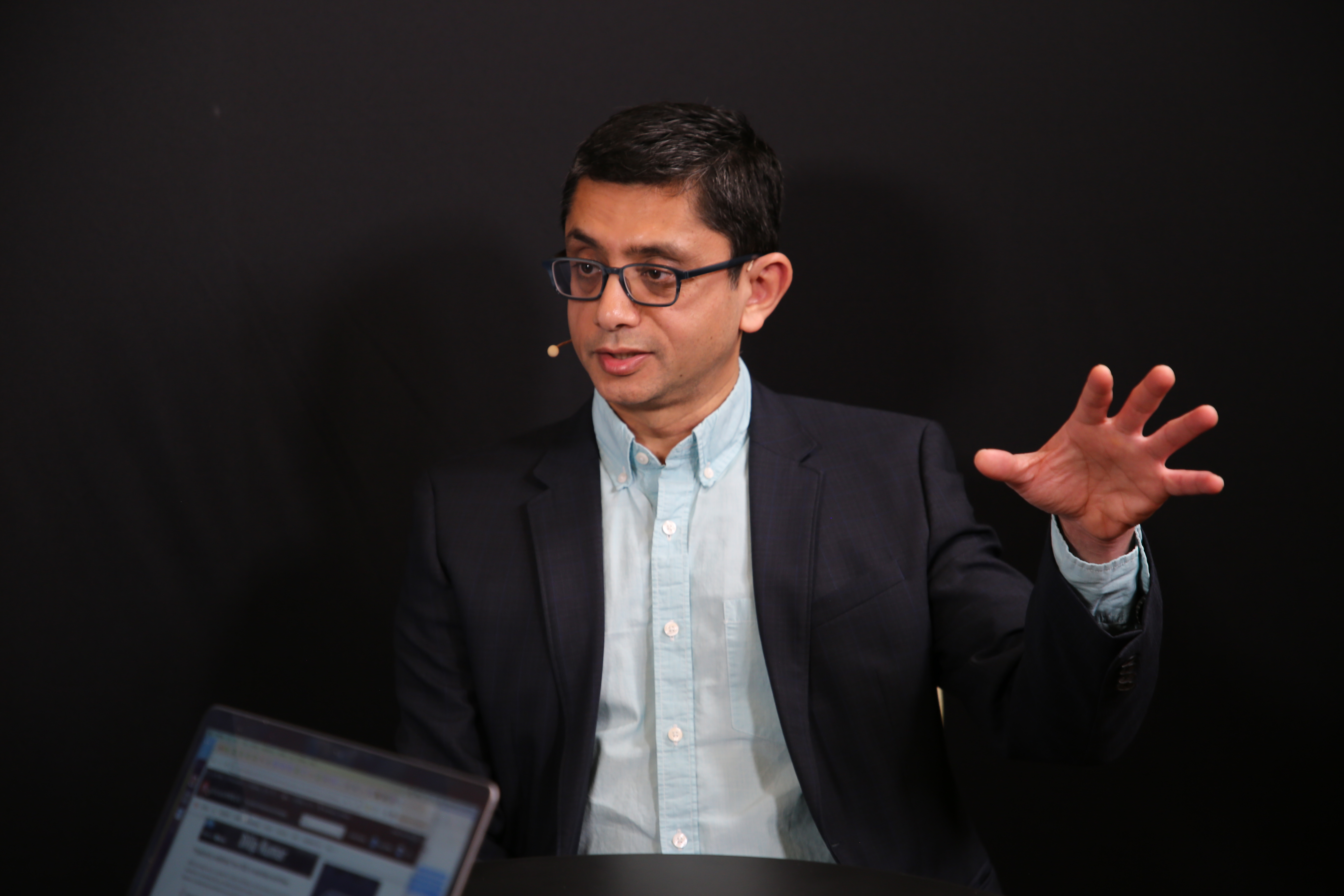
John Furrier, host of theCUBE, interviews Mukesh, GM and director of Amazon Q for Business. Mukesh discusses the recent announcements at AWS re:Invent, focusing on the capabilities of Q for Business, including data integration, natural language tasks, and workflows. The integration with QuickSight and BrainBox AI is also highlighted, showcasing the platform's data storytelling and reasoning abilities. Mukesh explains the ease of deployment for customers to ingest data and customize applications to fit their needs, emphasizing the importance of starting small ...Read more
exploreKeep Exploring
What are some of the implications of the features announced by Matt for an organization?add
What are the benefits of Q for customers and how can they integrate it into their workflows seamlessly?add
What does Q Business do with access controls in relation to Q in Quicksight?add
What factors are considered when choosing a model for customers in AWS?add
>> Welcome back, everyone. We are here in the AWS re:Invent press area for our coverage of AWS re:Invent. Four days of wall-to-wall cover. I'm John Furrier, host of theCUBE. Mukesh is here at GM and director of Amazon Q for Business. Great to see you.
Mukesh Karki
>> Good to meet you.>> Thanks for coming back on theCUBE. Appreciate it. I'll say yesterday was the big keynote reveal of more Q for Business. We had a little scoop with the lip around this product. Q for developers, everyone seeing that it's been quite the buzz and listen, the progress, the numbers Q for developers. So we've seen that same value proposition go into business, which I love because the trend towards democratizing the non-technical programmer user is really kind of here, right? It's coming, it's now.
Mukesh Karki
>> Yes.>> And I think Q for Business to me highlights the progression of the developer market as they go closer to the hardware and do more harder things. Like Swami pointed out on stage, the coding is not going away, it's being augmented by Q for Developer, but the productivity gains that the non-technical users are getting with Q for Business is, to me, one of these really game-changing moments because that's going to change the entire labor equation. This is a big part of Q, So take me through the announcements here at re:Invent real quick. And then, I want to get into some of the implications of what this means for an organization.
Mukesh Karki
>> Yeah, thanks John. Yeah, so we are super excited about the things that Matt talked about yesterday, like the ability to combine what Q and QuickSight does with what Q Business does. Imagine a business intelligence person, BI person, being able to not only generate reports about their business for the last six months, but also extract all the information from all the meetings they've had, all the information sitting in their documents in Outlook and all of that, bringing it all together. That's just compelling. So, that was a big announcement. The second one that Matt talked about was this ability to take actions. Our users in Q Business, within Q Business, they can do natural language, say "I want to create a ticket," with the specific support cases, make those things happen right there within the chat window. That's super compelling as well. What then all bringing it together is sort of the workflows. There are these workflows that people have in sitting in SOPs, sitting in PDF files, kind of bringing all of them together, being able to say, well Q Business, just make these sort of flow. Just sort of give me what the workflow looks like and then execute those. That's compelling as well.>> You mentioned QuickSight, I thought was good. Also, BrainBox AI is a company that's being featured. I think I interviewed him at that company many times. Great team there. But I think one of the things that you see with the agent discussion that Swami was laying out, he loved this example of finding free food at the event, and he had this whole agent set tasks. It's so clever. Because it's like, where are all the parties? We should write an app for that actually. But he's highlighting the reasoning and what I like about the Q for Business and some of the things you said about QuickSight is that the data storytelling, it's data storytelling, basically. You can use querying through whatever natural language or any interface to the user, not technical, and have it do stuff like, "Give me a PowerPoint presentation or make sense of this." So those reasoning is a big part of this. Talk about this is not just some sort of chatbot or some trivial thing.
Mukesh Karki
>> Absolutely not. What's really happening behind the scene is we are using these models to sort of go through all these structured data that exists in your data lakes, data stores, and all of these places, and these models are trained to actually make sense of, give insights to the users. And it's not just the data scientists, data engineers, but other folks as well. Through the Q business interface they can basically say well get that insight from Q and QuickSight, and combine it all of this together. So it's much more than just a chatbot at this point of time.>> Yeah, it's foundational, I think, for the agents too. Let's get into some of the specifics around benefits to customers because I won't say they're going to be skeptical. They're going to be like, "Okay, where do I use this?" So take me through the process. I'm a customer, I'm a big enterprise, I got teams of people working on stuff. I always want to find stuff. So is real popular these days. So I got a lot of data, unstructured data, I got structured data, what do I do? How do I deploy Q? Do I just hit the console? Do I have to roll out into the apps? How do I seamlessly integrate this into my workflows?
Mukesh Karki
>> So the really compelling thing is that the yard business admins, with only a few clicks, they can create an application. And once they have this application, they can sort of point it to the different various sources of data. It could be Microsoft Exchange, it could be Confluence, it could be any other data store you have.>> . I couldn't say, "Here's my S3 file."
Mukesh Karki
>> Exactly. Exactly. And then, what we do is we sort of preserving the security and privacy. We just pull that all into what we call the Q Index. Matt talked about it yesterday where once it's in the Q Index, a user then can get insights from that data, but only the data that they have access to, and not any other sort of information that exists there. And once they have the insight, they can actually task out of it. They can say, well, I see all the information now I want to take action based on that information. If I was a support professional, imagine the productivity gains I have in the sense of being able to look through all the tens of thousands of support tickets that've already been solved by my peers and then being able to say, "Well, I know exactly how I solve this specific problem.">> Do you see a use case progression where you can advise someone, okay, here's how I would start it. Do you pick a use case? Do you pick a use case? You just roll it out everywhere. How does it get... Because this is not just an application, it's a platform.
Mukesh Karki
>> Yeah.>> So you got to index things. So, how do people implement it? What's your advice?
Mukesh Karki
>> So if I were to have to tell, and this is what we tell our customers is, you have to pick a specific use case. You've got to make sure your data is cleansed. You've got to make sure you know exactly what problem you're trying to solve here. For example, you could say, "Well hey, what I want to do is with this, I want to just keep content that my marketing folks need so that they can create new content out of it." And then run those POCs, proof of concept, see if you're getting the compelling responses back or see that you're able to create the content and it matches what your organization needs. So, that's sort of how. You've got to start small. You got to see those gains. And once you do that, then you sort of get bigger and solve other problems in the organization.>> And the persona you guys are targeting is the who, the business user? I mean I got to stand it up, I'm just kind of walking through. Do I have to log onto the console and then I provision it to the whole company? Then there's users coming out. use cases?
Mukesh Karki
>> Yeah, so there could be multiple use cases. I talked about the marketing use case. It's just the marketing teams who would do that. However, there are organizations which have set it up for all of their customers. For example, Smartsheet, they pull in all the information about how their employees on-board. All of that information is sitting in our index now. And what their employees do is they are big into Slack. So from within Slack, now once they have set up Q, now Slack becomes much more powerful. Well, they basically say, "Hey, how do I get this information? What are the steps I need to do as I join this organization?" And they get all the information that's sitting inside Slack, in the Slack channel, but also in documents in other places coming from Q Index. So that's sort compelling is just kind of bringing it out.>> So it creates an index of the onboarding manual basically.
Mukesh Karki
>> Exactly.>> And then just allows for customization, personalization.
Mukesh Karki
>> Exactly. And sort of meeting the employees where they are in Slack, in Microsoft Teams, all the places that folks already work, instead of having to go to yet another application.>> So what are your goals for the business? You've got to look at the growth. What are some of your objectives as GM?
Mukesh Karki
>> It's like we've got to focus on what our customers are asking for, John. Since we launched Q Business last year, it told us about, hey, how do we get insights from this data? What do we do? How do we support more and more applications? Like today we support 45 plus applications where you can sort of get the data from, kind of keep on growing that is super important to us. And then Agentic AI is sort of becoming really compelling, so we've got to make sure we are solving all those use cases.>> I was talking to Swami about this on and off-camera, but the off-camera conversation was more of, it's such a hot area that you're in. You've got such a great opportunity, but it's kind of you end, kind of your victory. It's kind of in a pre-existing world of analytics and dashboards, and then business intelligence, but you're also got the hardcore data geek side of it too, which is developing with agents. So, you got all this new stuff. So, you've got the confluence of the new personas that want to do this stuff over here. Then you've got the old school analytics team. It's weird to say old school, but analytics that have expectations. So you got, "I want reports, I want dashboards," but then you've got this new innovation. How do you look at that? You got to get the priorities. You got to make sure you meet the customer where they are. I get that.
Mukesh Karki
>> Exactly.>> How do you look at that?
Mukesh Karki
>> To us, what we announced yesterday around Q in Quicksight, Q Business coming together, customers of Q in Quicksight, getting data from Q Business and vice versa. That is a first step. We want to remove the boundaries of structured, unstructured. That's not how people think. That's not how users think about it. They just want to get insight from all the data, wherever it is. And we just want to keep on removing those boundaries.>> I think you're a comment earlier about getting that data right, clean, and you said clean, I think you said clean, but get in nice and tight so it's accurate.
Mukesh Karki
>> Exactly.>> Access controls becomes a huge thing. Does Q Business learn access controls? In jest, is there magic behind that too?
Mukesh Karki
>> So that's a great question, John. And what we do is we basically preserve all the access control that were in the applications or those stores. We just sort of mirror them in the index itself. So exactly the thing that was sort of locked down before, it's locked down now. And we also keep on refreshing it. You could go and change the application. We make sure that those are sort of reflected back in the index.>> So maybe I'll tap your consulting brain here for a second to mentor our CUBE team. We have all of our transcripts stored on S3, just point Q at it and say go to town Q Developer and Q Business?
Mukesh Karki
>> Yes, that'd be awesome. Imagine you could find all the sort of transcripts of information, all those sitting in Q Index, it's searchable. You can kind of figure out which were the ones, the interviews you were sort of excited about, the ones you liked, all of those at your fingertips.>> I can see how many times Andy Jackson has just un-drifted heavy lifting and giddy up as big phrases. No, I mean this is like we look at the content. It's all there. I mean I could point it at it. It's on S3. This just sucks it all in.
Mukesh Karki
>> Exactly. And I'm glad you brought this up. One of the capabilities we are rolling out is the ability to sort of take those audio files as well and transcribe those so you have even more compelling abilities. Not just the text document, the .>> You can link that transcript of the video.
Mukesh Karki
>> Exactly.>> And roll up some clips. Sounds like something we should be working on.
Mukesh Karki
>> Yeah, something.>> No, but all kidding aside, we actually do that actually. But I'd love ingest the data, but it brings up the simplicity. I'm trying to get to the point of that. It sounds like there's a lot of dark arts of stuff going on. People get sometimes nervous. Okay, it sounds too good to be true. So how do they get going? So okay, I ingest my data. Do I then expose an app to my team? What happens next?
Mukesh Karki
>> So, there are multiple risks. Q business comes with an application, you can expose that application. The other thing folks do is they create their own application and embed Q inside that application. So that's the second model where you already have an application. You can kind of use->> Like Slack.
Mukesh Karki
>> Exactly. You could basically say, "Well, all my users are in Slack or Microsoft Teams. Well let's just bring them there." And there's sometimes folks have customer applications which they've already developed. You can sort of add Q to that as well.>> So you can really make Q whatever you want it to be.
Mukesh Karki
>> Absolutely.>> It's customizable.
Mukesh Karki
>> It is absolutely customizable. The power comes from the index and the use of Gen AI technologies, and the front end can be anything that your organization wants and wants it to be.>> So congratulations, love this area. We'll probably do a lot more talk about this and get some customer stories come on the Q. But I have to ask you, you mentioned Smartsheet earlier. Are there any other customer examples you can point to that are innovating, leaning in with Q Business?
Mukesh Karki
>> Absolutely," Asana. Asana is another one. They provide productivity application. What they are doing is basically partnering with us so that when our common customer, they set up a Q Index and though that customer could tell Asana, Hey, now you have access to all the data from other applications, or some parts of it." And then the Asana users basically, imagine I'm sort of in Asana, I'm sort of looking at my project, I can pull in information saying, "Why is this project late?" And all the information that sits in documents, in transcripts, all of that kind of shows up right there.>> You're going to appreciate this. When I talked with Deepak and Dillip when I was prior to this event, I know they're both product guys. So I said, "Hey, how does Q for developer and Q change the role of product manager?" Because if you think about the productivity gains, just on the ideas of keeping everything together, because you've got Q for Business and Developer, you could literally recast what a product manager does, accelerate the idea of moving the requirements in quicker and then actually have the code assist start kicking in some coding. What's your reaction to that? Because this is an area I see as an example of many positions that productivity gains and how they do their job will change.
Mukesh Karki
>> Absolutely. We see it ourselves in AWS in terms of how I do my job, in terms of how quickly I can access information. Absolutely John, this is a transformative moment in terms of how not just product managers, developers, operational people, all of those, it's super compelling.>> Yeah, I know you guys do a lot of internal, these anthropic and a lot of the different models internally. Good to hear them tell that story yesterday, that internally even they're experimenting with all the different models. Any favorites on your end that you can share that you use, that you like?
Mukesh Karki
>> Well, we will give customers the choice they want in terms of the abilities and we choose the model based on the different use cases. So, we are going to go where our customers take us.>> Okay, Mukesh, final word for the folks watching. What should they know about Q Business? Why should they care? What should they do with it? Give them some quick tutorial advice.
Mukesh Karki
>> So what I'll tell folks, your audience, is they should try it out. Choose the data set, point it to the application, get going, get some results out of it. They will love it.>> All right, you'll love it. You heard it here first on theCUBE. Okay, with more coverage here, wall the wall coverage. I'm John Furrier, your host. Thanks for watching.