We just sent you a verification email. Please verify your account to gain access to
Cloud AWS re:Invent Coverage. If you don’t think you received an email check your
spam folder.
In order to sign in, enter the email address you used to registered for the event. Once completed, you will receive an email with a verification link. Open this link to automatically sign into the site.
Register For Cloud AWS re:Invent Coverage
Please fill out the information below. You will recieve an email with a verification link confirming your registration. Click the link to automatically sign into the site.
You’re almost there!
We just sent you a verification email. Please click the verification button in the email. Once your email address is verified, you will have full access to all event content for Cloud AWS re:Invent Coverage.
I want my badge and interests to be visible to all attendees.
Checking this box will display your presense on the attendees list, view your profile and allow other attendees to contact you via 1-1 chat. Read the Privacy Policy. At any time, you can choose to disable this preference.
Select your Interests!
add
Upload your photo
Uploading..
OR
Connect via Twitter
Connect via Linkedin
EDIT PASSWORD
Share
Forgot Password
Almost there!
We just sent you a verification email. Please verify your account to gain access to
Cloud AWS re:Invent Coverage. If you don’t think you received an email check your
spam folder.
In order to sign in, enter the email address you used to registered for the event. Once completed, you will receive an email with a verification link. Open this link to automatically sign into the site.
Sign in to gain access to Cloud AWS re:Invent Coverage
Please sign in with LinkedIn to continue to Cloud AWS re:Invent Coverage. Signing in with LinkedIn ensures a professional environment.
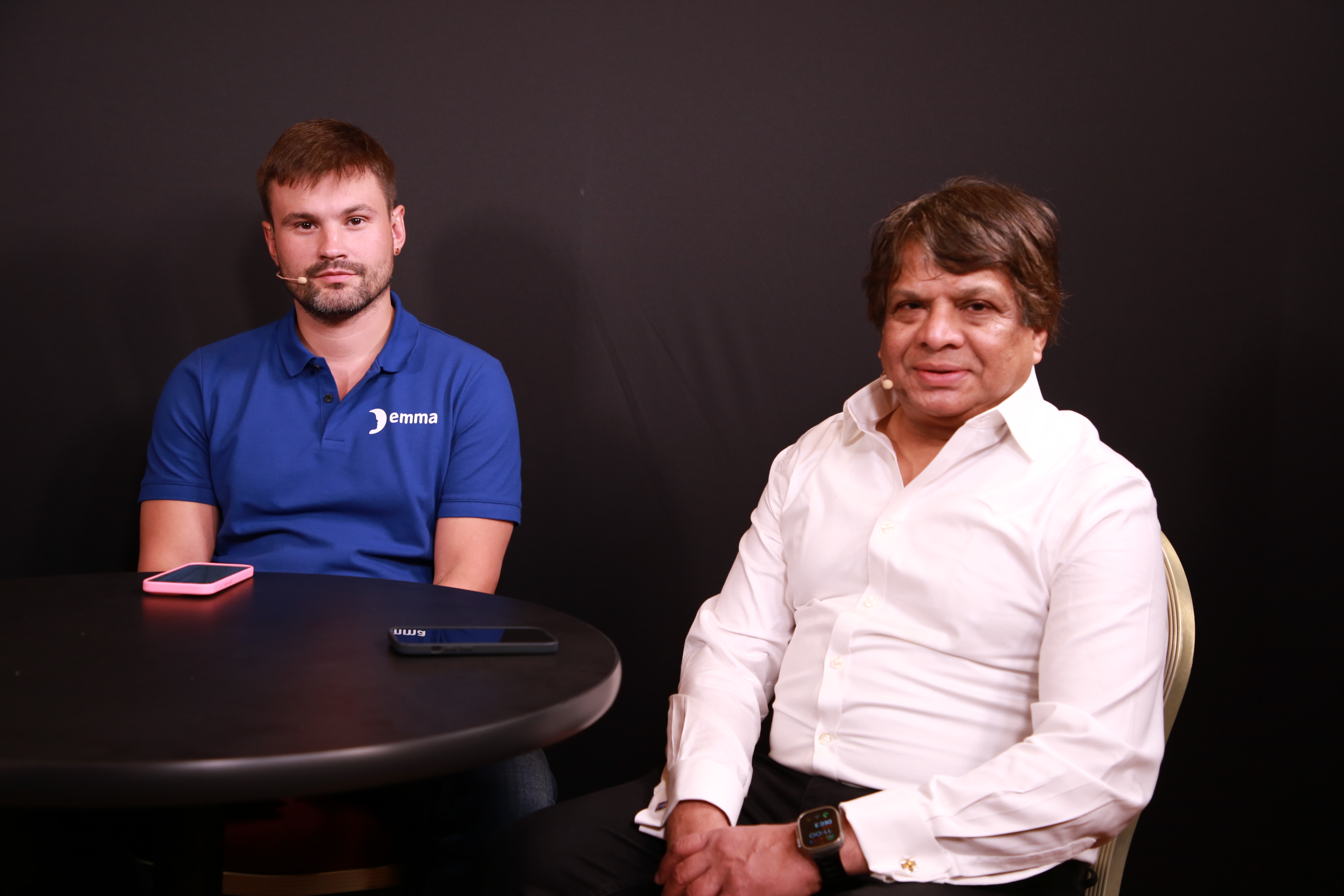
TheCUBE is covering AWS re:Invent 2024 in Las Vegas, discussing multi-cloud environments. Dmitry, founder of emma, and Sid from Gartner break down the market. Multi-cloud adoption is increasing, driven by complex workloads and the need for best-in-class capabilities across different cloud providers. The goal is to unify and interconnect clouds for seamless data flow and business outcomes. Dmitry's platform simplifies networking and infrastructure management, offering cost savings and automation tools for platform engineers and DevOps teams. The trend is drive...Read more
exploreKeep Exploring
What is driving the increasing adoption of multi-cloud solutions in organizations?add
What has Gartner defined as the cross-cloud integration framework and how does it connect clouds in a seamless fashion using native APIs rather than going through exchange providers?add
What options are available for customers who do not want lock-in when choosing a cloud service provider?add
What type of risk management is being discussed in the conversation?add
What approach should the CIO take when developing a smart city infrastructure, without focusing solely on technology acquisition?add
>> Welcome back everyone to theCUBE's coverage here in Las Vegas for AWS re:Invent 2024, our 12th year covering Amazon Web Services, watching them grow from building basic building blocks to now full-blown cloud systems. Then with GenAI, it's really looking at a full distributed computing market with high-performance computing. Now the center stage is all about performance and the big story is infrastructure, but really around multiple environments. We've got a great segment here talking about multi-cloud, multiple environments all happening at the same time. Dmitry is the founder and CEO of emma and Sid from Gartner to break it all down. Gentlemen, thanks for coming on theCUBE here at re:Invent day one. Day zero was yesterday. Great to see you guys.
Sid Nag
>> Yeah, absolutely. Thanks for having us.>> So multi-clouds kind of a reality. We've been calling it super clouds. Some of them call it other clouds, but at the end of the day it's a distributed computing environment. Just different vendors. Amazon's got a big association cloud, so does Google, so you got this big democratization of supercomputing you're seeing. But the apps, at the end of the day, people just want to write better apps. So if I'm JPMorgan Chase or I'm a big customer, I'll use whatever cloud best runs my workloads.
Sid Nag
>> True.>> At the end of the day. So let's get into this whole multi-cloud. So before we get into emma, because you guys have an interesting solution, I want to dig into. Sid, break us down on the marketplace because what has now become recognized is that we have heterogeneous market. How does multi-cloud look like from a customer perspective and how are the vendors playing in that, the big whales?
Sid Nag
>> Absolutely, John. Yeah. So we are seeing an explosion of the adoption of multi-cloud. It's been happening over time. Thing to keep in mind is that multi-cloud doesn't mean every workload is multi-cloud. We predict that. I think two years ago it was 75% of organizations so were multi-cloud and we are predicting 90% at the end of this year. We almost at the year now. So the one thing I want to point out when I say those numbers is even if an organization has one workload that's multi-cloud, that counts in the number. So it's not actually 75 or 90% of workloads are multi-cloud. That's a clear distinction. We need to make sure we understand. So that begs the question, why are people going multi-cloud? Why? Because workloads are getting more complex, the ones that are being moved into the cloud and the primary cloud provider, although may have all the capabilities service that workload, it may not be best in cloud. So let's take example of algorithmic trading application of a hedge fund down to Manhattan. It primarily runs on Amazon, let's say, but it may need an analytics engine from Microsoft and it could be Power BI as deemed by the owner of the application. So now you're leaning into a second cloud of Power BI, and as an artifact of that, Microsoft will probably say, "Hey, my Power BI runs based on Azure, so you've got to buy some Azure AI." So this is that how second cloud fits in the context. And then owner of the application may say, "I want AI capabilities from Google for that particular application." So then you got a primary, secondary, tertiary. That's the highest running use case that we see in the industry for multi-cloud.>> Yeah, it's interesting Dmitry, we're here at AWS and we've heard the narrative over the years and even Andy Jassy who made an appearance for Matt Garment on stage here at the event, he's almost saying multi-cloud, but he's talking about the models. They announced Nova and he's like, "Everyone, you can't use one. You got to use." So again, so the reality, he says, "This is how the real world works. You don't talk to one expert." He's talking about models. But at the end of the day, that's the way the environment is. Customers have choice.
Dmitry Panenkov
>> Yeah. So I'm totally with you guys. So look, customers, they find themselves in a multi-cloud reality because of different things. Sometimes they acquire the different companies and then, okay, so you acquire the company because of the business metrics, not because of the environment you utilize and you deploy your applications and the end of the day. So customers, they don't want to care about the underlying infrastructures. They want simply to run their applications, they want to scale their applications, they want to leverage different infrastructures. And even if we're talking about a high-performance computing, all these like GPU training models, et cetera, et cetera. So again, sometimes you also experience the lack of the resources on the marketplace, right? Imagine you need five accelerators, top accelerators from Nvidia, and you see with your current provider you have only available five and you need 12. So what are you going to do? And so multi-cloud helps you here to combine the different resources from the different cloud service providers and utilize them. So leverage these resources as a commodity.>> So we asked you a question Dmitry, I know you guys talk about this a lot and I've heard you speak about this complexity.
Dmitry Panenkov
>> Sure.>> I mean the vendor lock, and that's a whole another discussion, but let's talk about complexity because one of the things you're seeing is more complexity comes about from trying to manage resources across multiple environments. Forget multi-cloud, but add that in. You got edge too. So as you look at distributed computing or cloud operations, how do you look at that unification when you have more complexity coming? I know you guys are addressing it. What are some of the things that people can do to deal with this? Is AI going to abstract away complexity? So what are some of the strategies people are taking say, "Okay, I want to have heterogeneous choice, but I've got complexity blowing up." How would you answer that question?
Sid Nag
>> I can go if you want.>> Yeah, go ahead.
Sid Nag
>> Do quick answer there.>> Sure.
Sid Nag
>> They have a solution that kind of gets to that end state, right? And I don't know their solution, so I'm going to talk it from a partner point of view. So we look at multi-cloud as a desirable architecture adoption model. The reality is people struggle with it and don't know how to make it work. Many reasons people don't have the skill sets, the tools don't exist, et cetera. So at Gartner we have defined something called the cross-cloud integration framework. How do you connect these clouds in a seamless fashion and through native API's rather than going through some sort of exchange provider? That's a more solution rather than native API. So if you talk about networking, you're talking about exchanging border gate with protocol routing tables and things of that nature through APIs mind you, not getting to the bowels of the implementation of that secondary cloud provider. And that's the sort of the fundamental of the cross-cloud framework, the base functionality. And then we talk about a layered cake approach. So we talk about cross-cloud data, cross-cloud security, cross-cloud and federated GNI. Let's take GNI since the hot word of today.
So you have Bedrock from Amazon, you have Vertex AI from Google, and you have Azure AI from Microsoft. I'm a consumer of all three clouds. I bring in AI workload. I don't want to have to struggle with freaking out which LLM from which API should be accessing these things and bring it all together. That's the idea of a federated cross-cloud GNI model. And then above that you can have cross-cloud data, sorry, applications and cross-cloud business outcomes. It's a layered cake of thoughts starting with interconnectivity.>> So what's the progress in your view on what data are you guys sharing? Can you share around how people are making progress with this as a whole?
Sid Nag
>> Sure, Google was the first company that implemented our cross-cloud framework and they have now something called cross-cloud Interconnect. You may have seen that at the last Google Next conference. So Google has done it. We've seen sort of instances of where Oracle has worked with Microsoft, has worked with Amazon recently at the Oracle World conference. I think you were there. Matt Garmin and Larry Ellison were on stage. Who would've thought that this would happen? So these things are happening today, but again, those are a little bit sort of pair-wise->> Hell froze over on that day. It was ...
Sid Nag
>> It was one to one solution.>> It wasn't Jassy, it was Garmin.
Sid Nag
>> So we want to see many-to-many solutions where you can connect any cloud to any other cloud and make it work. And that's the idea of the cross-cloud framework.>> Great. Dmitry, what's your angle on this? Obviously you're in business of unifying people's platforms together. What's your take on complexity?
Dmitry Panenkov
>> So no, a hundred percent agree. So what we've built, we've started with this networking backbone. So we understand that the clouds that should be interconnected like you said, so otherwise you cannot eliminate it vendor lock-ins. You have an incredible egress costs, so you cannot freely transfer the data back and forth. You cannot actually migrate your workloads. So you're locked in without the networking backbone or interconnections. And on top of that, you can build whatever software you want. So basically everything that on top is an overlay. So actually internet is an overlay on top of a network. Cloud is an overlay on top of the internets. I mean this sort of things.>> So let me ask you a question. If I'm a customer and I don't want to have lock-in, how can you help me? What do you guys do for me? If I say, "Hey, I want to have more choice," do I do a framework cross-cloud like they're recommending, or do I build connective tissue between clouds and write that myself within my platform? Do I build a platform on them and then have a platform cut open? What's your advice? What do you guys offer? Take us through your pitch.
Dmitry Panenkov
>> Yeah, I mean, my advice go and sign up into the platform because all these cloud service providers, they're already interconnected. So basically we took your framework and we've built in networking, hardware networking back.>> So you built the cross cloud framework?
Dmitry Panenkov
>> Yeah, so I mean we've built the way we think that should work with our platform, but this is a cross cloud framework where all the providers are interconnected and on top of that, all these managed services and the applications that cloud service providers they build in, they're also available for you. So you can use them, combine them, leverage any whatever best of bridge services.>> Who's purchasing that platform? Is it this platform architect? Who's the person making that call saying, hey, is it coming from the data side, data engineering, DevOps teams? Is it coming from the platform side? Is it coming down from more the business people saying we got to make more cash.
Dmitry Panenkov
>> We mostly work with a cloud architects and site reliability ahead of site reliability engineers because these guys, they care about the applications and the workload that these workloads, they're up and running 24/7. And I mean, we also work in a cooperation with the Phenops guys and DevOps engineers because these guys, they need to validate their product and for them we provide the familiar tools. So for example, they can leverage our API gateway with their Terraform scripts to deploy their workloads.>> So you're making their life easier?
Dmitry Panenkov
>> Yeah.>> That's the pain point. So the platform folks are the main pain point. Okay. Yeah. So okay, now let's get to the reality of the market side. What's the uptake here in terms of traction generally in the enterprise? I see mainly the enterprise being a big customer here.
Sid Nag
>> I think what I want to point out here is that in the past it was more of a engineering exercise, right? Because like Dmitry said the IT folks get together, try to figure out how to bring these things together, how to stitch it together, which still, but what we are seeing change today, these edicts are coming from the board level. The boards are asking, "Hey, it's too risky to be on one cloud." And furthermore, workloads are very complex. So it's not a DR strategy as such. Some people confuse multi-cloud as the DR strat. It is not, we rarely see where 50% of business goes to one provider. The other 50 goes to another provider. That never happens. The boards are saying, "Our workloads are complex. We have to make sure we are using the best in class capabilities. Go figure out which of those cloud providers can do the job for us." And then the work obviously is done by the IT. I know folks and the IT folks, they're looking for tools to stitch these things together.>> So it's not a hundred percent risk management from a recovery standpoint, but it's kind of risk management from a supplier standpoint, you're saying?
Sid Nag
>> Exactly. Exactly.>> Okay. So yeah, that makes sense. We don't want to put all of our eggs in one basket.
Sid Nag
>> That's right. Yeah. Well also your basket may not have the best fruit that you want to eat, right? You're preparing an apple pie, you want the best apple, right?>> Yeah.
Sid Nag
>> That particular basket may never have that best of breed apple. Could be another basket, right? That's the idea.>> I think what's validates your premise there and your solution is that we're seeing on the hardware side, remember the old days make a motherboard, ship it, put it through manufacturing, bang out a bunch of servers, rack and stack it. Now every single company has got end-to-end workloads that have unique characteristics that you need certain things and that's end to end. Now you're adding more data into it. Okay, that's going to change things for sure. And that's why we see in the Kubernetes world, those platform engineers are like they're freaking out because when stuff breaks, they have to deal with it. So you solve their problem.
Dmitry Panenkov
>> Yeah, we solve their problem.>> The market problem. With the business side's kind of, you got the board level dictating down, "Look it, we want to make cash with GenAI. We see that future, but let's clean house first."
Sid Nag
>> Yeah, I think GenAI is a great example because you're not going to replicate LLM data across all these different cloud environments. So data is not going to move around. A, it's possible to do that. And B, data egress charges are humongous. You just can't do it. And we're seeing the advent of what we call domain-specific and industry-specific LLM's that are being created. I think Matt talked about it this morning from these frontier LLM's, right? You take a very large general purpose LLM, and it creates specific domain-specific specific, purpose-built, private, secure, running in a well-guarded environment. And those things have a very different need. So in order to federate that data to achieve that, you need a cross-cloud framework. You just have to have a multi-cloud.>> That's called distributed computing. If it's done right, it should run wherever the data is. Why should I have topology? It reminds me the old mini-computer days, I had proprietary NASA's going back, we're dating ourselves now Dmitry, but I remember back in the eighties, the dominant players before the big open systems wave in the nineties was, you know, IBM had proprietary network operating system. DEC had one, all the big players and the interoperability was horrible. You couldn't run, you had to run gateways across. So I think we're in an era now if we don't get to some unified cross-cloud interoperable framework, we're going to be living in siloed stacks.
Sid Nag
>> Sure and nobody wants that.>> And that's a disaster.
Dmitry Panenkov
>> It was always like this, starting from the internet, disconnected different campus networks, then TCPIP appeared, then different networking companies, they had their own standards and protocols and I mean then they have agreed, "Okay, let's build this VXLAN, EVP and VXLAN thing to do the interoperability networks." And then yeah, we have the same problem with the clouds.>> The nice thing about this Dmitry, I would say, I'd love to get your thoughts because you started a company around this and you talked to customers deploying and Sid obviously doing great market work over at Gartner is that we have open source right now living in a time where that's the checkpoint. It's almost the check to power. It's almost doing the journalism job of keeping the vendors alive. Open source has been a great scenario. Yeah, there's been some things that have happened with, but I think in general, the collective intelligence was open. Take us through your thoughts on how your world evolved, what a customer's thinking about, because I hear the big enterprise, they're also contributing to open source. If you look at some of the best open source environments, the corporations are contributing. Why? Because they want to hire more people.
Dmitry Panenkov
>> That's true. So my personal opinion that open source is important thing, is important movement as such. And of course in the other days you can gather more people if you're building something incredible to support your ideas. But again, so you should be careful with that. So us as a company, we also support an open source project and we also have certain pieces of our platform which are available and open source. So you can basically take for example, an automation tool from our platform or CLI. It's purely open source, but on the other hand, sometimes when you play the game and you change the rules a hawk, it happened with the other.>> This blowback. Yeah, that big blowback. Well you got to eat the cost. Sometimes it's perverse incentives, capitalism, and VC's and whatnot. Talk about why you guys are winning and when you roll out with your customers. Obviously we were just riffing on this. Obviously the market conditions for cross-cloud and was working this demand there architecturally. Why are you guys winning? Why do people work with you?
Dmitry Panenkov
>> So great question. Several aspects here. First of all, so platform engineers, they appeared because they failed to find a platform like ours on a marketplace and they realized that they have a lot of requests from their developers and they need to build something simple internally so developers can ship their code and applications faster. So basically this is what emma does. So when we target these guys. We tell them->> That's more beer time for them is a direct quote on the QVAD. One developer, "What is AI doing?"
"It gives me more beer time with my friends." I'm like, beer time. That's a new metric.
Dmitry Panenkov
>> So that's the first thing. So here it is, the solution that works. Secondly, so emma is like a free of charge platform because we work only in case we provide you with a certain success. So if we reduce your cloud bill, then we charge you. If not, so you paying nothing. This is something that also attracts our customers.>> Yeah, because they're all skeptics. They like, no one can solve this problem. Okay, try it.
Dmitry Panenkov
>> Yeah, give it a try.>> I say skeptics in a good way. It's compliments, not really .
Dmitry Panenkov
>> So normally what we hear is like, "Okay guys, you can do networking, you can do deployment, you can do automation, you can do cost management, you can do observability. And you're like six years old company. Come on, it's too good to be true. We are not willing to pay you.">> What's the catch? What's the catch?
Dmitry Panenkov
>> What's the catch, say. Okay, get it and try free of charge. So yeah, those things. And on top of that, the infrastructure management is boring stuff. So everyone wants nowadays to work within AI. They want to ...>> They want cool stuff and tools.
Dmitry Panenkov
>> Exactly. And again, so our platform eliminates this so we can automate this routine and they can start doing cool things.>> All right, Sid, final question to you is also you're keeping track of the horses on the track. In this market of platform engineering converging with foundational setup for a next-gen run of the cloud/on-prem edge, just call it distributed computing, where apps are going to need to run anywhere, everywhere and you're going to have computer vision on cameras. You're going to have to have data architecture's completely changing. What's your take of the horses on the track in this market? What's the prospects? Y.
Sid Nag
>> You mean vendors or just industry?>> Vendors just in general. Is it going to be pop and growing, is it going to slog along for a little bit and then kick up? What's your vision of how you see it ?
Sid Nag
>> I think I have a slightly different point of view on this whole topic or the question that you asked. It's not about technology. It's not going to be about technology. It's going to be about outcomes. No CIO wakes up in the morning and says, "I'm going to go buy some GenAI or cloud." If I'm the CIO of the city of Paris, I wake up and think of building a smart city. How do I build a smart city? I sprinkle IoT sensors everywhere, collect a lot of data. I move that data into a hyperscale edge like I don't know, Amazon Wavelength or Google Distributed cloud, whatever. I do a lot of application processing there. I may have some GenAI inferencing capabilities in that state. That stuff that I can't do on that edge, I ship it back to my nearest cloud provider's data center, which might be in Frankfurt. How do I do it? If I have a terrestrial connection, that's great. If I don't, I'm going to use 5G with high bandwidth and low latency. I do some data and analytics on it. I do some training of the data using GenAI functionality, and I come up with some KPI's and metrics that I empower my police force on my fire department with. Now what I've done is I've come close to building a smart city in the process. I use multiple technology in a commentary fashion. That's what's going to be the big deal in the future, in my opinion.>> Yeah, I've always loved the cloud model of building blocks. You're getting it because you basically want to work back from a solution. What am I trying to do? hat technology fits?
Sid Nag
>> Exactly.>> And that's heterogeneous open wins. Guys, thanks so much for coming on. Dmitry, thanks for coming on. Appreciate it. Congratulations on all the great work you're doing at Gartner. Good to see you back on theCUBE.
Sid Nag
>> Absolutely, John, pleasure.>> Always have Gartner expertise. Of course we're going to all the action from the floor here. We're in the press area. We're getting all the action. We had all the top executives coming in. Also, the top newsmakers where we have people coming from the stage. We have JPMorgan Chase, and we're going to have the CEO of PagerDuty coming on as well. She was on stage highlighting her startup success. They're not a startup anymore, so we'll be back after this short break.