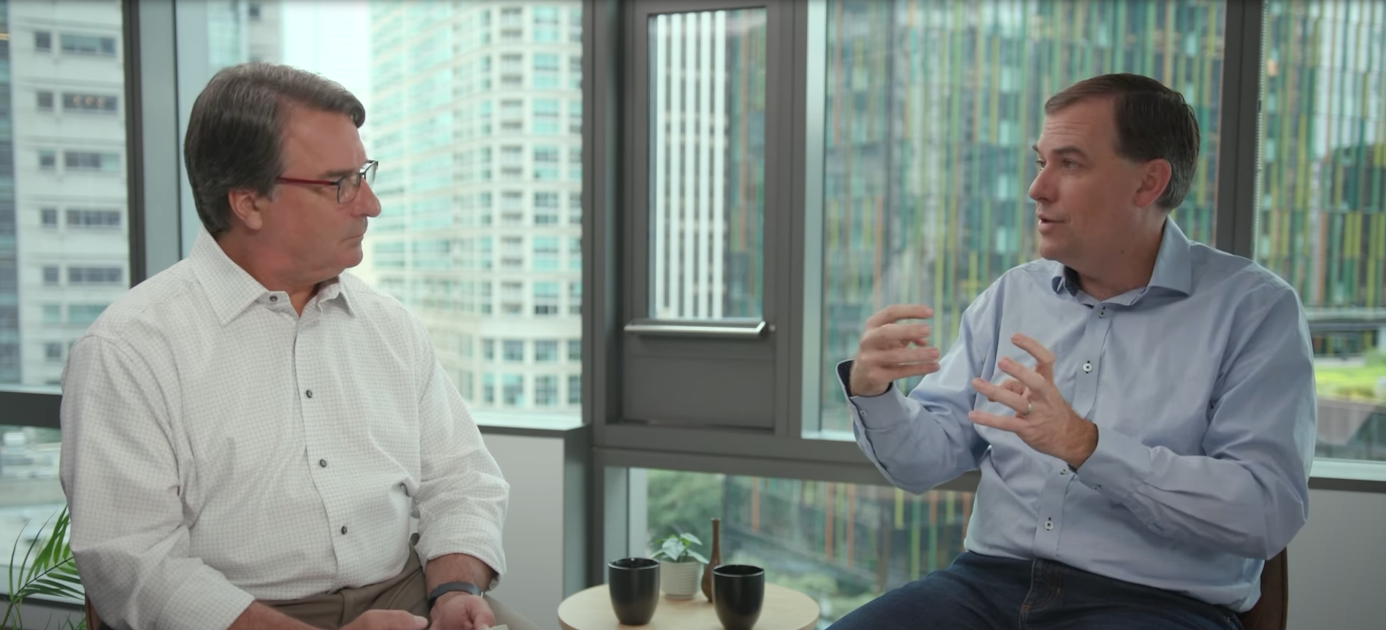
In this AWS Mid-Year Leadership Summit interview, Rajiv Chopra, VP of Amazon Just Walk Out, joins theCUBE’s John Furrier to unpack the evolution and impact of computer vision in retail. Chopra shares how AWS has transformed the breakthrough technology behind Amazon Go into a scalable, edge-powered solution for partners across stadiums, hospitals, universities and airports. With over 250 deployments outside of Amazon properties, Just Walk Out is redefining how consumers shop by enabling fast, frictionless experiences without checkout lines.
Chopra details key benefits for retailers, from revenue growth to shrink reduction, and illustrates use cases across venues like Lumen Field, UC San Diego and Hudson News. He breaks down the technological architecture behind the scenes, including deep learning models, custom edge compute devices and cloud integration, and explains how Just Walk Out balances accuracy, performance and customer experience. The conversation also highlights the broader trend of digital-physical convergence and visual reasoning as a frontier for applied AI.
Watch to learn how AWS is turning real-world environments into intelligent, automated spaces – and how Just Walk Out is leading the charge in reimagining retail through innovation.
Forgot Password
Almost there!
We just sent you a verification email. Please verify your account to gain access to
AWS Mid-Year Leadership Summit 2025. If you don’t think you received an email check your
spam folder.
In order to sign in, enter the email address you used to registered for the event. Once completed, you will receive an email with a verification link. Open this link to automatically sign into the site.
Register For AWS Mid-Year Leadership Summit 2025
Please fill out the information below. You will recieve an email with a verification link confirming your registration. Click the link to automatically sign into the site.
You’re almost there!
We just sent you a verification email. Please click the verification button in the email. Once your email address is verified, you will have full access to all event content for AWS Mid-Year Leadership Summit 2025.
I want my badge and interests to be visible to all attendees.
Checking this box will display your presense on the attendees list, view your profile and allow other attendees to contact you via 1-1 chat. Read the Privacy Policy. At any time, you can choose to disable this preference.
Select your Interests!
add
Upload your photo
Uploading..
OR
Connect via Twitter
Connect via Linkedin
EDIT PASSWORD
Share
Forgot Password
Almost there!
We just sent you a verification email. Please verify your account to gain access to
AWS Mid-Year Leadership Summit 2025. If you don’t think you received an email check your
spam folder.
In order to sign in, enter the email address you used to registered for the event. Once completed, you will receive an email with a verification link. Open this link to automatically sign into the site.
Sign in to gain access to AWS Mid-Year Leadership Summit 2025
Please sign in with LinkedIn to continue to AWS Mid-Year Leadership Summit 2025. Signing in with LinkedIn ensures a professional environment.
Are you sure you want to remove access rights for this user?
Details
Manage Access
email address
Community Invitation
Preethi CN, AWS | AWS Summit NYC 2025
In this AWS Mid-Year Leadership Summit interview, Rajiv Chopra, VP of Amazon Just Walk Out, joins theCUBE’s John Furrier to unpack the evolution and impact of computer vision in retail. Chopra shares how AWS has transformed the breakthrough technology behind Amazon Go into a scalable, edge-powered solution for partners across stadiums, hospitals, universities and airports. With over 250 deployments outside of Amazon properties, Just Walk Out is redefining how consumers shop by enabling fast, frictionless experiences without checkout lines.
Chopra details key benefits for retailers, from revenue growth to shrink reduction, and illustrates use cases across venues like Lumen Field, UC San Diego and Hudson News. He breaks down the technological architecture behind the scenes, including deep learning models, custom edge compute devices and cloud integration, and explains how Just Walk Out balances accuracy, performance and customer experience. The conversation also highlights the broader trend of digital-physical convergence and visual reasoning as a frontier for applied AI.
Watch to learn how AWS is turning real-world environments into intelligent, automated spaces – and how Just Walk Out is leading the charge in reimagining retail through innovation.
In this exclusive interview from AWS Summit NYC 2025, theCUBE’s John Furrier sits down with Preethi CN, Tech Executive and Advisor of Agentic AI at AWS, to unpack the biggest launch of the event: AgentCore. Preethi shares how AWS is giving developers the building blocks to bring intelligent agents from prototype to production with ease, backed by AWS’ first principles of scale, security and reliability.
Preethi outlines the six new AgentCore services – Runtime, Memory, Identity, Tools, Observability and Gateway – and explains how each solves critical...Read more
exploreKeep Exploring
What are the highlights and key topics covered at the AWS Summit 2025?add
What details can you provide about the event, particularly regarding the Nova models and the focus on agentic AI?add
What are the six services offered in the AgentCore framework?add
What experiences are customers having with AgentCore and how are they utilizing its features?add
>> Welcome back, everyone. I'm John Furrier, host of theCUBE here at the Javits for AWS Summit 2025, and of course it's theCUBE's Media Week in New York City as we have our New York Stock Exchange news studio where we've been covering cloud and AI, of course. Today we are at the Javits featuring all the top news around AWS, and their ecosystem is here, all the practices. It's a free event. All the customers come in, but everybody's in town, and of course the top story is the Nova models, Agent Core which is the agentic AI system, and of course the marketplace has a dedicated new section to agentic AI, and of course, not just agents but tooling. All that's coming around, and again, comprehensive, real big lift. Preethi is here. She's the director of agentic AI and she's got the keys to the kingdom for this segment on the agents and the tooling. Preethi, thanks for coming on theCUBE. Congratulations.
Preethi CN
>> Thank you very much, John. Very excited to be here.>> You guys really had a great, it feels like re:Invent, a little mini re:Invent. Big numbers. This show always gets big people in New York as everyone's here, every industry, a lot of customers. Everyone comes in town to go visit those customers when they come here. But this year, this news is hard news, and it feels like the first half of the year was a full year.
Preethi CN
>> Yes.>> I mean, the velocity of action, news, I mean, Matt Garman's announcing another cap, $20 billion here, $10 billion there, more regions opening up, coming online, more ages. So much news. I mean, they have to pre-release Kiro.
Preethi CN
>> Yes, yes.>> Okay, because that's like the small news and that would've been like a headline story for any company.
Preethi CN
>> Yeah, yeah, yeah. Very excited about the launch today with AgentCore. As Swami announced in his keynote, my team has been working incredibly hard over the last few months and can't wait to get it to our hands of our customers.>> So explain what AgentCore is for the folks who didn't see the keynotes. If you haven't seen the keynote from Swami, definitely watch it. It's pretty historic. I think this is a marker in time we'll look at as a timeless moment of an industry. What is AgentCore? Give the quick tutorial.
Preethi CN
>> We want AWS to be the best place for customers to come build, deploy, and operate agents at scale. And AgentCore, today we are launching up to six services and each of these services are flexible, composable, and helps you bring an agent from prototype to production with just a few lines of code. The remarkable part of this is you can pick and choose which building blocks you want to integrate, and it comes with AWS first principles, which is the security reliability and operating at scale.>> I was actually going to ask you what are the first principles of this product. Go a little deeper. Talk about the team accomplishments. What are some of the highlights in this release that's notable? Obviously, identity was talked a lot about. I interviewed Byron yesterday about the math proofs. So you see a lot of intellectual property inside the AWS tool chest and the war chest and the jewels. What's in here? Give us the core jewels in this release. What's the key things?
Preethi CN
>> Yes. So with models becoming very powerful over the last few months and being able to reason, act, and accomplish complex business objectives, we started to see that developers can build prototypes very quickly, but it is a multi-month effort to actually take it to production. For example, there is a lot of heavy lifting that developers have to do. And take for example a travel assistant you want to build, and if you want the agent to book your top destinations with a specific recommendation in terms of your preferences to your hotels and flights and what your budget is, you can think about a developer who could build an agent with strands. With just some simple prompts, pick a model and you have an agent code. But now if you have to think about hooking up user preferences, you need AgentCore memory that can help you retain context. You need access to AgentCore tools that helps you run secure browser environment. Then how do you provide agent identity so that it can execute actions on your behalf? How do you connect to enterprise tools so that you can bring any of your data onto your agents? So it is a complex set of work that developers need to do, so basically enabling developers to solve these problems, so we have come up with these six different services and capabilities and each of them are phenomenal because it's addressing a very core challenge.>> Lay out the six services.

Preethi CN
>> Starting with AgentCore Runtime. So once you build an agent code, you can deploy it in Runtime and it offers VM level isolation per session. So it prevents user sessions from being cross-wired with other user sessions, so you get security with the highest grade. And we offer the longest running sessions as well with Agent Runtime. The second one is Agent Memory, where we enable developers to hook short-term and long-term memory where we can automatically extract user preferences, semantic memory, summarization, and store it in our vector store, and those are available to developers at Runtime for agents to make decisions. The third one is Agent Identity, which can take actions on your behalf and can also be pre-authorized for long-running actions. The next one is the tools. We offer a secure browser tool. Again, using the same principles of isolation that we have in EC2 and Lambda is now available for browser tools, which can now navigate websites, can fill up forms on your behalf. We have Code Execution tool as well, because the agents can generate code, and you want that untrusted code to be run so that it doesn't do anything adversarial actions. So we offer that too. Then we have the Agent Observability that once you build this agent, you can monitor and make sure that the agent failures are understood. And the last one, but not the least, is the Agent Gateway, which allows you to bring access from your enterprise data and others, accessible to your tools and agents in an MCP compatible way. So without making any changes to your microservices, you have them ready to be interacted with in the agentic world.>> Awesome. Well, thank you for taking the time to lay them out. Well done. Thank you. That was a great highlight. Our AI will love that in the highlight reel for sure. Great stuff. I got to ask you about security, because obviously you mentioned code execution. A lot of the stuff that people were afraid of was two things. Vibe coding is great, but moving into production's difficult, and there's some tooling for that. So also when it's out in the wild, what is the range? What's the evaluation of it? And then three, I'm worried about security.
Preethi CN
>> Yeah.>> How are you guys addressing the security? What was the big piece there?
Preethi CN
>> Yeah. For AWS, security is our job zero, and that's what we have invented over the past two decades across various services. So the Agent Runtime is giving the VM level isolation that gives you the top rate security, so your agent code is completely secure. So whether your agent is doing any sort of critical mission, critical work, you can be rest assured that it doesn't interfere with other data that it shouldn't have access to.>> You guys brought security to the team on the isolation.
Preethi CN
>> Yes. We have basically taken the first principles of our other products and brought into the agentic AI. It's using the same level of isolation that is available with EC2 and Lambda. And similarly, the Runtime, the code execution tools are using the similar underlying technology. So it really gives you the sandbox environment where you don't have to worry about, "I'm using this payment instrument for the specific transaction. How do I make sure that it is not misutilized in any way?">> I mean, those are the details that are hard to nail down on just someone throwing a product out there. You've got to have the details. A couple observations I'd love to get your reaction to. Vibe coding and now Kiro and now with agentic AI and what you guys are building with AgentCore, coding is becoming easy-
Preethi CN
>> Yes.... >> if you know coding.
Preethi CN
>> Yes.>> So what's happening is a lot of people are coming out of retirement. I haven't coded in 25 years, but I had a lot of coding discipline jammed into my head, pounded in, and now I feel like I'm a kid again. I'm seeing a lot of other folks coming in because they understand how to build, but might not have the semantic knowledge of the latest tooling. And so what you're seeing is a surge of problem-solving from what I call people coming out of the woodwork. And then on the customer side, you're seeing customers who are always requesting stuff and it gets to the product teams and it's always, "Oh yeah, we'll put it on the product roadmap," classic line, right, like, "We'll get to it later," where people are vibe-coding the prototypes.
Preethi CN
>> Yes.>> And saying, "Here, this is what I want."
Preethi CN
>> Yes.>> So you're starting to see a new interaction into product development.
Preethi CN
>> Yes.>> I think this is going to change one, entrepreneurship and two, companies' product-led growth successes.
Preethi CN
>> Yes.>> So I think there's a business model transformation. What's your reaction to that? Do you agree?
Preethi CN
>> Yes. I mean, I think vibe coding, as you rightly called out, it helps developers or even people who have no experience to coding to create an application. And with Hero agentic AI DE, it's bringing a lot of structure to that code path because you can give detailed requirements as a specification. You can provide architecture documents or diagrams, and you have an agentic code that is now very structured, right? And one->> And it does it for you.
Preethi CN
>> It does it for you. And the best thing is you can construct quality and you can maintain quality with the agentic hooks because you can provide the hook that I want to make sure that have 90% unit test coverage for my code or a hundred percent .>> It's like having a personal product manager on your team.
Preethi CN
>> Yes. Create documentation and optimize the code. And now once, let's say you built your agent code with Hero ID, you have agent code for deployment because now you can build that, take that code and deploy it into production using all the offerings that we have today, and you are ready to go and scale to millions of customers without having to worry about managing any of these services because they are completely managed offerings.>> I got to ask you on a personal note, I mean, is it me or is it everyone is excited? Because what you just said, what we were talking about, this is a game changer because the blocker was either personal time, I don't know how to code, but also the document, I got to do a PR doc, a design doc. I mean, you guys live in a document world at AWS. I know that from covering Amazon. I'm sure working backwards are being done by agents now. Is there like an algorithm internally?
Preethi CN
>> Yes, yes.>> This is really exciting. What's it like inside AWS?
Preethi CN
>> We are very excited about it. In fact, all of these products are internally used within Amazon and by AWS and it brings them so much efficiency and productivity in everything that we do and it's really transforming the way we operate. And I feel this agent, as we go through the journey of agentic AI, we envision a world there is billions of agents that are going to be interacting alongside humans, so it's going to be changing the way we live and operate and I feel very excited to be part of this transformation era so that we can see this change and contribute by doing building this product.>> As someone who's built products, engineering, as these agents get built, how do you see that unfolding for customers? What are their pain points now and what pain points turn into opportunities as the system that progresses if you ladder it out a little bit?
Preethi CN
>> Yeah, I think our customers, the whole vision of AgentCore came from really listening to our customers and understanding what were the real pain points, and that's why offering this flexibility and choice and was important for us. We have several customers who are trying out AgentCore. For example, Itau, which is a financial banking, they are reinventing their agentic experiences and creating personalized experiences for their customers and deploying their agents on AgentCore Runtime. We have a healthcare company who is building health assistants, they have tons of their enterprise data and workflows and they wanted to make it available to agents in no time. And they were able to use our AgentCore gateway and hook up all their enterprise data and workflows in no time and make it ready for their health agents. So it's a lot of excitement and we are seeing how customers are innovating and accelerating with these capabilities and considering and picking and choosing what is important for them and building on top of it, and that's what is exciting at this point.>> So I mentioned that the summit here is a mini re:Invent. That's my perspective. A lot's happened. We still got a second half to go. So if this is like the halftime show for re:Invent, you must have some tricks up your sleeve. I know you saved the goodies for re:Invent. What's coming out at re:Invent? Can you share the big product news there?
Preethi CN
>> I think first of all, we are very excited to get what we have to our customers. So we are very eager to see how they're going to adopt and how they're going to and what we can learn from them, and for us, continuously iterating from that feedback and then solving their pain points will remain our journey over the next few months.>> Very good. So you stayed on track. I tried to shake it out of you. Okay. I'll tell you what I think's going to happen at re:Invent. I think that you're going to see more super-intelligence-like direction where the agents are going to start to get smarter, because what we're seeing in the developer community right now is tooling is one of those surprises that's coming out of agentic code. So tooling has always been either general purpose, not custom, hard to build. Strands is a great example of how that came out. I think we'll see more strands-like situations where agents will create and code development will be done to token usage. And as reasoning gets smarter, if you make the price of tokens highly abstract entities, I think you're going to have new stuff happen that might make the marketplace the new console, or hey, build me an app.
Preethi CN
>> Yeah, yeah. In fact, that is what with Kito ID, you could actually say that, "Hey, build me this agent that can actually do these things," and leveraging the strands SDK, which is completely built on the model-driven approach, which is very unique because now you are giving the power to the model to define how you want to construct your agentic code.>> And if it's attainable, and can it be evaluated? So new kinds of coolness coming in. One thing I will tell you is I will not be replaced by an agent by re:Invent. I will be there and looking forward to the announcements. And congratulations on a great release and congratulations to you and your team. It's great to see this kind of progress. Getting into production has been the core issue the past 12 months of companies. We've been talking to enterprises. They're in POC sprawl, great enthusiasm, but the confidence to get it in has created very narrow road to production. So hopefully that backlog and these new ideas will come in. Thanks to you guys, so I appreciate it.
Preethi CN
>> Yeah, yeah, yeah, very excited about this launch and looking forward to the upcoming one.>> Well, we'll be keeping track. Thanks for coming on.
Preethi CN
>> Yeah, thanks for having me here, John. Nice talking to you.>> Okay, this is theCUBE coverage. Again, we're here wrapping up day one of the first day, the only day here at AWS Summit in New York. This is our media week for AI and cloud at the NYSE Studio. But today, Wednesday, we are here for the Javits for the Amazons mid-year big summit Celebration, kind of a mini re:Invent. Hope you enjoyed it. We did our best to bring all the data content to you. I'm John Furrier, host of theCUBE. Thanks for watching.