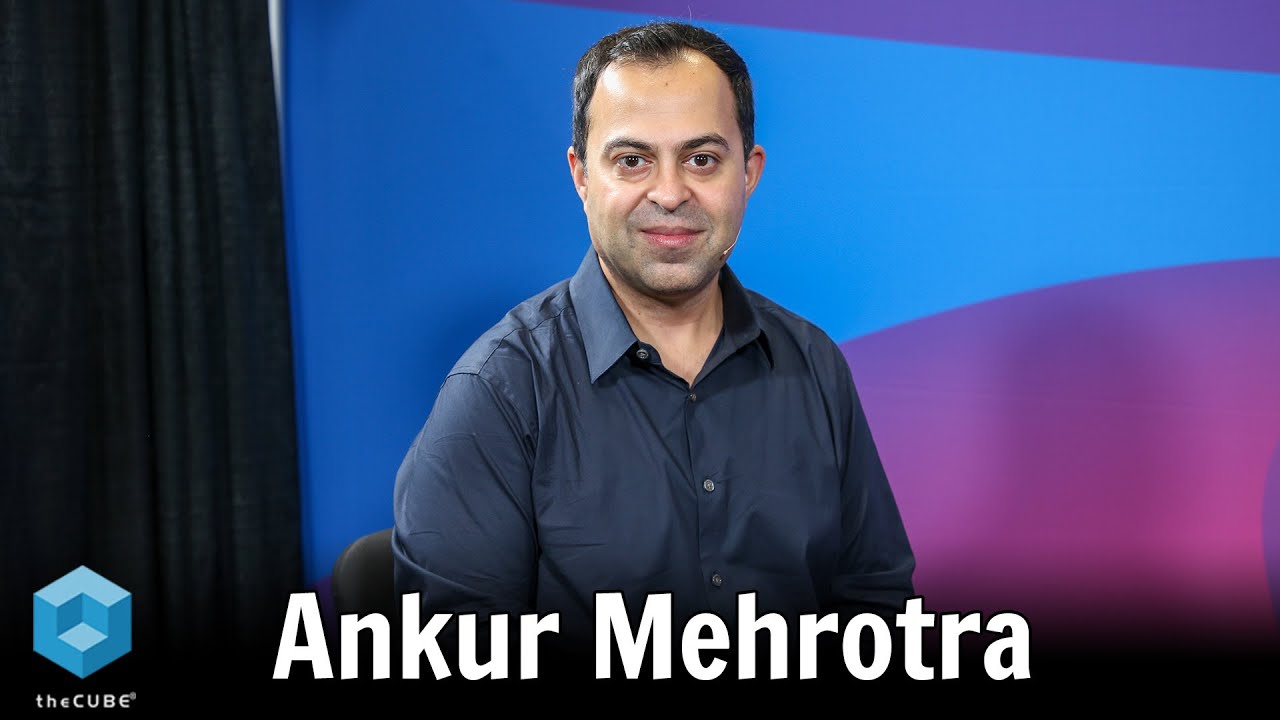
Ankur Mehrotra, director and general manager of Amazon SageMaker at Amazon Web Services (AWS), joins industry leaders at the 2025 AWS Summit in New York City, held at the Javits Center. This annual gathering brings together AWS customers, partners and practitioners to explore the latest advancements in cloud technology, with a particular focus on AI developments.
In this insightful session hosted by John Furrier of SiliconANGLE Media Inc. on theCUBE, Mehrotra shares their extensive expertise and discusses fundamental trends shaping AI and cloud computing. The conversation highlights Amazon SageMaker’s pivotal role in advancing AI, emphasizing model customization, the democratization of generative AI access, and AWS's innovative approach to customer-centric development.
Key takeaways from the conversation include Mehrotra's discussion on upcoming model customization capabilities within Amazon SageMaker AI. Mehrotra explains how these enhancements empower organizations to efficiently tailor AI models for specific business needs. The dialogue also addresses the critical role of tools and infrastructure such as SageMaker and DeepSeek-R1 in enhancing the functionality and scalability of AI applications.
Forgot Password
Almost there!
We just sent you a verification email. Please verify your account to gain access to
AWS Mid-Year Leadership Summit 2025. If you don’t think you received an email check your
spam folder.
In order to sign in, enter the email address you used to registered for the event. Once completed, you will receive an email with a verification link. Open this link to automatically sign into the site.
Register For AWS Mid-Year Leadership Summit 2025
Please fill out the information below. You will recieve an email with a verification link confirming your registration. Click the link to automatically sign into the site.
You’re almost there!
We just sent you a verification email. Please click the verification button in the email. Once your email address is verified, you will have full access to all event content for AWS Mid-Year Leadership Summit 2025.
I want my badge and interests to be visible to all attendees.
Checking this box will display your presense on the attendees list, view your profile and allow other attendees to contact you via 1-1 chat. Read the Privacy Policy. At any time, you can choose to disable this preference.
Select your Interests!
add
Upload your photo
Uploading..
OR
Connect via Twitter
Connect via Linkedin
EDIT PASSWORD
Share
Forgot Password
Almost there!
We just sent you a verification email. Please verify your account to gain access to
AWS Mid-Year Leadership Summit 2025. If you don’t think you received an email check your
spam folder.
In order to sign in, enter the email address you used to registered for the event. Once completed, you will receive an email with a verification link. Open this link to automatically sign into the site.
Sign in to gain access to AWS Mid-Year Leadership Summit 2025
Please sign in with LinkedIn to continue to AWS Mid-Year Leadership Summit 2025. Signing in with LinkedIn ensures a professional environment.
Are you sure you want to remove access rights for this user?
Details
Manage Access
email address
Community Invitation
Lisbeth Kaufman, AWS | AWS Summit NYC 2025
Ankur Mehrotra, director and general manager of Amazon SageMaker at Amazon Web Services (AWS), joins industry leaders at the 2025 AWS Summit in New York City, held at the Javits Center. This annual gathering brings together AWS customers, partners and practitioners to explore the latest advancements in cloud technology, with a particular focus on AI developments.
In this insightful session hosted by John Furrier of SiliconANGLE Media Inc. on theCUBE, Mehrotra shares their extensive expertise and discusses fundamental trends shaping AI and cloud computing. The conversation highlights Amazon SageMaker’s pivotal role in advancing AI, emphasizing model customization, the democratization of generative AI access, and AWS's innovative approach to customer-centric development.
Key takeaways from the conversation include Mehrotra's discussion on upcoming model customization capabilities within Amazon SageMaker AI. Mehrotra explains how these enhancements empower organizations to efficiently tailor AI models for specific business needs. The dialogue also addresses the critical role of tools and infrastructure such as SageMaker and DeepSeek-R1 in enhancing the functionality and scalability of AI applications.
In this exclusive conversation from AWS Summit NYC, Lisbeth Kaufman, Head of Climate Tech Startups and Ecosystem at AWS, joins theCUBE’s John Furrier to spotlight how AWS is accelerating climate innovation with cloud and AI. Kaufman discusses the AWS Compute for Climate Fellowship, a grant and technical support program helping mission-driven startups scale breakthroughs in energy, agriculture, transportation and beyond.
She shares inspiring examples from the 2024 cohort, including Realta Fusion’s use of cloud-based HPC to simulate plasma for fusion ene...Read more
exploreKeep Exploring
What is happening at the AWS Summit in New York, and who is speaking about AWS Climate Tech Startups?add
What is the role and focus of the group mentioned in relation to addressing the climate crisis?add
What are some ecosystem missions being funded or supported, and what notable companies are involved in those initiatives?add
What is the current evolution of the climate tech ecosystem?add
>> Hello, welcome back to theCube. We are here on the floor at AWS Summit in New York, this is where all the action is this week. Everyone's in town for what's going on in cloud, AI, and of course, how's this changing society? And of course, we're having our media week at the NYSE studio all week, so check out the content. Lisbeth Kaufman's here, Head of AWS Climate Tech Startups and the Ecosystem. Obviously, we've been covering a lot of the sustainability around how these regions are deployed and the billions of dollars of CapEx that AWS is putting out there to power AI, but of course, an ecosystem is building around that around the world, so we're going to hear about the exciting startups, the white spaces, the opportunities, and the needs that are out there. Lisbeth, thanks for coming on theCube, appreciate you taking the time.
Lisbeth Kaufman
>> Yeah, thank you so much for having me. I'm excited to share about the amazing startups that we're working with.>> Climate change, climate tech is hot. I mean, we now live in an era where super computing is now at our fingertips. So a lot of the scientists who have been working on climate, it's like a pinch-me moment of like, wow, we actually can compute a lot of stuff. So we're seeing a lot of growth around big moonshot projects, indexing the biosphere. I saw many of the startups working on understanding, gridding out how to map pollution. I mean, all kinds of cool ideas that were never possible. Talk about what the focus is of your group and some of the ecosystem companies. So first, lay out your charter. What's your role, what's your focus?
Lisbeth Kaufman
>> Yeah, so you're absolutely right, that the existing computing power and AI are incredible tools to address the climate crisis and for the startups building those solutions. So, I'm Head of Climate Tech Startups at AWS, and our goal is to make AWS as helpful as possible to climate tech startups so that they can build with our technology and grow and succeed at addressing the climate crisis. This is the biggest challenge humankind has ever faced, and these startups are building the solutions, and we want to support them and help them do it.>> Yeah, one of the things I've seen, I've never seen this in my career before, but now we're seeing it, the confluence of technology, money, and impact are all kind of coming together. So, I'm seeing a lot of startups that have mission and profit built in. There's real actually, appetite for entrepreneurs who see opportunity to go after them and there's profit objectives. Talk about some of the ecosystem missions that you're one, funding or supporting, what they're working on. What are the hottest companies and what's their mission?
Lisbeth Kaufman
>> Yeah, absolutely. So yeah, this is a huge problem and with great problems come great opportunities, and these startups are solving real problems and creating value for their customer. So, we actually created a fellowship to support these startups. So we've got the Compute for Climate Fellowship, which is an R&D funding program to provide grants and technical support to some of the best climate tech startups in the world. So I can share one that's really exciting, is a company called Realta Fusion, so they're creating fusion energy, which is zero carbon, abundant, low cost energy. And of course, energy, there's growing need for it as well as it emits a lot of greenhouse gases. So, they've joined our fellowship and we are helping them use AI and high performance computing to do their plasma simulation modeling. And this is really intensive modeling, and it had never been done in the cloud before because it was so intensive. And so in the fellowship, we helped them basically build a supercomputer in the cloud with our high performance computing, and then Realta Fusion was able to do their modeling and their simulations in the cloud, which helped them speed it up dramatically. So, instead of waiting a year for access to a physical supercomputer at a government lab, they were able to set it up in a week. And that can accelerate their R&D, which can help them to get to commercial grade fusion, which can then help the world get that low cost, clean energy that we all need so badly.>> It's so exciting because you think about, most people don't know that the current data center build out that's not even built yet, but if it was built, the ones that's projected to be built would basically constitute about 40 million homes of electricity. That's just the demand, roughly some of the estimates we see. But then also, AI and crypto too are bounded by energy. So the future of AI is really kind of on the shoulders of energy sources. So, this is the key opportunity. Of course, as Amazon wins there too because you guys have data and you have goals too, to be carbon-neutral, I think, what? By 20-
Lisbeth Kaufman
>> 2040.>> 2040.
Lisbeth Kaufman
>> Yeah, the climate .>> I think you guys are on track for that.
Lisbeth Kaufman
>> Yeah.>> So, congratulations. What other action do you see? I mean, obviously energy's one. Are there other things? Because it's a big data problem, compute problem. I mean, waiting a year for a super computing or procuring APC servers. Why are you up together?
Lisbeth Kaufman
>> .>> That's a slow road.
Lisbeth Kaufman
>> Yeah, exactly. And with the climate crisis, we need to move as quickly as possible to address this problem. And cloud computing, AI, they're very good tools to accelerate things to move more quickly. So, it's really exciting to see how these startups are leveraging AI to move more quickly. So, let's see, another big area is in agriculture. So, agriculture both emits carbon dioxide or greenhouse gases, as well as pollution. So we have a really cool company called Aigen, and they're addressing the issue of pesticides in agriculture, and they're using AI. They've invented a robot that's autonomous, powered by AI, and also solar-powered, so totally clean, and it roams the fields for farmers killing weeds. So farmers don't have to use pesticides, which then pollute the water, they can use these robots, and it's more affordable. So->> Robotics example right there. AI and robotics. Yes.
Lisbeth Kaufman
>> Yeah, exactly. So AI, robotics in an agriculture. So that means that farmers can make cleaner food and we can have abundant food and food security. So, that's one example of an area where AI can have a real impact.>> Any other examples? Cool, share the top ones. I see you got them on here on your-
Lisbeth Kaufman
>> Yeah, yeah, sure. Let's see. So also in agriculture, we have a company out of London called Phytoform, and they're addressing food security, as well as making crops more climate resilient, need less water and land. So they're using AI to actually invent new genetics for crops, and then they can grow those crops. And for example, they've created a new tomato that needs less water and less land, but produces 400 times the amount of fruit on a plant. So, that is much more climate resilient and good for providing food for the world that we all need to eat.>> So, what's it like in your job right now? Because I mean, right now you're seeing a lot of pressure on AI. So we know the energy problems, really clear, everyone sees that. There are a lot of startups and entrepreneurs who have this mission-focused, I don't want to say mission over money, but pretty much is, but money making is happening. How would I get involved? Because there's a lot of the younger generation specifically, they're like, who created this problem? We can solve this. And then they have the tools to do that with AI and everything else. So, what's the playbook? Let's just say I wanted to solve a problem with the climate, I have an idea, my dorm mate or college PhD programs say, "Hey, we solved an algorithm or let's do something." Do you guys onboard people, do I apply for this fellowship? What's the playbook? How do I get involved? How do you vet the companies?
Lisbeth Kaufman
>> So the playbook for us to vet these companies?>> Yeah.
Lisbeth Kaufman
>> Yeah, so with our Compute for Climate Fellowship, we look for two major things. So, one is their impact on the climate crisis and the environment. And then the other is their innovation, how they're leveraging our cloud computing and innovating and building new technology, so->> And you guys give them compute, which means you set up the clusters for them.
Lisbeth Kaufman
>> Yeah.>> Credits or cash or both?
Lisbeth Kaufman
>> Yep, yep, exactly. So it's a grant program, and these companies apply to our fellowship with a specific idea of something really bold that they want to build, and then we provide a grant in the form of our cloud credits to pay for it. And then we also bring in some of the best minds from AWS to help them build it. Yeah.>> What's it like internally, people like volunteering for that project, because I'm sure there's a lot of climate change advocates inside AWS.
Lisbeth Kaufman
>> Yeah, yeah. People are super excited to work on this fellowship, and actually, we've expanded it dramatically. So it's three years old, our first year we had four companies. Last year we had eight. This year we just announced that we've accepted 23 climate tech startups into the Compute for Climate Fellowship, and that's in part because so many people across the AWS want to work with these startups. So actually, I was thinking, another example of a cool company is a company called SmartX, and they're out of Portugal, and they're addressing the issue of waste in fashion. So, they are helping fabric manufacturers identify flaws in their fabric, and they're using our AI to do that, so that if they weren't there, these manufacturers just produce all this fabric and they waste all of that fabric that has a flaw in it, they would throw it out. So this company allows them to identify the flaw when it happens so they don't waste the fabric. And they've saved, I think hundreds of, a million kilometers of fabric already, and they're just getting started.>> That's a really good example. I have to ask you, last year we did the first ever CUBE at our NYSE studio, we launched it, climate week was in New York City.
Lisbeth Kaufman
>> Oh, great, awesome.>> So it's coming up again in September, and that's a UN kind of thing going on, that's when everyone's in town. Are you guys having any plans around that event?
Lisbeth Kaufman
>> Yep.>> I know that's a big week in town for climate tech.
Lisbeth Kaufman
>> Yeah, yeah, it's huge. I think 100,000 people come to New York for this New York Climate Week. So what we are doing is we are organizing a kind of a half-day conference focused on climate tech and AI, and we're going to showcase these real tangible examples of climate tech startups that are building with AI to address the climate crisis, because we want to inspire the climate community to leverage these tools. They're here to speed things up, they're here to do things that weren't possible previously.>> So, it provides the credits in the application. Why is Amazon Cloud good for climate tech startups? What specifically resonates with the startups?
Lisbeth Kaufman
>> Yeah. Well, we have the depth and breadth of services. So what these startups need to build their technology, we've got it. And then we have the most cutting edge services, like a big area that's really becoming useful for climate tech startups is Generative AI. We have Bedrock, which has the most models available. So there's all of these resources. And then we have my team that's specifically focused on climate tech startups, and we have these programs like the Compute for Climate Fellowship to help the startups.>> It's a great community. I got to say, last year I was very psyched when we did the Climate Change Climate Week event, because I had no idea how much tech entrepreneurship is going on in this area. And it's not like two kids in the garage, it's like serious PhD, technical people. Because I learned kind of what you pointed out, is that the alternative to getting access to compute was old school methods of, stand in line for a supercomputer or provision your own HPC servers, load everything up, tons of cash just to get started. The old Amazon playbook, which is, why provision the data center when you can go to the cloud, was perfectly aligned with the problem. Now that democratization has happened with super computing, I mean, basically that's what's happening.
Lisbeth Kaufman
>> You're so right, I love how you put that. Yeah, a lot of climate tech startups, these founders are the best of the best coming from academia as scientists and engineers. And in academia, sometimes they're more comfortable with the on-prem. But we have these, like you said, they don't have to wire up their own HPC systems, we have all of that ready to go that can really speed things up. And so companies like Realta Fusion, and we have actually two more fusion companies, Thea Energy and Xcimer Energy, they can now do all of that in the cloud and speed things up rapidly, yeah, and do->> All right-
Lisbeth Kaufman
>> ... things they couldn't.>> Lisbeth, talk about the group, what your goals are. I mean, obviously ecosystem is forming, so we're seeing it on our side. You have first party data on this. Tell us about the ecosystem in general. Growing fast? Is it still specialty? How is the ecosystem around climate tech evolving?
Lisbeth Kaufman
>> Yeah, so climate tech over the past five or 10 years has grown really rapidly, and this is just an enormous problem, and it's also such a meaningful problem so the best minds are moving into this space. And we see solutions and we help startups across the whole spectrum, energy, agriculture, transportation. Actually, in our new cohort, we have a company called AURA AERO, and they have invented electric airplanes, and they've actually had the first electric airplane licensed in France to fly.>> Cool.
Lisbeth Kaufman
>> So imagine that, and they're using our AI and computing to design their airplanes.>> Wow.
Lisbeth Kaufman
>> So we're super excited to have them.>> Is there a geographical spread or is it pretty much global at this point? Is it US based, north America, Europe?
Lisbeth Kaufman
>> The community?>> Yeah, the community and the startups you are funding, what's the geography dispersion?
Lisbeth Kaufman
>> Yeah. Well, so our program is a global program. So we have companies, I think across, we have companies across, I want to say 16 countries.>> So it's not just the US, it's everywhere.
Lisbeth Kaufman
>> Yeah, yeah. So we've got US, Europe, Africa. We've got two companies in Australia. We have one company, this year we have a new focus on indigenous solutions because indigenous communities have so much knowledge that they honed over thousands of years that can help address the climate crisis, so we did a special call. And we have a company in Australia that's using indigenous wisdom as well as AI to do electromagnetic seed treatments, to make seeds for crops more climate resilient and also need less resources. So, .>> You got to love the agent, you can create your bigger team by having more agents. What's your goals for the year? If you had to go look at the re-events coming up, what are some of your key metrics?
Lisbeth Kaufman
>> We're just laser focused on our startups, so we want to support these startups. We want to find the best startups, help them as much as we possibly can, help them grow, solve problems, get them resources. So, it's all about the startups and helping them achieve their goals.>> Lisbeth, thanks for coming on theCUBE. Great mission. Love it, and we'll see you at Climate Week in September.
Lisbeth Kaufman
>> Yeah, excellent. Thank you so much.>> All right. Thanks for coming on. I'm John we're here on the ground, we're at the AWS Summit. It's got a mini re-invent happening this year, there's so much activity. Every sector, tons of news. It feels like the whole year has happened but it's only halfway to re-invent, more coverage here at theCUBE after this short break.