In this insightful episode from the AWS Summit NYC 2025, we explore the intersection of cloud technology and artificial intelligence with Tom Godden, enterprise strategist and Chief Experience Officer advisor at Amazon Web Services (AWS). The discussion, hosted by an individual from SiliconANGLE Media, navigates pivotal advancements in generative artificial intelligence and its implications for businesses. Godden shares their expertise drawn from years leading and advising on enterprise strategy.
Godden provides valuable insights from AWS's recent innovations, highlighting AI's transformative potential in enterprise settings. As a key strategist at Amazon Web Services, they explain how their team, comprised of former Chief Information Officers and Chief Technology Officers, disseminates best practices and learns from global enterprise leaders to drive AI adoption and effective enterprise strategy. With research and video analysts emphasizing the rapid advancements within Amazon Web Services, the discussion underscores the burgeoning role of generative AI and its innovative landscape.
Key takeaways feature the strategic investments AWS is making in AI, including a $100 million commitment to the Generative AI Innovation Center, aiming to enhance customer proficiency with AI tools. According to Godden, Amazon Web Services' vision to blend centralized and decentralized artificial intelligence approaches empowers organizations, fostering a new era of citizen developers and encouraging collaborative innovation in enterprises. This episode reveals the cultural and technological shifts enterprises must embrace to harness artificial intelligence's transformative capabilities effectively.
Forgot Password
Almost there!
We just sent you a verification email. Please verify your account to gain access to
AWS Mid-Year Leadership Summit 2025. If you don’t think you received an email check your
spam folder.
In order to sign in, enter the email address you used to registered for the event. Once completed, you will receive an email with a verification link. Open this link to automatically sign into the site.
Register For AWS Mid-Year Leadership Summit 2025
Please fill out the information below. You will recieve an email with a verification link confirming your registration. Click the link to automatically sign into the site.
You’re almost there!
We just sent you a verification email. Please click the verification button in the email. Once your email address is verified, you will have full access to all event content for AWS Mid-Year Leadership Summit 2025.
I want my badge and interests to be visible to all attendees.
Checking this box will display your presense on the attendees list, view your profile and allow other attendees to contact you via 1-1 chat. Read the Privacy Policy. At any time, you can choose to disable this preference.
Select your Interests!
add
Upload your photo
Uploading..
OR
Connect via Twitter
Connect via Linkedin
EDIT PASSWORD
Share
Forgot Password
Almost there!
We just sent you a verification email. Please verify your account to gain access to
AWS Mid-Year Leadership Summit 2025. If you don’t think you received an email check your
spam folder.
In order to sign in, enter the email address you used to registered for the event. Once completed, you will receive an email with a verification link. Open this link to automatically sign into the site.
Sign in to gain access to AWS Mid-Year Leadership Summit 2025
Please sign in with LinkedIn to continue to AWS Mid-Year Leadership Summit 2025. Signing in with LinkedIn ensures a professional environment.
Are you sure you want to remove access rights for this user?
Details
Manage Access
email address
Community Invitation
Tom Soderstrom, AWS | AWS Summit NYC 2025
In this insightful episode from the AWS Summit NYC 2025, we explore the intersection of cloud technology and artificial intelligence with Tom Godden, enterprise strategist and Chief Experience Officer advisor at Amazon Web Services (AWS). The discussion, hosted by an individual from SiliconANGLE Media, navigates pivotal advancements in generative artificial intelligence and its implications for businesses. Godden shares their expertise drawn from years leading and advising on enterprise strategy.
Godden provides valuable insights from AWS's recent innovations, highlighting AI's transformative potential in enterprise settings. As a key strategist at Amazon Web Services, they explain how their team, comprised of former Chief Information Officers and Chief Technology Officers, disseminates best practices and learns from global enterprise leaders to drive AI adoption and effective enterprise strategy. With research and video analysts emphasizing the rapid advancements within Amazon Web Services, the discussion underscores the burgeoning role of generative AI and its innovative landscape.
Key takeaways feature the strategic investments AWS is making in AI, including a $100 million commitment to the Generative AI Innovation Center, aiming to enhance customer proficiency with AI tools. According to Godden, Amazon Web Services' vision to blend centralized and decentralized artificial intelligence approaches empowers organizations, fostering a new era of citizen developers and encouraging collaborative innovation in enterprises. This episode reveals the cultural and technological shifts enterprises must embrace to harness artificial intelligence's transformative capabilities effectively.
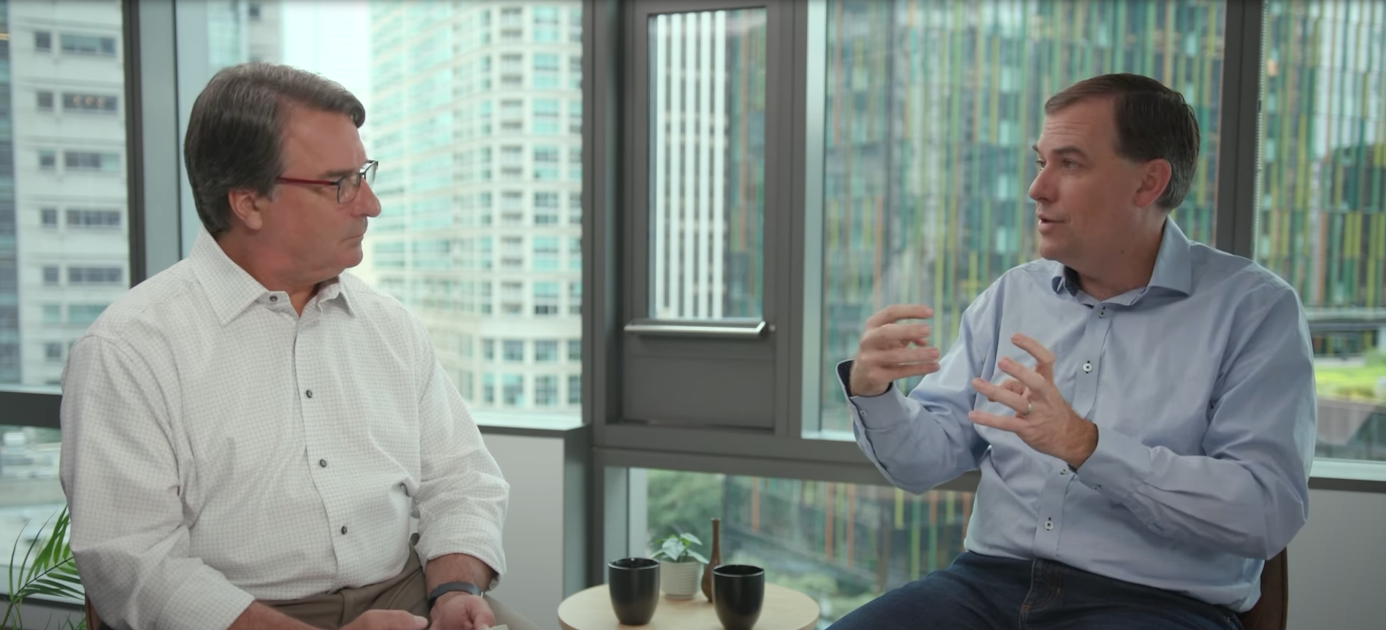
In this exclusive AWS Summit NYC interview, theCUBE’s Dave Vellante sits down with Tom Soderstrom, AWS enterprise strategist, to explore how organizations can drive innovation at scale with generative and agentic AI. Drawing on decades of transformation experience across public and private sectors, Soderstrom shares what it takes to build a “culture of experimentation” and why cloud adoption was just the beginning.
Soderstrom outlines the similarities between the early cloud movement and today’s AI wave, noting that while cloud was led by technologists...Read more
exploreKeep Exploring
What is your current role and what experiences led you to it?add
What is the role and perspective of the Chief Technologist Organization Worldwide at AWS in relation to digital transformation and public sector clients?add
What is the difference in company involvement between cloud technology and generative or agentic AI?add
What strategies were suggested for fostering a culture of experimentation in the Australian public sector using generative AI?add
What is the role and significance of generative AI, agentic AI, and traditional AI in a company's organizational structure, and how can new roles be created and filled in anticipation of future developments in AI?add
>> Hey, everybody. Welcome back to NYC Summit, AWS's annual event here at the Javits Center 2025. My name is Dave Vellante. John Furrier is also in the house and we're here with Tom Soderstrom, who's AWS enterprise strategist and CUBE alum. Good to see you, Tom. Thanks for coming back on theCUBE.
Tom Soderstrom
>> Thanks for having me back.
Dave Vellante
>> Yeah. So, your former AWS and public sector, which we've done a ton of stuff with public sector. You were at NASA in the Jet Propulsion Lab, you were the IT CTO there and innovation officer, and now you're working with... Describe your role. You're working with customers and helping them embrace innovation, right?
Tom Soderstrom
>> So, almost five years ago now, almost to the day, I wanted to do something new. So, I was chief technology innovation officer at NASA's Jet Propulsion Laboratory and we changed how we innovate and that's part and parcel, but experimenting, trying new things, which was very counter-culture at the time, but it led to big things. It led to the cloud being adopted by NASA and introduced to the federal government. But for us, it was not about cloud, it was about what you can do with cloud. Can you have, what Amazon calls, two-way doors, where you can go through the door and come right back so you take much smaller risk? And so, I came to AWS and created something called the Chief Technologist Organization Worldwide. So, I work with public sector customers worldwide. Turns out, it's very similar. Public sector is very similar to other public sector and very similar to large enterprises, so it's all very relevant. And then, two years ago I became an enterprise strategist, which really means that we're a small group of people that have done the transformation, the digital transformation and lived it. So, therefore, we can empathize with what the problems and challenges are. And you probably guessed it's mostly cultural. So, we can say, "Here are the blockers you'll see and here's the things that are coming that can help you." So, in essence, I give advice. So, great, I just give advice and I say, "Yep-"
Dave Vellante
>> It's interesting what you say about the two-way door because you don't want to go... On-prem was always a one-way door.
Tom Soderstrom
>> It was.
Dave Vellante
>> You put down the capital... Even though back then the cloud was because IT was so inefficient, and there's some debates whether or not it is and where it is and... That's secondary when you talk to customers, same. It was always the agility and the ability to experiment and not go through that one-way door that was the allure. Now, you've helped organizations, like NASA, like public sector, global enterprises embrace innovation. What do you see as the similarities and differences with what you've done in the past with gen AI today?
Tom Soderstrom
>> Great question. So, I work now with commercial and public sector all over the world. And if you are a company that was a rebel at your time and you were successful, so you grew large and old, you have a challenge of innovating. It seems to be universal.
Dave Vellante
>> It's the way it is.
Tom Soderstrom
>> Yeah. Plus, you have now silos and you have departments, et cetera. So, I think when we look at generative AI, and now agentic AI with agents, it's the same journey as when we did cloud, but the customer or the driver for cloud were the techies, like me, chief technology innovation officer. The driver for generative AI and agents is the business leaders. So, you approach it a little different, but the key is to experiment, try it. And so, what I see is I see those who dare to try and dare to experiment are much more successful. And the difference with the cloud and generative AI, and soon agentic AI, is that the whole company can be involved. With cloud, it was techies. And eventually, you showed that it paid out, it was enough volume to see that you save money. With generative AI and agentic AI, it's you want to see a business value very quickly, but you can get it from your finance department, from your marketing, from your manufacturing. Everybody can participate.
Dave Vellante
>> So, you, as a techie... So, I'm not a developer, I would consider myself a business person, but you could speak wallet and you can speak geek, if you will.
Tom Soderstrom
>> Yep. And I can empty that wallet.
Dave Vellante
>> . Amazon historically has spoken to the developers and I think a lot of its messaging is still very developer-centric. So, that's why it's interesting that you've created this role to address that assistance to that C suite.
Tom Soderstrom
>> Yeah, we have people who led the transformation from government agencies, there's two of us. And then, from commercial, from finance, gaming, medical, and we're global. So, we get a lot of requests, but you're absolutely right. Amazon usually talks to builders. So, we have to talk a little differently to executives and that's really our role. So, we create content, we give keynotes, but the favorite thing is really to talk to customers.
Dave Vellante
>> What are some of the non-obvious blockers to deploying gen AI? We know data and governance and compliance and things of that nature. We could talk about those as well, but what are some of the out of out-of-scope expectations that customers should be aware of, blind spots potentially?
Tom Soderstrom
>> I think you nailed it. It's the out-of-scope expectation. What we recommend is don't shoot for the moon right away, instead start with something small and fairly easy to do and involve your whole stakeholders to try to do it. Otherwise, what happens is you always have a lot of naysayers who said, "We've done it this way before. We've seen these new shiny toys. They come and go," but in this one it's different. So, when you start small and you show that business value, so you work backwards from the customer problem. And so, you think big and then you start small by saying, "I'm going to try this experiment and this two-way door and this two-way door," but focus on the business outcome. And then, now the naysayers start seeing that there's actually results here and it was cheap, and it was scrappy and it was frugal. So, all of a sudden, you find that one thing that really matters. Then, you've thought big, you started small, now you scale fast. So, you put it in the cloud and it will scale up or scale down automatically, the cloud is built that way. So, it all translates to lower risk.
Dave Vellante
>> As somebody who has been involved in moonshots and Mars-shots, are you saying that well should the enterprise have an AI moonshot and a North Star that they at least can communicate to the organization or is that a distraction?
Tom Soderstrom
>> So, I'll explain what I did for a couple of customers. The Australian public sector. So, I've come up with this idea of creating a culture of experimentation and then what are the future trends? This is what you experiment on. So, if you build a table, come idea. So, generative AI with the public sector in Australia had a needing to talk about it. Then, a brainstorming session to... They came up with the ideas and I helped score them from LA, but basically score them by easy to do or impactful to the business. Which one do you start with?
Dave Vellante
>> I would say easy to do.
Tom Soderstrom
>> Easy to do.
Dave Vellante
>> To get some muscle memory going.
Tom Soderstrom
>> Get some muscle memory. You learn, but you keep those impactful to the business and when you're ready, you switch over and implement that. And that works really, really well. And AWS has this AI Innovation Center that we will help customers create those, especially those big things.
Dave Vellante
>> Interesting.
Tom Soderstrom
>> Like you asked, the unexpected blockers are really about, "This is just a new shiny thing, why bother?" So, how do you win those over and you win them over with business results and small teams. I used to do three people, the IT person, the person with a business problem and cybersecurity, to make sure that you're safe, et cetera. It's cultural, but that worked really well.
Dave Vellante
>> It makes sense. I mean you get some, like you say, muscle memory and-
Tom Soderstrom
>> And AI is going to be the same journey.
Dave Vellante
>> And they might say, "Well, that was easy, but what's the business impact?" And then you turn it around to them and say, "How could you apply that to your business?" And the light bulbs go off.
Tom Soderstrom
>> You start with a business impact. If it's just an IT thing, don't bother. It's got to solve a business problem, small problem and start with something internal because then you don't risk your reputation. One of the other fun things you said, you're not a developer, but you will be. Meet Dave, the developer. Because most people when they have a problem at home, who do they turn to fix the IT problem? They're teenagers.
Dave Vellante
>> Sure, kids.
Tom Soderstrom
>> But with generative AI now and agentic AI, we all can become technology teenagers because you can experiment from home and it gives you immediate value. The other blocker is that generative AI sometimes is wrong, it hallucinates, so do people. So, you just have to be intelligent about how you approach it and realize that the human always have to look at it before submitting it.
Dave Vellante
>> Build trust the gen AI, you said follow the leadership principle.
Tom Soderstrom
>> I know. Earn trust.
Dave Vellante
>> So, the media will always go to, "AI is going to replace jobs." I mean sure machines have always replaced humans throughout the course of history. Of course, the first time that it's in a cognitive function, so that is a little bit scary. I get it. Marc Benioff wrote an article in the Wall Street Journal saying, "I will be the last generation of managers to manage only humans. We'll be managing agents and humans." So, what does that mean for... And we believe in augmentation, not replacement, but how do you see that changing the org chart? How do we manage agents differently than we manage humans?
Tom Soderstrom
>> Two of my biggest partners at NASA JPL, as we tried to do this transformation, was the leader of HR and the chief financial officer. And the same thing is going to be true here. So, from a leader of HR, how do you manage a mixture of people and agents? And it's absolutely going to happen. Today, AWS released AgentCore where it's going to be able to scale up to 1,000 agents right away. That's 1,000 employees doing something specialized, but they're able to reason like a human would, but they're not going to have necessarily the final say, humans need to do that. And when I talk to people that I have mentored throughout the years and I ask them, "How do you use generative and agentic AI?" It's very interesting. I expected them to say, "Oh, it codes some things for me." But no, it becomes their coding advisor. One of them takes two different models and he says same problem to both of them. Both of them come back very authoritatively and say, "Here's the answer," but they may disagree. So, now he's then able to dive into that, just like we would with humans. So I think Marc Benioff is right.
Dave Vellante
>> So, from the standpoint of the org chart though, based on what you said, it seems to me that the org chart's fundamental structure stays the same, but the individuals in the org chart now have a number of resources agents working for them that they are in charge of. So, I, as a top leader in the company, my job is to enable that and train them to be efficient
Tom Soderstrom
>> And not be afraid of it. The difference between generative AI and agentic AI and plain old AI... Plain old AI.
Dave Vellante
>> Aren't we in the future?
Tom Soderstrom
>> Is that agentic AI can and it can make decisions and change its mind and pivot, just like people can, but they're going to be specialized. You're going to have an agent that's really specialized on payroll, another one that's specialized on invoicing, et cetera. So, I think the org chart is going to be super interesting and I think if for the listeners here, the opportunity is to create the new role before it exists. So, I was fortunate enough to create the NASA CTO role and the data scientist role and I'm not talking to all the new chief AI officers. What does it look like? If you create this new role before it becomes vogue, promote your own people into those roles, it'll be like Wayne Gretzky. Why is he successful? Because he went to where the puck was, same thing here. They will rise to the expectations. And then, if it becomes important and takes off, you couldn't afford to hire him, but now you're already there. So, I think that's a really fun thing to do, create these new roles, mixture of agents and people.
Dave Vellante
>> One of the exciting things about agentic AI is the potential to really reimagine the organization-
Tom Soderstrom
>> And the partners.
Dave Vellante
>> Yeah, the whole ecosystem.
Tom Soderstrom
>> Yeah.
Dave Vellante
>> So, my question to you is how do you help organizations or how should organizations approach this in terms of avoiding paving the cow paths? Meaning, we're going to automate the existing process, even if it's not the best process.
Tom Soderstrom
>> Yeah. Do you remember in the olden days something called Robotic Process Automator?
Dave Vellante
>> Yeah.
Tom Soderstrom
>> That's what they did. That was the problem with that, that they paved the cow paths. We have an old process, we'll automate it. Well, if you automate the process that's no longer relevant, it just does the no longer relevant work faster. So, part of it, when I advise people, is rethink work, focus on why you are in business and focus on those and how can you work backwards to do something that can move that forward? And so, that there maybe processes that just go away. In fact, we know there are . And do those people lose their jobs? Not necessarily. I'm asked a lot by customers, "I don't have the people I need." And we, enterprise strategists, typically say, "Yes, you do. They don't have the skills they need, but for every new technology that's coming out, are you going to fire a bunch of people and hire a bunch of new people to learn the business? No, upskilling and training." And AWS is focused on that. We're going to train 2 million people here in 2025 in AI skills for free or mostly free. So, that's the opportunity for these companies to think backwards, think big, then start small and have your own people learn on the job. And learning on the job now with agentic AI is going to mean people and agents and what works best together? It's a fun new world.
Dave Vellante
>> Yeah. In the 1960s, I think it was IBM, I know it ran on an IBM mainframe, I think it was IBM introduced an experiment called ELIZA. And ELIZA was the conversational AI, essentially. And people at the time felt like, "Wow, this could be a companion, a digital companion." They probably didn't use that word and I don't think they used the word chatbot, they used something different. But how do you think about AI as a companion? I talk to AI all the time.
Tom Soderstrom
>> So, I think that AI, the naysayers, "This is just another new shiny thing." They're downplaying how important this is, how it affects everybody. And I was sitting on the plane next to an older man who was a musician, but his hands were not working anymore. So, he's talking to his iPad and he's talking to his assistant and her name was Betty. Betty was awesome. She knew about his medical condition. I looked at their transcription and where he should go, support groups. And also, he had moved to a place in the country, a new place that she advised him how to meet people. It was AI, it was generative AI. So, it's going to be with us... In 1900, the average lifespan was 47. In 2000, it's 77. 2100, I have no idea. But we're getting implants, we're getting the deaf can hear, the blind can see. We're going to live longer and AI is going to be the thing that manages all of that. So, it's not just a new shiny thing. I have grandkids now, they are raised by white noise generators, cameras in the crib. AI is our lifelong companion. So-
Dave Vellante
>> They say if we live to 2050, we may live forever. I'm not sure I want to live forever. But how do you think about humanity in a digital AI world? How will humanity be preserved?
Tom Soderstrom
>> That's a super interesting question. It's not my area of expertise. I'm not sure it's anybody's there-
Dave Vellante
>> No, that's why I threw it-
Tom Soderstrom
>> AI is a tool, it's a very capable tool. In fact, it's many different tools. So, it's about learning how to use that tool. It's not going to solve everything. It does not replace human judgements, because if you look at it at scale, AI may make the wrong assumption and go for the most expedient, efficient way. Whereas a human would not go that far. They would say, "No, we're going to do this way." So, I don't think that Arnold is going to come down and kill us all. I think AI will be a very useful tool and I'm asked a lot by college students especially, they're really worried about this. And in order to understand it, you have to try it, you have to use it.
Turning your back and saying, "We should not be investing in AI. We should not be researching," that's hopeless because somebody else will. And now you fall behind them and you're not going to lose your job to AI, you'll lose your job to the ones that learned AI. And so, I think agents, what I like about that especially is the way Amazon is now structured is you can use the AWS infrastructure, which is humongous or you can reach out using open source protocols with a model context protocol and now A2A, agent-to-agent interface, et cetera. So, partners can be much more productive and I think that's one that they haven't tackled yet. We tend to think of ourselves as trust my own data. But if you could have trusted agents, imagine what you could do, how you could partner differently. I think the biggest opportunity is to have guardrails, guardrails that protect you within the way you work, but that they're automated. In NASA, in the early days we had person approving, another person approving, another person approving, and they were inserted because we failed an audit. Those can all be automated and you speed it up and new job functions. So, I'm getting excited.
Dave Vellante
>> As an industry, I don't think we've ever been more excited. I've seen every wave and this feels like it's... I mean I'm 90-plus percent confident that this will be bigger than the previous waves that we've seen. I think it's bigger than cloud, bigger than internet, definitely bigger than-
Tom Soderstrom
>> And when you tie it into robotics, which goes to my background, it's pretty exciting. But also, the robots that can help disabled people at home. So, we tend to think of robot as something negative. We now have just released our millionth robot in Amazon.
Dave Vellante
>> I saw that. More robots than humans in-
Tom Soderstrom
>> A ton of new jobs. Tons.
Dave Vellante
>> Yeah, I bet.
Tom Soderstrom
>> So, it's not like those people who are fired, they were able to do more things.
Dave Vellante
>> Yeah, I wish I could continue with you, but we're out of time. Thank you so much, Tom, for coming on today.
Tom Soderstrom
>> Thank you very much, Dave. This was such a pleasure and you guys do such a great job.
Dave Vellante
>> Thank you. Appreciate it. We'll see you at re:Invent, if not before. All right. And thank you for watching. This is Dave Vellante for John Furrier and the entire CUBE team from AWS's Summit at NYC 2025. We'll be right back right after this short break.











 Dave Vellante