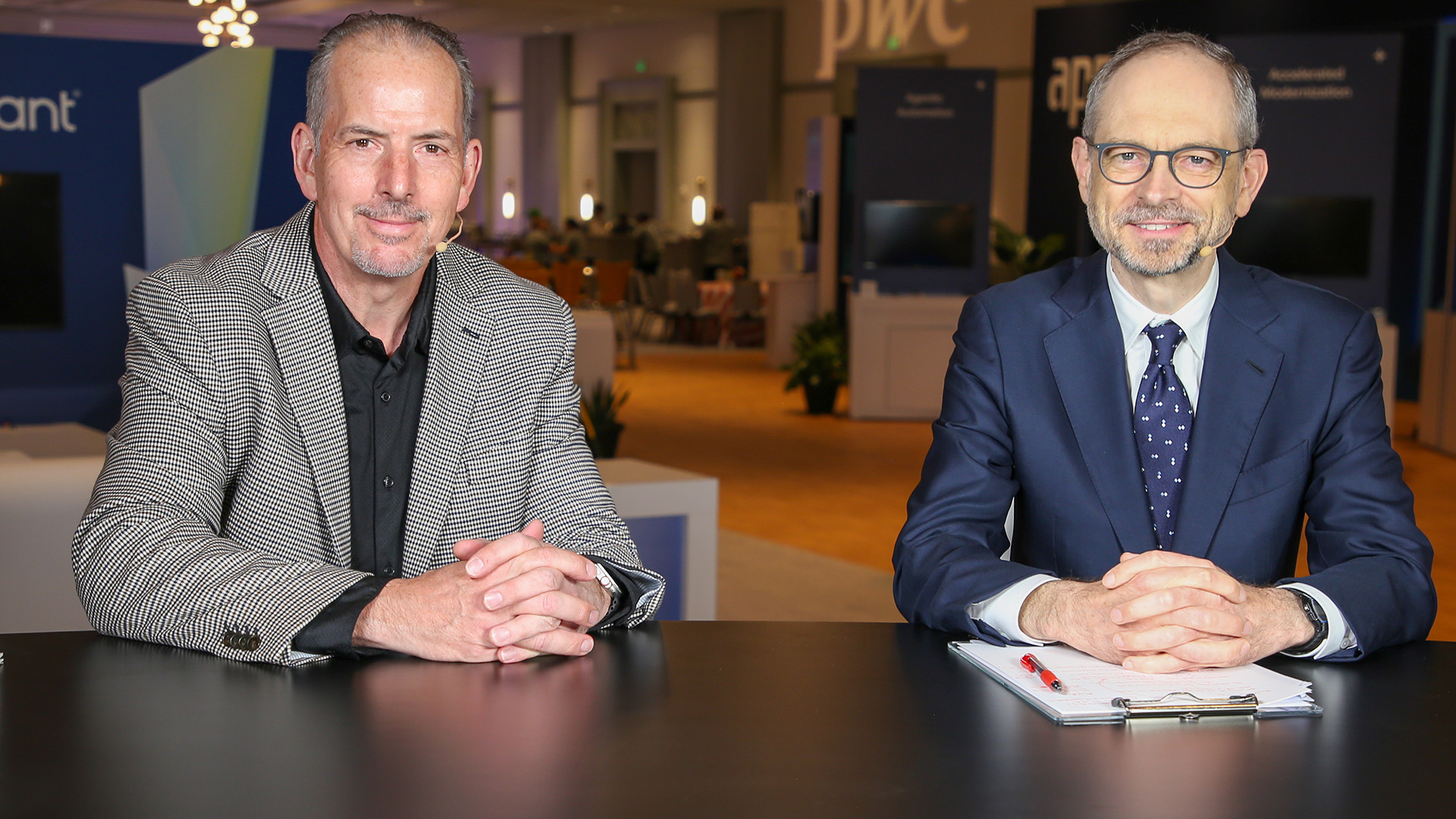
In this interview from Appian World 2026, Matt Calkins, co-founder and chief executive officer of Appian, joins Mal Cullen, chief executive officer of CIBC Mellon Trust Company, to talk with theCUBE's Dave Vellante and co-host Alison Kosik about why enterprises in regulated industries are choosing a deliberate, process-first approach to embedding AI into their operations. Calkins frames the moment as a rare convergence of software, AI and an enlightened customer — one where strategy matters as much as speed. Cullen, whose firm safeguards more than $3.4 trillion in assets, explains how CIBC Mellon is using Appian's data fabric to connect disparate systems and gain operational agility without depending on the global platforms of its parent companies. He notes that Appian is the only platform where CIBC Mellon currently runs AI in production, because its auditable governance model fits what Calkins calls "East Coast AI": deliberate, validated and safe.
The conversation also explores how CIBC Mellon is reengineering workflows rather than automating existing ones — a distinction Cullen frames as the difference between putting a bandage on a broken process and fixing its root cause. A standout example: his team built a total cost reporting application on Appian to meet a Canadian regulatory deadline of December 31, 2025, co-creating it with clients in a timeline Cullen says would have been impossible through legacy platform channels. Calkins reinforces the broader transformation case, pointing to Hitachi consolidating 500 applications into one and the U.S. Air Force saving $80 million in its first year after modernizing seven systems on Appian. On agentic AI, Calkins offers a measured view: agents are most valuable where adaptive intelligence is genuinely needed, but carry the highest risk of going off-script without process guardrails. Both Calkins and Cullen agree the path forward is inevitable but incremental — pairing probabilistic AI with deterministic process frameworks to deliver outcomes enterprises can actually trust.
Forgot Password
Almost there!
We just sent you a verification email. Please verify your account to gain access to
Appian World 2026. If you don’t think you received an email check your
spam folder.
In order to sign in, enter the email address you used to registered for the event. Once completed, you will receive an email with a verification link. Open the link to automatically sign into the site.
Register for Appian World 2026
Please fill out the information below. You will receive an email with a verification link confirming your registration. Click the link to automatically sign into the site.
You’re almost there!
We just sent you a verification email. Please click the verification button in the email. Once your email address is verified, you will have full access to all event content for Appian World 2026.
I want my badge and interests to be visible to all attendees.
Checking this box will display your presense on the attendees list, view your profile and allow other attendees to contact you via 1-1 chat. Read the Privacy Policy. At any time, you can choose to disable this preference.
Select your Interests!
add
Upload your photo
Uploading..
OR
Connect via Twitter
Connect via Linkedin
EDIT PASSWORD
Share
Forgot Password
Almost there!
We just sent you a verification email. Please verify your account to gain access to
Appian World 2026. If you don’t think you received an email check your
spam folder.
In order to sign in, enter the email address you used to registered for the event. Once completed, you will receive an email with a verification link. Open the link to automatically sign into the site.
Sign in to gain access to Appian World 2026
Please sign in with LinkedIn to continue to Appian World 2026. Signing in with LinkedIn ensures a professional environment.
Are you sure you want to remove access rights for this user?
Details
Manage Access
email address
Community Invitation
Matt Calkins, Appian & Mal Cullen, CIBC Mellon
At Appian World 2026 in Orlando, Matt Calkins of Appian and Mal Cullen of CIBC Mellon join theCUBE hosts Alison Kosik and Dave Vellante to discuss technology-led transformation in regulated financial services. The conversation draws on theCUBE Research and explores Appian's data fabric, joint-venture dynamics with BNY and CIBC, practical artificial intelligence governance, agent use cases and how low-code platforms enable faster auditable delivery of client-facing solutions.
Cullen notes that Appian's data fabric gives CIBC Mellon greater agency over distributed data and accelerates client-facing changes. Calkins emphasizes a measured governance-first "East Coast" approach to AI that prioritizes auditability, human oversight and deterministic process controls. They highlight practical wins including client cost reporting, reconciliations and net asset value anomaly detection and recommend stepwise provable AI adoption.
This discussion provides practical guidance on adopting data fabric, low-code development and AI governance in financial services. The episode emphasizes auditability, human oversight and measurable outcomes for modernization and digital transformation initiatives.
In this interview from Appian World 2026, Matt Calkins, co-founder and chief executive officer of Appian, joins Mal Cullen, chief executive officer of CIBC Mellon Trust Company, to talk with theCUBE's Dave Vellante and co-host Alison Kosik about why enterprises in regulated industries are choosing a deliberate, process-first approach to embedding AI into their operations. Calkins frames the moment as a rare convergence of software, AI and an enlightened customer — one where strategy matters as much as speed. Cullen, whose firm safeguards more than $3.4 trilli...Read more
>> Welcome to Appian World 26. We are streaming live right here in Orlando. I'm Alison Kosik joined alongside by Dave Vellante and we are in sort of an exclusive moment. The conference here not yet quite open. It's kind of the pregame.
Dave Vellante
>> I like to call it the Cube After Dark.
Alison Kosik
>> I like that. I think that's pretty accurate. Well, we've got some great guests to join in right now on the Cube. We've got Matt Calkins. He's the founder and CEO of Appian. Welcome to The Cube. And Mal Cullen, the CEO of CIBC Mellon, welcome to the Cube as well.
Mal Cullen
>> Thank you.
Alison Kosik
>> So I'm going to start with the basics before we dive into the strategy. Matt, how long has Appian been working with CIBC Mellon?
Matt Calkins
>> Yeah, we got together in 2021 when we happened to have a joining booth set at Sibos. We had a discussion, realized we could work really well together. And so now we've been working for six years, five, six.
Dave Vellante
>> Mal, it's never been a more interesting time in tech. I think I've seen every tech wave from mainframes and PCs, et cetera, but I've never seen an environment where the customer actually can, I think, add more value than the technology industry. You're a CEO who's leaning into modernization and technology. What are your thoughts on where we are, your thoughts on how you apply technology to your company, maybe some of the business drivers that are changing things for CIBC?
Mal Cullen
>> Yeah. So we're a joint venture and Bank of New York owns half the business and CIBC owns the other half. And that partnership came together 30 years ago. So not many joint ventures will live that long. But we've got a secret sauce there where BNY provides the technology, the scale, the platforms, and CIBC has all the great client relationships across the country that we leverage as well. What we decided though was that in order to be great at what we do, which is an asset servicing organization, is that we actually had to be a technology leader as well. And so that was the mission that I set forth when I joined here about three and a half years ago. I said, "Not only do we want to be the number one asset servicer in Canada, we also have to become a technology leader as well."
Alison Kosik
>> So what role does Appian play in this ecosystem in this partnership? You're basically safeguarding more than $3.4 trillion.
Mal Cullen
>> Yeah. So because of the way that we're structured as a joint venture, we leverage CIBC and BNY's technology, but in order for us to have the agility to respond to our changing client needs in terms of what they need from us, we needed to take more agency over our own data, over our own technology. And Appian's data fabric allows us to connect systems together such that we can now improve them for our clients and create a better experience without having to go back to either BNY or CIBC for changes, which would be very difficult to do, just given the scale of the platforms that they run globally across the world.
Alison Kosik
>> Matt-
Dave Vellante
>> So the data fabric allows you to get access to any data, irrespective of where it is physically, whether it's in the cloud, on prem, doesn't matter which hyperscaler it's in. So that's an interesting technology component. Matt, you are a software company. And remember Andreessen said that software is eating the world. People say every company is becoming a software company. That actually never happened, but it's happening now. And I wonder if you could comment on that.
Matt Calkins
>> Yeah. And first of all, I just want to say I love what Mal said because it is our intention as a software company to be an empowering force for our customers. And the fact that he's able to achieve agility and to build systems more rapidly than he would have if he depended on the corporate parents and that he can build something that he can trust in our technology, this is the fulfillment of our intention. So I love what he said. Just wanted to make note of that. As for the effect right now that software is having, I believe that now is a unique moment where the partnership between software and AI and an enlightened customer can do extraordinary things, but you need all three. You need a smart guide. You need a customer. As you said, the customer is creating a lot of value today because they're able to shape the way these technological concepts come together. And so they could be very wise and productive, or they can be scattershot and less productive. But this is a great moment when there's so much power in the hands of a software vendor and a customer and a client put together that we can do incredible things.
Dave Vellante
>> So how do you think about that, Mal? We've now got this... We would program systems and they would do what we told them to do, and now they're generating ideas and we're tapping into intelligence in the form of tokens. I was joking the other day. I said, "Here's your laptop. Here's your token budget." And that's what the world is becoming. How do you, as a CEO, think about that?
Mal Cullen
>> So AI for us is early in its journey. Financial services has always been late to the game for emerging technologies. Just think about how long it took Wall Street to go to cloud, right? A lot of firms never thought they'd even get there, but they did. But the risk appetite that we have to live with the regulators and think of the exposure I could create to either BNY or CIBC if we had an ungoverned or an irresponsible AI deployment is very, very high. So we have to take it very, very carefully. And what I say to people is that we can't go any faster than the comfort level of our clients. Every week now we're getting inquiries from our clients to ask us to provide evidence of what we're doing with AI, how are we using AI, where it's embedded within the organization across all the platforms. And actually, one of the only places we're actually using it in a production mode is with Appian right now. The reason for that is because they have a very controlled governance model where I can provide transparency to how it's being used. I can audit that. I can have documentation and it's not impacting the client yet. It's being delivered for an internal purpose. So for us, that's a really good starting point on an internal perspective. Until the industry gets to the point where we believe we can start to deliver services through that to our clients, but we're not there yet.
Dave Vellante
>> Move fast and don't break things.
Matt Calkins
>> Exactly. That's right. I like to joke that what we do is called East Coast AI, right? We don't move fast and break things. Instead, we keep it extremely safe and we fit within that risk profile that Mal is talking about that he's got to stay within. AI shouldn't be risky. A lot of people are doing crazy things with it, but our approach, we got to serve the government. We work in all 15 agencies of the US government. We serve customers who have to be mindful of their reputation and regulations and we can't take the same approach to AI. We use it constantly. Most of our customers, the vast majority are using AI on the Appian platform, but we can't use it recklessly. We have to serve a different degree of safety because our customers demand it. And so our approach is very deliberate and cautious and proven and validated before we can deploy AI.
Alison Kosik
>> Talk us through how you are being cautious. Can you give a couple of use cases?
Matt Calkins
>> Yeah, absolutely. Let's say, for example, you're taking a legacy application and you're moving it to a new platform, to the Appian platform using AI. AI is a terrific way to convert an application from an old platform to a new platform, so that's great. However, AI is also not entirely reliable. It's probabilistic technology and it could make the occasional mistake if you just put the whole job into AI's hands. Instead, you've got to be really careful. And this is where we come in. We ask AI to first tell the user exactly what it is that's going to create every rule, every interface, every data table, every last thing, and lay it all out in a neat format for auditing before you build the application. So you get all ready and then you pause and you say, "Are you sure this is correct?" Look through everything and if you're satisfied, then AI will write it for you. And once it's written it, you can come back and iterate and go through that step again and look at it again and create it again. But the last thing we want to do is use AI to fire and forget and just see what happens with the application. Our customers would never put up with that. We've got to be exceptionally cautious and validated before we let AI loose on either the creation of an application or the production of any decision or anything a customer could see.
Dave Vellante
>> So you're bringing the deterministic world and the probabilistic worlds together in a way that can be trusted. I'm interested in-
Matt Calkins
>> That's right on.
Dave Vellante
>> So you've got to innovate, you got to move fast, but you can't break things. Two question, two part question. One is, how do you make sure that you're not just paving the cow path, automating a process that maybe should be changed and how do you manage shadow AI?
Mal Cullen
>> Yeah. So for us, I think if you go back four or five years, a lot of firms like us had put RPA in, automated task and they would count how many keystrokes they saved and multiply that by X number of people over X number of days. And that was the ROI for the project, right? For us, we were being very different about it because that just put a bandaid on the problem. It didn't actually solve the root cause of why you've got a manual process. And in our industry, scale is everything. So anything that's bespoke for a particular client or its manual creates risk. So we're trying to get all of that out of our operations. And for us being able to take the Appian platform and find ways that we can actually create efficiencies across handoffs between teams and being able to deliver things into our clients differently. Those are a re-engineering of the way that we work. It's not an automation of how we used to work. So we're thinking about this differently in terms of, let's redesign the process. And the best way we do that is having the people on the ground that are actually doing the work. They're the ones that are actually making those decisions, not people in the boardroom.
Dave Vellante
>> Is AI helping you do that?
Mal Cullen
>> AI is giving us accelerators when we have to design the new process. It's helping our teams figure out how to do that, and then they can build the tool and they can put it into production.
Dave Vellante
>> And of course, Matt, your last quarter, it was interesting to note the professional services side of your business, which I think is really interesting. I think this is what a lot of people are missing. The ability to have expertise to go in and help companies like Mal's to implement AI and agentic, because those forward deployed engineers are few and far between who actually know how to do that.
Matt Calkins
>> Yeah, but we specialize in it. We see our services team as a catalyst for innovation. And we also have terrific partners who do the same thing, catalyst for innovation. But we see all of the Appian community, the practitioner community as having that role, their job is to learn about what it is we can do that the rest of the market can't and then deploy it safely in order that customers succeed. Also, I love what Mal was just saying, and I wanted to say that the moment that you upgrade an old system, that you modernize an old system, that's a moment of transformation. You wouldn't want to pave a cow path. You would want to create something that was the ideal expression of the purpose of that original application. So today what we're doing with our customers that are modernizing is creating a revolutionary experience, a real change, not just a replatforming. Hitachi took 500 applications and consolidated them down to one and the US Air Force saved $80 million in their first year after modernizing seven systems on Appian. So our goal is transformation, not just porting an application from an old platform to a new platform.
Alison Kosik
>> But... Oh, go ahead, go.
Dave Vellante
>> No, please.
Alison Kosik
>> I was going to ask Matt that AI is becoming this active participant and not a passive observer. How do you find the balance?
Mal Cullen
>> So as I said, we're quite early in the process. So we have pretty much eliminated any exposure into the client's ecosystem for now, and we're focusing on redesigning our internal processes. So we have guardrails around the process when it's designed that says it can only go so far before a human oversight has to take over and hand off that work. And that's how we do that, is that we make sure that the process is designed such that before we get into the point where it's going to impact a client outcome, there's a human responsible for that. Just like you would today if you brought in a new employee and gave it some work to do, you'd still have somebody supervise that process before it got to impact a client.
Matt Calkins
>> We were just on a panel a moment ago and he told an incredible story about the total cost reporting application that he built on Appian with AI. And maybe you could just say what it is you accomplished with that because it is really impressive.
Mal Cullen
>> Yeah. What I've told them is that internal stuff is great, but my clients don't really care if we modernize our internal processes and become more efficient. Everybody is doing that. The real win for me was to be able to deliver an experience in a digital way out to our clients. And last year, there was a regulatory change in Canada that required the transparency around cost of running a fund, mutual fund and ETF, where they actually had to provide more transparency in terms of the total cost of that went into that fund. And we had to deliver that in Canada. And back to my earlier point, if I had gone to the platforms, the global BNY platforms and asked for changes to support a Canadian regulatory cost reporting challenge, the likelihood of getting that done in time would have been low. My team built that on Appian. The clients now have a client facing application to deliver that. And the real win for us was that we co-created that with clients and the client experience was developed with Appian, with CIBC Mellon and our clients together. And the team actually told me they would never have made that date of December 31st, 2025 if we didn't do this on Appian.
Dave Vellante
>> Alison and I just came back from Google Cloud Next and it was a Kool-Aid injection of agent, agent, agent. And then when you talk to customers, the reality set in. It was, we're taking it slowly, we're being really careful, we need governance. So I wonder if you guys could address this, the reality of agentic. You hear so much hype around it. Where are we? How are you helping clients be safe and implement agents responsibly?
Matt Calkins
>> Yeah. Do you want to go? Or I... Okay. Agents are an incredibly powerful tool, but they have to be used correctly. Agents can't do everything. They may make decisions, but they shouldn't make every decision. Some people come to me and say, "Look, agents can decide the next action. So do you need process at all? Maybe you should just let agents loose." And in my experience, agents actually need process more than any other form of AI. They're the ones that go off the rails the easiest if you don't have the regulations, the guardrails, the tracking. If you don't have the structure of process, agents are the first part of AI to wander off the reservation. I think people have to be careful about when to use agents and when not to. You need it when you need adaptive intelligence. You don't need it the rest of the time. In fact, the rest of the time it's strictly disadvantageous because it's more expensive, slower and less accurate. So you want to use agents just at the right time and not at the other times, which means you need a nuanced both strategy and they have to be balanced and you should take extra care that when you deploy agents, that you're not allowing them to do unanticipated and off script actions. So you got to be all the more watchful about what agents are actually doing because you've increased the possibility for a surprising outcome when you put an agent into the picture.
Dave Vellante
>> So presumably you want them to do the mundane, take that off of the human and have the humans do more high value activities, but how are you approaching it and what role do you see Appian playing?
Mal Cullen
>> So I'll give you two examples where we could use them in a very safe, secure way. A lot of reconciliations in our business between system A and system B that we have to do every day. So an AI agent could help the people and identify those reconciliation breaks much, much quicker than humans can. That just accelerates the job that people are doing. Another thing is we do net asset value. We do NAV processing on funds every day. We can find anomaly detection between one fund that looks like another fund and say that there's probably something that went wrong there and it just creates a tremendous amount of efficiency to get to the root cause of the problem. But again, we're not letting it make a decision on behalf of our business that is going to impact a client yet. So it's just helping our own teams be more efficient in terms of how they can actually deliver the work that they do every day.
Dave Vellante
>> So really improving analytical insights, right? And then eventually you'll allow them to take agency. Do you see that in the near or midterm future?
Mal Cullen
>> I think it's inevitable.
Dave Vellante
>> Yeah.
Mal Cullen
>> It's just when and how how we're going to be able to do it.
Matt Calkins
>> Yeah. There's some things that agents can do better than anybody else. If you need adaptive intelligence, if you've got genuine unclarity about the state of work or the job when it arrives at the action moment, you need agency, sorry, you need agents to fill out the picture and maybe to adjudicate the right action from amongst a set of possible actions and states that are too great for writing rules about. Agents can get through that better than anything else.
Dave Vellante
>> One of our analysts is working with Jeffrey Moore and when we put together this framework, he said, "Okay, but show me how I get from point A to point B." And we actually, George Gilbert did the work. There are a lot of steps and it's an evolution. We're not just going to instantly turn on agents and have them go wild or they will go rogue. It's going to happen, but it's a journey, right?
Matt Calkins
>> Yeah. We believe in taking careful steps. No rogue agents.
Alison Kosik
>> What advice would you give to other executives taking the same journey?
Matt Calkins
>> Well, take careful, deliberate, provable steps. Take on something that you know you can succeed at, do it carefully, show momentum, demonstrate that you've succeeded and you've earned the next step and be just so careful about what AI can do. It's incredibly powerful and incredibly risky if you don't use it correctly. So be sure that you're watching every step and monitoring and giving it a narrow aperture of action. It needs constraints. It's a probabilistic technology and if it's agents, it's got everything at its fingertips. You really need to pair AI with a deterministic framework in order to keep it safe.
Dave Vellante
>> And that's exactly what you're doing. And actually, AI is really good when you can tell it reinforcement learning with the right answer, but how do you get the right answer? You get the right answer because you have someone like Appian who actually knows what the right answer looks like. And then you can iterate and I guess presumably learn from those reasoning traces.
Matt Calkins
>> We've been trying to build the product for years now to be the ideal synergistic partner to AI. AI's got some rough edges and it's got some permanent blind spots because it's probabilistic. It will always be unreliable. We've built our process to be the natural companion to the power of AI so that together we can do things and go places that AI could never go alone.
Dave Vellante
>> But to be clear, you guys are both excited about AI. You see the massive opportunity, but you just want AI done right is what I'm hearing.
Mal Cullen
>> Correct.
Matt Calkins
>> East coast.
Dave Vellante
>> East coast AI. We're east coast. It resonates.
Alison Kosik
>> All right, Matt, Mal, fantastic conversation. Thanks so much for your time.
Matt Calkins
>> Oh-
Mal Cullen
>> Thank you for having us.
Matt Calkins
>> . Appreciate it.
Mal Cullen
>> I really enjoyed it.
Alison Kosik
>> you got it. And you're watching The Cube, the leader in live technology coverage. We'll be right back.











 Alison Kosik
 Dave Vellante