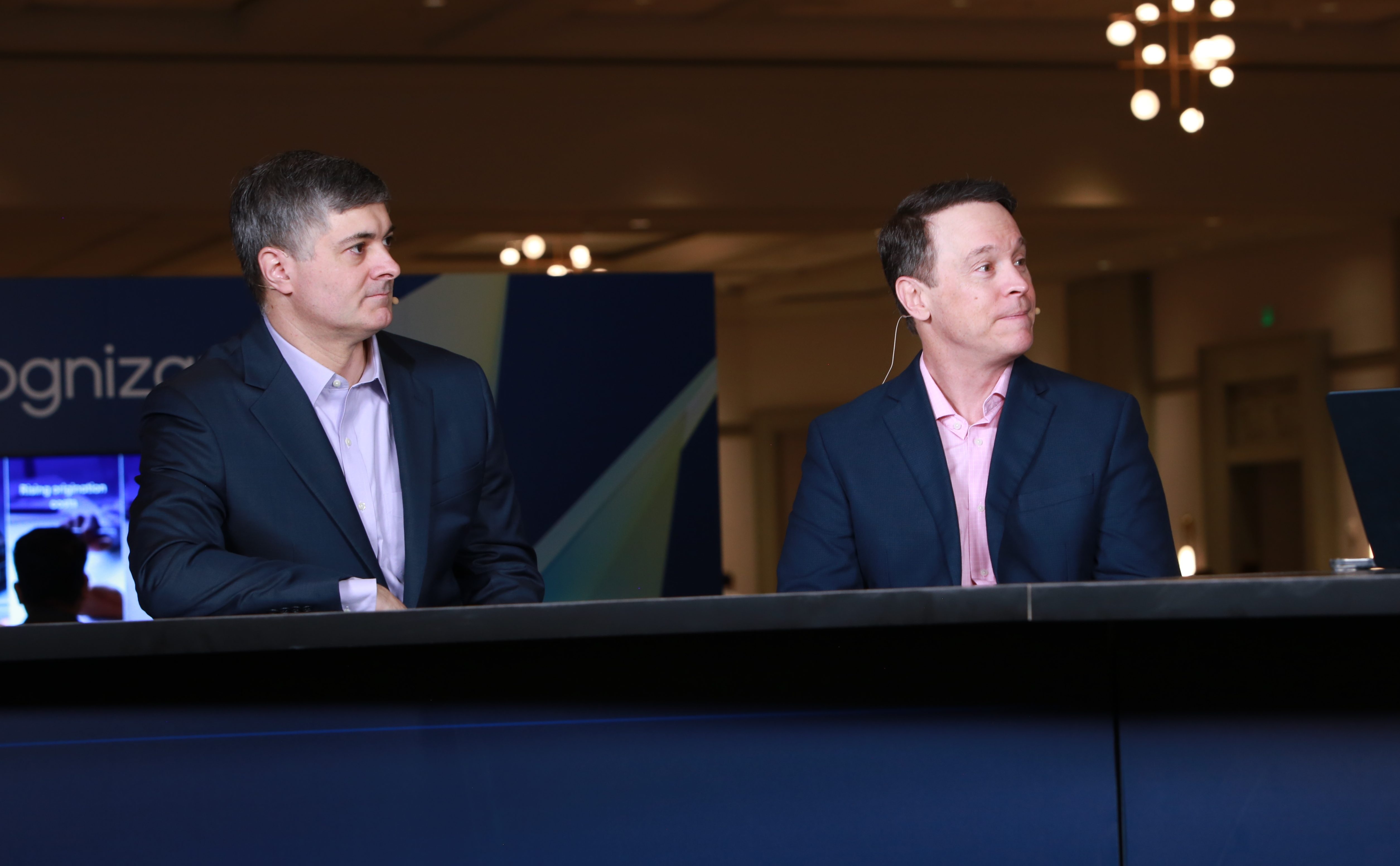
In this interview from Appian World 2026, Scott Van Valkenburgh, senior vice president of global partners and alliances at Appian, joins Dan Scott, principal at PricewaterhouseCoopers, to talk with theCUBE's Dave Vellante and co-host Alison Kosik about how enterprises are embedding AI into governed process platforms to drive measurable operational outcomes. Van Valkenburgh describes Appian as the engagement layer for enterprise work — a governed platform processing billions of transactions — while Scott underscores that PwC contributes domain depth in areas like financial compliance and pharmaceutical labeling that the technology alone cannot provide. Together, they detail how the alliance is accelerating transformation at the enterprise level, not just the project level. A standout example: using Appian's DocCenter to compress suspicious activity review for anti-money laundering from four hours to 38 seconds.
The conversation also explores the mechanics of legacy modernization — a challenge every established enterprise faces. Scott explains how PwC has spent over two years using AI to extract and interpret business logic trapped inside decades-old code, surfacing it for human review before rebuilding it in modern platforms like Appian. Van Valkenburgh adds that replacing a flawed process with new technology still produces a flawed process, making the upfront logic extraction step critical. The panel addresses where enterprises stand on the AI adoption curve: most are moving cautiously from pilot to production, keeping humans in the loop until quality and governance confidence builds. Scott pushes back on token-cost anxiety, arguing that organizations focused on the right business problem — faster processing, higher quality, new capabilities — will find the economics follow. From extracting 30-year-old business logic to scaling AI agents within governed workflows, the discussion charts a practical path from legacy debt to intelligent, process-centric operations.
Forgot Password
Almost there!
We just sent you a verification email. Please verify your account to gain access to
Appian World 2026. If you don’t think you received an email check your
spam folder.
In order to sign in, enter the email address you used to registered for the event. Once completed, you will receive an email with a verification link. Open the link to automatically sign into the site.
Register for Appian World 2026
Please fill out the information below. You will receive an email with a verification link confirming your registration. Click the link to automatically sign into the site.
You’re almost there!
We just sent you a verification email. Please click the verification button in the email. Once your email address is verified, you will have full access to all event content for Appian World 2026.
I want my badge and interests to be visible to all attendees.
Checking this box will display your presense on the attendees list, view your profile and allow other attendees to contact you via 1-1 chat. Read the Privacy Policy. At any time, you can choose to disable this preference.
Select your Interests!
add
Upload your photo
Uploading..
OR
Connect via Twitter
Connect via Linkedin
EDIT PASSWORD
Share
Forgot Password
Almost there!
We just sent you a verification email. Please verify your account to gain access to
Appian World 2026. If you don’t think you received an email check your
spam folder.
In order to sign in, enter the email address you used to registered for the event. Once completed, you will receive an email with a verification link. Open the link to automatically sign into the site.
Sign in to gain access to Appian World 2026
Please sign in with LinkedIn to continue to Appian World 2026. Signing in with LinkedIn ensures a professional environment.
Are you sure you want to remove access rights for this user?
Details
Manage Access
email address
Community Invitation
Scott Van Valkenburgh, Appian & Dan Scott, PwC
This interview explores partnership strategies for artificial intelligence-driven process modernization presented at Appian World 2026. Scott Van Valkenburgh of Appian, Senior Vice President Global Partners and Alliances, and Dan Scott of PwC, Principal, join hosts Alison Kosik and Dave Vellante for a live conversation recorded at the event.
The discussion covers global partner strategy, AI-enabled process design and legacy-application extraction. It addresses artificial intelligence governance, multi-agent readiness, DocCenter use cases, know your customer and anti-money laundering improvements, data fabric and pathways for enterprise modernization. Van Valkenburgh highlights Appian’s governed platform for scaling agents, bridging silos and moving pilots into production. Scott explains that PwC employs AI-driven extraction and accelerators to reduce cost and accelerate time to value. They emphasize embedding controls into the process layer rather than relying on people and using AI to extract and interpret legacy business logic for faster modernization.
This content provides practical insights for technology and business leaders focused on process automation, legacy modernization, cloud adoption and digital transformation. Keywords include artificial intelligence, AI, process modernization, process automation, legacy modernization, data fabric, large language models, agents, DocCenter, know your customer, anti-money laundering, cloud and digital transformation.
In this interview from Appian World 2026, Scott Van Valkenburgh, senior vice president of global partners and alliances at Appian, joins Dan Scott, principal at PricewaterhouseCoopers, to talk with theCUBE's Dave Vellante and co-host Alison Kosik about how enterprises are embedding AI into governed process platforms to drive measurable operational outcomes. Van Valkenburgh describes Appian as the engagement layer for enterprise work — a governed platform processing billions of transactions — while Scott underscores that PwC contributes domain depth in areas l...Read more
>> Welcome back to Appian World 26. We're streaming live here in Orlando. I'm Alison Kosik, alongside Dave Vellante. Good morning.
Dave Vellante
>> Good morning. It's good. Quiet again. It's going to pick up later.
Alison Kosik
>> It is.
Dave Vellante
>> I got to say these JW Marriotts, they do it right, don't they? Nice hotel, good venue, very comfortable.
Alison Kosik
>> Absolutely. Coffee's great. Let's talk about the power of the partnership, shall we? Let's dig in with our guests, Scott Van Valkenburgh, the senior vice president of Global Partners and Alliances with Appian. Good morning and welcome to theCUBE.
Scott Van Valkenburgh
>> Good morning. Thanks for having me.
Alison Kosik
>> We've also got Dan Scott with PwC. Welcome to theCUBE as well. So, tell me about this partnership.
Scott Van Valkenburgh
>> So, we've had an alliance for quite a long time. PwC is one of our most strategic alliances within Appian. And Dan and the theme have been experts at Appian, delivering value for customers for years.
Alison Kosik
>> And what's really worked? What's maybe some of the standout examples that you can give?
Scott Van Valkenburgh
>> Dan, what are some of the viewpoints from the firm?
Dan Scott
>> So, I think really for us, we add value when we add both the business understanding to the technology that Appian brings. So, for us, it's usually about how do we transform someone's business, not just how do we upgrade from one version to another?
Dave Vellante
>> You know... Oh, go ahead, please.
Alison Kosik
>> No, no. Go-
Dave Vellante
>> So, I was going to say, PwC, the internet was going to put you out of business and the cloud was going to put you out of business. Now, LLMs are going to put you out of business. So, somehow you guys keep growing and powering through that. So, what's happening in the field, actually, both internally at the company, because you guys have such an opportunity to drive transformation and you know a little bit about transformation?
Dan Scott
>> That's right.
Dave Vellante
>> And then, you can bring that to the customer base, your client base, along with partners like Appian. So, where are you at internally and how are you translating that externally with your partners?
Dan Scott
>> Look, this is a journey, I think that you're right, that we're taking both ourselves and we're taking with our customers. And so, we have to do it to ourselves first to be comfortable with what we need to do with our customers. So, we've been on an AI journey for over two years, deploying that, changing the way we do business, improving the value we deliver to the clients, and also making it faster and less expensive to do so. So, our customers have challenged us to do what they then ask us to help them do, which is to help them transform their business. So, this is a great spot. We have a lot of legacy software and we've been helping clients and ourselves unlock the value in that software, extract the business logic that's been built up over 30 plus years, understand what that's actually doing, and then figure out how I put it in a modern tool so that I can then do agentic on it and transform the way that I do business, but not lose what's made the company .
Alison Kosik
>> What have been the biggest challenges that come to mind as you've tried to modernize these legacy operations?
Dan Scott
>> So, controls have changed quite a bit. If you actually think about a lot of controls today that are people-based, they rely on people being concerned about violating company policies. Agents and some of the AI don't have that, so you need to build controls elsewhere. So, previously, where you could rely on a person doing something, you really need to move that control into the process, so that the process itself takes that, provides the appropriate governance and still has the safety at a speed that you can actually make sense.
Dave Vellante
>> So, when you talk about how you had a lot of legacy apps, that's not uncommon. When you think about things like data fabric, how you can access data without having to move it. And when you think about the way companies are organized, they all have their own data, they have their own data warehouse, their own data mart, their own BI tools, and this is a lot of wrangling that has to happen. And by the time it's over, the market has changed. And so, the promise is that with things like data fabric and abstraction layers on top, we can bust down those silos and it has real implications for departments as well. Maybe we can dissolve some of that stove piping and be more effective and be more efficient and go to market. Are you seeing that take hold yet? A bunch of earnings are coming out tonight. Everybody, all Wall Street wants to see ROI. What's actually happening on the ground in the field? Are you seeing some of those dissolve? Are you seeing light at the end of the tunnel? Give us the real-world, on-the-ground truth.
Scott Van Valkenburgh
>> Well, we're pretty excited with the alliance. If you start thinking about just Appian as a whole, we've been on a tear, we've had six quarters of growth. We have another quarter coming up that I'm excited to see how we do on the street. The biggest thing that Dan's talking about is everybody's struggle with unlocking value with AI. Agents, is this going to be the end of jobs for everybody? But what we found out is if you can put a governance framework controls, that you can have AI do the right things that AI is good for, you can scale, you can get past the legacy modernization and finally put that investment dollar, versus just taking things out to be able to doing new things. And with our alliance together, we've had some great success transforming clients in simple things like our DocCenter, the ability to read documents and actually start doing stuff, whether it's going to be in KYC or AML and other financial institutions or insurance. So, I think what you're going to see this policy, when you can put a framework for control, as Dan said, AI in process, it's really going to take and unlock the value, not only for productivity, but innovation.
Dave Vellante
>> So, if I looked at the activity pie or the bar of a KYC or an AML compliance, how much of that is labor today? And are you able to attack that or is it really not labor-intensive and it's more just automating, so that you have less errors? Help us understand those two examples that you just gave, how your technologies and your services are helping compress that.
Scott Van Valkenburgh
>> I'll speak a little bit about technology and I'll ask Dan you to think about the services. But let's take AML, anti-money laundering. One of the biggest things that banks are trying to do is see suspicious activity that could be fraudulent in nature. The process for a bank, you would think this would live in one place, but it could touch 9, 10 different groups within a bank. Someone has to determine something might be wrong, someone's then got to review it, someone's then got to follow up on it, but these people and these groups don't all live in one place and it's not all one technology. And what an application like Appian does is it bridges the gap. It may say, "Hey, you know what, this looks incredibly unreal. Would someone take a look at it?" Well, that becomes a case and someone then in a different group has to look at it. In some of our clients, we were talking about even yesterday, we've taken them from four hours to look at a suspicious activity to 38 seconds. And then, you go, "If I can catch that before it happens, we're really making progress."
Maybe Dan, you could talk a little bit about some of the process steps and services around that?
Dan Scott
>> Sure. So, look, I think a lot of the things that you just said, it's interesting to see as clients are trying to transition from pilots to actually production. They need to actually get this into production. And we're actually doing this today with a client where we took the product that you talked about, DocCenter, and using AI in a real production scenario. But to your point, I think process workers have become really the new manual laborers and we need to upskill those folks into more knowledge workers who are able to become managers of the process instead of the ones doing it. And you get not only some cost savings from that in terms of fewer hours, but you also get increased quality, speed that you were just talking about. And so, it's not just about the cost savings anymore, it's also about improving the way you do business.
Dave Vellante
>> Yeah. So, that example that you gave, Scott, you've got the needle in the haystack, you've got the compressed time to actually get to an answer. You've got the quality piece, so it reduces your risk, potential exposure to, I guess, fines, reputational damage and the like. Okay. So, second part of that question is, Dan, you triggered something. We were again at Google last week and it was like, "The era of agents is here. Go." And you're like, "Whoa, hold on." You talk to the customers and you get to the ground truth and it's like, "Well, we're being cautious." We talked last night to your CEO, he's like, "We're East Coast AI." That was a great... "Go fast, but don't break-"
Scott Van Valkenburgh
>> He didn't have his gold chain on then?
Dave Vellante
>> Yeah, right. Exactly.
Alison Kosik
>> That's great.
Dave Vellante
>> So, where are your customers at in terms of moving into production at scale? I hosted a round table of executives at Mobile World Congress. Very few were aggressively going after complicated multi-agents because they couldn't govern them yet. And so, that seems like you guys are working on that layer or step of the S-curve. Can you help us understand where... I know it's a spectrum, but how would you characterize where customers are on the journey?
Dan Scott
>> So, I think you're right, it's a spectrum. And I think they're coming out of the, "Hey, I'm testing this out and into the actually, I'm doing this, but I'm putting guardrails on it. I need to have a human in the loop still at the end to take a review of this. I want to make sure that the quality is good." They're then getting comfortable with, "Hey, the quality's actually better than what I had before. The speed is actually better than what I had before." And so now, how can I understand where the human is still needed and where the AI can actually take over and give me the benefit that I've been looking for? And so that's where they are in the process. I agree with you that multi-agent, there's a few folks who are doing that. It's coming, but I think the great thing about this tool is that it allows companies to move along that process towards maturity and as they're ready, the tool's ready.
Dave Vellante
>> Do you feel like PwC is significantly ahead of its customers on that journey or are you struggling with some of the same challenges and cautions and it's actually maybe closer? Because I know you talk to Google, they're miles ahead, NVIDIA is miles ahead, but you guys are a big, far-flung global organization and face up many of the same challenges.
Dan Scott
>> So, look, I think we try and have humility in that we struggle with many of the same problems that our customers have. And I'll be honest with you, I think that makes us better consultants. We're not confused as to why this transformation is hard. This transformation is hard. We've been doing that transformation ourselves. And so, when we sit down at a table with someone, we're not talking about theoretical things, we're talking about steps that we've already taken ourselves and no work and no can work for our customers.
Dave Vellante
>> What is the nature of the partnership in detail? I'm sure there's a go-to-market component. You guys obviously have a professional services organization that really knows how to use Appian and tune it. PwC picks up from there. Can you just describe the nature of the relationship in more depth?
Scott Van Valkenburgh
>> I think it carries on from the question you just asked. If you look at every client, they're struggling. I read an article last night. Apparently Claude erased a company's entire database that was in production with no backup.
Dave Vellante
>> Oops.
Scott Van Valkenburgh
>> So, when you talk about controls, that can put people a little feeling uncomfortable in that risk. And what Appian does is deliver an incredible platform that's governed at scale. We do billions of transactions. We are the engagement layer for work. And what PwC brings is the engagement layer for domain and process in that change in transformation. So, that's why when clients can go, "Can I believe in Appian?" They can believe in the technology, but they said, "Hey, do you really understand the depth of my KYC? Do you understand my pharma co-labeling issues? Do you understand insurance regulatory compliance issues?" And that's not our sweet spot. Our sweet spot is giving the best technology platform to ensure you can grow your agentic, you can do your processes, you can do automations, and your database doesn't get erased. And with PwC, we get the ability for them to really have that reach and confidence to help that client go through that journey.
Alison Kosik
>> You had me wiped out the entire database. I have to go find that article and read it, I did not have a chance yet. Looking ahead, what does success look like a year from now for you? How do you see this alliance delivering even more impact? Where are you in a month to two years from now?
Scott Van Valkenburgh
>> Well, from our perspective, one of the key things when I joined Appian and I got a chance to work with Dan and the team is we doubled down our investment. We put more people on the team. We hired senior leaders to help drive and accelerate this type of innovation in the area of AI to drive. And what you're going to see from PwC and Appian and the alliance is helping really transform at an enterprise level versus a project level. For example, legacy modernization, you mentioned. Everybody's had this dream of getting off old apps and getting the new ones and getting the power of AI. I think you're going to see some surprising things with what we're going to be doing with PwC over the next 12 months.
Alison Kosik
>> And what are your thoughts over the next 12 months?
Dan Scott
>> Look, I think it's going to be an exciting time. We've got a lot of solutions. I think he mentioned one, which is called labeling. That is a very obtuse term for, "Hey, if you've got a headache and you look at the back of whatever you're about to take to solve that problem, chances are it has a label on it and that label needs to be correct." I know I want it to be when I take that drug. So, that's a very fragmented process today. And it's something that Scott sort of talked about of, how can we actually bring solutions to our clients. So, we know this is a fragmented process. We know that it needs automation orchestration, not just to make that process easier for the companies to comply, but also to make sure that the quality in this mission-critical thing is high. And so, that's one of the solutions that we're trying to bring together as we're also doubling down on our alliance with Appian because we're excited about the opportunity that I think that brings to our clients.
Dave Vellante
>> What does that legacy modernization, the app modernization look like? I mean, every company that's not a startup has legacy apps.
Dan Scott
>> That's right.
Dave Vellante
>> And they're reticent to just chuck them because there's this real value there. So, what does that modernization look like? What does it entail? Maybe work backwards from the North Star. Is it to get an abstraction layer that speaks AI? Is it to make it AI-native, which sounds like a rip-and-replace? Is it to migrate the app? What does that actually look like?
Scott Van Valkenburgh
>> So, what's really interesting is as you look at all these legacy apps, some people don't even know what they still do, but they don't want to unplug them. And there's this common belief that, "I'll just vibe code... I'll instantly go build this and now it'll do what it was doing." And what happens is when you find out, if you're just going to replace a process that was a bad process with new tech, it's still a bad process. So, what the technology, like what PwC has developed for extraction and what Appian can do is to build this governed layer, full-stack application from the data, from the process layer, agentic layer, and then the UI layer, we're able to understand and compress the time of what does the app do? Maybe it's across several apps because the process is an app. And then, can we actually turn this into something that's going to be real, that's going to be useful and work with the client to co-design? PwC has developed some great technology upfront and combined with Appian Composer, we've really been able to go in and show clients they can get real value by transforming, getting rid of legacy, saving on license costs, people costs, but actually a more powerful user application.
Dave Vellante
>> So, is it exposing some of the metadata and application logic that's trapped inside those legacy apps and then making it available to do other things with? I presume that's maybe part of it. Just as a side and a joke, I vibe coded an Appian clone last night on theCUBE with Grok.
Scott Van Valkenburgh
>> Did it bring you coffee? Like it was an automatic process?
Dave Vellante
>> It was awesome. It took like five minutes, it built all this Python code and it said, "Here you go." And I said, "That's awesome. Does it work?" He said, "Oh God, no."
But okay. So, back to my long-winded question here, does it involve exposing that locked up metadata and application logic? And then, does it allow business users to vibe code a product requirements doc and test it out a little bit before they burn expensive developer hours? Is that what this modernization looks like? And what are the pieces that I'm missing?
Scott Van Valkenburgh
>> Yeah, Dan, maybe you can talk a little bit about the upfront piece.
Dan Scott
>> Yeah. So, look, I think you hit on it there, which is this really starts with the business and understanding the business logic that's trapped in that legacy code. And so, what we try and do is we extract that business logic and try and make sense of it. Over 30 years, you can imagine there are a number of changes that probably occurred to that application, and not all of that application is likely to still be in use. And so, if you actually exercise some of that code, you would get something that was unintentional and not what you wanted. So, the first step is to go through, and we've been, for the last two plus years, using AI to extract business logic from those. We then take those back to the business requirements of what's actually being executed, so that we can then take that and put it into a modern application like Appian.
Dave Vellante
>> So, AI helps extract it and probably helps interpret it like AI is probably pretty good at understanding, probably better than I am, at understanding COBOL code and so things like that, but it doesn't always get it right.
Dan Scott
>> That's right.
Dave Vellante
>> So, it extracts, it interprets, and then it puts it in front of a human and says that, "Did I get this right?" And it gets you 90% or 80% of the way there.
Dan Scott
>> That's why we go to market as a service. We're not selling the tool to do that extraction, we're selling an integrated team that brings tools, so that someone can actually make sense of the results and say, "Okay, this is the business logic. This is what's actually running. Now, how do we want to modernize?"
Dave Vellante
>> But after some time of doing that in your business, this is why AI doesn't kill companies like PwC, you actually can turn all that into software. And then, you'll start to see software like marginal economics in your business at scale, which is you got scale.
Dan Scott
>> That's right. We call them accelerators because we use them as part of projects, but our accelerators get better all the time, and so that brings down the cost of our service. When the cost of something goes down, demand generally goes up. And so, you're right, our model is not really at risk right now. As we bring the price of some of these services down, the opportunities just increase.
Dave Vellante
>> You hear a lot of these startups talk about how they're burning all these tokens and the cost of tokens going up. When we look at the market, we say on average at the macro, about 4% of companies' revenues is spent on IT or technology. We think the potential is for that to explode as companies start to scale with less labor, that could go to 10%, 15%. Are you seeing any evidence of that? First of all, do you buy the premise? Are you seeing any evidence that organizations are going to be tapping that intelligence in the form of tokens through APIs and driving value, new models, new revenue models? I mean, that's the promise. Any indication that that's happening or is it sort of, "Let's just get this old stuff to work"?
Scott Van Valkenburgh
>> I mean, I think it's early days. I think just like when cloud happened, everybody's concerned, "If I move my stuff up, is this going to cost me forever? How does this work?" And you saw a tremendous productivity gains, savings, but productivity gains, new technologies, faster innovations. I think with the proper governed use of AI, the concept of the price of tokens to go down, the consumption layer, how traditional software vendors like Appian, you're seeing other players like Salesforce, et cetera, figuring out what's that model as they shift to consumption-like models, plus usage, plus number of users or applications. So, I will see what Dan thinks, but I think we're early stages and I think we're still looking for value and return, which Appian's had a few great home runs recently with simple things like DocCenter.
Dan Scott
>> Look, usually when we start the conversation with the price of tokens, I would tell you that we're probably starting the conversation in the wrong spot. I think it's really about, "Okay. Well, what's the opportunity that I have here?" And if I have $100-million opportunity, the price of tokens usually is not a barrier to that. But I think as people rush into AI, a lot of times they're feeling pressure, "Hey, I need to do something with AI," not, "Okay, what are my biggest business problems? How can AI help me with that business problem?" And then, if you actually look at the metrics and what we were talking about earlier of like, "Am I going to do this faster? What's the value of that to me? Am I going to do it with improved quality? What's the value of that to me? Am I going to be able to do something that I wasn't able to do before?" There's value in all those things. And if you go in looking for the value instead of thinking about the token count, I think you'll have a much better experience, but if you just deploy these tools without thinking about the why, I think that's where a lot of people are looking at like, "Well, I've got a lot of new subscriptions and I'm not getting the value that I wanted." Great thing about Appian is in the process, you can actually see how many hours did I save and how much faster did my process go? So, you're not questioning, "How do I tell leadership about what the value was that we created here?"
Dave Vellante
>> Yeah. And Scott, your cloud analogy is a good one, maybe on steroids here, because you saw it, we all were just using the cloud because it was valuable. And all of a sudden, wow, the world was cloud and then finance was complaining about the bill.
Scott Van Valkenburgh
>> There were a couple of people that left a job running or two in cloud and AWS felt excited about the extra income.
Dave Vellante
>> That's right.
Alison Kosik
>> All right. Great conversation. Thanks for stopping by theCUBE this morning.
Scott Van Valkenburgh
>> Thanks for having us.
Dave Vellante
>> Thanks, guys.
Dan Scott
>> Thanks a lot.
Alison Kosik
>> And you're watching theCUBE, the leader in live technology coverage. We'll be right back.











 Alison Kosik
 Dave Vellante