In this interview from Appian World 2026, Matt Calkins, co-founder and chief executive officer of Appian, joins theCUBE's Dave Vellante and co-host Alison Kosik to discuss how process platforms are becoming the foundation for operationalizing AI safely across enterprise workflows. Drawing on findings from a joint study with Harvard Business Review, Calkins explains why AI adoption remains slow in high-stakes use cases — noting that only 18% of organizations have integrated AI into a formal process, even as 92% acknowledge the need for rules-based guardrails. He argues that process provides what AI lacks on its own: safety, reliability, structure and specialization. Calkins also draws a sharp distinction between "vibe coding" — fit only for low-reliability applications — and spec-driven development that enables mission-critical software built from a natural language starting point.
The conversation also explores Calkins' Wall Street Journal argument that AI-generated code follows the same pattern as the open source movement — free code doesn't kill software, it elevates it. He positions Appian's Data Fabric as directly comparable to Palantir's Ontology product: a read-write, auto-tuned layer that gives AI agents frictionless access to distributed enterprise data without requiring migration. Where competitors focus on robotic automation or process mining, Calkins argues that starting from process as a strategic center point allows Appian to extend governance and action across the entire AI stack. From doubling the value delivered to customers to a TAM that has exploded alongside AI integration, he outlines why organizations that prioritize usefulness, openness and safety are best positioned to thrive as the enterprise AI stack continues to take shape.
Forgot Password
Almost there!
We just sent you a verification email. Please verify your account to gain access to
Appian World 2026. If you don’t think you received an email check your
spam folder.
In order to sign in, enter the email address you used to registered for the event. Once completed, you will receive an email with a verification link. Open the link to automatically sign into the site.
Register for Appian World 2026
Please fill out the information below. You will receive an email with a verification link confirming your registration. Click the link to automatically sign into the site.
You’re almost there!
We just sent you a verification email. Please click the verification button in the email. Once your email address is verified, you will have full access to all event content for Appian World 2026.
I want my badge and interests to be visible to all attendees.
Checking this box will display your presense on the attendees list, view your profile and allow other attendees to contact you via 1-1 chat. Read the Privacy Policy. At any time, you can choose to disable this preference.
Select your Interests!
add
Upload your photo
Uploading..
OR
Connect via Twitter
Connect via Linkedin
EDIT PASSWORD
Share
Forgot Password
Almost there!
We just sent you a verification email. Please verify your account to gain access to
Appian World 2026. If you don’t think you received an email check your
spam folder.
In order to sign in, enter the email address you used to registered for the event. Once completed, you will receive an email with a verification link. Open the link to automatically sign into the site.
Sign in to gain access to Appian World 2026
Please sign in with LinkedIn to continue to Appian World 2026. Signing in with LinkedIn ensures a professional environment.
Are you sure you want to remove access rights for this user?
Details
Manage Access
email address
Community Invitation
Matt Calkins, Appian
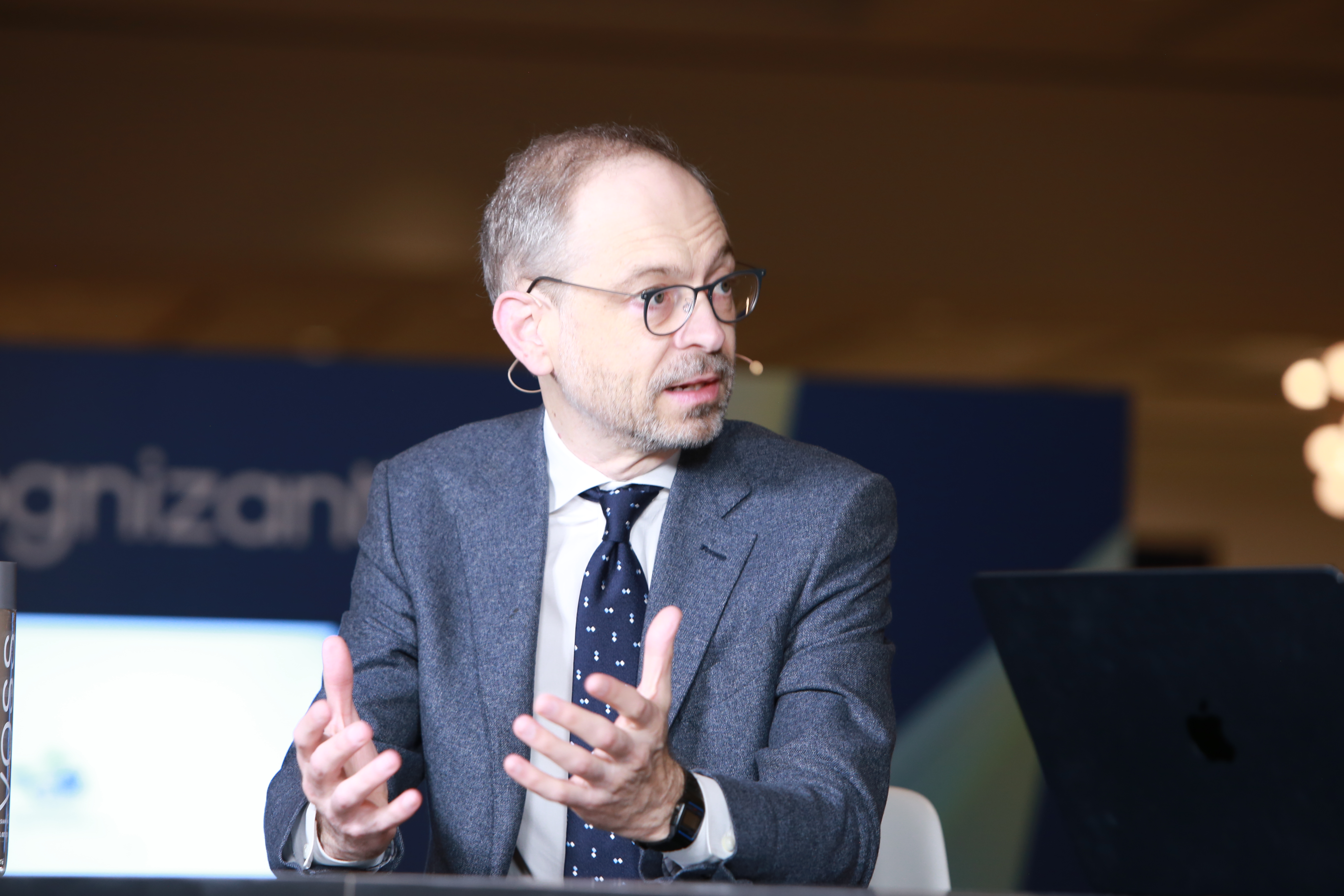
Dave Vellante and Alison Kosik sit down with Matt Calkins, CEO & Founder, Appian, at Appian World 2026 at the JW Marriott Orlando, Grande Lakes in Orlando, FL.
In this interview from Appian World 2026, Matt Calkins, co-founder and chief executive officer of Appian, joins theCUBE's Dave Vellante and co-host Alison Kosik to discuss how process platforms are becoming the foundation for operationalizing AI safely across enterprise workflows. Drawing on findings from a joint study with Harvard Business Review, Calkins explains why AI adoption remains slow in high-stakes use cases — noting that only 18% of organizations have integrated AI into a formal process, even as 92% acknowledge the need for rules-based guardrails. ...Read more
>> Welcome back to Appian World '26. We're streaming live in Orlando. I'm Alison Kosik, alongside Dave Vellante, and I want to get straight to Appian Founder and CEO, Matt Calkins, who joins us now in theCUBE. Welcome back to theCUBE.
Matt Calkins
>> Hi, Allison. Thanks.
Alison Kosik
>> First of all, congratulations on a fantastic keynote.
Matt Calkins
>> It's been really, yeah.
Alison Kosik
>> Thoroughly enjoyed it and this has been a fantastic conference, so I really enjoyed it.
Matt Calkins
>> Thanks.
Alison Kosik
>> Now, you teamed up with Harvard Business Review on the study about AI and the enterprise. What are you seeing in the market that made you want to take a closer look?
Matt Calkins
>> Yeah. Well, of course, we're very close to the AI progress generally because we're helping it along. We're a key compliment to AI technology and we want to see what progress we're making, particularly as regards to whether AI can be used in our backyard, which is the largest companies doing the most critical work in an error intolerant way. We were curious whether AI could be brought to those customers and what it would take. And we found from the HBR study, that while AI is universally accepted and every organization out there is trying to make the most out of it, that especially in serious use cases like the ones I just described, AI uptake has been slow. And this mirrors a set of other findings in the last 12 months from PWC, MIT, McKinsey and others that have said that AI hasn't created enough value, it hasn't been used enough in strategic use cases. It may be fine for personal productivity, but it's not getting used for business decisions, customer facing things, regulator facing things. We need to find a way to make AI connect to the most important work in the world, and Appian is doing that. So we're very interested in a closeup of the adoption of AI for the most strategic use cases.
Dave Vellante
>> I mean, I made a prediction in early this year that this is going to be the year of enterprise IT. And frankly, it's been elusive, so I'm so super excited to be here at this conference because I'm seeing some real evidence.
Matt Calkins
>> I agree with you. This is the year where AI hits the enterprise, but it doesn't happen automatically, we've got to make it happen. We have to reassure people that AI can be safe enough to be used in the most enterprise cases and do the most valuable work. And we're achieving that with guardrails, with structure, with process. In a word, we're giving process... Process gives AI what it's missing otherwise. Process gives AI the safety, the reliability, the structure, the guardrails, the specialization that AI doesn't have alone.
Alison Kosik
>> And that, you're saying, is what makes Appian stand out in this whole landscape?
Matt Calkins
>> That's our exact role, is to give AI all of that structure and safety and allow it to do the world's most important work. Without Appian and without process, you couldn't trust AI to do that work, it's not reliable enough. But with the structure of a process, now you can. So we are the vehicle by which AI can address the world's most important work.
Dave Vellante
>> One of the really cool things that I've learned this week is this company was founded by four individuals who are still at the company. Not only at the company, but actively involved as operators, which, that is really unique.
Matt Calkins
>> It's a remarkable thing. I don't know of another technology company that kept all four founders together for a quarter century.
Dave Vellante
>> First of all, we love founder-led companies because they go into founder mode. But four founders who are actively involved, I think it's a unicorn in that sense. I couldn't even come close to naming another company like that, so congratulations on keeping that together for so long.
Matt Calkins
>> Thank you.
Dave Vellante
>> You wrote an article in the Wall Street Journal, which was, you talked about open source and the whole narrative in the industry of, "Oh, open source is going to kill software." And it didn't, it actually lifted software to new heights. And you use that as an example of what's happening in AI. I wonder if you could explain the premise?
Matt Calkins
>> Sure. The core premise there is that technology advances recently have made it seem like code is free. And in many ways it is free, it's becoming free. And if code becomes free, does that mean that the software industry disappears? And the answer is code's been free already, open source is free code. And it doesn't mean the software industry disappears, it means it just adapts and it addresses a higher end niche or it specializes in order to compliment in other ways. But software survives even though code becomes free. The real cost of building an application these days isn't actually the code, it's the trust. It's the safety and the reliability. Code may be cheap, but mistakes are expensive. And so when people tally up the reasons why it's expensive to build an application, I think these days they're already thinking more about whether it's reliable than whether the code itself was expensive.
Alison Kosik
>> As we move into this new era of AI agents, how should leaders be thinking about the balance of power between autonomy and orchestration?
Matt Calkins
>> Yeah, all right, I'm not sure I understand your question entirely. Sorry.
Alison Kosik
>> There has to be guardrails. You've talked about the guardrails, especially knowing that 92% of leaders agree that AI agents need these rules-based guardrails, but less than half have defined them.
Matt Calkins
>> Yeah, this is a fascinating thing that we discovered in the HBR survey. It's the customers and users of AI around the world, they know what they need, they just haven't done it yet. They know, 18% of them have integrated AI into a process so far, but 71% of them are working on it. And 92% say they know they need rules-based guardrails, but most of them haven't done it yet. So it's not hopeless. You can look across the economy and realize that people, they know what they need to make AI reliable. And if you worry why they haven't put AI into strategic use cases yet, it's because they understand they haven't done the things they need to, like given the guardrails and put it in a process. They're cognizant, 71% are putting it in a process now, it's just taking a while. They know what they need and it's our job to help them get there.
Dave Vellante
>> I want to come back to this idea of open source, the article that you wrote and what it means for the future of AI. I'm struck by listening to you. I remember well, you may also, you've been focused on building a business, but the Hortonworks and Cloudera battle in the big data days. And the narrative was Red Hat's the only company who's been able to make money at open source. And I would say every single company in the world uses open source, so anybody who's making money is making money as a result of open source, at least as a foundation.
Matt Calkins
>> I think the majority of the code running worldwide is open source at this point.
Dave Vellante
>> No question.
Matt Calkins
>> Open source has been incredibly successful, but the fact that it made code free didn't stop software. Software industry has grown by multiple 5X since the open source movement began. So we can coexist, software will continue. And particularly around AI, there's an incredible vibrance around software that relates to and accelerates AI.
Dave Vellante
>> And you think about stacks, the lamp stack, the modern data stack, and now the AI stack is forming and it's emerging. And I want to help the audience understand how you see that and where Appian fits.
Matt Calkins
>> Yeah, this is fascinating. AI is going to triumph, right? AI is going to be all over the world and every organization's going to use it, but it's not going to go there alone. It's going to need certain supportive technologies that go everywhere AI goes. And one of those is what Appian represents, which is the process, the structure to keep AI reliable. We're not the only one, though. You could also say that AI is going to require software that reviews the reliability of the code it writes after the fact, or there's going to be other things.
Dave Vellante
>> But that's a coexist-
Matt Calkins
>> databases. There are going to be other things that AI requires.
Dave Vellante
>> Oh, for sure. Okay.
Matt Calkins
>> It'll encourage new forms of APIs and regulating an ecosystem across the enterprise.
Dave Vellante
>> Yes, okay. But a coding assistant that tests code, okay, that's nice and that's important, but you're doing something that's, my view anyway, far more interesting, which is providing the governance capabilities to be trusted. That chart that you did your pyramid with the reliability.
Matt Calkins
>> Oh, sure. Yeah.
Dave Vellante
>> If you're two nines, no big deal, but if you need four nines and five nines and more nines, that's where you guys come in.
Matt Calkins
>> Here's the thing, AI has the potential to write so many applications around the world. And so far, the means by which we're doing it are only suitable for low reliability applications. That's what people call vibe coding. Vibe coding is fine if you don't need perfect performance. But if you have to be accurate all the time, like if you're deciding who gets a loan or deciding personal safety or complying with essential regulations, then you need more reliability, more nines. They would say, "You need two, three, four, five nines." And in that case, vibe coding is not nearly reliable enough. So what we're doing is providing a structure in which you can do spec-driven development that results in a far more predictable and reliable application.
Alison Kosik
>> With you saying that AI is not as able to generate code that's more reliable, I'm wondering why maybe you feel more confident that this isn't a more fundamental disruption?
Matt Calkins
>> Yeah. Well, okay, AI is able to generate code, but it needs help, right? By itself, it's going to be able to generate some kind of quasi-reliable applications, but with the right structure, and we're providing the right structure, you could write the most exacting software on earth with natural language. You could start with natural language. But if you're doing the kind of review steps that we put in place, the kind of iteration that we put in place, you're going to be able to write the highest tolerance software in the world with a natural language starting point.
Dave Vellante
>> When you think about the AI stack that's emerging, I mean, we're not just going to throw everything out and bring in all this new stack, but it's going to evolve over time. And so you've got these historical systems of analytics, Snowflake, Databricks, and then you've got the sort of real time transaction systems. You guys sort of interact with all of that, if I understand it, with Data Fabric.
Matt Calkins
>> Yes, we do.
Dave Vellante
>> We see this, what we call the system of intelligence emerging, which is this sort of harmonization layer that takes that data. And similar to what Palantir's doing, but they're kind of in, I would put them in an analytics bucket. We see you guys as the system of agency, we like to call it, system of action, some people call it.
Matt Calkins
>> Yeah, that's right.
Dave Vellante
>> But your secret sauce, as we see it, is bringing together the deterministic and the probabilistic together, understanding when to apply each. I wonder if you could pick it up from there and talk about your vision of the future AI stack?
Matt Calkins
>> Yeah, okay. I agree with you, we're bringing together the deterministic and the probabilistic and repairing the gaps that AI will perpetually have in terms of reliability because it's probabilistic. I also agree with you on the parallel between Appian and Palantir. Palantir is a little more focused on the data with their Ontology product, but of course, our Data Fabric is somewhat similar to that, and then we're more focused on the action. However, I love how the stack is getting re-architected right now because certain firms are going to be participating in the new AI enterprise and others are not. To be part of the AI enterprise, you've got to be transparent, open, participatory across the enterprise. At this point, you could develop an Appian application without ever opening a window in Appian. Not just call Appian, not just run it, not just use MCP, but literally design the entire application without ever opening an Appian screen. I think that's what it means to be part of the new AI enterprise, having complete usability from other interfaces and being able to handle requests from any direction.
Dave Vellante
>> And for our audience, sometimes we like to put companies in buckets, Gartner Magic Quadrants and the like.
Matt Calkins
>> Sure. Yeah, that's right.
Dave Vellante
>> It's instructive. And so the Palantir example is a good one because they're doing some really interesting work around harmonization. Data Fabric starts to touch on that, so I'm interested in how far you see Appian going in terms of that harmonization and the semantics, because that's a bit of a different vector.
Matt Calkins
>> That's right. Well, okay, Data Fabric is the closest thing to Ontology right now in the market, from what I've seen.
Dave Vellante
>> Yep.
Matt Calkins
>> And it's well beyond what other people are calling Data Fabric. They've co-opted the term, but ours is read, write and auto-tuned and performance and security because you're using qualification, you're using the logons from whoever you're asking the question as. So it's incredibly sophisticated and it's light, which is perfect for today's distributed enterprises. So what we're doing there is actually kind of comparable, though we haven't competed directly.
Dave Vellante
>> Okay.
Matt Calkins
>> We just use it to support action.
Dave Vellante
>> And I would see a company like Celonis, they're pretty good at process mining, but they don't have the system of agency that you have taking action. I see UiPath is very tactical, they're taking basically RPA on steroids.
Matt Calkins
>> Yeah.
Dave Vellante
>> And so the question is strategically, I mean, you're in a good spot because you are a high value piece of real estate in the AI stack.
Matt Calkins
>> The blessing of this organization has always been that we started at the right place, that we have the right foundation. It's funny to hear you compare us to these organizations, UiPath and Celonis, because they're similarly ambitious. And they're, of course, terrific companies in their own right.
Dave Vellante
>> Yeah, sure.
Matt Calkins
>> But we started in the right place. Process is the ideal center point for controlling the enterprise, for regulating an imperfect technology like AI. If you start at the right point, then you can extend power out across in all directions. And it's better to start with something strategically sound like a process, than something lighter and more peripheral.
Dave Vellante
>> And your superpower, as I see it relative to those others, is you can, through Data Fabric, extract not only the data, but the underlying application logic and the process knowledge and bring that in. And it's a difficult step, but there's a path there to that, what we call that system of intelligence harmonization layer.
Matt Calkins
>> Data Fabric is unbelievably powerful. And I like to say it's like bringing the enterprise to your doorstep, except you didn't have to move it. You've got the kind of connectivity and intimate control over far-flung silos and databases, but you don't have to move them. So it's the best way to lightly integrate the whole enterprise. And these days, that information is more important than ever. An agent is only as smart as the data you give it, for example. And so having a Data Fabric where the agent can just surf the enterprise and find out what it needs to know, makes your AI better.
Dave Vellante
>> And they're in my ear and I know you have a hard stop, but I feel like we're just getting started. Would love to have you back and have this discussion in our New York Stock Exchange studio. This is fascinating. My last question is, is it your intent to expand your TAM by trying to take this capability, which Data Fab gives you, as a horizontal layer across the entire AI landscape ecosystem?
Matt Calkins
>> We've been tempted, we've been tempted, but here's the way I see it. Once the Data Fabric layer is in place, it becomes a tool for AI anywhere in the enterprise. And our number one goal in thriving in the AI ecosystem, number one goal is be useful. The Data Fabric is useful. You put it out there and now it's a resource for any agent. And if we're getting calls and we're providing information, then we're useful. I would offer that as advice to any company these days. Things are changing, you don't know where your cheese is going to be next week, so just be useful. And then ideally, if you can, be open and be safe, but it starts with be useful above all, and the Data Fabric serves a purpose.
Dave Vellante
>> And the TAM expansion then, will take care of itself.
Matt Calkins
>> Oh, the TAM has exploded. We can do so much more now with AI as a part of our processes. I feel like we've doubled the power we can offer to our clients and double the TAM. And you can see that in the testimonials that have been on stage this week, story after story with incredible hard numbers behind what they've accomplished. I think it must be the most impressive lineup of results I've ever seen at Appian World, and this is the 15th time we've done it.
Dave Vellante
>> Well, I think that message is going to play well with the street. I know you have your investor day coming up, I think, in May.
Matt Calkins
>> Yeah.
Dave Vellante
>> So congratulations and thank you for having us here. It's really been a pleasure.
Matt Calkins
>> It has. And thanks for bringing such good energy to the floor.
Alison Kosik
>> Matt Calkins, thanks for stopping by theCUBE. I know your schedule is busy.
Matt Calkins
>> Thank you.
Alison Kosik
>> And you've been watching theCUBE, the leader in live technology coverage and enterprise tech analysis. We'll be right back.










 Alison Kosik
 Dave Vellante