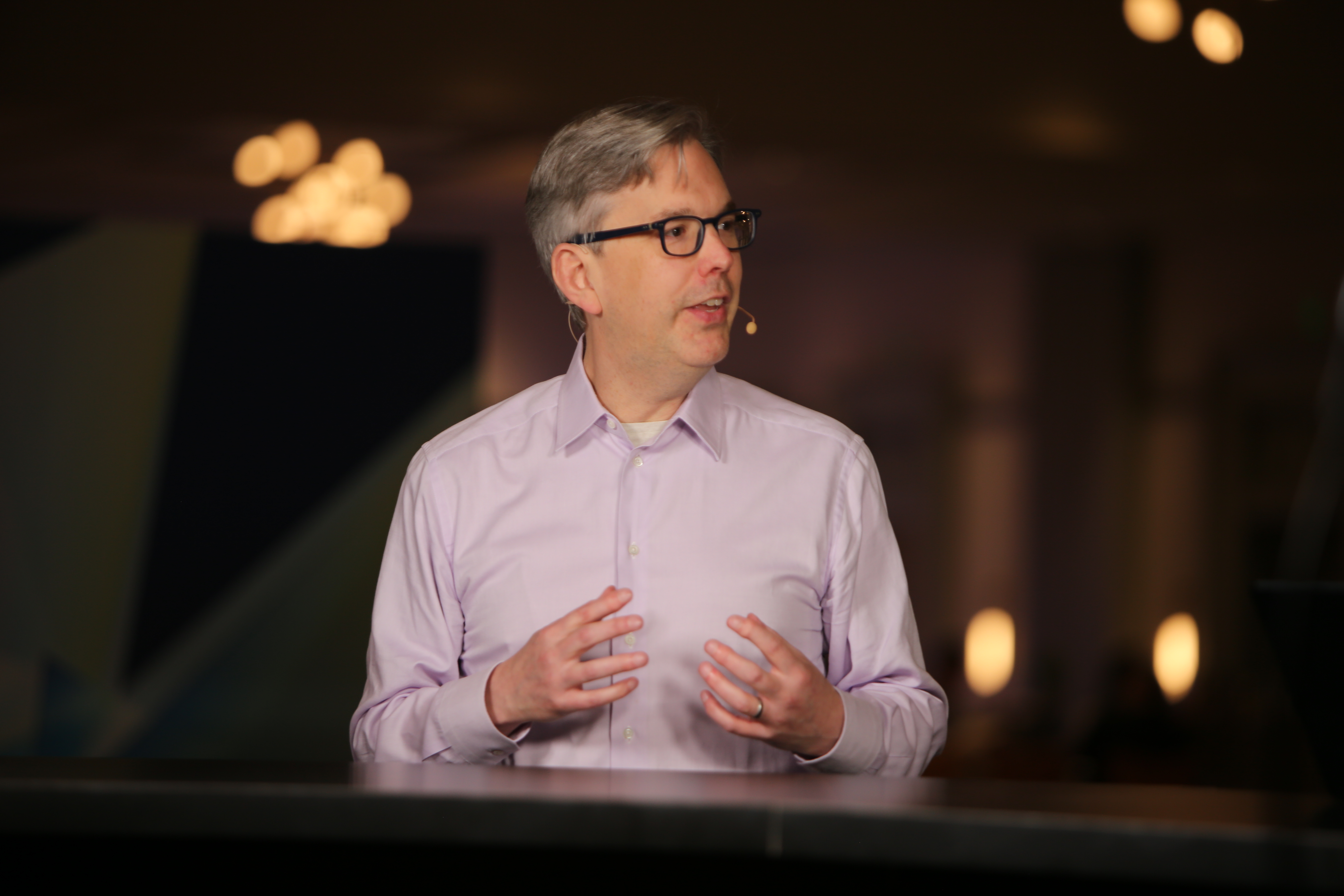
In this interview from Appian World 2026, Michael Beckley, co-founder and chief technology officer of Appian, joins theCUBE's Dave Vellante and co-host Alison Kosik to discuss how process orchestration is becoming the essential harness for operationalizing AI across the enterprise. Beckley traces Appian's founding premise — that employees should be creators, not consumers of technology — and ties it to the platform's current role bridging deterministic process automation with AI-driven reasoning. He argues that as code generation commoditizes, value shifts into two deeper layers: the orchestration harness that sequences AI agents and controls workflow, and the context layer beneath it governing data security, accuracy and governance. Appian's data fabric, he explains, acts as a virtual database that unifies siloed enterprise data without requiring migration, giving AI agents the grounded, auditable context needed to execute decisions reliably at scale.
The conversation also explores the concept of a "digital twin" of the enterprise — a real-time map of people, processes, data and applications that allows trusted agents to act across the full business. Beckley details a new Snowflake partnership announced at the conference, enabling direct access to Snowflake Cortex AI from the Appian data fabric and process engine, extending the platform's reach into a far broader landscape of enterprise data. He addresses the economics of AI reasoning, explaining how Appian's deterministic process engine lets organizations balance token consumption against operational need — burning tokens during AI-powered discovery, then running reliably without any once an optimal process is established. Beckley highlights Process HQ as the real-time telemetry layer that keeps mission-critical workflows on track against KPIs and SLAs even as AI velocity outpaces human oversight. From enabling customers like CIBC Mellon to productize their own workflows and sell them to peers, to empowering developers with new Composer tools for generating AI-native applications, Beckley provides a roadmap for how process-centric AI architecture will define enterprise leadership in the years ahead.
Forgot Password
Almost there!
We just sent you a verification email. Please verify your account to gain access to
Appian World 2026. If you don’t think you received an email check your
spam folder.
In order to sign in, enter the email address you used to registered for the event. Once completed, you will receive an email with a verification link. Open the link to automatically sign into the site.
Register for Appian World 2026
Please fill out the information below. You will receive an email with a verification link confirming your registration. Click the link to automatically sign into the site.
You’re almost there!
We just sent you a verification email. Please click the verification button in the email. Once your email address is verified, you will have full access to all event content for Appian World 2026.
I want my badge and interests to be visible to all attendees.
Checking this box will display your presense on the attendees list, view your profile and allow other attendees to contact you via 1-1 chat. Read the Privacy Policy. At any time, you can choose to disable this preference.
Select your Interests!
add
Upload your photo
Uploading..
OR
Connect via Twitter
Connect via Linkedin
EDIT PASSWORD
Share
Forgot Password
Almost there!
We just sent you a verification email. Please verify your account to gain access to
Appian World 2026. If you don’t think you received an email check your
spam folder.
In order to sign in, enter the email address you used to registered for the event. Once completed, you will receive an email with a verification link. Open the link to automatically sign into the site.
Sign in to gain access to Appian World 2026
Please sign in with LinkedIn to continue to Appian World 2026. Signing in with LinkedIn ensures a professional environment.
Are you sure you want to remove access rights for this user?
Details
Manage Access
email address
Community Invitation
Michael Beckley, Appian
At Appian World 2026, theCUBE Research interviews Michael Beckley of Appian, founder and chief technology officer. Beckley discusses Appian's approach to combining deterministic process orchestration with large language model driven reasoning, the company's data fabric and recent platform enhancements that enable secure artificial intelligence agents, process automation and scalable integration across enterprise systems.
Key takeaways include a strategic shift of value to orchestration and context and the importance of a secure read-write data fabric for trustworthy AI deployments. Beckley notes Appian's enhancements, including a partnership with Snowflake, enable virtualized data access, auditability and low-latency process execution. Hosts Alison Kosik and Dave Vellante note enterprises must couple orchestration, context and telemetry to lead in enterprise AI.
In this interview from Appian World 2026, Michael Beckley, co-founder and chief technology officer of Appian, joins theCUBE's Dave Vellante and co-host Alison Kosik to discuss how process orchestration is becoming the essential harness for operationalizing AI across the enterprise. Beckley traces Appian's founding premise — that employees should be creators, not consumers of technology — and ties it to the platform's current role bridging deterministic process automation with AI-driven reasoning. He argues that as code generation commoditizes, value shifts in...Read more
>> Welcome back to Appian World '26. We are streaming live in Orlando. I'm Alison Kosik, alongside Dave Vellante, and we are kind of in the pregame. We're watching the conference literally being set up before our eyes.
Dave Vellante
>> Yes, and people are starting to stream in. We're seeing the booths being set up, and this place will be hopping in a couple hours.
Alison Kosik
>> It will be. At least until then, let's get it hopping with another interview. We've got Michael Beckley, the founder and CTO of Appian, joining us on theCUBE. Welcome to theCUBE.
Michael Beckley
>> Yeah, thanks for having me.
Alison Kosik
>> So you founded this company. Where did you see the need? Why did you start the company?
Michael Beckley
>> Yeah. Why did I start the company? I ask myself that, why did I start the company? I actually saw a clear need for people to be able to be creators, not just consumers of technology. And in business, in complex businesses, in government agencies, in big banks, insurance companies, healthcare providers, creating is really hard. There's so much complexity to how you integrate with data, to how you have to consider so many different requirements, and so it's really intimidating. And so what I wanted to do was actually bring the tools of consumer technology to the enterprise and allow people to be inspired to create and provide their feedback and their ideas, because your employees are your best asset, and they have incredible ideas on how to improve a process and optimize the customer experience, and I just thought we could do that.
Dave Vellante
>> So as a CTO, how are you thinking about what's going on these days, where LLMs are coding, you see Elon putting down a bunch of dough for Cursor? Which is kind of remarkable and actually kind of smart. If you want to be in that business, you better have a coding agent. But as somebody who writes code and has written code and you're seeing this change, how do you think about this?
Michael Beckley
>> It's incredibly exciting. And I also love the irony in that some people think that AI is so smart, it's going to write all the code, and yet we see the AI companies are still writing a lot of code and paying billions of dollars, or tens of billions of dollars even, for code. So there's something else going on here. What I see is that there's a great mystery about how to make AI useful for more than just prototyping. How do you actually trust it? How do you make it reliable and repeatable and deterministic so that you can trust it for missions that matter? And building that harness around AI, that's what companies like Appian are doing, and it's really remarkable the value we're able to unlock.
Alison Kosik
>> Oh, go ahead.
Dave Vellante
>> Please. Please.
Alison Kosik
>> Just bouncing off what you said, if code creation is becoming this commodity, then where does the value actually move?
Michael Beckley
>> Yeah, so the value moves both to the harness, that is how do you orchestrate different AI agents? How do you ensure that the data they have access to is correct and accurate and is in the right context? And so it's not just the orchestration. It's also the context layer beneath the orchestration that the value moves into. So some people think the harness is just the state machine, the process, the sequencing, but it's far deeper than that. It's actually then how do you have security and governance over the data you share with your AI and then also make sure that it's accurate to make sure that it's not hallucinating?
Dave Vellante
>> So you know well, when we moved from on-prem software to SaaS, everything changed. The technology model, the operational model, the pricing model, it's happening again. And so the whole software stack is being re-imagined. We're not throwing away all the old pieces. The deterministic pieces are critical, we're realizing, in order to be able to trust agency, but there's this new thing. You mentioned context, there's this sort of intelligence layer that's emerging. LLMs are playing a key part of it. How do you see that evolving and what role does Appian play in your view?
Michael Beckley
>> Yeah. So there's definitely dramatic new opportunities to rethink the traditional software stack from just interface and logic and data. Now we're looking at a reasoning layer and a perception layer. And so the role for Appian is in providing that linkage between all of these pieces. So at that orchestration layer, Appian's known as a process company where we believe that a business is fundamentally a set of processes. And whether it's an ERP system, what they're doing is they're giving you a bunch of finance processes or HR. There's a bunch of human resources processes for onboarding, for recruiting. And what Appian does is allow you to connect the right AI and the right data at the right time to solve a problem. But then once you have that reasoning completed, Appian's role is to actually then allow you to accelerate how you automate. So you can now imagine being able to do the same right decision that AI brought you to millions and billions of times and get an outcome that you expect as opposed to being surprised in a bad way.
Dave Vellante
>> Okay. So you've got now AI in the mix and we were talking about earlier, you're bringing together the deterministic and the non-deterministic worlds together. Your customers, the linchpin of their value is their proprietary data, how they shape that, how they apply that, how they add value on their end. So I'm interested in how you help them do that. I get the orchestration piece. The context, where does that come from? And what role do you guys play there? Obviously the LLM is playing that role. Is that new invention required? What are you working on that you can share with us?
Michael Beckley
>> Yeah, of course. So nearly 10 years ago, we discovered that we had kind of made a mistake. In just building a process engine and a process orchestration layer, we had thought that the data problem that you're talking about, how do you integrate all these different data types, how do you integrate data from inside and outside the enterprise, how do you get supply chain partners to collaborate on data, to optimize production lines, well, we thought that was going to be solved by other people, and we were just wrong. It didn't happen. What happened was a bunch of companies all decided that they were going to compete to own your data, and the value proposition of the cloud became, "Give us all your data and we'll take care of you forever." And that didn't quite work out because, of course, you still have all these different cloud providers. And so Appian grew up to then realize we needed something new to weave these things together into a unified model for people to be able to understand, because you have customers and you have products and you have contracts and you have transactions, and they may come from different data sources. So we created the data fabric and we didn't create it for AI. We created it for systems to be integrated and for people to be integrated as teams in these workflows. And it just so happened that that's the necessary security, governance, and context of the business data that you need. Just like a human needs it, an AI agent needs it to understand how to make a decision and to make it accurately and to make it safely. And so the work we've done lately, and what we're announcing here at the show, is the enhancements to the data fabric to make it work great at massive scale and to make it work great with AI agents.
Dave Vellante
>> I want to pick up on the data fabric because it's an interesting part of your architecture and your announcements. When you think about data and departments, every department has their own data. We've got a $50 billion BI industry that was created so that people could have their own dashboards. But that data lives in silos, and essentially so do the departments. The promise, I think, and I'd love your CTO mindset feedback on that, the promise is that those barriers get broken down. That there's finally, in this industry, a single version of the truth, which we've been promising forever, but it's been elusive. Will that become a reality, and what has to happen for that to become a reality?
Michael Beckley
>> So it's becoming a reality, and AI is the opportunity and the forcing function because there's now so much incentive. People see how powerful AI can be, but without the right data, it's useless. You don't get anywhere near the value you'd think. And so people are implementing Appian data fabric as a precursor to rolling out AI enterprise wide to knock down all those stove pipes and unify them on a shared model and a clear semantic layer of the things you need to get access to in a secure and safe way. And data fabric provides a virtual database so you don't have to migrate the data, and you can leave it where it is if you want to and still perform these feats of wonderful context summarization and transactions can be executed across many different systems. And now agents can be coordinated even though the data isn't necessarily even all yours.
Dave Vellante
>> So just to put a finer point on that, because you said you went back a decade plus ago and you said, "Hey, we got to rethink this thing," is Appian, is it your job to do the harmonization of that data? You mentioned semantics, I think of like Ontology, you think of what Palantir's doing with a lot of heavy lifting. That is your responsibility, is that correct? That's IP that you ... Because that's a really high value piece of real estate in the new software stack.
Michael Beckley
>> It is, and it's a fair comparison. I would say Palantir's Ontology is the most similar technology out there in terms of creating a digital twin of your business to what Appian has. The difference being they came from an analytic perspective, like the business intelligence market that I came from myself long before I started Appian. And with Appian, we started with the premise of, well, you actually need to execute transactions. It's not enough to know you have to be able to do. And so we've put a lot of our intellectual property into the data integrity and being able to write and roll back if something fails and be able to always have a clear audit trail, and yet also to not assume that you cannot migrate all that data into one place. The data fabric is so different from any normal ontology because it works as well with remote data as it does local data.
Dave Vellante
>> The light bulb just went off. I know, Alison, I'm like dominating here-
Alison Kosik
>> You're fine.
Dave Vellante
>> ... but when you said, Michael, a digital twin of the business, that to me is the north star of any organization. Rather than speaking in strings that databases understand, I want to have a 4D map of my enterprise, people, places, things, and activities, or processes in your case, so that in real time I can see the state of my business. You've mentioned state machine before, but then I want to be able to have agents act on that in a trusted way. Now there's a journey. That's going to take, I think, the better part of a decade to actually evolve, but is that the right ... Am I getting it right? That to us is the north star of what enterprises want.
Michael Beckley
>> You're getting it exactly right. As you said, where's the value moving? Because writing code is easy. The value is in making effective business processes that you are so good that you can actually not just optimize your own business, but you can turn them into digital self-service experiences for customers and even sell that process to your peers and competitors. A lot of the customers here at Appian, at the show are talking about their journey to do just that. They are mapping out their data, they're integrating their view of their customers and their products, and then they're creating new digital products that are so good at, say, custodial services like you just heard from CIBC Mellon, that they can then sell that as a process to other banks and other investors.
Alison Kosik
>> If we fast forward a couple of years, what really defines successful enterprise AI architecture? What would the winners be getting right?
Michael Beckley
>> Yeah. So what they get right is that it is both orchestration and context. And so it's very important that you're able to map out a process end to end, and measure it, and monitor to always know you're getting the results you expect, especially at AI velocity. It's very hard for humans to keep up. And so mapping it out in a process that is giving you the real time telemetry is very important to knowing that your processes are on track and that you're hitting your KPIs and your SLAs. And then the second part is that actual context layer, that context graph of the data and relationships inside and outside the business. And if you get that right, then you can work with third party agents, you can work with agents in Appian, for example, and coordinate them very safely. There's another layer of context as well, which is as you're modernizing all of your applications to keep up, to work with this new business layer and to interact with these new orchestrations, well, you need to be aware of those application objects, the workflows, the interfaces, the actual logic and the business rules. Those are many, many different objects that have layers of dependencies, and that's its own context graph. And so being able to couple those three things together, that will be the hallmark of a business two years from now that is actually leading the AI revolution.
Dave Vellante
>> Okay. So you're developing what we sometimes call the system of intelligence, this cognitive layer. You've also got the orchestration layer. Sometimes we call it the agent control framework. That's sort of our geeky term. And what you just said is that you're able to interact with, ingest, I don't know, communicate with the metadata and application logic and process knowledge that lives in other applications. It might be Salesforce, it might be ServiceNow, et cetera. You saw the headless stuff that's been coming out. People are taking different approaches. We saw, I don't know, a year ago now, Nadella trolling Benioff saying, it was ironic, he said, "The future of SaaS is agents talking to a CRUD database." Isn't that ironic that everything that he has in his personal productivity software is in a file format that's open now? But the world is changing. You're playing into all that with, basically, it sounds like you're evolving your architecture for the future of that digital twin of an enterprise.
Michael Beckley
>> Well, and it's not just us. There is clearly some convergent evolution happening in the market right now. Everyone has figured out that the scaffolding is getting commoditized. That Anthropic leak a month ago, we saw their scaffolding, everyone saw how they're doing it, and that's driving even more rapidly everyone to add scaffolding like Nadella was talking about. He's saying that the value is, beyond the AI model, it's in how you connect it and control it. And then he wants to directly connect it to other people's systems of record. But the important thing is, it's not just one change, it's actually the combination of things. In the same way the iPhone, Apple didn't invent the mobile phone, they didn't invent the touchscreen, they didn't invent the web browser. They didn't invent even, maybe they sort of invented multi-touch, but you get a critical mass of innovations together and suddenly we have this breakthrough where we can trust AI to do multi-step long-running processes for banking, for insurance, for healthcare, because we've now got the process orchestration, the data context, and the application context in a way that humans can manage and understand and control.
Dave Vellante
>> And you don't have to own per se, the transaction substrate. You can just interact with it. You don't have to be Oracle.
Michael Beckley
>> No.
Dave Vellante
>> Fine, Oracle's going to do their thing. You just have to be able to plug in and out of it.
Michael Beckley
>> Yeah. Appian is that mortar that connects your enterprise bricks. We are not trying to replace all those systems of record. It's way too expensive and difficult to do rip and replace. That's the genius of the data fabric is allows you to leverage what you have and then orchestrate it with our process engine.
Alison Kosik
>> Yeah. I was going to say, how much is orchestration effectively becoming the new operating system?
Michael Beckley
>> I think that's a great analogy. Maybe we should use it more. Yes.
Dave Vellante
>> And you don't have to move the data with data fabric. That's the genius of it. How do you do that?
Michael Beckley
>> So that's a few hundred million dollars in R&D. So we optimize our awareness of how that data is stored, what it is. We index it. We understand the shape of the data. We also have some really exotic technology for how we can optimize those queries and anticipate them as well. We're monitoring how you use the data fabric so we can anticipate that your data access patterns, your query patterns, and optimize them ahead of you. And so all of that's a critical part. But there's also the data governance layer. How do you secure it by row and by column and by role and by attribute? And we build a data catalog with the lineage. So it's not enough to show people why they're making a decision. You have to show them the data that you're trusting to make that decision and where it comes from.
Dave Vellante
>> And your data catalog will sit above, think of something like down low in the stack, like a Polaris or a Snowflake Horizon. You're up above that and you can interact with those in a read-write fashion. Is that right?
Michael Beckley
>> Exactly. Read-write. People attempted data fabrics before, but they really were more analytic only and the writing took a lot of custom code. We're natively read-write and we're announcing here at the conference our new partnership with Snowflake to make it all the more optimized to access Snowflake Cortex AI directly from the Appian data fabric and Appian processes.
Dave Vellante
>> Oh, we're going to be at the Snowflake Summit. We've done, I think, many of the Snowflake Summit. So hopefully see you there. It's interesting to see their expanding ecosystem, which they have to do because they changed the world of analytics and now the world changed again. And so they've got to really expand their ecosystem with partners like you guys.
Michael Beckley
>> Yeah. We're really excited. It has a lot of overlap between our customers. People have been asking for this for a long time, and it really extends the reach of Appian into really an infinite landscape of new data.
Dave Vellante
>> What are your thoughts on the state of frontier models? What's your relationship with the LLM vendors? When gen AI first came out, John Furrier and I published The Power Law of Gen AI. And I look back, it's kind of trivial now. We had, "Oh, you'll have all these small specialized models." And of course that happened, but the frontier models are so functional and they're getting so good, and so they're kind of grabbing more of the value. How do you think about that? What's your relationship with those? They change the benchmark. Elon's making chess moves. How do you think about it as a CTO?
Michael Beckley
>> Well, we partner with all of them, but part of our value is in protecting our users from having to guess right. If you had to pick the right car company in 1910, you'd be in trouble. 100 car companies and how many survive. And the same is true with these frontier models. Even though right now, you might think, even month to month or day to day, it changes the lead between Anthropic or OpenAI or DeepSeek. Just today, there was a headline that Jensen is saying he's going to spend, what, 26 or $27 billion to build his own competitive models. So really using Appian means that you always have model choice and we're able to absorb those changes in what capabilities you're able to deliver without you being set back. So for example, you saw the Anthropic controversy in the federal government. Appian customers are able to take advantage of switching out to different models without impacting their mission because when you're building on Appian, that process just keeps working. It's our responsibility to make sure that underneath the covers, it's still being prompted in an optimal way and that the model's giving you the best answers.
Dave Vellante
>> So with so much changing, you got to pick your spots in terms of where you add value, and you got to make sure that you don't add value in a place that, like you say, an LLM vendor is not just going to come along. And so how do you think about that? How would you describe to our audience Appian's unique value, that sort of area where you are going to be the best at, your kind of home court, if you will?
Michael Beckley
>> Yeah. So we're not some software startup where we can only do one thing. In fact, our value is really as an integrator to solve the hard problem of how do you make AI useful in a process in a mission that matters. And so it would be easy to say, Appian's a process company, our process orchestration layer will always be the best. We have Process HQ, that gives you real time insights in a way that's very hard to replicate. And we have this incredibly powerful process engine which can handle all different types of workflows and it can do it with very, very low latency in milliseconds. And it's very difficult for an LLM to match because when an AI agent reasons, it takes a second or more to make the next decision by design. And the more it reasons, the better decision it can make, but you don't always want that. In fact, tokens are expensive and they may become exponentially more expensive someday when investors stop subsidizing the AI boom. And so you want to have the right mix of intelligence and determinism. And so yes, Appian's AI orchestration layer is great, but we also have this context layer and that's a deeper layer of value that I see as enduring because it's very difficult to replicate.
Dave Vellante
>> Interesting about your comment about, well, you mentioned Jensen and he wants to be on the frontier of everything, but your point about tokens, they are expensive. I'm hopeful that the cost per token keeps dropping like a rock because that's where innovation is going to explode like it did with Moore's Law. If I'm wrong about that, that probably creates new opportunities, but what are your thoughts on that?
Michael Beckley
>> Well, I don't want to see token prices go up, but the fact is building on an Appian or Appian-like solution means you have a lot of levers to pull to optimize your token usage and decide when you want more. LLM review, a second reviewer, if you will, on a process to make sure that you don't even need to have humans looking at things, you can get more straight through processing. But if tokens are too expensive, well then we can insert a human reviewer and you can dial back on things and being able to find that best process with AI discovery, burn a lot of tokens doing it, and then reliably run it without any tokens at all through Appian's orchestration engine.
Dave Vellante
>> Well, one would hope with all this CapEx that the AI factory is going to keep getting more economical.
Michael Beckley
>> Yeah, we can hope.
Dave Vellante
>> Yeah, yeah.
Alison Kosik
>> What are the conversations you're looking forward to having at the conference?
Michael Beckley
>> So there are so many customers here who have been delivering so much real value with AI, and that is what I'm excited to see. Customers who are actually showing real patterns for how do you go about introducing AI in a process, where is the right way to introduce digital workers into a long running interaction between suppliers and shippers and in financial services and insurance. We're seeing such creativity and how people are looking at introducing AI into their customer experiences. That, to me, is the real excitement. And again, also, this is the biggest concentration of Appian developers we get all year. And they are so excited and so looking forward to sharing their thoughts about how they're using the new Composer tools to actually use the power of these LLMs we're talking about, but to generate safe, modern applications in Appian. There's just so much creativity that that's unlocking. I'm really excited to see it.
Dave Vellante
>> Well, looking forward to seeing you guys at Moscone, at the Snowflake Summit in June. Love to have you back. It was a really interesting conversation.
Alison Kosik
>> Yeah.
Michael Beckley
>> No, thank you. I look forward to it.
Alison Kosik
>> Thanks so much for your time.
Michael Beckley
>> Oh, thank you.
Alison Kosik
>> And you're watching theCUBE, the leader in live technology coverage. We'll be right back.










 Alison Kosik
 Dave Vellante