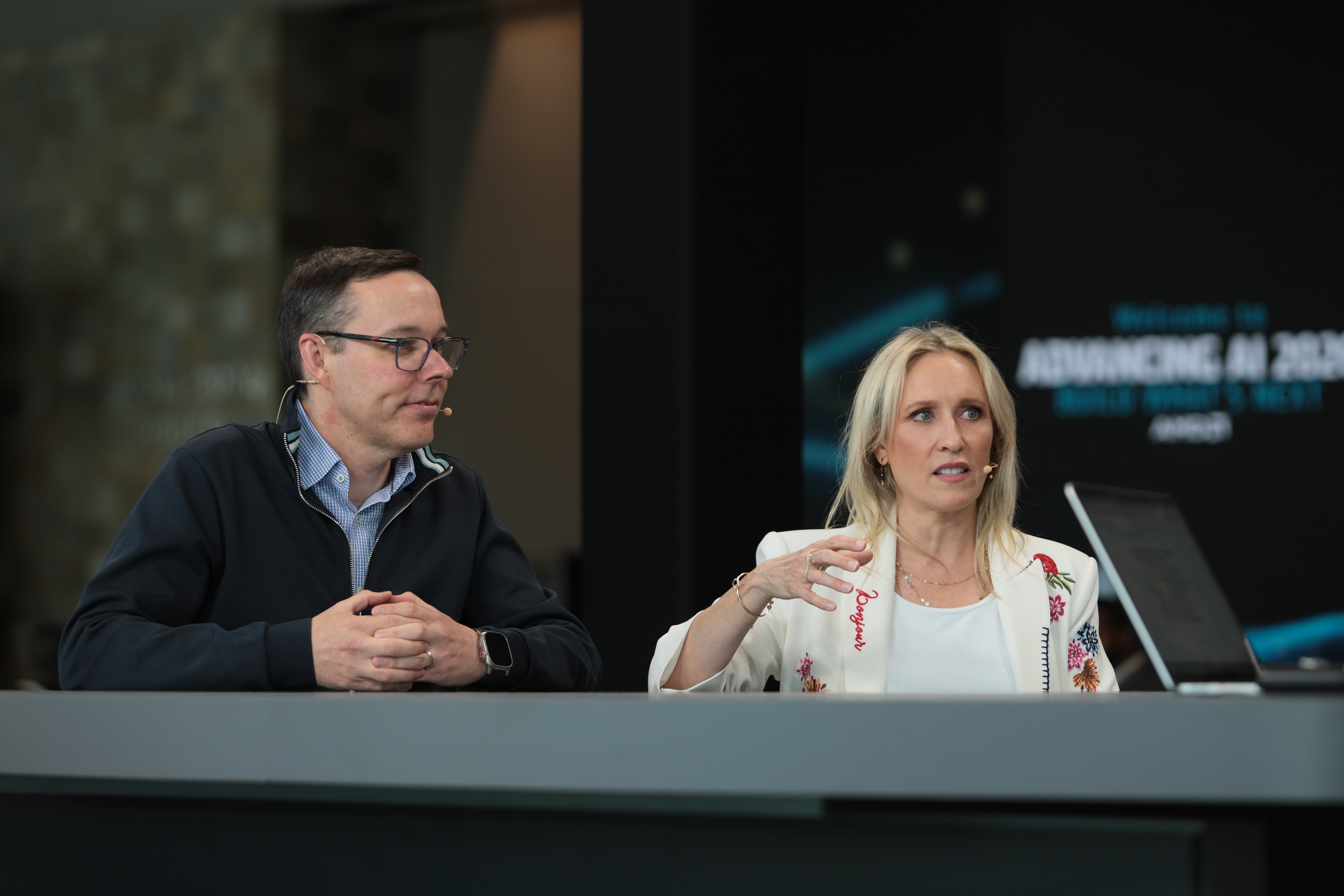
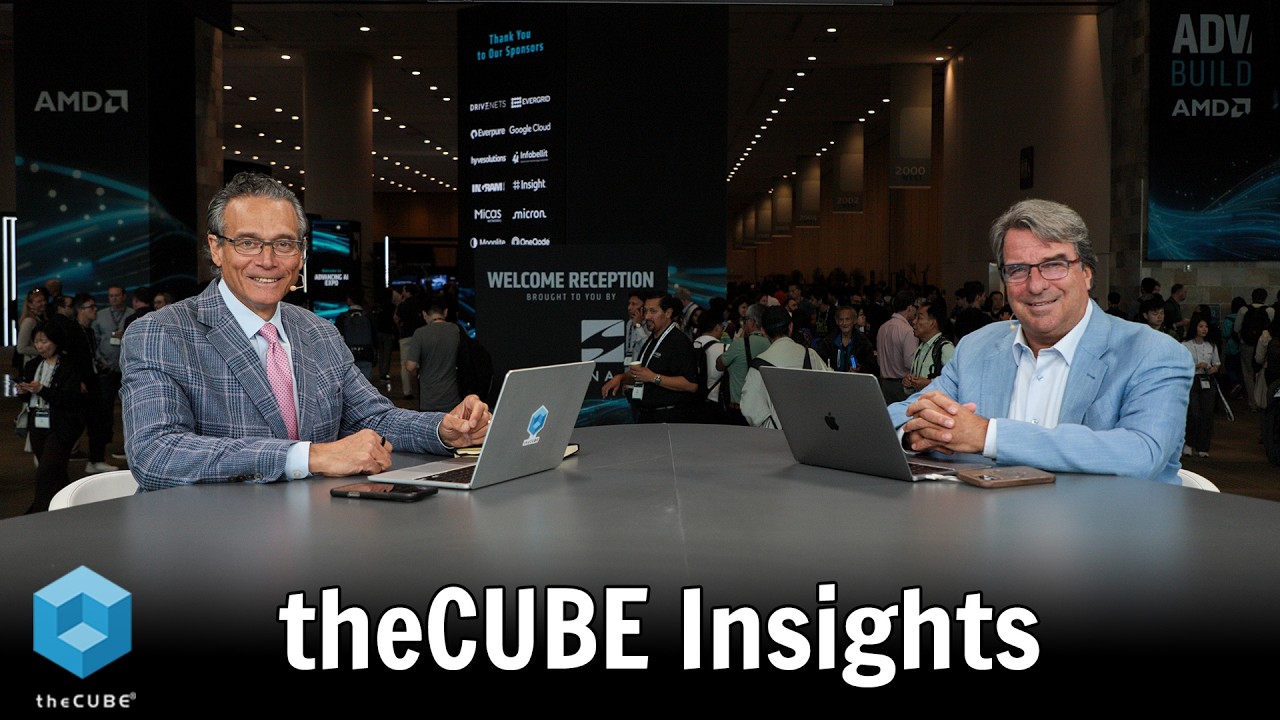
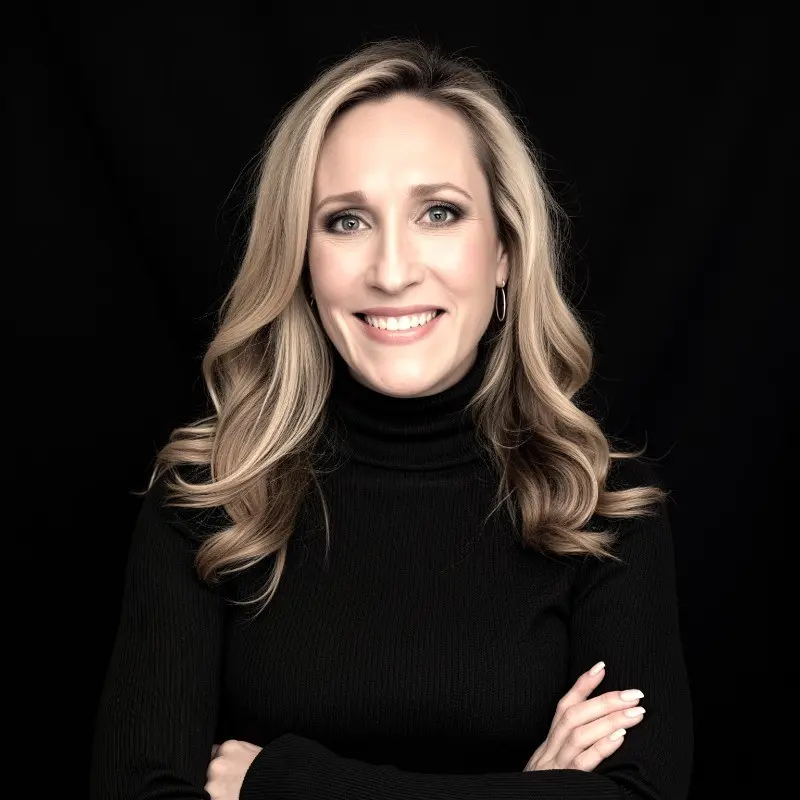
This discussion at Advanced Micro Devices' Advancing AI 2026 in Moscone West examines Microsoft Azure infrastructure strategy and co-design with Advanced Micro Devices, including Helios rack-scale systems and strategies for scaling artificial intelligence workloads.
Jessica Hawk of Microsoft, corporate vice president Azure Infrastructure; Alistair Speirs of Microsoft, general manager Azure Infrastructure; and Dave Vellante of SiliconANGLE Media, Inc., co-founder and co-CEO join Bob O'Donnell of theCUBE Research to explore Microsoft Azure's infrastructure approach and co-innovation with AMD. Hawk emphasizes end-to-end collaboration from chip to data center and they highlight the role of silicon diversity and system-level co-design for scalable AI. Speirs observes that Helios completes the picture for deployment at scale and they describe how rack-scale systems support global data center rollouts. Vellante notes rising agentic AI compute demand and they discuss the need for FinOps and improved observability.
The conversation covers rack-scale design, software-hardware integration, Radeon Open Compute abbreviated ROCm and open platforms, Azure AI Foundry and how ecosystem-first engineering enables workload portability, optimization and emerging distributed AI patterns.
Key takeaways include the importance of silicon diversity and system-level co-design for scalable AI, the need for FinOps and observability to manage agentic AI compute demand, and the value of platform approaches such as Helios and Azure AI Foundry for deployment and workload portability.
-design
Forgot Password
Almost there!
We just sent you a verification email. Please verify your account to gain access to
Advancing AI 2026. If you don’t think you received an email check your
spam folder.
In order to sign in, enter the email address you used to registered for the event. Once completed, you will receive an email with a verification link. Open the link to automatically sign into the site.
Register for Advancing AI 2026
Please fill out the information below. You will receive an email with a verification link confirming your registration. Click the link to automatically sign into the site.
You’re almost there!
We just sent you a verification email. Please click the verification button in the email. Once your email address is verified, you will have full access to all event content for Advancing AI 2026.
I want my badge and interests to be visible to all attendees.
Checking this box will display your presense on the attendees list, view your profile and allow other attendees to contact you via 1-1 chat. Read the Privacy Policy. At any time, you can choose to disable this preference.
Select your Interests!
add
Upload your photo
Uploading..
OR
Connect via Twitter
Connect via Linkedin
EDIT PASSWORD
Share
Forgot Password
Almost there!
We just sent you a verification email. Please verify your account to gain access to
Advancing AI 2026. If you don’t think you received an email check your
spam folder.
In order to sign in, enter the email address you used to registered for the event. Once completed, you will receive an email with a verification link. Open the link to automatically sign into the site.
Sign in to gain access to Advancing AI 2026
Please sign in with LinkedIn to continue to Advancing AI 2026. Signing in with LinkedIn ensures a professional environment.
Are you sure you want to remove access rights for this user?
Details
Manage Access
email address
Community Invitation
Alistair Speirs & Jessica Hawk, Microsoft
This discussion at Advanced Micro Devices' Advancing AI 2026 in Moscone West examines Microsoft Azure infrastructure strategy and co-design with Advanced Micro Devices, including Helios rack-scale systems and strategies for scaling artificial intelligence workloads.
Jessica Hawk of Microsoft, corporate vice president Azure Infrastructure; Alistair Speirs of Microsoft, general manager Azure Infrastructure; and Dave Vellante of SiliconANGLE Media, Inc., co-founder and co-CEO join Bob O'Donnell of theCUBE Research to explore Microsoft Azure's infrastructure approach and co-innovation with AMD. Hawk emphasizes end-to-end collaboration from chip to data center and they highlight the role of silicon diversity and system-level co-design for scalable AI. Speirs observes that Helios completes the picture for deployment at scale and they describe how rack-scale systems support global data center rollouts. Vellante notes rising agentic AI compute demand and they discuss the need for FinOps and improved observability.
The conversation covers rack-scale design, software-hardware integration, Radeon Open Compute abbreviated ROCm and open platforms, Azure AI Foundry and how ecosystem-first engineering enables workload portability, optimization and emerging distributed AI patterns.
Key takeaways include the importance of silicon diversity and system-level co-design for scalable AI, the need for FinOps and observability to manage agentic AI compute demand, and the value of platform approaches such as Helios and Azure AI Foundry for deployment and workload portability.
-design
play_circle_outlineAzure and AMD long-term partnership and increased co-innovation
replyShare Clip
play_circle_outlineRack-to-Silicon Co-Design: Custom Silicon Diversity for Cost and Performance Optimization Across Chips, Networking, Data Centers, and Software
replyShare Clip
play_circle_outlineHelios rack completing AMD's system-level offering and validating ecosystem alternative
replyShare Clip
play_circle_outlineFrom CUDA to ROCm: Triton and Open Platforms Enabling Portable, Compiler-Agnostic AI Code Generation
replyShare Clip
play_circle_outlineDistributed AI workloads: Azure Local, edge, devices, and orchestration needs
replyShare Clip
play_circle_outlineAgentic AI causing surge in compute demand and infrastructure scaling challenges
>> Hi everybody, welcome back to Moscone West. This is theCUBE's live coverage of AMD's Advancing AI 2026. 14 ,000 people registered. Lisa Su's keynote today, I don't think there were 14 ,000 people, I don't think that many fit Bob O'Donnell inside of Moscone West. We're going to need a bigger boat. I'm Dave Vellante, and we're excited to have Microsoft in the house, we're going to talk Azure. We got the great hats, Alistair Speirs is here, he's the GM of Azure at Microsoft, and Jessica Hawk is the corporate VP at Azure, of course, at Microsoft. Thanks guys for coming in, really appreciate it.
Alistair Speirs
>> Thanks for having us.
Dave Vellante
>> So long term relationship with AMD, of course. Take us through that relationship, and how would you describe the current form?
Jessica Hawk
>> Well, our mission is to empower, and we really mean that. And when I think about Azure in particular, we're here to build the best compute platform on the planet. And we think of that as something we do with the ecosystem. I think we've been an ecosystem -first company for quite some time. Before I joined Microsoft, I actually came out of the ecosystem, so I understand what it's like to be a partner. and we believe our customers and the industry needs that diversity and competition to meet the moment. And so our relationship is long, and I would say in terms of what's evolved over the last couple of months and years is really with the AI race that we're all living through and witnessing and driving, frankly, we have an increased level of co -innovation and engagement to meet the moment.
Dave Vellante
>> Well, speaking of competition, Alistair, Azure's been on an incredible run. obviously, AWS got the IaaS and PaaS all started. I've been watching very closely the Azure ascendancy and trying to dig into the numbers and really understand your business. And just to see what a flywheel effect that has created between your software business, how you brought in the AI piece of it, what a tailwind that created, all the changes we've seen there. What's going on with Azure? You listen to the earnings, we listen to earnings calls, more demand than supply. How are you approaching that? Are you running out of storage and compute? How are you dealing with the demand?
Alistair Speirs
>> it's been a phenomenal run, as you mentioned. So every breakthrough, every capability is really driving more and more usage for the cloud. Whether it's Xbox or Excel at Microsoft, every part of our business is accelerated by the cloud, is more and more powered by Azure. So the work that we're doing with organizations like AMD to really co-design, optimize, and build more of this capability, we don't have a problem finding a use for it. It's really about finding the best use for this capability right now.
Dave Vellante
>> So double-click on the co-design, because that's something we've been talking about for a while. NVIDIA talks about extreme co-design, it's internal, but AMD very clearly communicated that they're co-designing with the ecosystem. Jessica, you've mentioned how important ecosystem is to Microsoft. What are the salient aspects of that co-design and the co -engineering?
Alistair Speirs
>> I think I would put it in two parts. First, on the compute side, we have a shared love of x86, and perhaps more so than many others in terms of squeezing the most out of that platform, both on the operating system side, the cloud side, and of course also our application side on the data tier, SQL Server, all the way up to our cloud-native data platforms like Fabric and our AI platforms like Foundry that need to be fed by all this data really fast as well. So as we engage with AMD, as we're looking at that platform, you really have to design this whole thing together from the data center, the facilities, the rack, the hardware, the power distribution, the networking, and then of course the software as well. So as AMD is working on that chip and working on the trade -offs that they're making between bandwidth, cache, chiplet design, we're also thinking about how we will implement that in software as well as how we'll roll that out at scale in our data centers all around the world.
Dave Vellante
>> I'm glad you brought that up, Alistair, because we've been doing a lot of research on what the new AI software stack looks like. And we're actually very high on what Microsoft are doing because you've got the new client surface, whether it's for developers or business people, with things at the back end, like you mentioned Fabric, you've got this context and system of intelligence layer, Alex Karp calls it the ontology. You've got the governance frameworks, you've got the ecosystem as well. How do you see that all coming together and what are the requirements that are needed that are different that you're seeing?
Jessica Hawk
>> Yeah, well if you've ever built products or any kind of software solution, you know that that feedback loop, it's gold. And the days of putting surveys into products and hoping your users might tell you something, I think we're kind of done with those days. And so the value of the 1P, what we would call a first party internal feedback loop cannot be overstated. And so whether it's because we're literally, as Alistair said, thinking about the physical aspects of the data center build out, or the software layer that sits on top, and we could start with IaaS and get to PaaS and then get to SaaS based solutions like Fabric. We're in this beautiful moment where we're co -developing all of these things almost at the same time, which is really rare. If you think, we're, I like to say we're grandparents competing with teenagers and toddlers. Let it be said, we are a little longer in the tooth than others, perhaps, but that cycle has typically meant that we has products that were at different stages of maturity and therefore it became this kind of after the fact bringing together. Whereas right now, between the very first launch of Azure OpenAI Service, which was in the beginning of 23 to when we brought Fabric to market just shortly thereafter, to all of the innovation that's happened since then with Copilot and most recently Microsoft IQ, which is what you're thinking of with that context layer, we're bringing these things together as a team. And that extends all the way into the physical layer that Azure's powering all of this.
Dave Vellante
>> What I find interesting,
Alistair Speirs
>> just to follow up specifically on AMD, since we're here at the AMD event, is, and Alistair and I, fortunately enough, were able to have an interesting conversation last night on some of this. And you talked about how the industry is looking for some competition. they're looking for alternatives, right? NVIDIA does amazing stuff, but let's be honest, you want to have more people involved. But it felt like it took the rack to really kind of make it real, right? everybody's been talking about AMD as this great alternative. But frankly, without Helios, it didn't feel like it was really legit. that's a horrible thing to say, and it's not true. It completes the picture, though. But it does. And it makes it feel okay, now this is real. Obviously, then they've committed to multiple year timelines. how big of a deal was that for you guys in terms of bringing AMD in? Is the release of Helios really kind of making that part of your overall story?
Jessica Hawk
>> Oh, we couldn't be more thrilled. We need this collaborative silicon diversity, but also it completes the picture because we're not building point solutions, we're building systems from the ground up. And so we need that complete picture to bring the value that our customers have.
Alistair Speirs
>> It's tough to get these bigger building blocks, really. We're building bigger and bigger data centers, so being able to, instead of thinking about chips, think about the system, think about the rack scale system and all the stuff that is embedded with that, that is co -designed together at the rack level that can then plug into our data center that's designed at that scale. It's a massive unlock just to be able to scale this system out without having to pull together multiple different components.
Dave Vellante
>> One thing I do want to ask about,
Alistair Speirs
>> because we've heard in the past there's been this moat around CUDA, right? And that was a big challenge. So how did you guys address that in porting over a lot of your applications to run on AMD and how can others potentially learn from what you guys did? Yeah, CUDA's a phenomenal platform, super successful, a lot of support out there in the market. And ROCm's really gone in leaps and strides as well. So this open source, open platform kind of capability, it unlocks a lot. At the same time, the scarcity of GPUs and access out there has driven a lot of innovation, right? And I think OpenAI has done an awesome job with Triton of building this abstraction layer, compile layer that can be optimized for ROCm, optimized for CUDA as well. So that helps a lot. And the second thing I would say is this code generation, what we're seeing with agents being able to do now, GitHub Copilot, it's not the developer writing the code anymore. And this is low-level code now, written by the system themselves. It's just pretty phenomenal. And when you think about all of the legacy code that exists in the world, not just AI compilers, but think mainframes, think those AS/400 systems, the COBOL systems that are out there, now with this agentic AI capability, the systems can kind of refine themselves, re-optimize for the platforms they're on, which is just a phenomenal step change in what's going on.
Dave Vellante
>> Well, they can also understand it, right?it's so complicated, the legacy hairball code.
Alistair Speirs
>> Well, and the other thing is, and I thought one of the most interesting parts of the keynote today, excuse me, was the ROCm.ai. The idea that, hey, we can create this tool and let AI port this GPU code over to AMD and just, all of a sudden, that solves a huge problem there. And so that to me, I think, was particularly intriguing, and it just shows you that, yes, their open approach and how they're doing all that, I think, really is paying off for them, and I think, sets them up very nicely for the future.
Jessica Hawk
>> Well, I think history tells us what this path will look right? Developers in particular will insist on extensibility and open and choice and access to all layers. If I just take, let's take SQL Server for an example. Still running most of the world's most important workloads, whether it's the on-prem version or in the cloud in Azure. And then we have a solution like Microsoft Fabric that is a fully SaaSified solution that doesn't allow that same layer of access and control that the most seasoned DBA will demand if they want to just tweak and tune it just a little harder to get a bit more performance out. That's what I think about when I think about the value of the ecosystem approach that we're taking here. As Microsoft, we want to power the world's software needs and therefore we'll have this wide spectrum of developers and some will want, I want something that I already understand completely, it's very quick, easy to get started. Some are going to want a super deep level of access down to the hardware and infrastructure itself and we intend to offer everything that our customers could ask for and give them that nice connected spectrum of capability that they can shift up and down.
Dave Vellante
>> So many of the assumptions and narratives early on in Gen AI have just been thrown out the window. One model to rule them all, everything's going to the cloud, token costs don't matter, et cetera, et cetera. You guys remember 2020 and the pandemic, everybody was going to the cloud, they has to. And then 2022, when we started to come back to life, It was all about cost optimization. You has to respond to that. Now you're hearing about, oh, token cost is out of control. How are you addressing that? What are you doing to help customers manage those costs, both visibility and being more efficient?
Jessica Hawk
>> I'll start. I would say if I were to guess what the theme of 27 might be, FinOps is definitely in my, It's on my bingo card for sure. And so at a software layer level, you'll see us continue to do things like we've announced Agent 365 and it is that end -to -end observability of everything that's happening in the enterprises with regards to agents, the ones that they build on the Microsoft platform, and the ones that they've chosen to build with others. So we're always going to take our responsibility to help enterprises govern their IT very seriously and that's what we do with Agent 365. where I think it connects to what we're doing today is in order to deliver that cost performance efficiency that the frontier's going to keep insisting we deliver on, then that's where silicon diversity and choice becomes really important. That's always been our goal here with our relationships with our great chip partners is to deliver that as well as our own custom silicon when we're thinking that that might be useful.
Alistair Speirs
>> And that plays in beautifully to another theme that Alistair and I talked about last night and was a big theme here today, and that's this notion of distributed workloads, right? Distributed AI workloads. And what's the opportunity for things like Azure Local and bringing some of this compute there, obviously even onto devices themselves. AMD's got an interesting story to tell there. And in my mind, Microsoft as a whole, not just Azure, but Microsoft in sum, could potentially play a very interesting role in becoming that orchestrator, that semantic router, whatever people like to use, to figure out how do I break up workloads and send some of it to Azure in the cloud, send some of it to an Azure Local instance within an enterprises, and then perhaps do some of it here, all related to the token FinOps, tokenomics, whatever we want to call it, of reducing these costs.
Dave Vellante
>> How are you guys thinking about that?
Alistair Speirs
>> Yeah, it's got to be an open platform here, and it's got to be a diverse platform. this capability changes. You want to have the right workload running on the right infrastructure with the right model at the right time. So having that, we overuse the word fungibility because that's really what we're doing here, moving these workloads around, finding the best use case for them, and that will change. And so being able to very quickly move that, switch that around, and our Foundry platform helps do that. But as we build Foundry, how do we make sure that we have Foundry on our Azure Local environment? Foundry Local that can run similar models on the edge if that makes more sense. Or even all the way down to the devicewith Copilot+ PCs as well. So we're really thinking about the AI touching everything. Touching every aspect of technology which is just kind of crazy. You don't really see these revolutions very often that just have such a broad impact on every facet of technology. Yeah.
Dave Vellante
>> Well, the interesting thing about this one is, when we went from on-prem to cloud, the operating model changed, the pricing model changed, the business model.
Jessica Hawk
>> That's right.
Dave Vellante
>> The technology model obviously changed for SaaS, but it really only affected the IT department.
Dave Vellante
>> Exactly, yeah.
Dave Vellante
>> And of course, software vendors, right? The SaaS companies. Now, all three of those dimensions are changing, but it affects every part of the organization, every industry on the planet, every country, everything. And that's...
Jessica Hawk
>> That's what's different, right? It's really different, yeah. It's all happening at the same time.
Dave Vellante
>> And you can imagine, if you play this forward, if we're right about the impacts of AI, those who apply it best are going to have, it's almost like they're going to get software-like marginal economics in every business. You're going to have a winner take most dynamic, potentially, in every industry. And so getting on that AI curve fast is going to be, we call it services as software, almost flipping the equation.
Alistair Speirs
>> Look, it's here to unlock human ambition, right? Giving the capabilities for anyone to be a rock star coder to solve the problems they need. What I'm really interested in is this very personalized software. The app that you write just for you, all of a sudden, now we're not writing these big, broad systems, but the systems are able to be customized so much that you can really solve your problem and the problems that you know best, that you would need a massive developer team if you were going to do this even a year ago. Now we can start to do this automatically with no code required.
Dave Vellante
>> So maybe this is, maybe not your swim lane, but Azure is the platform for what I'm about to say. Yeah. Is that there was an edict from CEOs, thou shalt do AI, and we have not has a sustained high single digit productivity, improvement since the PC era. And the promise is we'll have that, but so there was that edict top down, and now we're seeing this bottom up, to your point, Alistair, these individuals learning AI. The risk is we start to create silos of intelligence. Azure is potentially this platform that can help bring that all together, the software stack that you guys are building. How do you see that building out? Is that something you guys think about and talk about with your customers?
Jessica Hawk
>> It's fundamental, so I'd say two things. One, I call it the cycle of convincing. There's always been this cycle of convincing, and generally it's IT -led, of finding a new pattern or a new opportunity and then begins the process of convincing. So you first convince your boss, and you convince your boss's boss. You get to your CIO, eventually you get to the CFO, you've got to make the pitch. That absolutely did not happen with this one. It's a complete reversal. My theory is because a lot of the people who are sitting in decision seats in enterprises watched the dot com era and saw what happened to those who didn't engage. And so there's a completely different approach. So it is absolutely top down pulling up. The good news is the access to the capabilities has massively exploded, which I think is so required to get that learning and that, what we call ubiquitous innovation, that's how we think about this. Anyone can be a coder. Anyone can take advantage of these capabilities. And then we're making them available to everybody through our various tools. Microsoft 365 is sitting on the desktop of most information workers and decision makers, right? That is a solution you can actually build your own personal agent with if you'd like. It then gets connected and extended with Copilot Studio for the departmental team that's more in the day in, day out of software making, but not quite the pro dev team. And then it goes to GitHub and Foundry where it's all pro code. Everything is supported by that same foundation. And the Microsoft IQ layer is the thing that is pulling it all together. Because our bet is that as this agentic AI starts to mature, companies are not going to want the same things being built a thousand times over in different places, they're actually going to get to a point where they're going to have points of view on what the best version of that capability is, and they're going to want to be able to build that, evaluate it, and then scale it. And that means you need a connected platform that allows these systems to talk together. So your innovator in the sales department can then connect to what the pro dev team can do, and then once that gets hardened and is working great, let's go give it to the other departments that could use the same capability. That's what we're doing with Microsoft IQ, building that portability of agent capability across the Microsoft Cloud.
Dave Vellante
>> We talk all the time about deterministic and stochastic software, and the fact is, even determinism is a myth. You've got determinism within the finance department, or the HR group, and so the tacit knowledge of the enterprises is hidden. And what you're talking about with IQ is bringing that all together.
Alistair Speirs
>> Yeah, that's right. It's locked up in your email, in your chat logs, in your calendar requests, and being able to harness that with these frontier models, it's just a massive unlock.
Jessica Hawk
>> With transparency, though, with transparency, because what you're talking about is evaluations, and those eval loops are both human-driven, and eventually they can become more agent-driven. There must be transparency in the decision-making, because you're right, as deterministic as we think we might be, what we find over and over again with our many, many thousands of customers and Foundry in particular, is the eval cycle is actually where all the ROI for AI comes from because you put people who understand what good would look like in a position of seeing the choices the model's making and running refinements and testing and repeating testing and tweaking and tweaking. And they get to measure that on quality of output and accuracy, but also cost.
Dave Vellante
>> And Jessica, you're bringing up a great point because that's how the tacit knowledge finds its way into the system where the back end is learning from the reasoning traces of the humans on exceptions and it's that loop that is really the unlock.
Dave Vellante
>> That's right.
Dave Vellante
>> It's all running on Azure. that's the exciting part is it can't just run in silos.
Alistair Speirs
>> So one thing I want to follow up on, we've been talking around a little bit about agentic but we're clearly seeing massive increases in compute demands based on agentic.
Alistair Speirs
>> How are you guys going to address that?
Alistair Speirs
>> We've already heard stories about certain large model providers, people are oh, it's not working. You guys have a massive set of things you have to keep running and massive demand coming on.
Alistair Speirs
>> How are you trying to overcome and prepare for that?
Alistair Speirs
>> It's tough. This is an explosion of compute needs. Recently talking to the GitHub team, as soon as this started at the start of the year and OpenAI Codex and Claude Code and all these capabilities, what we saw at GitHub, and so having that infrastructure that we can rapidly scale up but then also work to optimize that code is really important. And that's something that gives us a lot of hope here in that the models are getting better and better on the same hardware generation. So we're able to optimize and squeeze. We're very early days in this technology. It's kind of inefficient. And so we can continue to optimize it and make really good improvements here to squeeze more compute, more capacity out of the infrastructure that we have, while at the same time, expanding that infrastructure long term.
Alistair Speirs
>> Are there concerns?
Alistair Speirs
>> we're also in the early days of people really using agents, right? And there's only a few people who are really kind of doing it. That starts to go mainstream, at what point does it become an issue where as fast as you're trying to build data centers, as efficient as you're trying to make them, sometimes you hit a wall. the nice thing is we get a lot of these signals early. We partner really early with these frontier AI labs. We're seeing these trends. We see the usage data in our platforms, not just on the infrastructure and the backend side, but on the frontend side as well. So keeping a pulse on how we see adoption around the world is critical to us as well. Because you're right, some of these projects, data centers aren't built overnight, right? They take time to pour that concrete, set that concrete, secure that energy. And so we're constantly looking further out on where do we need these foundational platforms? And then what's the optionality? How can we reuse that capability? Maybe it's not agentic AI, maybe it's data usage, maybe it's video streaming, Teams streaming, Xbox. So the diversity of our kind of business helps us respond when there's changes in demand in certain parts of the world. Well, it's not like you're not putting your chips on the
Dave Vellante
>> table, you're writing checks and making bets.
Dave Vellante
>> Exactly.
Dave Vellante
>> We all pray that Satya and Sundar and Lisa and Jensen and Andy and everybody's right. And I think, generally speaking, you've got good visibility and you're getting those signals. So we appreciate it, it's a fun time to be in our industry.
Alistair Speirs
>> Sure is, sure is.
Dave Vellante
>> Guys, thanks so much for coming in and good luck with everything.
Alistair Speirs
>> Thanks for having us.
Dave Vellante
>> Thank you. Thank you. All right, thank you for watching. This is Dave Vellante with Bob O'Donnell. You're watching theCUBE's live coverage of AMD's Advancing AI from Moscone West in San Francisco. We'll be right back right after this short break. Thank you.
>> Hi everybody, welcome back to Moscone West. This is theCUBE's live coverage of AMD's Advancing AI 2026. 14 ,000 people registered. Lisa Su's keynote today, I don't think there were 14 ,000 people, I don't think that many fit Bob O'Donnell inside of Moscone West. We're going to need a bigger boat. I'm Dave Vellante, and we're excited to have Microsoft in the house, we're going to talk Azure. We got the great hats, Alistair Speirs is here, he's the GM of Azure at Microsoft, and Jessica Hawk is the corporate VP at Azure, of course, at Microsoft. Thanks guys for coming in, really appreciate it.
Alistair Speirs
>> Thanks for having us.
Dave Vellante
>> So long term relationship with AMD, of course. Take us through that relationship, and how would you describe the current form?
Jessica Hawk
>> Well, our mission is to empower, and we really mean that. And when I think about Azure in particular, we're here to build the best compute platform on the planet. And we think of that as something we do with the ecosystem. I think we've been an ecosystem -first company for quite some time. Before I joined Microsoft, I actually came out of the ecosystem, so I understand what it's like to be a partner. and we believe our customers and the industry needs that diversity and competition to meet the moment. And so our relationship is long, and I would say in terms of what's evolved over the last couple of months and years is really with the AI race that we're all living through and witnessing and driving, frankly, we have an increased level of co -innovation and engagement to meet the moment.
Dave Vellante
>> Well, speaking of competition, Alistair, Azure's been on an incredible run. obviously, AWS got the IaaS and PaaS all started. I've been watching very closely the Azure ascendancy and trying to dig into the numbers and really understand your business. And just to see what a flywheel effect that has created between your software business, how you brought in the AI piece of it, what a tailwind that created, all the changes we've seen there. What's going on with Azure? You listen to the earnings, we listen to earnings calls, more demand than supply. How are you approaching that? Are you running out of storage and compute? How are you dealing with the demand?
Alistair Speirs
>> it's been a phenomenal run, as you mentioned. So every breakthrough, every capability is really driving more and more usage for the cloud. Whether it's Xbox or Excel at Microsoft, every part of our business is accelerated by the cloud, is more and more powered by Azure. So the work that we're doing with organizations like AMD to really co-design, optimize, and build more of this capability, we don't have a problem finding a use for it. It's really about finding the best use for this capability right now.
Dave Vellante
>> So double-click on the co-design, because that's something we've been talking about for a while. NVIDIA talks about extreme co-design, it's internal, but AMD very clearly communicated that they're co-designing with the ecosystem. Jessica, you've mentioned how important ecosystem is to Microsoft. What are the salient aspects of that co-design and the co -engineering?
Alistair Speirs
>> I think I would put it in two parts. First, on the compute side, we have a shared love of x86, and perhaps more so than many others in terms of squeezing the most out of that platform, both on the operating system side, the cloud side, and of course also our application side on the data tier, SQL Server, all the way up to our cloud-native data platforms like Fabric and our AI platforms like Foundry that need to be fed by all this data really fast as well. So as we engage with AMD, as we're looking at that platform, you really have to design this whole thing together from the data center, the facilities, the rack, the hardware, the power distribution, the networking, and then of course the software as well. So as AMD is working on that chip and working on the trade -offs that they're making between bandwidth, cache, chiplet design, we're also thinking about how we will implement that in software as well as how we'll roll that out at scale in our data centers all around the world.
Dave Vellante
>> I'm glad you brought that up, Alistair, because we've been doing a lot of research on what the new AI software stack looks like. And we're actually very high on what Microsoft are doing because you've got the new client surface, whether it's for developers or business people, with things at the back end, like you mentioned Fabric, you've got this context and system of intelligence layer, Alex Karp calls it the ontology. You've got the governance frameworks, you've got the ecosystem as well. How do you see that all coming together and what are the requirements that are needed that are different that you're seeing?
Jessica Hawk
>> Yeah, well if you've ever built products or any kind of software solution, you know that that feedback loop, it's gold. And the days of putting surveys into products and hoping your users might tell you something, I think we're kind of done with those days. And so the value of the 1P, what we would call a first party internal feedback loop cannot be overstated. And so whether it's because we're literally, as Alistair said, thinking about the physical aspects of the data center build out, or the software layer that sits on top, and we could start with IaaS and get to PaaS and then get to SaaS based solutions like Fabric. We're in this beautiful moment where we're co -developing all of these things almost at the same time, which is really rare. If you think, we're, I like to say we're grandparents competing with teenagers and toddlers. Let it be said, we are a little longer in the tooth than others, perhaps, but that cycle has typically meant that we has products that were at different stages of maturity and therefore it became this kind of after the fact bringing together. Whereas right now, between the very first launch of Azure OpenAI Service, which was in the beginning of 23 to when we brought Fabric to market just shortly thereafter, to all of the innovation that's happened since then with Copilot and most recently Microsoft IQ, which is what you're thinking of with that context layer, we're bringing these things together as a team. And that extends all the way into the physical layer that Azure's powering all of this.
Dave Vellante
>> What I find interesting,
Alistair Speirs
>> just to follow up specifically on AMD, since we're here at the AMD event, is, and Alistair and I, fortunately enough, were able to have an interesting conversation last night on some of this. And you talked about how the industry is looking for some competition. they're looking for alternatives, right? NVIDIA does amazing stuff, but let's be honest, you want to have more people involved. But it felt like it took the rack to really kind of make it real, right? everybody's been talking about AMD as this great alternative. But frankly, without Helios, it didn't feel like it was really legit. that's a horrible thing to say, and it's not true. It completes the picture, though. But it does. And it makes it feel okay, now this is real. Obviously, then they've committed to multiple year timelines. how big of a deal was that for you guys in terms of bringing AMD in? Is the release of Helios really kind of making that part of your overall story?
Jessica Hawk
>> Oh, we couldn't be more thrilled. We need this collaborative silicon diversity, but also it completes the picture because we're not building point solutions, we're building systems from the ground up. And so we need that complete picture to bring the value that our customers have.
Alistair Speirs
>> It's tough to get these bigger building blocks, really. We're building bigger and bigger data centers, so being able to, instead of thinking about chips, think about the system, think about the rack scale system and all the stuff that is embedded with that, that is co -designed together at the rack level that can then plug into our data center that's designed at that scale. It's a massive unlock just to be able to scale this system out without having to pull together multiple different components.
Dave Vellante
>> One thing I do want to ask about,
Alistair Speirs
>> because we've heard in the past there's been this moat around CUDA, right? And that was a big challenge. So how did you guys address that in porting over a lot of your applications to run on AMD and how can others potentially learn from what you guys did? Yeah, CUDA's a phenomenal platform, super successful, a lot of support out there in the market. And ROCm's really gone in leaps and strides as well. So this open source, open platform kind of capability, it unlocks a lot. At the same time, the scarcity of GPUs and access out there has driven a lot of innovation, right? And I think OpenAI has done an awesome job with Triton of building this abstraction layer, compile layer that can be optimized for ROCm, optimized for CUDA as well. So that helps a lot. And the second thing I would say is this code generation, what we're seeing with agents being able to do now, GitHub Copilot, it's not the developer writing the code anymore. And this is low-level code now, written by the system themselves. It's just pretty phenomenal. And when you think about all of the legacy code that exists in the world, not just AI compilers, but think mainframes, think those AS/400 systems, the COBOL systems that are out there, now with this agentic AI capability, the systems can kind of refine themselves, re-optimize for the platforms they're on, which is just a phenomenal step change in what's going on.
Dave Vellante
>> Well, they can also understand it, right?it's so complicated, the legacy hairball code.
Alistair Speirs
>> Well, and the other thing is, and I thought one of the most interesting parts of the keynote today, excuse me, was the ROCm.ai. The idea that, hey, we can create this tool and let AI port this GPU code over to AMD and just, all of a sudden, that solves a huge problem there. And so that to me, I think, was particularly intriguing, and it just shows you that, yes, their open approach and how they're doing all that, I think, really is paying off for them, and I think, sets them up very nicely for the future.
Jessica Hawk
>> Well, I think history tells us what this path will look right? Developers in particular will insist on extensibility and open and choice and access to all layers. If I just take, let's take SQL Server for an example. Still running most of the world's most important workloads, whether it's the on-prem version or in the cloud in Azure. And then we have a solution like Microsoft Fabric that is a fully SaaSified solution that doesn't allow that same layer of access and control that the most seasoned DBA will demand if they want to just tweak and tune it just a little harder to get a bit more performance out. That's what I think about when I think about the value of the ecosystem approach that we're taking here. As Microsoft, we want to power the world's software needs and therefore we'll have this wide spectrum of developers and some will want, I want something that I already understand completely, it's very quick, easy to get started. Some are going to want a super deep level of access down to the hardware and infrastructure itself and we intend to offer everything that our customers could ask for and give them that nice connected spectrum of capability that they can shift up and down.
Dave Vellante
>> So many of the assumptions and narratives early on in Gen AI have just been thrown out the window. One model to rule them all, everything's going to the cloud, token costs don't matter, et cetera, et cetera. You guys remember 2020 and the pandemic, everybody was going to the cloud, they has to. And then 2022, when we started to come back to life, It was all about cost optimization. You has to respond to that. Now you're hearing about, oh, token cost is out of control. How are you addressing that? What are you doing to help customers manage those costs, both visibility and being more efficient?
Jessica Hawk
>> I'll start. I would say if I were to guess what the theme of 27 might be, FinOps is definitely in my, It's on my bingo card for sure. And so at a software layer level, you'll see us continue to do things like we've announced Agent 365 and it is that end -to -end observability of everything that's happening in the enterprises with regards to agents, the ones that they build on the Microsoft platform, and the ones that they've chosen to build with others. So we're always going to take our responsibility to help enterprises govern their IT very seriously and that's what we do with Agent 365. where I think it connects to what we're doing today is in order to deliver that cost performance efficiency that the frontier's going to keep insisting we deliver on, then that's where silicon diversity and choice becomes really important. That's always been our goal here with our relationships with our great chip partners is to deliver that as well as our own custom silicon when we're thinking that that might be useful.
Alistair Speirs
>> And that plays in beautifully to another theme that Alistair and I talked about last night and was a big theme here today, and that's this notion of distributed workloads, right? Distributed AI workloads. And what's the opportunity for things like Azure Local and bringing some of this compute there, obviously even onto devices themselves. AMD's got an interesting story to tell there. And in my mind, Microsoft as a whole, not just Azure, but Microsoft in sum, could potentially play a very interesting role in becoming that orchestrator, that semantic router, whatever people like to use, to figure out how do I break up workloads and send some of it to Azure in the cloud, send some of it to an Azure Local instance within an enterprises, and then perhaps do some of it here, all related to the token FinOps, tokenomics, whatever we want to call it, of reducing these costs.
Dave Vellante
>> How are you guys thinking about that?
Alistair Speirs
>> Yeah, it's got to be an open platform here, and it's got to be a diverse platform. this capability changes. You want to have the right workload running on the right infrastructure with the right model at the right time. So having that, we overuse the word fungibility because that's really what we're doing here, moving these workloads around, finding the best use case for them, and that will change. And so being able to very quickly move that, switch that around, and our Foundry platform helps do that. But as we build Foundry, how do we make sure that we have Foundry on our Azure Local environment? Foundry Local that can run similar models on the edge if that makes more sense. Or even all the way down to the devicewith Copilot+ PCs as well. So we're really thinking about the AI touching everything. Touching every aspect of technology which is just kind of crazy. You don't really see these revolutions very often that just have such a broad impact on every facet of technology. Yeah.
Dave Vellante
>> Well, the interesting thing about this one is, when we went from on-prem to cloud, the operating model changed, the pricing model changed, the business model.
Jessica Hawk
>> That's right.
Dave Vellante
>> The technology model obviously changed for SaaS, but it really only affected the IT department.
Dave Vellante
>> Exactly, yeah.
Dave Vellante
>> And of course, software vendors, right? The SaaS companies. Now, all three of those dimensions are changing, but it affects every part of the organization, every industry on the planet, every country, everything. And that's...
Jessica Hawk
>> That's what's different, right? It's really different, yeah. It's all happening at the same time.
Dave Vellante
>> And you can imagine, if you play this forward, if we're right about the impacts of AI, those who apply it best are going to have, it's almost like they're going to get software-like marginal economics in every business. You're going to have a winner take most dynamic, potentially, in every industry. And so getting on that AI curve fast is going to be, we call it services as software, almost flipping the equation.
Alistair Speirs
>> Look, it's here to unlock human ambition, right? Giving the capabilities for anyone to be a rock star coder to solve the problems they need. What I'm really interested in is this very personalized software. The app that you write just for you, all of a sudden, now we're not writing these big, broad systems, but the systems are able to be customized so much that you can really solve your problem and the problems that you know best, that you would need a massive developer team if you were going to do this even a year ago. Now we can start to do this automatically with no code required.
Dave Vellante
>> So maybe this is, maybe not your swim lane, but Azure is the platform for what I'm about to say. Yeah. Is that there was an edict from CEOs, thou shalt do AI, and we have not has a sustained high single digit productivity, improvement since the PC era. And the promise is we'll have that, but so there was that edict top down, and now we're seeing this bottom up, to your point, Alistair, these individuals learning AI. The risk is we start to create silos of intelligence. Azure is potentially this platform that can help bring that all together, the software stack that you guys are building. How do you see that building out? Is that something you guys think about and talk about with your customers?
Jessica Hawk
>> It's fundamental, so I'd say two things. One, I call it the cycle of convincing. There's always been this cycle of convincing, and generally it's IT -led, of finding a new pattern or a new opportunity and then begins the process of convincing. So you first convince your boss, and you convince your boss's boss. You get to your CIO, eventually you get to the CFO, you've got to make the pitch. That absolutely did not happen with this one. It's a complete reversal. My theory is because a lot of the people who are sitting in decision seats in enterprises watched the dot com era and saw what happened to those who didn't engage. And so there's a completely different approach. So it is absolutely top down pulling up. The good news is the access to the capabilities has massively exploded, which I think is so required to get that learning and that, what we call ubiquitous innovation, that's how we think about this. Anyone can be a coder. Anyone can take advantage of these capabilities. And then we're making them available to everybody through our various tools. Microsoft 365 is sitting on the desktop of most information workers and decision makers, right? That is a solution you can actually build your own personal agent with if you'd like. It then gets connected and extended with Copilot Studio for the departmental team that's more in the day in, day out of software making, but not quite the pro dev team. And then it goes to GitHub and Foundry where it's all pro code. Everything is supported by that same foundation. And the Microsoft IQ layer is the thing that is pulling it all together. Because our bet is that as this agentic AI starts to mature, companies are not going to want the same things being built a thousand times over in different places, they're actually going to get to a point where they're going to have points of view on what the best version of that capability is, and they're going to want to be able to build that, evaluate it, and then scale it. And that means you need a connected platform that allows these systems to talk together. So your innovator in the sales department can then connect to what the pro dev team can do, and then once that gets hardened and is working great, let's go give it to the other departments that could use the same capability. That's what we're doing with Microsoft IQ, building that portability of agent capability across the Microsoft Cloud.
Dave Vellante
>> We talk all the time about deterministic and stochastic software, and the fact is, even determinism is a myth. You've got determinism within the finance department, or the HR group, and so the tacit knowledge of the enterprises is hidden. And what you're talking about with IQ is bringing that all together.
Alistair Speirs
>> Yeah, that's right. It's locked up in your email, in your chat logs, in your calendar requests, and being able to harness that with these frontier models, it's just a massive unlock.
Jessica Hawk
>> With transparency, though, with transparency, because what you're talking about is evaluations, and those eval loops are both human-driven, and eventually they can become more agent-driven. There must be transparency in the decision-making, because you're right, as deterministic as we think we might be, what we find over and over again with our many, many thousands of customers and Foundry in particular, is the eval cycle is actually where all the ROI for AI comes from because you put people who understand what good would look like in a position of seeing the choices the model's making and running refinements and testing and repeating testing and tweaking and tweaking. And they get to measure that on quality of output and accuracy, but also cost.
Dave Vellante
>> And Jessica, you're bringing up a great point because that's how the tacit knowledge finds its way into the system where the back end is learning from the reasoning traces of the humans on exceptions and it's that loop that is really the unlock.
Dave Vellante
>> That's right.
Dave Vellante
>> It's all running on Azure. that's the exciting part is it can't just run in silos.
Alistair Speirs
>> So one thing I want to follow up on, we've been talking around a little bit about agentic but we're clearly seeing massive increases in compute demands based on agentic.
Alistair Speirs
>> How are you guys going to address that?
Alistair Speirs
>> We've already heard stories about certain large model providers, people are oh, it's not working. You guys have a massive set of things you have to keep running and massive demand coming on.
Alistair Speirs
>> How are you trying to overcome and prepare for that?
Alistair Speirs
>> It's tough. This is an explosion of compute needs. Recently talking to the GitHub team, as soon as this started at the start of the year and OpenAI Codex and Claude Code and all these capabilities, what we saw at GitHub, and so having that infrastructure that we can rapidly scale up but then also work to optimize that code is really important. And that's something that gives us a lot of hope here in that the models are getting better and better on the same hardware generation. So we're able to optimize and squeeze. We're very early days in this technology. It's kind of inefficient. And so we can continue to optimize it and make really good improvements here to squeeze more compute, more capacity out of the infrastructure that we have, while at the same time, expanding that infrastructure long term.
Alistair Speirs
>> Are there concerns?
Alistair Speirs
>> we're also in the early days of people really using agents, right? And there's only a few people who are really kind of doing it. That starts to go mainstream, at what point does it become an issue where as fast as you're trying to build data centers, as efficient as you're trying to make them, sometimes you hit a wall. the nice thing is we get a lot of these signals early. We partner really early with these frontier AI labs. We're seeing these trends. We see the usage data in our platforms, not just on the infrastructure and the backend side, but on the frontend side as well. So keeping a pulse on how we see adoption around the world is critical to us as well. Because you're right, some of these projects, data centers aren't built overnight, right? They take time to pour that concrete, set that concrete, secure that energy. And so we're constantly looking further out on where do we need these foundational platforms? And then what's the optionality? How can we reuse that capability? Maybe it's not agentic AI, maybe it's data usage, maybe it's video streaming, Teams streaming, Xbox. So the diversity of our kind of business helps us respond when there's changes in demand in certain parts of the world. Well, it's not like you're not putting your chips on the
Dave Vellante
>> table, you're writing checks and making bets.
Dave Vellante
>> Exactly.
Dave Vellante
>> We all pray that Satya and Sundar and Lisa and Jensen and Andy and everybody's right. And I think, generally speaking, you've got good visibility and you're getting those signals. So we appreciate it, it's a fun time to be in our industry.
Alistair Speirs
>> Sure is, sure is.
Dave Vellante
>> Guys, thanks so much for coming in and good luck with everything.
Alistair Speirs
>> Thanks for having us.
Dave Vellante
>> Thank you. Thank you. All right, thank you for watching. This is Dave Vellante with Bob O'Donnell. You're watching theCUBE's live coverage of AMD's Advancing AI from Moscone West in San Francisco. We'll be right back right after this short break. Thank you.