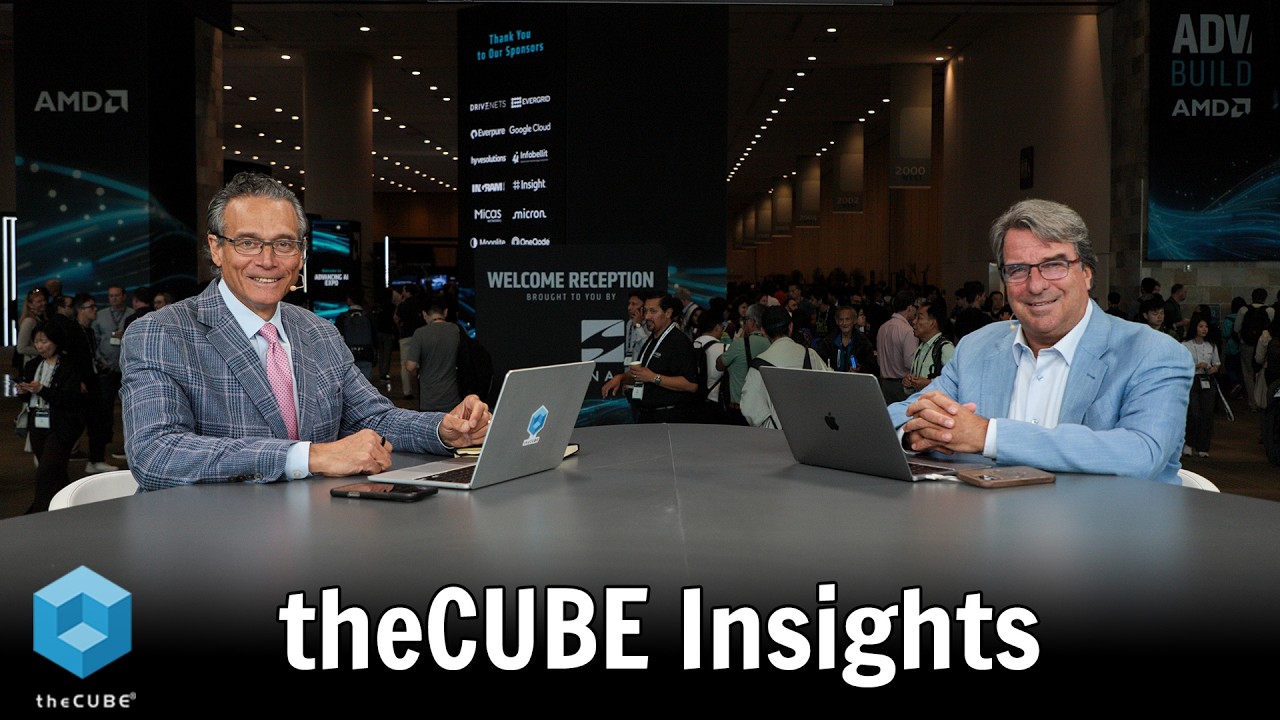
In this interview from AMD Advancing AI 2026 in San Francisco, Kirk Saban, corporate vice president of product marketing and management at AMD, joins theCUBE's Dave Vellante and John Furrier to discuss the company's push into physical AI and robotics. Saban unveils four new announcements from AMD's embedded business, headlined by the Kria AI Robotics Developer Kit. He details how the kit pairs the new Ryzen AI Embedded X100 system-on-module, which combines CPU, GPU and NPU compute with a unified memory architecture, with a Spartan UltraScale+ FPGA carrier card for sensor aggregation. Saban also highlights AMD's open-source robotics software stack and a newly launched robotics partner network, framing the announcements as a full-stack answer to the next wave of agentic AI embodied in humanoid robots.
The conversation explores why AMD's Xilinx heritage gives it a distinct advantage in physical AI, combining decades of FPGA determinism, functional safety and industry-standard COM-HPC form factors with AMD's CPU and GPU leadership. Saban explains how ROCm's shared codebase lets developers train on data center Instinct GPUs and deploy locally on embedded silicon, while agentic AI tools are accelerating CUDA-to-ROCm porting and closing what he calls NVIDIA's software moat. He also touches on the sales and technology synergies unlocked by the Xilinx acquisition, from longstanding robotics relationships to a broadening embedded portfolio. From deterministic latency requirements to human-safe cobot design, Saban outlines AMD's roadmap to become a serious, long-term player across the physical AI market.
Forgot Password
Almost there!
We just sent you a verification email. Please verify your account to gain access to
Advancing AI 2026. If you don’t think you received an email check your
spam folder.
In order to sign in, enter the email address you used to registered for the event. Once completed, you will receive an email with a verification link. Open the link to automatically sign into the site.
Register for Advancing AI 2026
Please fill out the information below. You will receive an email with a verification link confirming your registration. Click the link to automatically sign into the site.
You’re almost there!
We just sent you a verification email. Please click the verification button in the email. Once your email address is verified, you will have full access to all event content for Advancing AI 2026.
I want my badge and interests to be visible to all attendees.
Checking this box will display your presense on the attendees list, view your profile and allow other attendees to contact you via 1-1 chat. Read the Privacy Policy. At any time, you can choose to disable this preference.
Select your Interests!
add
Upload your photo
Uploading..
OR
Connect via Twitter
Connect via Linkedin
EDIT PASSWORD
Share
Forgot Password
Almost there!
We just sent you a verification email. Please verify your account to gain access to
Advancing AI 2026. If you don’t think you received an email check your
spam folder.
In order to sign in, enter the email address you used to registered for the event. Once completed, you will receive an email with a verification link. Open the link to automatically sign into the site.
Sign in to gain access to Advancing AI 2026
Please sign in with LinkedIn to continue to Advancing AI 2026. Signing in with LinkedIn ensures a professional environment.
Are you sure you want to remove access rights for this user?
Details
Manage Access
email address
Community Invitation
Kirk Saban, AMD
In this interview from AMD Advancing AI 2026 in San Francisco, Kirk Saban, corporate vice president of product marketing and management at AMD, joins theCUBE's Dave Vellante and John Furrier to discuss the company's push into physical AI and robotics. Saban unveils four new announcements from AMD's embedded business, headlined by the Kria AI Robotics Developer Kit. He details how the kit pairs the new Ryzen AI Embedded X100 system-on-module, which combines CPU, GPU and NPU compute with a unified memory architecture, with a Spartan UltraScale+ FPGA carrier card for sensor aggregation. Saban also highlights AMD's open-source robotics software stack and a newly launched robotics partner network, framing the announcements as a full-stack answer to the next wave of agentic AI embodied in humanoid robots.
The conversation explores why AMD's Xilinx heritage gives it a distinct advantage in physical AI, combining decades of FPGA determinism, functional safety and industry-standard COM-HPC form factors with AMD's CPU and GPU leadership. Saban explains how ROCm's shared codebase lets developers train on data center Instinct GPUs and deploy locally on embedded silicon, while agentic AI tools are accelerating CUDA-to-ROCm porting and closing what he calls NVIDIA's software moat. He also touches on the sales and technology synergies unlocked by the Xilinx acquisition, from longstanding robotics relationships to a broadening embedded portfolio. From deterministic latency requirements to human-safe cobot design, Saban outlines AMD's roadmap to become a serious, long-term player across the physical AI market.
>> Welcome back to theCUBE's coverage here in San Francisco for AMD Advancing AI where they're introducing all the new technologies that make up the systems that power AI. That's the differentiator in this market as AI moves to the next phase of growth. The system's got to work. Kirk, I see physical AI is upon us. You're seeing robotics, data centers, all the worlds coming together with physical AI. Next guest, Kirk Saban, Corporate Vice President of Embedded Products and Software Solutions at AMD. Kirk, this is your world now. The physical AI is moving super fast. We were just at the RAISE Summit in Paris where there was a whole Day Zero event on robotics. It was super popular. The top talent is working on this area right now because it's got to involve the chips. It's got the software. It has to work holistically in a distributed system, whether it's a data center or a robot or in manufacturing, wherever the use case is, hospitals, the developers are building next generation. You guys got some great news here. Show us what you got.
Kirk Saban
>> Yeah, we do. We're super excited to be here at Advancing AI 2026. And we've got four different product announcements coming out of AMD's Embedded Business Unit. So I'm really, really pleased to be here today and show off our brand new Kria AI Robotics Developer Kit. So we're launching this kit here at Advancing AI. This is really fundamentally built for the embedded developer who's looking at building a full scale robotic solution. This consists of a couple of key pieces inside of this box. So there is a system-on-module, which is what this looks like. And it's got a heat sink on either side of it. But this fundamentally has our Ryzen AI Embedded X100 device that we're launching here at Advancing AI. This is a heterogeneous compute at its finest. So it has CPU, GPU, and NPU technology all combined into a single chip with a unified memory architecture. So ideally suited for those real-time applications that we need in the embedded space. And then also inside of the box here, there's a carrier card that this plugs onto that has our Spartan UltraScale+ FPGA on it. That's ideally suited for sensor aggregation, sensor fusion, bringing in all the various different types of cameras and sensors that you need in a robotics environment. And then on top of that, we're also deploying and launching a robotics software stack, open source, like we do at AMD, so fully open source software stack. And on top of that, also announcing our robotics partner network here at Advancing AI. So really going all in in physical AI and robotics.
John Furrier
>> I want to get into the FPGA and AMD co-designing on this machine, but first I want to talk about the market dynamics with all the agent discussions, bringing in whether it's enterprise or large scale neo clouds and hyperscalers, it's the same conversation. This is targeted for developers.
Kirk Saban
>> That's right.
John Furrier
>> People who are building that box, they can code on it and then port to whatever form factor they're going to end up putting it in. Take us through that workflow.
Kirk Saban
>> Yeah. But it's the same requirements. The same issues.Same requirements, the same challenges that you're seeing with agentic AI. You need a boatload of compute. If you look at a humanoid robot or any type of autonomous robot, it's not just about GPU compute. Yes, you need GPU compute, but you need CPU compute as well for all of the autonomous functions. And it's really the ultimate application of agentic AI, the ultimate embodiment, is a humanoid robot. So if you look at the development experience here that we see for developers, you can fundamentally build all of your applications on this box, prove out your system, and then this system-on-module is actually designed to go straight into volume production. So these are available through a number of our design partners here, and we've got many of them over here in our showcase, showing off their SOM solutions. They can customize and tailor it to whatever they need. That plugs onto a carrier card and goes straight into volume production.
John Furrier
>> The plugging into the card, I've heard some rumblings around some physical AI developers saying, hey, I do all my development, then I go to plug in, the sockets don't match. This is becoming an issue. Could you just clarify what that looks like?
Kirk Saban
>> This is the COM-HPC standard. So we're leveraging an industry standard. This is not proprietary, unlike our competitors who use a proprietary standard. This is COM-HPC, industry level form factor. In addition to that, if customers want to go chip down and do a full complete chip down solution, we offer that path as well, right?
Dave Vellante
>> So let's talk about the market dynamics. John started to get into that. How do you guys think about it? What's the investment thesis? Obviously the market's huge. How do you think about it? Now this is going to power whether it's, as John said, in a manufacturing environment, a robot doing the same exact thing, or maybe even more generalized robots, multi-purpose robots. How do you think about the market? How do you break it down?
Kirk Saban
>> I think what we're seeing is, So from an AMD embedded standpoint, we are a multi-market business unit. We service markets, healthcare, agriculture, automotive, all types of industrial IoT. So there's many, many applications for this. So part of the flexibility and really the value prop here is that with the FPGA technology that we have for sensor aggregation, it doesn't matter what market you're going after. We can support that, we can scale it. So we're seeing, and you'll see a huge showcase here, industrial robotics, whether that's AMRs, cobots, when you're working in conjunction with humans, safety is absolutely critical. So we're just seeing an explosion in customer demand for these types of applications. We are seeing it literally across every market you can imagine. We've got a demo over here showing how a robot puts DIMMs into a server, for example. So you can go across data center, pretty much through every market that we're covering.
Dave Vellante
>> But at some point you had to make a decision in your R &D roadmap, rather than going hyper -specialized to go general purpose, because obviously the advantage is a bigger market, but the Xilinx capabilities, the DNA, allows you to have that cross -functional flexibility and the programmability of it.
Kirk Saban
>> You nailed it.
Dave Vellante
>> It's really what allows you to service any application.
Kirk Saban
>> That's right, that same hardware that's in here can be reprogrammed and repurposed for multiple different applications, gives you tremendous flexibility for sensor aggregation. So it's not a custom chip, right? you can tailor that hardware to whatever type of sensor you want to be able to plug in, whatever type of camera, whatever type of MIPI interface you need. So that is really part of our entire value prop, is we can service the entire robot spectrum, spine, brain, joints, we now have the complete solution.
Dave Vellante
>> Is this one of those things, Kirk, where you don't even bother trying to size the market because it's just so enormous, it's the physical world, right, it's everything.
Kirk Saban
>> Yeah, so the market keeps expanding, I'm not going to give you a number, right, but Lisa Su's going to talk about some of the TAM level numbers, right, but this market, it's very, very early days, it's growing incredibly fast, and that's why we're making investments here. You're seeing humanoid demonstrations all over the place, so there's no question this is really the next wave of AI investment heading into physical AI.
John Furrier
>> One of the things that's coming in, the robotics, obviously there's a lot of development, and I call them the alpha developers, because they really are, it's physical AI developers. There's been a lot of pressure in the US to get the game going faster. What are some of the things you see in the portfolio that's going to accelerate some of the success momentum points, because there's a lot of action and we've seen the tipping point this year where you're starting to see really good use cases, you're starting to see production workloads in robotics, humanoids are coming super fast. What's the acceleration path for solutions and developers?
Kirk Saban
>> Yeah, I think you have to have an easy to use development platform, right? So one of the other benefits here is that this leverages ROCm. Same ROCm that we use in data center GPUs, we use ROCm here for the integrated GPU, right? So the code base is absolutely the same. You can train on a data center GPU, on an Instinct GPU, and you can deploy that model here locally on our Kria AI Robotics solution, leveraging the same exact ROCm tool suite, right? The other thing that we're seeing that's really tremendous is we're bringing agentic AI to our entire embedded development stack within AMD embedded. So our Vivado tool suite that we use to program FPGAs, we now have MCP servers, we have an entire agentic suite for that, that allows developers, even if you haven't written FPGA code in years, you can leverage Claude, pick your favorite AI tool and plug it into our suite. So we're seeing the agentic development flow for embedded developers just be fundamentally game changing. You look, everybody's talked for years about how NVIDIA has such a moat with CUDA, right? That moat is coming apart with agentic AI because you can use HIP and very quickly take your CUDA code through agentic AI, port that over to ROCm and be up and running in literally a few hours.
John Furrier
>> Talk about that thing.
Dave Vellante
>> Yeah, let's stay on ROCm for a second. Maybe talk about the development of ROCm because you're right, everybody's talking about the CUDA and the CUDA ecosystem. You pitch us on ROCm, why should a developer think about that, what are some of the benefits that they're going to get out of that?
Kirk Saban
>> I think the fundamental benefit on ROCm is that we believe in AMD and the open source community. So ROCm is an open source, open environment, unlike CUDA which is closed and proprietary. And that goes across everything that we're doing here. If you look at, we are open across the board, including open hardware, right? So this, as I told you before, this SOM leverages an industry standard COM-HPC spec. We're also open sourcing the hardware base card here, so we're going to make the schematics and the reference design for the FPGA available open source. So it's really the combination, not just of ROCm, but the entire open environment that we are offering developers, I think is really what we see time and time again from the development community that they want to embrace. And the benefit from a ROCm standpoint, all of the R &D that AMD is putting into the latest and greatest models, you'll hear our AI team talking about day zero performance on the latest and greatest DeepSeek, pick your model. That all translates directly into what we have here on the physical AI and embedded side of things because it's common architecture, this is an integrated GPU, it leverages all that same DNA and we can get to market very, very quickly.
John Furrier
>> Talk about the dynamic between open source and the silicon advancements because you have two things going on here. you get the silicon advancements, FPGA, the Xilinx acquisition at AMD, and you have a massively growing open source community. How are you making that easier? How do you explain that to people? You guys got the silicon covered, they got the software. Is it that simple?
Kirk Saban
>> I think if you look at the focus here from a broad picture AMD perspective, if you look at it from a silicon roadmap perspective, I would say the industry has figured out and is recognizing the CPU leadership that we have, right? And GPU, we're absolutely right there. You look at where we're at here and with the announcements that we're making at Advancing AI around GPU technology. And then on FPGA technology, we are the leader. We are the number one player in FPGA in the industry. You put those three technologies together, it's tremendously powerful. And really what our customers have been asking us is, how do we continue to make things easier to use? And I think agentic AI, we have worked, I came into AMD through the Xilinx acquisition. We've worked on ease of use on our tools for decades. The biggest ease of use vehicle to ever come along is agentic AI, by far, right? It is an absolute game changer.
Dave Vellante
>> And you came out of the Xilinx acquisition.
Kirk Saban
>> I did, yeah.
Dave Vellante
>> Can we double click on that a little bit and explain to the audience what that gave AMD in terms of the flexibility and ability to enter new markets? Give us the FPGA 101 in terms of the benefits.
Kirk Saban
>> So FPGA, Field Programmable Gate Array. So fundamentally you can think of it as a custom chip that you can reprogram for whatever purpose. And we have a very, very broad portfolio depending on what performance, what power you need, what level of capabilities, how many IOs. We have little wee tiny chips that would fit on the end of my pinky finger up to massive chips that are nearly as big as this palm, right? And really I think what the Xilinx acquisition brought to AMD is a tremendous amount of synergies across the board. But as it relates specifically to embedded, Xilinx had a very strong, very large global sales presence for embedded sales. We've now been able to leverage that into the CPU business. So the embedded portfolio of our CPU business, we're unlocking opportunities all over the place because our sales team already has the relationships. There's hundreds of synergies on the technology side. You look at supply chain, R &D, those types of things exist as well, right? But I think the huge one that we maybe don't talk about as much is the sales synergy there. And then that positions us extremely well for these types of things. We've been in robotics for 20 years. We have a heritage there. We've played in the game. We know all the players. we know all the customers, we know what they need, we understand longevity, we understand, they want us to be in the market for a long time. If you go put a robot into an industrial application, they're expecting you're going to be there to support them for 10 years plus. So we understand that, we're bringing all of that to AMD's embedded portfolio, and combining that with all of the goodness of everything that AMD has to offer, and it's tremendously compelling for our customers.
John Furrier
>> Kirk, you said earlier, and this is very new, I want to double click on that and expand it, that the spine, the leaf, all these things are components. When you look at FPGA, there's a use case where this is all connected as a system. It's not about, here's a monster GPU.
Kirk Saban
>> That's right.
John Furrier
>> When you get into these components in physical AI, it is an operating system of things talking to each other. Talk about why FPGA, I won't say it's the alternative to the super GPU, but it does the function it needs in that system. Explain, it's very nuanced, but if you look at the big picture, it's the neural connections.
Kirk Saban
>> Yeah, you nailed it.And determinism and latency and being able to completely understand, having that deterministic latency is absolutely critical. GPUs are not good at that. FPGAs are, it's a custom chip, you can build it to be whatever you want, right? So you get very deterministic paths through there. So that's why we've seen FPGAs deployed in all types of industrial robots for years. And as you mentioned, this whole thing is a system. Things like time-sensitive networking, functional safety, security, those are all in our wheelhouse that we've played in in the FPGA space for decades, and you tie that all together. The other thing, look, these humanoids are evolving very quickly. They're developing new algorithms, reprogramming what's in the joints on a very rapid basis, right? So it's a perfect combination of technology.
John Furrier
>> The learning system is non-deterministic, that was a big phase one of AI. Oh, non-deterministic, great use cases. But all the best agent deployments in physical AI we've been talking to get non-deterministic, make it deterministic.
Kirk Saban
>> It has to be deterministic.
John Furrier
>> And embrace the determinism. This is a feature, not a bug.
Kirk Saban
>> That's right. And I also really want to emphasize the safety side of things, right? These things, physically, you're interacting with human beings, right? These things are heavy, they're big. If it's going to fail, it has to fail safe. And you need to have it in a cobot. It's cooperating with human beings. It's existing in the physical world, right? So that heritage that we have of functional safety and security being extended into the embedded CPU and APU world is absolutely important.
John Furrier
>> And that's why this is important, because they can do all the simulation here.
Kirk Saban
>> They can do everything right there in that box. That's right, and then take that to market very, very quickly.
Dave Vellante
>> And I like to think of it as the Zen microarchitecture allowed AMD to really attack the x86 market and do really, really well, gain share relative to Intel, and then AI comes along. You guys have compressed 15 years of market development into five years through organic invention and M &A, and that's what the Xilinx acquisition in a large part gives you is the ability to really compress that timeframe and compete in virtually any market.
Kirk Saban
>> Yeah, and I would add to that that the open source that's in our DNA from AMD, I'd say, is really helping us accelerate from a software standpoint. So look, NVIDIA's been working on CUDA for 10 plus years. But the fact that we can leverage the entire open source community with ROCm, ROCm is a world class piece of software. And if you look at, and you're going to hear a lot about that from our AI team here at Advancing AI. All of that directly applies to what we're doing here in the embedded space.
John Furrier
>> Well, Kirk, I'm sure we're going to have a lot more conversation. We just put a marker down, we're going to do a follow -up for sure.
Kirk Saban
>> Let's do it.
John Furrier
>> This is the hottest area. Closing comment, what's on your focus right now? What are you optimizing for? More of the same, better silicon, better open source? What are you focused on?
Kirk Saban
>> Yeah, we're focused on really expanding our entire portfolio here. So what we're launching here today at Advancing AI is our Ryzen AI Embedded X100 CPU. At CES we launched P100, so we're building up an entire portfolio here of solutions depending on what customers need in terms of core count, GPU performance. So we're really working on building out our fundamental portfolio here as it relates to robotics and physical AI, building out our software stack and then having a super compelling roadmap going forward that's going to put us absolutely in the game here. we intend to be a very, very serious player in the physical AI space.
John Furrier
>> It's super exciting, we're seeing the numbers and obviously the content, physical AI and robotics is booming, and it's a progression of all the agentic and GenAI, it's going to roll right into the physical world with safety, and the importance of an open robotics ecosystem is just as important as silicon, again, this is a lot more coming up in theCUBE, of course, in our NYSE Wired studios, more and more content, we'll be right back with more coverage from AMD Advancing AI after this short break, I'm John Furrier, your host with Dave Vellante, my co -host, thanks for watching.
>> Welcome back to theCUBE's coverage here in San Francisco for AMD Advancing AI where they're introducing all the new technologies that make up the systems that power AI. That's the differentiator in this market as AI moves to the next phase of growth. The system's got to work. Kirk, I see physical AI is upon us. You're seeing robotics, data centers, all the worlds coming together with physical AI. Next guest, Kirk Saban, Corporate Vice President of Embedded Products and Software Solutions at AMD. Kirk, this is your world now. The physical AI is moving super fast. We were just at the RAISE Summit in Paris where there was a whole Day Zero event on robotics. It was super popular. The top talent is working on this area right now because it's got to involve the chips. It's got the software. It has to work holistically in a distributed system, whether it's a data center or a robot or in manufacturing, wherever the use case is, hospitals, the developers are building next generation. You guys got some great news here. Show us what you got.
Kirk Saban
>> Yeah, we do. We're super excited to be here at Advancing AI 2026. And we've got four different product announcements coming out of AMD's Embedded Business Unit. So I'm really, really pleased to be here today and show off our brand new Kria AI Robotics Developer Kit. So we're launching this kit here at Advancing AI. This is really fundamentally built for the embedded developer who's looking at building a full scale robotic solution. This consists of a couple of key pieces inside of this box. So there is a system-on-module, which is what this looks like. And it's got a heat sink on either side of it. But this fundamentally has our Ryzen AI Embedded X100 device that we're launching here at Advancing AI. This is a heterogeneous compute at its finest. So it has CPU, GPU, and NPU technology all combined into a single chip with a unified memory architecture. So ideally suited for those real-time applications that we need in the embedded space. And then also inside of the box here, there's a carrier card that this plugs onto that has our Spartan UltraScale+ FPGA on it. That's ideally suited for sensor aggregation, sensor fusion, bringing in all the various different types of cameras and sensors that you need in a robotics environment. And then on top of that, we're also deploying and launching a robotics software stack, open source, like we do at AMD, so fully open source software stack. And on top of that, also announcing our robotics partner network here at Advancing AI. So really going all in in physical AI and robotics.
John Furrier
>> I want to get into the FPGA and AMD co-designing on this machine, but first I want to talk about the market dynamics with all the agent discussions, bringing in whether it's enterprise or large scale neo clouds and hyperscalers, it's the same conversation. This is targeted for developers.
Kirk Saban
>> That's right.
John Furrier
>> People who are building that box, they can code on it and then port to whatever form factor they're going to end up putting it in. Take us through that workflow.
Kirk Saban
>> Yeah. But it's the same requirements. The same issues.Same requirements, the same challenges that you're seeing with agentic AI. You need a boatload of compute. If you look at a humanoid robot or any type of autonomous robot, it's not just about GPU compute. Yes, you need GPU compute, but you need CPU compute as well for all of the autonomous functions. And it's really the ultimate application of agentic AI, the ultimate embodiment, is a humanoid robot. So if you look at the development experience here that we see for developers, you can fundamentally build all of your applications on this box, prove out your system, and then this system-on-module is actually designed to go straight into volume production. So these are available through a number of our design partners here, and we've got many of them over here in our showcase, showing off their SOM solutions. They can customize and tailor it to whatever they need. That plugs onto a carrier card and goes straight into volume production.
John Furrier
>> The plugging into the card, I've heard some rumblings around some physical AI developers saying, hey, I do all my development, then I go to plug in, the sockets don't match. This is becoming an issue. Could you just clarify what that looks like?
Kirk Saban
>> This is the COM-HPC standard. So we're leveraging an industry standard. This is not proprietary, unlike our competitors who use a proprietary standard. This is COM-HPC, industry level form factor. In addition to that, if customers want to go chip down and do a full complete chip down solution, we offer that path as well, right?
Dave Vellante
>> So let's talk about the market dynamics. John started to get into that. How do you guys think about it? What's the investment thesis? Obviously the market's huge. How do you think about it? Now this is going to power whether it's, as John said, in a manufacturing environment, a robot doing the same exact thing, or maybe even more generalized robots, multi-purpose robots. How do you think about the market? How do you break it down?
Kirk Saban
>> I think what we're seeing is, So from an AMD embedded standpoint, we are a multi-market business unit. We service markets, healthcare, agriculture, automotive, all types of industrial IoT. So there's many, many applications for this. So part of the flexibility and really the value prop here is that with the FPGA technology that we have for sensor aggregation, it doesn't matter what market you're going after. We can support that, we can scale it. So we're seeing, and you'll see a huge showcase here, industrial robotics, whether that's AMRs, cobots, when you're working in conjunction with humans, safety is absolutely critical. So we're just seeing an explosion in customer demand for these types of applications. We are seeing it literally across every market you can imagine. We've got a demo over here showing how a robot puts DIMMs into a server, for example. So you can go across data center, pretty much through every market that we're covering.
Dave Vellante
>> But at some point you had to make a decision in your R &D roadmap, rather than going hyper -specialized to go general purpose, because obviously the advantage is a bigger market, but the Xilinx capabilities, the DNA, allows you to have that cross -functional flexibility and the programmability of it.
Kirk Saban
>> You nailed it.
Dave Vellante
>> It's really what allows you to service any application.
Kirk Saban
>> That's right, that same hardware that's in here can be reprogrammed and repurposed for multiple different applications, gives you tremendous flexibility for sensor aggregation. So it's not a custom chip, right? you can tailor that hardware to whatever type of sensor you want to be able to plug in, whatever type of camera, whatever type of MIPI interface you need. So that is really part of our entire value prop, is we can service the entire robot spectrum, spine, brain, joints, we now have the complete solution.
Dave Vellante
>> Is this one of those things, Kirk, where you don't even bother trying to size the market because it's just so enormous, it's the physical world, right, it's everything.
Kirk Saban
>> Yeah, so the market keeps expanding, I'm not going to give you a number, right, but Lisa Su's going to talk about some of the TAM level numbers, right, but this market, it's very, very early days, it's growing incredibly fast, and that's why we're making investments here. You're seeing humanoid demonstrations all over the place, so there's no question this is really the next wave of AI investment heading into physical AI.
John Furrier
>> One of the things that's coming in, the robotics, obviously there's a lot of development, and I call them the alpha developers, because they really are, it's physical AI developers. There's been a lot of pressure in the US to get the game going faster. What are some of the things you see in the portfolio that's going to accelerate some of the success momentum points, because there's a lot of action and we've seen the tipping point this year where you're starting to see really good use cases, you're starting to see production workloads in robotics, humanoids are coming super fast. What's the acceleration path for solutions and developers?
Kirk Saban
>> Yeah, I think you have to have an easy to use development platform, right? So one of the other benefits here is that this leverages ROCm. Same ROCm that we use in data center GPUs, we use ROCm here for the integrated GPU, right? So the code base is absolutely the same. You can train on a data center GPU, on an Instinct GPU, and you can deploy that model here locally on our Kria AI Robotics solution, leveraging the same exact ROCm tool suite, right? The other thing that we're seeing that's really tremendous is we're bringing agentic AI to our entire embedded development stack within AMD embedded. So our Vivado tool suite that we use to program FPGAs, we now have MCP servers, we have an entire agentic suite for that, that allows developers, even if you haven't written FPGA code in years, you can leverage Claude, pick your favorite AI tool and plug it into our suite. So we're seeing the agentic development flow for embedded developers just be fundamentally game changing. You look, everybody's talked for years about how NVIDIA has such a moat with CUDA, right? That moat is coming apart with agentic AI because you can use HIP and very quickly take your CUDA code through agentic AI, port that over to ROCm and be up and running in literally a few hours.
John Furrier
>> Talk about that thing.
Dave Vellante
>> Yeah, let's stay on ROCm for a second. Maybe talk about the development of ROCm because you're right, everybody's talking about the CUDA and the CUDA ecosystem. You pitch us on ROCm, why should a developer think about that, what are some of the benefits that they're going to get out of that?
Kirk Saban
>> I think the fundamental benefit on ROCm is that we believe in AMD and the open source community. So ROCm is an open source, open environment, unlike CUDA which is closed and proprietary. And that goes across everything that we're doing here. If you look at, we are open across the board, including open hardware, right? So this, as I told you before, this SOM leverages an industry standard COM-HPC spec. We're also open sourcing the hardware base card here, so we're going to make the schematics and the reference design for the FPGA available open source. So it's really the combination, not just of ROCm, but the entire open environment that we are offering developers, I think is really what we see time and time again from the development community that they want to embrace. And the benefit from a ROCm standpoint, all of the R &D that AMD is putting into the latest and greatest models, you'll hear our AI team talking about day zero performance on the latest and greatest DeepSeek, pick your model. That all translates directly into what we have here on the physical AI and embedded side of things because it's common architecture, this is an integrated GPU, it leverages all that same DNA and we can get to market very, very quickly.
John Furrier
>> Talk about the dynamic between open source and the silicon advancements because you have two things going on here. you get the silicon advancements, FPGA, the Xilinx acquisition at AMD, and you have a massively growing open source community. How are you making that easier? How do you explain that to people? You guys got the silicon covered, they got the software. Is it that simple?
Kirk Saban
>> I think if you look at the focus here from a broad picture AMD perspective, if you look at it from a silicon roadmap perspective, I would say the industry has figured out and is recognizing the CPU leadership that we have, right? And GPU, we're absolutely right there. You look at where we're at here and with the announcements that we're making at Advancing AI around GPU technology. And then on FPGA technology, we are the leader. We are the number one player in FPGA in the industry. You put those three technologies together, it's tremendously powerful. And really what our customers have been asking us is, how do we continue to make things easier to use? And I think agentic AI, we have worked, I came into AMD through the Xilinx acquisition. We've worked on ease of use on our tools for decades. The biggest ease of use vehicle to ever come along is agentic AI, by far, right? It is an absolute game changer.
Dave Vellante
>> And you came out of the Xilinx acquisition.
Kirk Saban
>> I did, yeah.
Dave Vellante
>> Can we double click on that a little bit and explain to the audience what that gave AMD in terms of the flexibility and ability to enter new markets? Give us the FPGA 101 in terms of the benefits.
Kirk Saban
>> So FPGA, Field Programmable Gate Array. So fundamentally you can think of it as a custom chip that you can reprogram for whatever purpose. And we have a very, very broad portfolio depending on what performance, what power you need, what level of capabilities, how many IOs. We have little wee tiny chips that would fit on the end of my pinky finger up to massive chips that are nearly as big as this palm, right? And really I think what the Xilinx acquisition brought to AMD is a tremendous amount of synergies across the board. But as it relates specifically to embedded, Xilinx had a very strong, very large global sales presence for embedded sales. We've now been able to leverage that into the CPU business. So the embedded portfolio of our CPU business, we're unlocking opportunities all over the place because our sales team already has the relationships. There's hundreds of synergies on the technology side. You look at supply chain, R &D, those types of things exist as well, right? But I think the huge one that we maybe don't talk about as much is the sales synergy there. And then that positions us extremely well for these types of things. We've been in robotics for 20 years. We have a heritage there. We've played in the game. We know all the players. we know all the customers, we know what they need, we understand longevity, we understand, they want us to be in the market for a long time. If you go put a robot into an industrial application, they're expecting you're going to be there to support them for 10 years plus. So we understand that, we're bringing all of that to AMD's embedded portfolio, and combining that with all of the goodness of everything that AMD has to offer, and it's tremendously compelling for our customers.
John Furrier
>> Kirk, you said earlier, and this is very new, I want to double click on that and expand it, that the spine, the leaf, all these things are components. When you look at FPGA, there's a use case where this is all connected as a system. It's not about, here's a monster GPU.
Kirk Saban
>> That's right.
John Furrier
>> When you get into these components in physical AI, it is an operating system of things talking to each other. Talk about why FPGA, I won't say it's the alternative to the super GPU, but it does the function it needs in that system. Explain, it's very nuanced, but if you look at the big picture, it's the neural connections.
Kirk Saban
>> Yeah, you nailed it.And determinism and latency and being able to completely understand, having that deterministic latency is absolutely critical. GPUs are not good at that. FPGAs are, it's a custom chip, you can build it to be whatever you want, right? So you get very deterministic paths through there. So that's why we've seen FPGAs deployed in all types of industrial robots for years. And as you mentioned, this whole thing is a system. Things like time-sensitive networking, functional safety, security, those are all in our wheelhouse that we've played in in the FPGA space for decades, and you tie that all together. The other thing, look, these humanoids are evolving very quickly. They're developing new algorithms, reprogramming what's in the joints on a very rapid basis, right? So it's a perfect combination of technology.
John Furrier
>> The learning system is non-deterministic, that was a big phase one of AI. Oh, non-deterministic, great use cases. But all the best agent deployments in physical AI we've been talking to get non-deterministic, make it deterministic.
Kirk Saban
>> It has to be deterministic.
John Furrier
>> And embrace the determinism. This is a feature, not a bug.
Kirk Saban
>> That's right. And I also really want to emphasize the safety side of things, right? These things, physically, you're interacting with human beings, right? These things are heavy, they're big. If it's going to fail, it has to fail safe. And you need to have it in a cobot. It's cooperating with human beings. It's existing in the physical world, right? So that heritage that we have of functional safety and security being extended into the embedded CPU and APU world is absolutely important.
John Furrier
>> And that's why this is important, because they can do all the simulation here.
Kirk Saban
>> They can do everything right there in that box. That's right, and then take that to market very, very quickly.
Dave Vellante
>> And I like to think of it as the Zen microarchitecture allowed AMD to really attack the x86 market and do really, really well, gain share relative to Intel, and then AI comes along. You guys have compressed 15 years of market development into five years through organic invention and M &A, and that's what the Xilinx acquisition in a large part gives you is the ability to really compress that timeframe and compete in virtually any market.
Kirk Saban
>> Yeah, and I would add to that that the open source that's in our DNA from AMD, I'd say, is really helping us accelerate from a software standpoint. So look, NVIDIA's been working on CUDA for 10 plus years. But the fact that we can leverage the entire open source community with ROCm, ROCm is a world class piece of software. And if you look at, and you're going to hear a lot about that from our AI team here at Advancing AI. All of that directly applies to what we're doing here in the embedded space.
John Furrier
>> Well, Kirk, I'm sure we're going to have a lot more conversation. We just put a marker down, we're going to do a follow -up for sure.
Kirk Saban
>> Let's do it.
John Furrier
>> This is the hottest area. Closing comment, what's on your focus right now? What are you optimizing for? More of the same, better silicon, better open source? What are you focused on?
Kirk Saban
>> Yeah, we're focused on really expanding our entire portfolio here. So what we're launching here today at Advancing AI is our Ryzen AI Embedded X100 CPU. At CES we launched P100, so we're building up an entire portfolio here of solutions depending on what customers need in terms of core count, GPU performance. So we're really working on building out our fundamental portfolio here as it relates to robotics and physical AI, building out our software stack and then having a super compelling roadmap going forward that's going to put us absolutely in the game here. we intend to be a very, very serious player in the physical AI space.
John Furrier
>> It's super exciting, we're seeing the numbers and obviously the content, physical AI and robotics is booming, and it's a progression of all the agentic and GenAI, it's going to roll right into the physical world with safety, and the importance of an open robotics ecosystem is just as important as silicon, again, this is a lot more coming up in theCUBE, of course, in our NYSE Wired studios, more and more content, we'll be right back with more coverage from AMD Advancing AI after this short break, I'm John Furrier, your host with Dave Vellante, my co -host, thanks for watching.