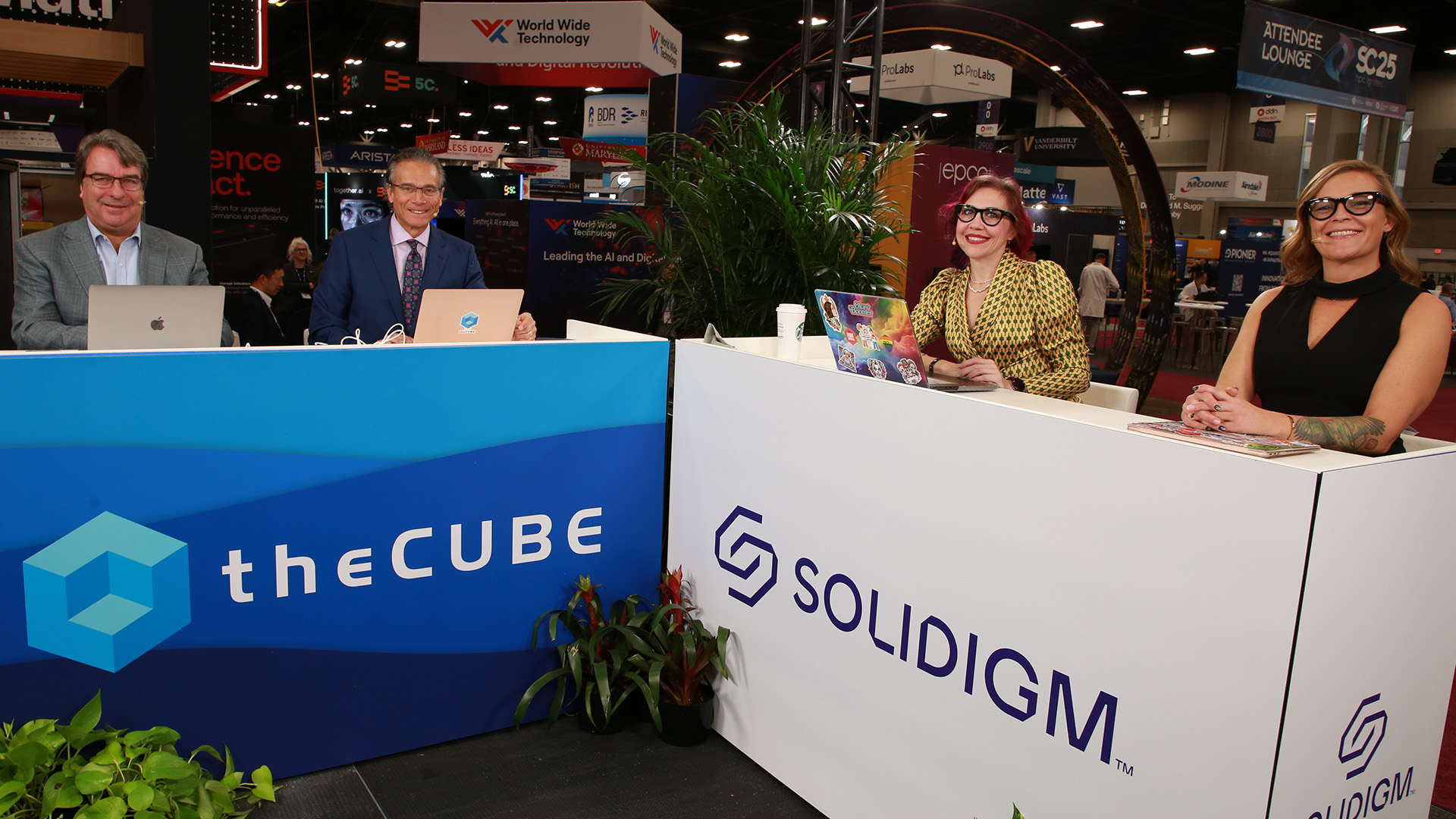
In this SC25 keynote analysis segment, theCUBE’s Savannah Peterson, John Furrier, Dave Vellante and Jackie McGuire set the stage for three days of live coverage from St. Louis as HPC finally has its mainstream moment. They unpack how GPU-dense racks, liquid cooling, rear-door heat exchangers and next-gen storage are reshaping data centers for AI, simulation and data-driven science, turning the show floor into an “art show for hardware nerds” and a proving ground for HPC+AI infrastructure at scale.
The conversation then zooms out to the economics and geopolitics of the AI build-out – from quantum’s long runway versus near-term AI gains, to multi-trillion-dollar CapEx bets, renewable energy dynamics, labor constraints and debates over whether an “AI bubble” is forming. The hosts dig into why standards, co-designed architectures with vendors like NVIDIA, emerging storage fabrics for agentic AI, safe innovation sandboxes such as Google’s Agent Sandbox and support from sponsors like Solidigm are becoming critical to keep SC25’s data center boom sustainable, resilient and ready for the next decade.
Forgot Password
Almost there!
We just sent you a verification email. Please verify your account to gain access to
SC25. If you don’t think you received an email check your
spam folder.
In order to sign in, enter the email address you used to registered for the event. Once completed, you will receive an email with a verification link. Open the link to automatically sign into the site.
Register for SC25
Please fill out the information below. You will receive an email with a verification link confirming your registration. Click the link to automatically sign into the site.
You’re almost there!
We just sent you a verification email. Please click the verification button in the email. Once your email address is verified, you will have full access to all event content for SC25.
I want my badge and interests to be visible to all attendees.
Checking this box will display your presense on the attendees list, view your profile and allow other attendees to contact you via 1-1 chat. Read the Privacy Policy. At any time, you can choose to disable this preference.
Select your Interests!
add
Upload your photo
Uploading..
OR
Connect via Twitter
Connect via Linkedin
EDIT PASSWORD
Share
Forgot Password
Almost there!
We just sent you a verification email. Please verify your account to gain access to
SC25. If you don’t think you received an email check your
spam folder.
In order to sign in, enter the email address you used to registered for the event. Once completed, you will receive an email with a verification link. Open the link to automatically sign into the site.
Sign in to gain access to SC25
Please sign in with LinkedIn to continue to SC25. Signing in with LinkedIn ensures a professional environment.
Are you sure you want to remove access rights for this user?
Details
Manage Access
email address
Community Invitation
Keynote Analysis
In this SC25 keynote analysis segment, theCUBE’s Savannah Peterson, John Furrier, Dave Vellante and Jackie McGuire set the stage for three days of live coverage from St. Louis as HPC finally has its mainstream moment. They unpack how GPU-dense racks, liquid cooling, rear-door heat exchangers and next-gen storage are reshaping data centers for AI, simulation and data-driven science, turning the show floor into an “art show for hardware nerds” and a proving ground for HPC+AI infrastructure at scale.
The conversation then zooms out to the economics and geopolitics of the AI build-out – from quantum’s long runway versus near-term AI gains, to multi-trillion-dollar CapEx bets, renewable energy dynamics, labor constraints and debates over whether an “AI bubble” is forming. The hosts dig into why standards, co-designed architectures with vendors like NVIDIA, emerging storage fabrics for agentic AI, safe innovation sandboxes such as Google’s Agent Sandbox and support from sponsors like Solidigm are becoming critical to keep SC25’s data center boom sustainable, resilient and ready for the next decade.
In this SC25 keynote analysis segment, theCUBE’s Savannah Peterson, John Furrier, Dave Vellante and Jackie McGuire set the stage for three days of live coverage from St. Louis as HPC finally has its mainstream moment. They unpack how GPU-dense racks, liquid cooling, rear-door heat exchangers and next-gen storage are reshaping data centers for AI, simulation and data-driven science, turning the show floor into an “art show for hardware nerds” and a proving ground for HPC+AI infrastructure at scale.
The conversation then zooms out to the economics and ge...Read more
exploreKeep Exploring
What are the general sentiments and discussions among attendees at this event?add
What emotions or sentiments are expressed regarding the current state and future of supercomputing technology?add
What is the current state and significance of hardware technology at the event being discussed?add
>> Good morning, HPC fans, and welcome to sunny St. Louis, Missouri. We're here on day one of Supercomputing. My name's Savannah Peterson, delighted to be kicking off three days of live coverage here with theCUBE, and I have my fabulous co-hosts for all the fun here with me, John, Dave, and Jackie. Thank you all for coming in here to the Midwest. I was expecting it to be a lot colder today and it's actually quite mild and lovely. I know, it's lovely out. It's a-
Dave Vellante
>> Pretty crazy storm last night, right?
John Furrier
>> Yeah.
Jackie McGuire
>> Yes, I saw a beautiful lightning storm behind the arch last night and then torrential downpour.
Savannah Peterson
>> Oh my goodness. I am slightly jealous. We got delayed. Actually, maybe that's why we were so delayed getting in. I didn't look.
Jackie McGuire
>> It was rough.
Savannah Peterson
>> Well, that makes a lot of sense. I just have to kick this off. Walking in to this event having been here in the last four years, it is massive. HPC is having a moment. We've been talking about how hardware nerds are finally having another moment for them as well as AI goes to hardware, and man, it is just really exciting looking around. I'm curious, Jackie, I know you were in town yesterday having some conversations. What's the pulse? What's the energy? What are people talking about here on the ground?
Jackie McGuire
>> I think everybody's really excited and I've been... My husband's in the data center business and all I did yesterday was walk around and take pictures and send them to him and I was just like, "There is the coolest stuff here," things that I didn't even know were going on and I think everybody was just happy. It's interesting to me. I come from security, so this is a slightly different community, but it's also very tight-knit like security and I'm walking around with some of my friends and they know everybody. So I feel very honored to be able to be here for the first time and it seems like everybody's really excited for a lot of the new ideas. We're at, I don't think inflection point, that's probably hyperbole, but we're definitely at a focus point that supercompute hasn't seen up until this point, at least in mainstream tech, and so that's really exciting for the people who've been doing this work for years to have people actually understand what rear door heat exchangers are now.
Savannah Peterson
>> Yeah, and like liquid cooling is cool. You know?
Jackie McGuire
>> Yeah.
Savannah Peterson
>> There's just so many different conversations and I love that there's so many different players. It's not just the GPU kings here, there's a lot of different types of intersection. Dave, you've been covering the show for a long time as well. What do you notice that's different this year so far?
Dave Vellante
>> I like how you started that off and giving your perspectives because you've been here for several years too. The first Supercomputing show, I think it was in 1988. Okay?
Savannah Peterson
>> It was. It was the year I was born. Supercomputing and I are the same age.
Dave Vellante
>> That's amazing.
Savannah Peterson
>> I'm sure that makes Dave feel great.
John Furrier
>> A lot more GPUs in there.
Savannah Peterson
>> We're both aging like fine wine.
Dave Vellante
>> So we have been waiting for this moment for a long, long time. We were talking to Deborah Goldfarb last night at the AWS booth. She runs the quantum computing business for AWS and she and I worked together at IDC and I had the pleasure-
Savannah Peterson
>> Oh, cool. I didn't know that.
Dave Vellante
>> She was in my group and she drove the whole HPC business. And she used to say to me, "Dave, this AI thing, it's going to take off. It's going to go mainstream," until like I said, and it never really did, but we've been waiting for this moment for the longest time and now it is going mainstream, to your point. And I will say the other thing is there's a lot of heat in this room. There's a lot of racks. I don't know how many GPUs there are.
Jackie McGuire
>> Yeah, that's a real... I'm glad you called that out.
Savannah Peterson
>> That's why it's so warm in St. Louis. We're single-handedly... It's all the HPCs. That's amazing.
Dave Vellante
>> There's a lot of equipment that's amazing in this building right now.
Savannah Peterson
>> Yes, there is.
Dave Vellante
>> And it's the place to be. You know?
Savannah Peterson
>> I mean, I would bet there's probably a billion dollars of hardware in here, which is a bold claim.
Jackie McGuire
>> If not more.
Savannah Peterson
>> Yeah, but I mean, just thinking, I mean, I saw... I was personally mesmerized watching Dell's build for their rack that they did this hyperlapse video to coming into this event. And the whole time I'm sitting there watching like...
Jackie McGuire
>> Ooh.
Savannah Peterson
>> It's like tell me you're a hardware nerd without telling me you're a hardware nerd. But there really is, there's so much cool stuff. It's not just visuals of it. It's on the ground. John, you and I have covered the show together for four years. Great to be back together. What do you think is different? What do you think? The market's doing some interesting stuff right now. Lots of our customers here. What are you seeing?
John Furrier
>> I mean, four years ago we saw it as an AI show and merging. Now it's full-blown AI and it's a data center love fest here. I mean, the nerd fest on the data center.
Savannah Peterson
>> Totally.
John Furrier
>> Jackie mentioned cooling and power. Vertiv gas probably got the coolest display. There's some new-
Jackie McGuire
>> Their booth was packed when I walked by. I had to go all the way around it.
John Furrier
>> It's beautiful. If you're into data center, it's like art show. It's beautiful designs. You're starting to see the show move from old-school HPC, which is like glaciers moving every year, get a little faster, and then all of a sudden NVIDIA hits the scene. I think you saw a massive explosion of accelerated, they call it, computing. That is changing. Four years ago, it was just the basic chips were coming out and then that was the beginning of the large-scale clusters. And then now all the top hyperscalers, neoclouds, anyone who's got serious data center chops is loving life, hence the bubble conversation going on and all the investments on the CapEx, the build-outs are there. So it's definitely an AI tsunami on the infrastructure. So it's an infrastructure market. And talking to NVIDIA, they had a session yesterday, they're laying out the roadmap of simulation AI and then quantum. So they're starting to lay out the visibility to what they're thinking about quantum. They're actually using GPUs to figure out quantum. So the quantum game is going along. It's moving along, some say fast, I think okay, but they're actually using GPUs to figure out how to deal with the tooling, a completely different paradigm-
Savannah Peterson
>> It makes sense. I mean, it's a sandbox, so it's
Dave Vellante
>> It's the end of the earth.
John Furrier
>> I think this show should-
Savannah Peterson
>> Yeah, no.
John Furrier
>> This show actually is Supercomputing, so I know-
Jackie McGuire
>> There's a flash session later today that I really want to catch that's on whether we actually need quantum computing or not, whether HP, because-
Savannah Peterson
>> But there is some interesting debate about that as well.
Jackie McGuire
>> Yeah, yeah. Because the energy-to-performance ratio, the data loss, obviously as you were talking about, there's still so many things that need to be figured out about quantum-
Savannah Peterson
>>
Jackie McGuire
>> ... and I think the question right now is, is the time and energy best spent there or in refining the use cases of the AI that we're using right now? And I think it's a really interesting question because-
Savannah Peterson
>> I agree with you.
Jackie McGuire
>> ... it's going to take another 10, 20 years for quantum to be commercially viable.
John Furrier
>> The other thing-
Dave Vellante
>> But the energy is so much less. It's less energy-consumptive, so that's the sort of trade-off that you're making here.
Jackie McGuire
>> Yes, yeah.
John Furrier
>> And the other point I'd say, Savannah and Jackie, is that this year what's different is there's more prospecting customers. Last year was more, and the years where Preet is here, more-
Savannah Peterson
>> I think that's a great point.
John Furrier
>> ... do some deals. We're hearing more about "get me some customers" because they've built out enough capacity in some of these overbuilds, I won't say overbuild, maybe that's a bad word, but they're overbuilding, definitely building.
Savannah Peterson
>> Yeah. Some things are overengineered in this room. It's okay to say that.
John Furrier
>> And so here's the customers. Where are the investors? Who's going to keep pouring money in? So there's a lot more less tech, some business stuff coming in. It's more customer money. Where's the money going to come from? Huge dynamic that we've never seen before.
Savannah Peterson
>> Yeah, I'm really glad you called that out. You actually called out two things I want to highlight. One, you called it an art show. It very much is an art show for nerds. Did you know they actually do an art show here? There is a high-performance computing art competition. I've actually tried to enter the last couple of years and didn't get my stuff together, but working on it.
Jackie McGuire
>> That's cute. Folks, you heard it first.
Savannah Peterson
>> Yeah, but it really is that. One thing that I noticed right away, and I noticed this actually in the airport late last night when we landed, was the amount of international investment in this show this year. There's ads for Taiwan AI right away when you get off your aircraft. We're sitting across from the Japan Advanced Institute of Science and Technology, which is a mouthful, but there really is a wildly... I mean, I think this is a Japanese university, but I don't even know what's going on. The world is at this show now. When we were sitting in Dallas, John, in that weird, creepy basement four years ago, it felt like the American companies, the American universities. Yes, there was NASA and some cool stuff going on, but it wasn't this global commitment, and the energy here is serving me real CES. It's serving me real this is the big show for HPC, much bigger than GTC and DC.
Dave Vellante
>> What about China? Maybe I just missed it, but I haven't seen an obvious China presence here.
Savannah Peterson
>> Do you think they would be obvious if they were here? Seriously.
Dave Vellante
>> Well, you know they're here.
Savannah Peterson
>> That's what I'm saying.
Dave Vellante
>> No question.
John Furrier
>> Yeah, they're in incognito mode.
Jackie McGuire
>> Yeah, 100 P.
Dave Vellante
>> But we've seen Alibaba at shows before with booths, and I haven't seen a big presence here.
John Furrier
>> The national sight scene is-
Savannah Peterson
>> I bet they're walking the floor.
Dave Vellante
>> Oh, no doubt. 100%.
Savannah Peterson
>> Yeah, yeah. I would assume because... Yeah. I mean, although nerds aren't very combative. I was just thinking if people would go up and pick a fight.
Jackie McGuire
>> Nah.
John Furrier
>> On the international thing, Savannah, it's an interesting point because if you look at all the action on the chip side, it's SK Hynix, it's Samsung, a lot of the memory which they're trying to weave into NVIDIA's architecture, not just the InfiniBand but the ethernet-
Savannah Peterson
>> 100%.
John Furrier
>> ... of the chips. And so that's been kind of out there. Everyone's talking about HBM. Storage is a big show highlight this year. We heard a bunch of things last night on storage-
Savannah Peterson
>> Interesting.
John Furrier
>> ... consortiums forming because they want to get some standards around these large-scale storage fabrics.
Jackie McGuire
>> Well, no storage, no agentic AI.
John Furrier
>> Yes, exactly.
Savannah Peterson
>> No AI, even.
Jackie McGuire
>> No AI, yeah. And I think that's the thing with the cost component that we did a breaking analysis on this a couple weeks ago. Nobody wants to admit this, but there is going to be a massive volume of storage generated by agents because while you don't have to log most of what a human does until they actually get to the important part, you have to log everything an agent does. And that-
Savannah Peterson
>> Absolutely right, Jackie.
Jackie McGuire
>> ... those logs have to be retained anywhere from a couple years to a decade. If you're dealing with Medicare, a decade from the date of service. So imagine you have some healthcare chatbot, every single, every training, every model you train for that chatbot, you retrain that model, you have to store the old models. Those models are massive. And so I just think there's a lot of... Storage is going to be weight. I think the weight of racks is something that we're not focused on yet that we will and-
Savannah Peterson
>> That's actually a wonderful point. I'm glad you brought that up. It's heavy.
Jackie McGuire
>> We were just having this conversation last night, myself and a group of people who are building data centers, because you can't put AI racks in old data centers. The foundations can't hold the weight. And so I think those data centers will actually be converted to storage centers.
John Furrier
>> That's a great point, Jackie. You brought up the data centers. You look at NVIDIA's biz dev activity, look at some of the reference architectures. There's a whole trend towards this co-design. They call it extreme co-design. But that changes the ecosystem because what does the ecosystem have to do to do co-design? They have to be multi-party, multi-party ecosystem. And I just put that on LinkedIn because you got to be on the roadmap two years in to do a storage fabric with NVIDIA or AMD. So it's not just do a deal, "Hey, source some chips." There's some serious engineering involved and it takes-
Savannah Peterson
>> Oh, absolutely.
John Furrier
>> And that's a big part of this year. NVIDIA's moves are all in that area right now and you see that's why some of the stock pops when you see a deal with NVIDIA.
Dave Vellante
>> And a big part of that co-design is NVIDIA co-designing-
John Furrier
>> With-
Dave Vellante
>> ... across its stack and then bringing in the ecosystem and saying, "Okay, here's how we're doing it. Now you can plug in."
John Furrier
>> How are you going to orchestrate that workload across a massive system? That is a engineering problem that is new this generation that even four years ago, no one was talking about orchestrating-
Savannah Peterson
>> It wasn't even a blip on the radar in Dallas.
John Furrier
>> ... a workload across a physical data center. Yeah, it was like, "Okay"-
Jackie McGuire
>> Standards weren't either, right? For years, we've been trying to hold companies accountable to some type of standard for their data, for their integrations, all of those things. So this is going to cause a seismic shift in you can't any longer be-
Savannah Peterson
>> I don't know. So I think-
Jackie McGuire
>> ... "I'm in security. I'm a security company that has eight different formats for my data for one platform."
Savannah Peterson
>> Which is insanity, which is absolute insanity. I don't know. I think IEEE, we had IEEE sitting behind us four years ago, and I mean, there's definitely this community, more than some, is very standards-heavy. They care. The HPC people get it because standards means savings, and that, I think, is actually really compelling. I think it's important. One of the interesting conversations I've been having the last few weeks at some analyst events is all around data centers and the battle, like what the modern wars, sorry to be dramatic, but what the modern geopolitical battles will be over and it's going to be over water, power, and data centers. And it's wild to think that these are going to be the assets, the king and queen on your chessboard when it comes to figuring out your place, not only in the world and the economy, but in business and market share and it's kind of... I mean, as a total geek, wow, I almost just swore, as a geek, I really feel like this is a validating moment from a like, "Hey, guys, look at us. The hardware always mattered. Your software was cute, but it all is actually data. It all needs a place to be stored. It needs to be processed. It needs models that are efficient," and who knows how we're going to be computing that? Whether that's with a CPU, NPU, GPU, quantum, whatever that is, it's all going to require all this energy. So-
Dave Vellante
>> You're right.
Jackie McGuire
>> And to Dave's point with China, what China has that the US doesn't-
Dave Vellante
>> They got power.
Jackie McGuire
>> ... is power.
Dave Vellante
>> And they got land.
Savannah Peterson
>> And they have renewable energy.
Dave Vellante
>> Land, power, and water, those are the three big things you need.
Savannah Peterson
>> Exactly.
Jackie McGuire
>> Well, so they have water in some places but not others, so that actually is one. Inland China has issues with water, so that is an area where they do need work.
Dave Vellante
>> To your point, power is not a constraint.
Jackie McGuire
>> But they are the largest supplier-
Dave Vellante
>> To use might be a constraint.
Jackie McGuire
>> ... and consumer of renewable energy in the world.
Savannah Peterson
>> It's that tension.
Jackie McGuire
>> And as the US starts to pivot back towards fossil fuels, that unfortunately is going to create a massive opportunity for China to lean in even more because the US is no longer producing renewable energy components. We're moving away from that. And I was just listening to a podcast-
Savannah Peterson
>> Absolutely, Jackie.
Jackie McGuire
>> ... this morning about how China is now the number one distributor of renewable energy components, and their intention is to keep leaning into that, especially as our policy shifts the other way.
Dave Vellante
>> So people are talking about the constraints to building out data centers and the market's freaking out now. It's down another 1.5% today. Lots of talk about bubble. We just did a breaking analysis that we quantified that the cumulative spend between now and 2030 on data center build-outs, AI factories, will be about $4 trillion. And the revenue, cumulative revenue, at that time will be about half that. So you get a $2 trillion gap between revenue and CapEx and-
Jackie McGuire
>> Just a small delta.
Savannah Peterson
>> We don't need to no stinking revenue. We got private equity.
Dave Vellante
>> Right, but there is a breakeven for a while.
John Furrier
>> We see it.
Dave Vellante
>> We see a breakeven. It's about a 10-year breakeven. So the point being, a lot of stuff has to happen before then. There's going to be a lot of patience and a lot of pullbacks. The dot-com bubble, there were many, several 10% market declines, and it looks like we're in the middle of one now.
John Furrier
>> But it's demand, there's demand here.
Jackie McGuire
>> Do we have enough cement trucks to pour $4 trillion worth of data center foundations?
Dave Vellante
>> And engineers to build these?
Jackie McGuire
>> Do we have enough people to pull?
John Furrier
>> Power?
Jackie McGuire
>> Each data center has 200 miles of cable inside it. Do we have enough people to pull all that cable? Do we have enough to people to go-
Savannah Peterson
>> Big people, expensive cable too.
Jackie McGuire
>> Yeah. Do we have enough people to go swap out filter walls? And I keep going back to the labor piece and I had a roundtable with a bunch of universities last night about this about how we need to start-
Savannah Peterson
>> Cool.
Jackie McGuire
>> ... going to two-year community colleges and building that skilled labor today.
Dave Vellante
>> Yeah. And I think it'll happen. I do because-
John Furrier
>> Yeah, that's a great point.
Dave Vellante
>> ... if there's a vacuum there, people will fill it. But these bubbles, I don't think we're in a bubble because I think the demand still far outstrips the supply-
John Furrier
>> Well, the question of the bubble-
Dave Vellante
>> ... but demand far outstrips the supply. When that flips, maybe that's when the bubble bursts.
John Furrier
>> The question on the bubble that Jackie brought up earlier about storage, if this AI infrastructure can't enable value, there's going to be a glut of almost a halfway spot between the bubble bursting that we can't get value and the pressure will be all those people that are buying, how can they sell those compute cycles? I think marketplaces might emerge. So I'm looking at-
Dave Vellante
>> Well, that's the software layer too. That's to your earlier point.
John Furrier
>> Well, I mean, agentic infrastructure is based upon the fruit coming off the tree on the infrastructure. So if the infrastructure doesn't work fast enough, then it's going to be a slowdown on the agentic. Yeah, there'll-
Savannah Peterson
>> Well, they're-
John Furrier
>> ... be some RAG search stuff-
Dave Vellante
>> Infrastructure, data house in order so you can serve agentic and govern it, secure it. A lot of things have to happen, and I think they will, it's just going to take a decade.
Savannah Peterson
>> It's going to get real messy here for a minute, I think, and that's all right. We're in this growth stage. If we're going to take all of this to scale, compliance, there's a whole bunch of things that are very complicated.
Dave Vellante
>> New waves are messy.
Savannah Peterson
>> Hey, exactly.
Dave Vellante
>> That whole J-curve thing is-
Savannah Peterson
>> Exactly. And it's why some of the smarter companies are launching, like Google's Agent Sandbox that they launched last year, or last year, jeepers, last week. We have been on the road a lot. Forgive me. It's a safe zone for play at scale that doesn't destroy your entire business and your entire system. And I think we're going to see a lot more of these types of solutions come out so that people can get messy in a safe space before they just destroy everything.
Jackie McGuire
>> And I'm not going to take full credit, but I, for three months, have been saying, "We need broader adoption of sandboxing. Everybody who touches a computer should know what a sandbox was. Give people safe places to do risky things." So thank you, Google, because we all should be playing in the sandbox.
John Furrier
>> Well, speaking of Google, Google was the only one that didn't go down on the Cloudflare outage this morning.
Dave Vellante
>> This morning, yeah.
John Furrier
>> You saw that-
Savannah Peterson
>> That's because of the previous issue they fixed, right, as you know?
Dave Vellante
>> Yeah. I think they're-
John Furrier
>> Maybe Google's not using Cloudflare.
Savannah Peterson
>> Yeah. We were in their offices in Ann Arbor yesterday-
Dave Vellante
>> CDN.
Savannah Peterson
>> ... and it was a topic conversation.
John Furrier
>> Another outage, Dave. Amazon, Azure. Who's next?
Savannah Peterson
>> What happens when the lights go off?
Jackie McGuire
>> Like you said, I couldn't help, you said, "It's going to get messy," and all I could see was that Marie Kondo meme that's like, "I'm so happy because I love mess." I trade options so I'm like, "Hell yeah. Give me some volatility for a year or two and I'll make some money."
Dave Vellante
>> You're getting your vol.
Jackie McGuire
>> I am, I am.
John Furrier
>> Absolutely.
Jackie McGuire
>> I know, I was just-
Dave Vellante
>>
Savannah Peterson
>> I think that -
John Furrier
>> Your chaos is happening.
Jackie McGuire
>> ... four-letter words this morning because I sold a put too early, but...
John Furrier
>> You like chaos, Jackie? No, yeah, come on.
Jackie McGuire
>> A little bit. I don't like-
Savannah Peterson
>> On that note-
Jackie McGuire
>> I get bored easily.
Dave Vellante
>> Oh, you couldn't time the market perfectly? Wow, what's wrong with you?
Jackie McGuire
>> I'm no Michael Burry.
Savannah Peterson
>> We're all trying. We're all trying. Speaking of things that aren't chaos, we have a wonderful lineup this week. We've got 32 segments scheduled over the next couple of days. We've got probably looking like over 50 guests from some of the biggest companies in the world. It's going to be absolutely fantastic, and I cannot wait to dig into all those stories.
Dave Vellante
>> Today is day one, brought to you by Solidigm, our big sponsor for today.
John Furrier
>> Shout out to Solidigm.
Dave Vellante
>> It's awesome.
John Furrier
>> All right.
Dave Vellante
>> Appreciate their support, yeah.
Savannah Peterson
>> Very grateful for our friends at Solidigm. This is going to be wonderful. Cannot wait to hear all the customer and partner stories that they have curated for us. We're all about making the rubber hit the road here at HPC party land, the art show that we are in, and it's going to be great. John, Dave, and Jackie, thank you so much for kicking it off right.
Dave Vellante
>> Thanks, guys.
John Furrier
>> Thanks.
Jackie McGuire
>> Thank you.
Savannah Peterson
>> And thank all of you for tuning into our three days of live coverage on the ground in St. Louis, Missouri here at Supercomputing. My name's Savannah Peterson. You're watching theCUBE, the leading source for enterprise tech news.